
UV Exposure Time Optimization for Enhanced Conversion, Hardness, and Flexural Strength in UDMA/TEG-DMA Composite Resins
DOI:
https://doi.org/10.48048/tis.2025.8603Keywords:
UDMA/TEG-DMA composite resin, UV exposure, Degree of conversion, Surface morphology, Mechanical properties, Water absorption, ShrinkageAbstract
This study examines the effects of varying ultraviolet (UV) exposure times on the properties of UDMA/TEG-DMA composite resins, focusing on degree of conversion, surface morphology, water absorption, shrinkage, hardness, and flexural strength. Composite resin samples were exposed to UV light for 30, 60, 90, and 120 min. The degree of conversion was assessed using Fourier Transform Infrared Spectroscopy (FTIR). Surface morphology was analyzed via Scanning Electron Microscopy (SEM). Water absorption and shrinkage were measured following standard procedures, while mechanical properties, including hardness and flexural strength, were evaluated using a Vickers hardness tester and a 3-point bending test, respectively. The results indicate that a UV exposure time of 90 min optimizes the composite resin properties, achieving the highest degree of conversion at 77 %, optimal surface morphology, minimal water absorption and shrinkage, and superior mechanical properties, including maximum flexural strength and hardness. In contrast, both shorter and longer UV exposure times detrimentally affected these properties, with prolonged exposure causing thermal degradation and reduced performance. This research underscores the importance of precise UV curing time control to enhance the performance and durability of UDMA/TEG-DMA composite resins, providing valuable insights and practical guidelines for their application in dental and industrial fields.
HIGHLIGHTS
- The incorporation of UDMA/TEG-DMA in composite resin formulations significantly enhanced mechanical properties such as flexural strength and modulus.
- Exposure to UV light affected the degree of conversion of the resin, impacting its polymerization kinetics and potentially influencing long-term durability.
- The study revealed notable changes in surface morphology, indicating potential implications for bonding characteristics and aesthetic outcomes.
- Investigating water absorption and shrinkage behavior provided insights into material stability and dimensional changes over time, critical for clinical longevity and patient satisfaction.
GRAPHICAL ABSTRACT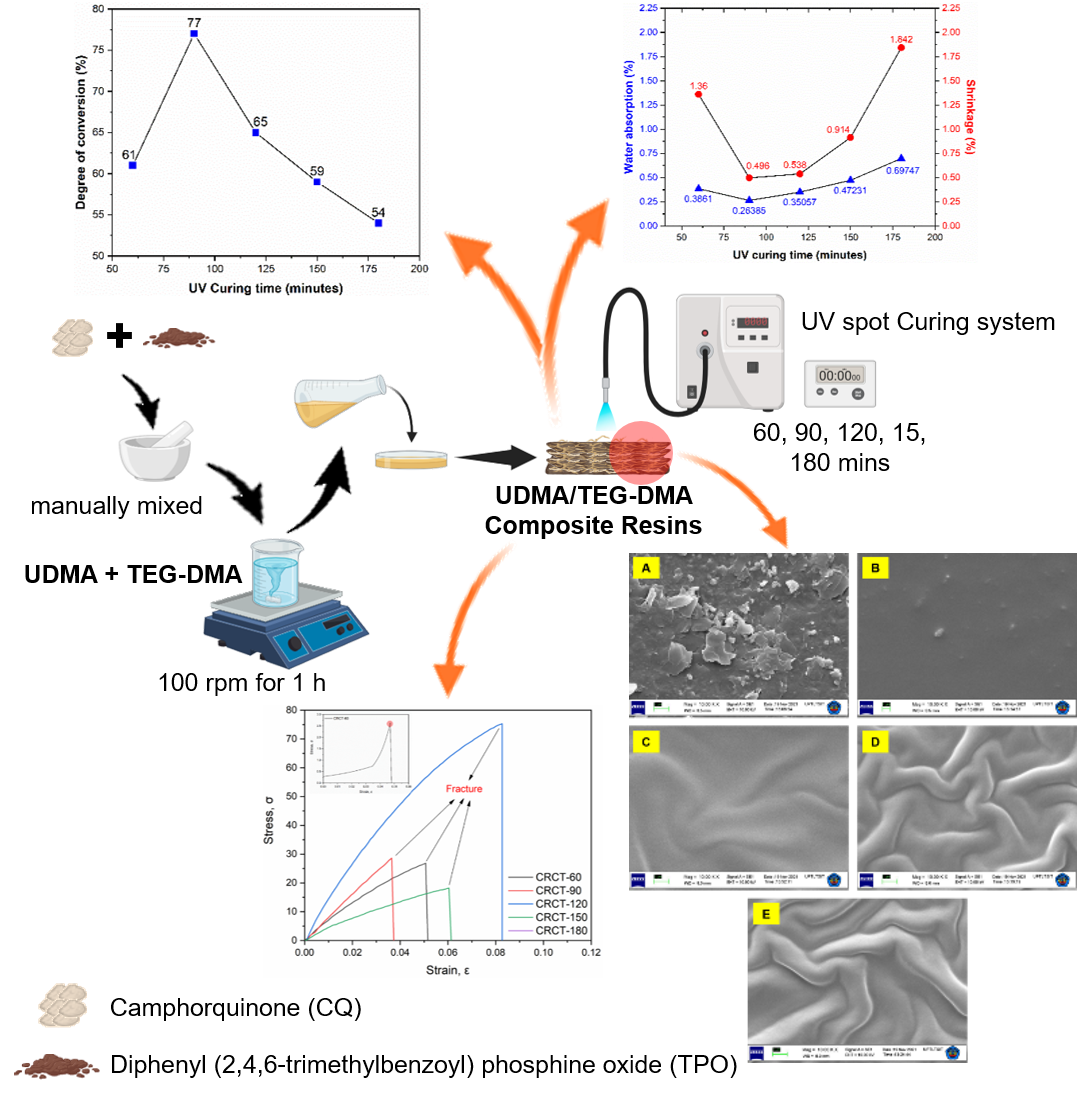
Downloads
References
EA Bonfante, M Calamita and ETP Bergamo. Indirect restorative systems - A narrative review. J. Esthet. Restor. Dent. 2023; 35, 84-104.
M Cadenaro, U Josic, T Maravic, C Mazzitelli, G Marchesi, E Mancuso, L Mancuso and A Mazzoni. Progress in dental adhesive materials. J. Dent. Res. 2023; 102, 254-62.
J Xue, J Wang, D Feng, H Huang and M Wang. Application of antimicrobial polymers in the development of dental resin composite. Molecules 2020; 25, 4738.
A Rupal, SR Meda, A Gupta, I Tank, A Kapoor, SK Sharma, T Sathish and P Murugan. Utilization of polymer composite for development of sustainable construction material. Adv. Mater. Sci. Eng. 2022; 2022, 1240738.
R Hsissou, R Seghiri, Z Benzekri, M Hilali, M Rafik and A Elharfi. Polymer composite materials: A comprehensive review. Compos. Struct. 2021; 262, 113640.
D Bonardo, NLW Septiani, F Amri, Estananto, S Humaidi, Suyatman and B Yuliarto. Review - Recent development of WO3 for toxic gas sensors applications. J. Electrochem. Soc. 2021; 168, 107502.
G Noirbent and F Dumur. Photoinitiators of polymerization with reduced environmental impact: Nature as an unlimited and renewable source of dyes. Eur. Polym. J. 2021; 142, 110109.
M Krasowski, S Ciesielska, B Smielak, K Kopacz and K Bociong. Preparation of an experimental dental composite with different Bis-GMA/UDMA proportions. Mater. Manuf. Process. 2024; 39, 1044-51.
A Szczesio-Wlodarczyk, A Polikowski, M Krasowski, M Fronczek, J Sokolowski and K Bociong. The Influence of low-molecular-weight monomers (TEGDMA, HDDMA, HEMA) on the properties of selected matrices and composites based on Bis-GMA and UDMA. Materials 2022; 15, 2649.
M Par, N Spanovic, D Mohn, T Attin, TT Taubock and Z Tarle. Curing potential of experimental resin composites filled with bioactive glass: A comparison between Bis-EMA and UDMA based resin systems. Dent. Mater. 2020; 36, 711-23.
B Lee, K Cheng, B Zeng, P Wang and T Yang. Development of a novel resin for provisional prostheses using hyperbranched polyurethane acrylate and triethylene glycol dimethacrylate-An in vitro study. J. Prosthodont. Res. 2021; 66, 557-63.
J Fouassier and J Lalevee. Photoinitiators: Structures, reactivity and applications in polymerization. 1st ed. Wiley-vch GmbH, Weinhem, Germany, 2021.
A Kowalska, J Sokolowski and K Bociong. The photoinitiators used in resin based dental composite - a review and future perspectives. Polymers 2021; 13, 470.
N Corrigan, M Ciftci, K Jung and C Boyer. Mediating reaction orthogonality in polymer and materials science. Angew. Chemie. Int. Ed. 2021; 60, 1748-81.
BM Duarte, JMS Neto, DDP Pinheiro and TSBD Araujo. Effects of photoinitiators on dental composite resins: a narrative review. MedNEXT J. Med. Heal. Sci. 2022; 3, 1-7.
C Felipe-Mendes, L Ruiz-Rubio and JL Vilas-Vilela. Biomaterials obtained by photopolymerization: From UV to two photon. Emergent. Mater. 2020; 3, 453-68.
L Lara, MG Rocha, LRD Menezes, AB Correr, MAC Sinhoreti and D Oliveira. Effect of combining photoinitiators on cure efficiency of dental resin-based composites. J. Appl. Oral Sci. 2021; 29, e20200467.
A Tichy and P Bradna. Applicability of exposure reciprocity law for fast polymerization of restorative composites containing various photoinitiating systems. Oper. Dent. 2021; 46, 406-18.
A Kowalska, J Sokolowski, T Gozdek, M Krasowski, K Kopacz and K Bociong. The influence of various photoinitiators on the properties of commercial dental composites. Polymers 2021; 13, 3972.
A Haroun, A Osman, S Ahmed and AH Elghandour. Synthesis and characterization of ibuprofen delivery system based on β-cyclodextrin/Itaconic acid copolymer. Trends Sci. 2022; 19, 5825.
M Rodin, J Li and D Kuckling. Dually cross-linked single networks: Structures and applications. Chem. Soc. Rev. 2021; 50, 8147-77.
RA Ningrum, S Humaidi, S Sihotang, D Bonardo and Estananto. Synthesis and material characterization of calcium carbonate (CaCO3) from the waste of chicken eggshells. J. Phys. Conf. Ser. 2022; 2193, 012009.
B Chakraborty. Statistical and nonlinear physics. In: TCB McLeish (Ed.). Polymer physics. Springer, New York, 2022.
G Youssef. Applied mechanics of polymers: properties, processing, and behavior. 1st ed. Elsevier, Amsterdam, Netherlands, 2021.
K Suka, E Frida, M Rianna and D Bonardo. Investigation of calcination duration on the surface morphology and specific surface area of zeolite-chitosan composite with oil palm ash for potential water contaminant remediation. J. Phys. Conf. Ser. 2023; 2672, 012008.
H Hu, Z Ren, Y Xi, L Fang, D Fang, L Yang, P Shao, H Shi, K Yu and X Lua. Insights into the role of cross-linking agents on polymer template effect: A case study of anionic imprinted polymers. Chem. Eng. J. 2021; 420, 129611.
E Lempel, D Szebeni, Z Ori, T Kiss, J Szalma, BV Lovasz, S Kunsagi-Mate and K Boddi. The effect of high-irradiance rapid polymerization on degree of conversion, monomer elution, polymerization shrinkage and porosity of bulk-fill resin composites. Dent. Mater. 2023; 39, 442-53.
C Nikolaou, NP Kalogiouri, P Mourouzis, A Kabir, K Furton and VF Samanidou. Fabric phase sorptive extraction of monomers released from dental resins in alcoholic beverages prior to their HPLC-UV determination. Microchem. J. 2023; 191, 108802.
L Pezzana, G Melilli, N Guigo, N Sbirrazzuoli and M Sangermano. Cross‐Linking of biobased monofunctional furan epoxy monomer by two steps process, UV irradiation and thermal treatment. Macromol. Chem. Phys. 2023; 224, 2200012.
X Peng, J Zhang and P Xiao. Photopolymerization approach to advanced polymer composites: Integration of surface‐modified nanofillers for enhanced properties. Adv. Mater. 2024; 36, e2400178.
E Marin, F Boschetto, M Zanocco, HN Doan, TPM Sunthar, K Kinashi, D Iba, W Zhu and G Pezzotti. UV-curing and thermal ageing of methacrylated stereo-lithographic resin. Polym. Degrad. Stab. 2021; 185, 109503.
OA Hakeim, F Abdelghaffar and AA Haroun. UV-curable hyperbranched polyester acrylate encapsulation of phthalocyanine pigments for high performance synthetic fabrics printing. Dye Pigment. 2020; 177, 108307.
M Par, D Marovic, T Attin, Z Tarle and TT Taubock. Effect of rapid high-intensity light-curing on polymerization shrinkage properties of conventional and bulk-fill composites. J. Dent. 2020; 101, 103448.
S Nakagawa and N Yoshie. Star polymer networks: A toolbox for cross-linked polymers with controlled structure. Polym. Chem. 2022; 13, 2074-107.
R Prabhu, S Mendonca, R D’Souza and T Bhat. Effect of water absorption on the mechanical properties of alkaline treated bamboo and flax fiber reinforced epoxy composites. Trends Sci. 2022; 19, 5779.

Downloads
Published
How to Cite
Issue
Section
License
Copyright (c) 2024 Walailak University

This work is licensed under a Creative Commons Attribution-NonCommercial-NoDerivatives 4.0 International License.





