
Improvement of Hygienic and Phytochemical Qualities of Mangosteen (Garcinia Mangostana) Peel by Irradiation
DOI:
https://doi.org/10.48048/tis.2024.8631Keywords:
Antioxidant, Antimicrobial, Mangostin, Irradiation, Mangosteen peel, Microbial decontaminationAbstract
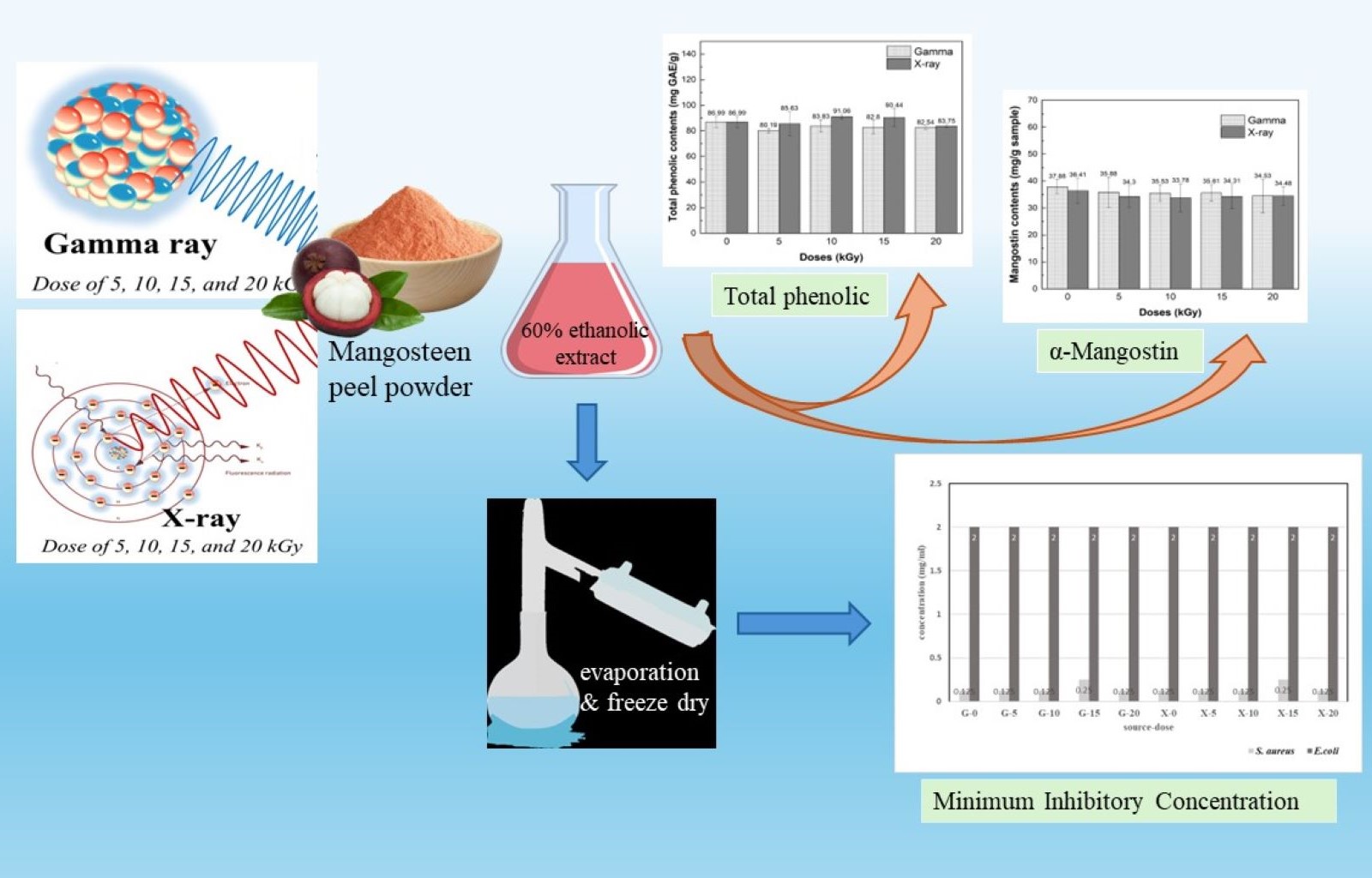
The aim of this study was to compare the effects of gamma ray and x-ray irradiation at different dose levels 95, 10, 15 and 20 kGy) on in mangosteen peel. The antioxidant activities were assessed using 2,2-diphenyl-1-picrylhydrazyl (DPPH) and ferric reducing antioxidant power (FRAP), while total phenolic contents and antibacterial activities against Staphylococcus aureus and Escherichia coli of 60 % ethanolic mangosteen powder extracts were analyzed. The results indicated that both types of ionizing radiations showed a non-significant decrease in measured parameters with increasing doses. The minimum inhibitory concentration (MIC) values of irradiated mangosteen peel extracted against S. aureus and E. coli ranged from 0.125 to 2.0 mg/mL. The quantity of bioactive compound mangostin determined via high-performance liquid chromatography (HPLC), did not show significant decrease with different irradiation sources and doses. In microbiological aspect, total yeast and mold from both irradiation sources were reduced by 1 log cycle after irradiation at 5 kGy. The irradiation induced color changes corresponding to Hunter color L a b value. X-ray irradiation caused slight color alteration compared to gamma rays. The advantage of x-ray irradiation was that it revealed non-significant changes in b values, whereas gamma irradiation showed the significant change in L, and b values with increasing dosage. The x-ray irradiation at the dose 5 kGy effectively decreased microbial contamination while causing minimal changes to phytochemical qualities and color.
HIGHLIGHTS
- Irradiation at 5 kGy was sufficient to control microbial contamination
- There were no significant changes in antioxidant activities (DPPH, FRAP), a-mangostin contents, total phenolic contents (TPC) and antibacterial activities: after irradiation up to 20 kGy
- X-ray irradiation was an excellent alternative to gamma irradiation for decontamination with a non-significant alteration in b values.
GRAPHICAL ABSTRACT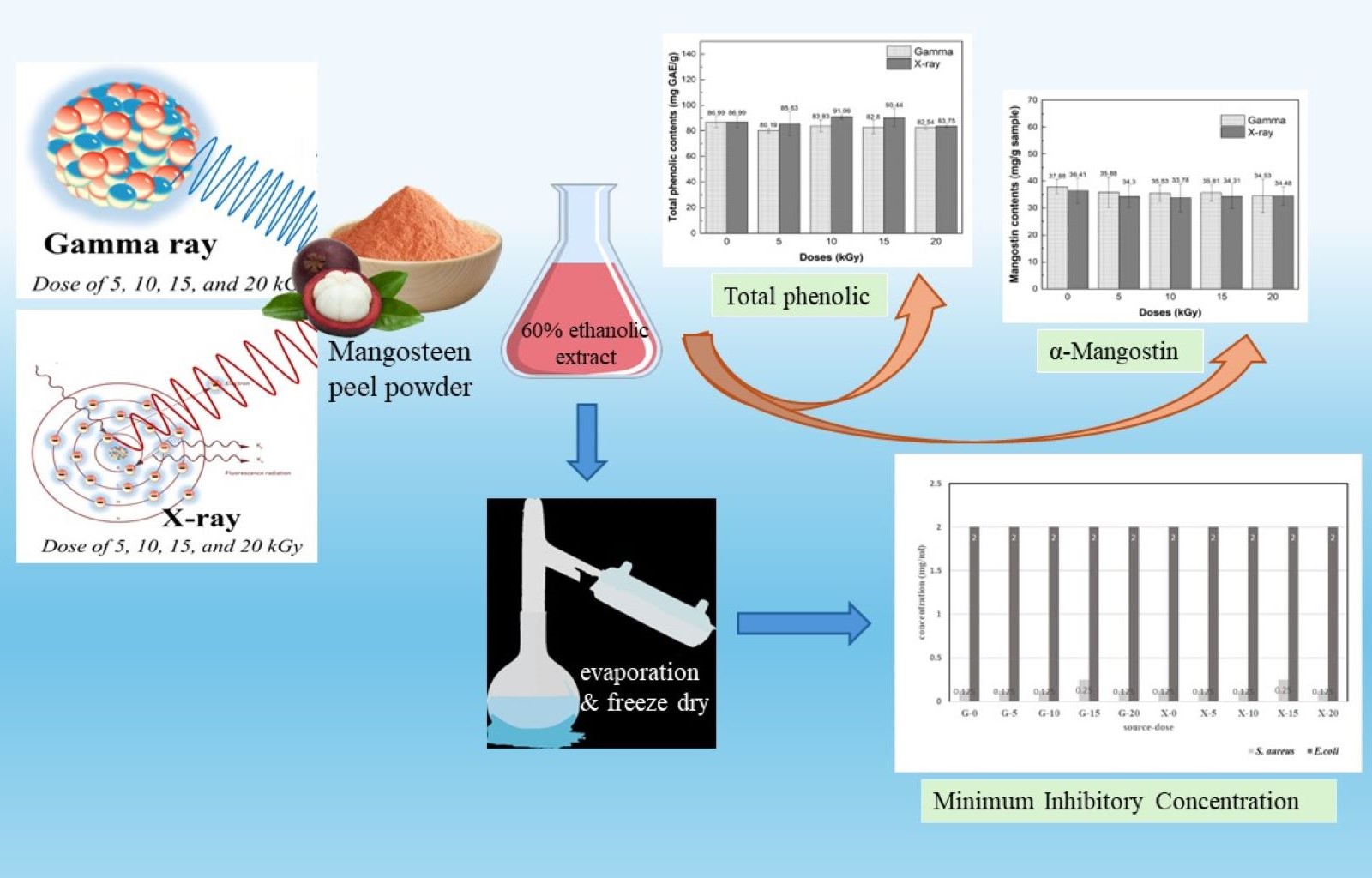
Downloads
References
D Obolskiy, I Pischel, N Siriwatanametanon and M Heinrich. Garcinia mangostana L.: A phytochemical and pharmacological review. Phytother. Res. 2009; 23, 1047-65.
MB Osman and R Milan. Fruits for the future 9: Mangosteen (Garcinia mangostana). Southampton Centre for Underutilised Crops, Southampton, 2006, p. 170.
YH Hong, JY Park, JH Park, MS Chung, KS Kwon, K Chung and KB Song. Inactivation of Enterobacter sakazakii, Bacillus cereus, and Salmonella typhimurium in powdered weaning food by electron-beam irradiation. Radiat. Phys. Chem. 2008; 77, 1097-100.
[ 4] A Bendini, TG Toschi and G Lercker. Influence of gamma irradiation and microwaves on the linear unsaturated hydrocarbon fraction in spices. Zeitschrift für Lebensmittel Untersuchung und For-schung A 1998; 207, 214-8.
M Suhaj, J Rácová, M Polovka and V Brezová. Effect of γ-irradiation on antioxidant activity of black pepper (Piper nigrum L.). Food Chem. 2006; 97, 696-704.
L Samuagam, CM Sia, GA Akowuah, PN Okechukwu and HS Yim. The effect of extraction conditions on total phenolic content and free radical scavenging capacity of selected tropical fruits’ peel. Health Environ. J. 2013; 4, 80-102.
FDA’s Bacteriological Analytical Manual (BAM). Aerobic plate count and yeasts, molds and mycotoxins, Available at: https://www.fda.gov/food/laboratory-methods-food/bacteriological-analytical-manual-bam, accessed January 2024.
KF Khattak,TJ Simpson and Ihasnullah. Effect of gamma irradiation on the extraction yield, total phenolic content and free radical-scavenging activity of Nigella staiva seed. Food Chem. 2008; 110, 967-72.
IFF Benzie and JJ Strain. The ferric reducing ability of plasma (FRAP) as a measure of “antioxidant power”: The FRAP assay. Anal. Biochem. 1996; 239, 70-6.
YS Velioglu, G Mazza, L Gao and BD Oomah. Antioxidant capacity and total phenolics in selected fruits, vegetable and grain products. J. Agric. Food Chem. 1998; 46, 4113-7.
GM Belbe and M Tofană. Effects of ionizing radiation on microbiological contaminants of foods. Bull. UASVM Agric. 2010; 67, 178-85.
Thai Industrial Standards Institute. Community Products Standards 480/2547 for dry herbs, Available at: http://tcps.tisi.go.th/pub%5Ctcps480_47.pdf, accessed January 2024.
W Pewlong, S Sajjabut, S Chookaew, J Eamsiri, K Khemthong and L Maikaew. Improvement of Thanaka powder by gamma radiation: Microbial and chemical properties. Chiang Mai Univ. J. Nat. Sci. 2021; 20, e2021041.
JF Diehl. Safety of irradiated foods. 2nd eds. Marcel Dekker, New York, 1995, p. 454.
R Rezanejad, M Heidarieh, SM Ojagh, M Rezaei, M Raeisiand and A Alishahi. Values of antioxidant activities (ABTS a nd DPPH) and ferric reducing and chelating powers of gamma-irradiated rosemary extract. Radiochim. Acta 2019; 108, 477-82.
MW Byun, HS Yook, OJ Kwon and IJ Kang. Effects of gamma irradiation on physicochemical properties of Korean red ginseng powder. Radiat. Phys. Chem. 1997; 49, 483-9.
M Jamshidi, M Barzegar and MA Sahari. Effect of gamma irradiation on the antioxidant and antimicrobial activities of cinnamon powder. J. Nutr. Sci. Food Tech. 2013; 7, 73-82.
K Alloun, O Benchabane, M Hazzit, F Mouhouche, A Baaliouamer, A Chikhoune and A Benchabane. Effect of gamma ray irradiation on chemical composition, antioxidant, antimicrobial and insecticidal activities of Thymus pallescens essential oil. Acta Chromatogr. 2019; 31, 57-62.
ER Kitazuru, AVB Moreira, J Mancini-Filho, H Delincee and ALCH Villavicencio. Effects of irradiation on natural antioxidants of cinnamon (Cinnamomum zeylanicum N.). Radiat. Phys. Chem. 2004; 71, 39-41.
J Eamsiri, S Chookaew, W Pewlong, S Sajjabut and P Orpong. Effects of irradiation on antioxidant and antimicrobial activities of Coscinium fenestratum (Goetgh.) Colebr. J. Phys. Conf. Ser. 2019; 1285, 012006.
LM Crawford and EH Ruff. A review of the safety of cold pasteurization through irradiation. Food Control 1996; 7, 87-97.
M Alothman, R Bhat and AA Karim. Effects of radiation processing on phytochemicals and antioxidants in plant produce. Trends Food Sci. Tech. 2009; 20, 201-12.
M Polovka and M Suhaj. The effect of irradiation and heat treatment on composition and antioxidant properties of culinary herbs and spices - A review. Food Revi. Int. 2010; 26, 138-161.
S Chatterjee, PS Variyar and A Sharma. Stability of lipid constituents in radiation processed fenugreek seeds and turmeric: role of phenolic antioxidants. J. Agric. Food Chem. 2009; 57, 9226-33.
KF Khattak and TJ Simpson. Effect of gamma irradiation on the antimicrobial and free radical scavenging activities of Glycyrrhiza glabra root. Radiat. Phys. Chem. 2010; 79, 507-512.
LGL Gerolis, FS Lameiras, K Krambrock and Maria Jose. Effect of gamma radiation on antioxidant capacity of green tea, yerba mate, and chamomile tea as evaluated by different methods. Radiat. Phys. Chem. 2017; 138, 177-85.
N Shahzad, R Elahi and S Ali. Effect of gamma irradiation on phytochemical content and antimicrobial activities of selected herbs. Austin J. Nutri. Food Sci. 2017; 5, 1093.
S Taheri, TL Abdullah, E Karimi, E Oskoueian and M Ebrahimi. Antioxidant capacities and total phenolic contents enhancement with acute gamma irradiation in Curcuma alismatifolia (Zingiberaceae) leaves. Int. J. Mol. Sci. 2014; 15, 13077-90.
M Adamo, D Capitani, L Mannina, M Cristinzio, P Ragni, A Tata and R Coppola. Truffles decontamination treatment by ionizing radiation. Radiat. Phys. Chem. 2004; 71, 165-8.
R Shigemura, DL Gerdes and WR Hall. Effect of gamma processing on prepackaged black and white pepper (Piper nigrum L.). Food Sci. Tech. 1991; 24, 135-8.
R Dhanya, BB Mishra and KM Khaleel. Effect of gamma irradiation on curcuminoids and volatile oils of fresh turmeric (Curcuma longa). Radiat. Phys. Chem. 2011; 80, 1247-9.
NS Najafabadi, MA Sahari, M Barzegar and ZH Esfahani. Effect of gamma irradiation on some physicochemical properties and bioactive compounds of jujube (Ziziphus jujube var. vulgaris) fruit. Radiat. Phys. Chem. 2017; 130, 62-8.
M Polovka and M Suhaj. Classification and prediction of γ-irradiation of ten commercial herbs and spices by multivariate evaluation of properties of their extracts. J Food Nutr. Res. 2013; 52, 45-60.
KG Lee and T Shibamoto. Toxicology and antioxidant activities of non-enzymatic browning reaction products. Food Rev. Int. 2002; 18, 151-75.
MC Nicoli, MA Casadei, ME Guerzoni and CR Lerici. Non-enzymatic browning reactions in irradiated glucose-glycine aqueous model systems. Appl. Radiat. Isot. 1994; 45, 389.
DM Holcroft, MI Gil and AA Kader. Effect of carbon dioxide on anthocyanins, phenylalanine ammonia lyase and glycosyltransferase in the arils of stored pomegranates. J. Am. Soc. Hortic. Sci. 1998; 123, 136-40.
E Pereira, AI Pimenta, L Barros, RC Calhelha, AL Antonio, SC Verde and ICFR Ferreira. Effects of gamma radiation on the bioactivity of medicinal and aromatic plants: Mentha × piperita L., Thymus vulgaris L. and Aloysia citrodora Paláu as case studies. Food Funct. 2018; 9, 12.
M Iinuma, H Tosa, T Tanaka, F Asai, Y Kobayashi, R Shimano and K Miyauchi. Antibacterial activity of xanthones from guttiferaeous plants against methicillin-resistant Staphylococcus aureus. J. Pharm. Pharmacol. 1996; 48, 861-5.
Y Sakagami, M Iinuma, KGNP Piyasena and HRW Dharmaratne. Antibacterial activity of α-mangostin against vancomycin resistant Enterococci (VRE) and synergism with antibiotics. Phytomedicine 2005; 12, 203-8.
R Merkl, I Hrádková, V Filip and J Šmidrkal. Antimicrobial and antioxidant properties of phenolic acids alkyl esters. Czech J. Food Sci. 2010; 28, 275-9.
Downloads
Published
How to Cite
Issue
Section
License
Copyright (c) 2024 Walailak University

This work is licensed under a Creative Commons Attribution-NonCommercial-NoDerivatives 4.0 International License.





