
Impact of Gamma Ray and X-ray Irradiation on the Microbial Load and Cosmeceutical Properties of Thanaka Powder
DOI:
https://doi.org/10.48048/tis.2026.11354Keywords:
Gamma ray, X-ray, Irradiation, Microbiological quality, Cosmeceutical properties, Arbutin, MarmasinAbstract
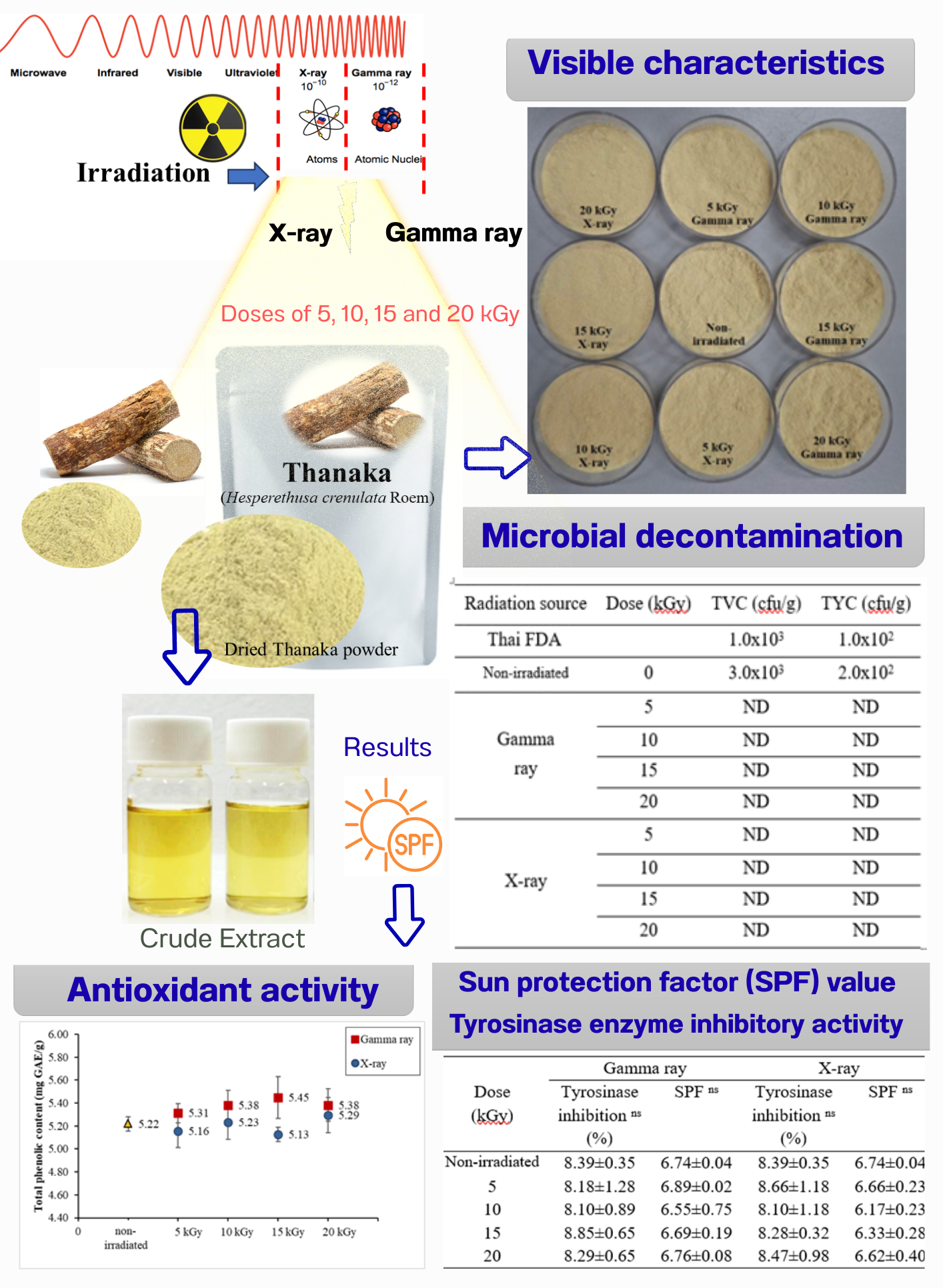
Thanaka (Hesperethusa crenulata Roem) is a traditional herbal powder widely used in cosmetic formulations for its skin-protective properties. However, microbial contamination during processing poses a safety concern. This study evaluated the effects of gamma ray and X-ray irradiation (5 - 20 kGy) on the microbial load and cosmeceutical properties of Thanaka powder. Non-irradiated Thanaka had TVC of 3.0×10³ and TYM of 2.0×10² CFU/g. Irradiation ≥ 5 kGy reduced both to undetectable levels, meeting Thai FDA standards. Minor color changes like dose-dependent darkening and a green-to-red shift occurred but did not affect the powder’s cosmetic quality. Key bioactive compounds, including arbutin (2.06 - 2.16 mg/mL) and marmesin (0.12 - 0.14 mg/mL), as well as tyrosinase inhibitory activity (8.10% - 8.85%), sun protection factor (SPF, 6.17 - 6.89), total phenolic content and antioxidant activity (DPPH, FRAP), remained stable post-irradiation. These findings indicate that ionizing radiation is an effective method for enhancing the microbiological quality of Thanaka powder without compromising its functional or aesthetic qualities, with X-ray irradiation offering a practical alternative to gamma ray.
HIGHLIGHTS
- Gamma ray and X-ray irradiation (5 - 20 kGy) reduce microbial load in Thanaka powder.
- Treatments meet Thai FDA safety standards.
- Arbutin and marmesin remain stable after irradiation.
- Antioxidant activity, tyrosinase inhibition, and SPF are preserved.
- X-ray is a viable non-radioactive sterilization method.
GRAPHICAL ABSTRACT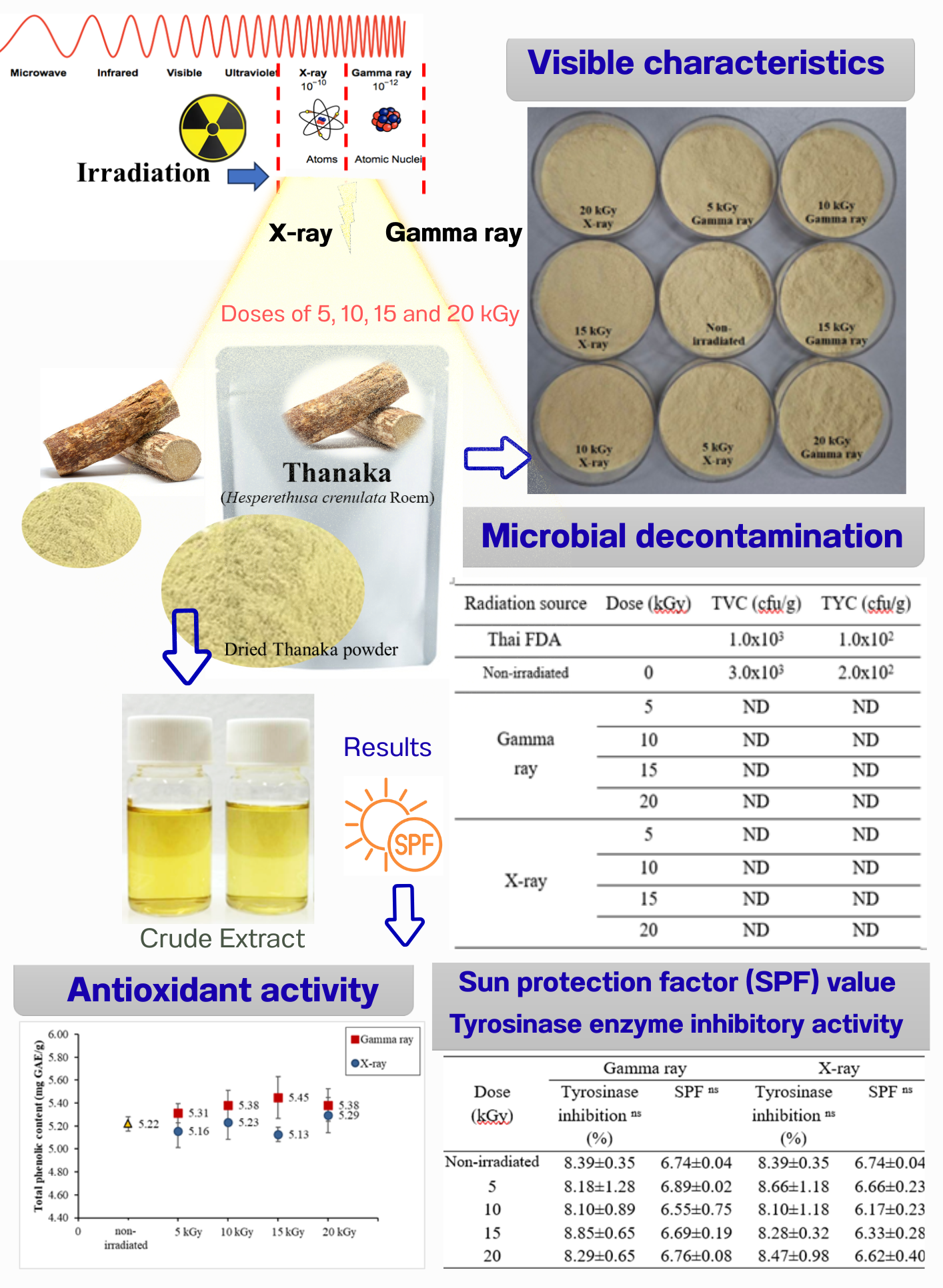
Downloads
References
MW Lim, MK Aroua and LT Gew. Thanaka (H. crenulata, N. crenulata, L. acidissima L.): A systematic review of its chemical, biological properties, and cosmeceutical applications. Cosmetics 2021; 8, 68.
The Business Research Company. Herbal medicine market report 2025, Available at: https://www.researchand
markets.com/reports/5939866/herbal-medicine-market-report, accessed July 2025.
Ministry of Public Health. Notification of the Ministry of Public Health re: Cosmetic products (No. 3) B.E. 2562 (2019), Available at: https://en.fda.moph.go.th/cat2-health-products/health-products-20190614-notification-of-cosmetics-committee-re-label-of-cosmetic, accessed July 2025.
S Nimrat, T Suksawat, JM Jones, A Williams and V Vuthiphandchai. Evaluation of bacterial contamination in Thanaka products distributed in Republic of the Union of Myanmar. KKU Science Journal 2014; 74(1-2), 494-501.
W Phianphak, S Rengpipat and W Cherdshewasart. Gamma irradiation versus microbial contamination of Thai medicinal herbs. Songklanakarin Journal Sciences Technology 2007; 29(1), 157-166.
JH Kim, JW Ahn, JW Lee, HS Yook and MW Byun. Color improvement of Curcuma aromatica extracts by gamma irradiation. Food Chemistry 2006; 94(2), 143-147.
O Andreoletti, H Budka, S Buncic, JD Collins, J Griffin, T Hald, A Havelaar, J Hope, G Klein, J McLauchlin, C Müller-Graf, C Nguyen-The, B Noerrung, L Peixe, MP Maradona, A Ricci, J Sofos, J Threlfall, I Vågsholm and E Vanopdenbosch. Scientific opinion on the efficacy and microbiological safety of irradiation of food. European Food Safety Authority Journal 2011; 9(4), 2103.
X Fan and BA Niemira. Gamma ray, electron beam, and X-ray irradiation. In: GV Barbosa-Cánovas, LVM Tiwari and BK Simpson (Eds.). Food safety engineering. Springer, Cham, Switzerland, 2020, p. 471-492.
W Pewlong, S Sajjabut, S Chookaew, J Eamsiri, K Khemthong and L Maikaew. Improvement of Thanaka powder by gamma radiation: Microbial and chemical properties. Chiang Mai University Journal of Natural Science 2020; 20(2), e2021041.
US Food and Drug Administration. Regulatory information on irradiated food and packaging, Available at: https://www.fda.gov/food/ingredients-additives-gras-packaging-guidance-documents-regulatoryinformation/regul
atory-information-irradiated-food-and-packaging, accessed July 2025.
US Food and Drug Administration. BAM chapter 3: Aerobic plate count, Available at: https://www.fda.gov/food/
laboratory-methods-food/bam-chapter-3-aerobic-p late-count, accessed February 2024.
US Food and Drug Administration. BAM chapter 18: Yeasts, molds and mycotoxins, Available at: https://www.
fda.gov/food/laboratory-methods-food/bam-chapter-18yeasts-molds-and-mycotoxins, accessed February 2024.
International Organization for Standardization. ISO 7932:2004 Microbiology of food and animal feeding stuffs - Horizontal method for the enumeration of presumptive Bacillus cereus - Colony-count technique at 30 degrees C, Available at: https://www.iso.org/standard/38219.html, accessed February 2024.
W Thongchai, B Liawruangrath and S Liawruangrth. Hogh-performance liquid chromatography determination of arbutin in skin-whitening creams and medicinal plant extracts. Journal of Cosmetic Science 2007; 58, 35-44.
J Mahendra, K Rakkhee, NJ Ravirajsinh, CT Menaka, VD Ranjitsinh and SH Mishra. Ameliortion of cabon tetrachloride induced hepatotoxicity in rats by standardized Feronia limonia. Linn leaf extracts. EXCLI Journal 2012; 11, 250-259.
S Bunleu and P Methin. Anti-tyrosinase and DPPH radical scavenging activities of selected Thai herbal extracts traditionally used as skin toner. Pharmacognosy Journal 2015; 7(2), 96-101.
C Malsawmtluangi, DK Nath, I Jamatia, ZE lianhimgthangi and L Pachuan. Determination of sun protection factor (SPF) number of some aqueous herbal extracts. Journal of Applied Pharmaceutical Sciences 2013; 3(9), 150-151.
YS Velioglu, GL Mazza and BD Oomah. Antioxidant capacity and total phenolics in selected fruit, vegetable, and grain products. Journal of Agricultural and Food Chemistry 1998; 46(10), 4113-4117.
KF Khattak, TJ Simson and Ihasnullah. Effect of gamma irradiation on the extraction yield, total phenolic content, and free radical-scavenging activity of Nigella sativa seed. Food Chemistry 2008; 110(4), 967-972.
LFF Benzie and JJ Strain. The ferric reducing ability of plasma (FRAP) as a measure of antioxidant power the FRAP assay. Analytical Biochemistry 1998; 239(1), 70-76.
EK Danyo, MN Ivantsova and IS Selezneva. Ionizing radiation effects on microorganisms and its applications in the food industry. Food and Raw Materials 2024; 12(1), 1-12.
BT Odai, K Tano-Debrah, KK Addo, FK Saalia and LM Akyeh. Effect of gamma radiation and storage at 4 °C on the inactivation of Listeria monocytogenes, Escherichia coli and Salmonella enterica Typhimurium in Legon-18 pepper (Capsicum annuum) powder. Food Quality and Safety 2019; 39(4), 265-272.
C Kaew-On, J Yuennan, N Tohluebaji, P Channuie, S Ruangdit, R Samran, T Tochomphoo and R Siri. Enhanced hydrophobicity, thermal stability, and X-ray shielding efficiency of BaSO4/P(VDF-HFP) nanocomposites for advanced lead-free radiation protection. Polymers 2025; 17(6), 723.
J Eamsiri, W Pewlong, S Sajjabut, S Chookaew, K Khemtong, R Photinam and P Prakongsil. Improvement of hygienic and phytochemical qualities of mangosteen (Garcinia mangostana) peel by irradiation. Trends in Sciences 2024; 21(12), 8631.
K Jung, BS Song, MJ Kim, BG Moon, SM Go, JK Kim, YJ Lee and JH Park. Effect of X-ray, gamma ray, and electron beam irradiation on the hygienic and physicochemical qualities of red pepper powder. LWT - Food Science and Technology 2015; 63(2), 846-851.
HW Woldemariam, M Kießling, SA Emire, PG Teshome, S Töpfl and K Aganovic. Influence of electron beam treatment on naturally contaminated red pepper (Capsicum annuum L.) powder: Kinetics of microbial inactivation and physicochemical quality changes. Innovative Food Science & Emerging Technologies 2020; 67, 102588.
K Jomova, R Raptova, SY Alomar, SH Alwasel, E Nepovimova, K Kuca and M Valko. Reactive oxygen species, toxicity, oxidative stress, and antioxidants: Chronic diseases and aging. Archives of Toxicology 2023; 97, 2499-2574.
S Rafi, AN Kamili, BA Ganai, S Jan and NA Wani. Enhancement in secondary metabolites and arbutin content via gamma irradiation elicitation in Bergenia ciliata (Haw.) Sternb. callus. Biochemistry Applications 2023; 1(1), 2177.
TR Wittenborn, HC Fahlquist, A Ferapontov, S Fonager, L Jensen, G Winther G and SE Degn. Comparison of gamma and x-ray irradiation for myeloablation and establishment of normal and autoimmune syngeneic bone marrow chimeras. Plos One 2021; 16(3), e0247501.
F Ducrozet, A Sebastian, CJ Garcia Villavicencio, S Ptasinska and C Sicard-Roselli. Quantifying hydroxyl radicals generated by a low-temperature plasma using coumarin: methodology and precautions. Physical Chemistry Chemical Physics 2024; 26, 8651-8657.
SA Ali and I Naaz. Biochemical aspects of mammalian melanocytes and the emerging role of melanocyte stem cells in dermatological therapies. International Journal of Health Sciences 2018; 12(1), 69-76.
HM Aung, N kanpipit and S Thapphasaraphong. Effects of Thanaka (Hesperethusa crenulata) stem bark extract on collagen activation and anti-melanogenesis for cosmetic applications. Tropical Journal of Natural Product Research 2024; 8(1), 5852-5860.
N Han, JY Lee, M Kim, JK Kim, YY Lee, MS Kang and HJ Kim. Effect of electron-beam irradiation on functional compounds and biological activities in peanut shells. Molecules 2023; 28, 7258.
SJ Yeom, GA Lee, SS Kim, KN Yoon, BS Song, JH Park, WJ Jung, YM Kim and JK Kim. Effect of gamma irradiation on post-harvest quality of king oyster mushrooms (Pleurotus eryngii). Korean Journal of Food Preservation 2023; 30(5), 729-742.
S Gabros, P Patel and PM Zito. Sunscreens and photoprotection. StatPearls Publishing, Tampa, 2025.
S Miksa, D Lutz and C Guy. New approach for a reliable in vitro sun protection factor method - Part II: Practical aspects and implementations. International Journal of Cosmetic Science 2016; 37, 555-556.
AJ Nidal, NZ Abdel, H Fatima, I Linda, A Mohammad and F Balsil. Phytoconstituents, antioxidant, sun protection and skin anti-wrinkle effects using 4 solvents fractions of the root bark of the traditional plant Alkanna tinctoria (L.). European Journal of Integrative Medicine 2018; 21, 88-93.
SH Joo, SC Lee and SK Kim. UV absorbent, marmesin, from the bark of Thanakha, Hesperethusa crenulata L. Journal of Plant Biology 2004; 47(2), 163-165.
L Shi, W Zhao, Z Yang, V Subbiah and HAR Suleria. Extraction and characterization of phenolic compounds and their potential antioxidant activities. Environmental Science and Pollution Research 2022; 29(54), 81112-81129.
M Abdul, R Fitria, C Kartika, A Lili and A Arif. Effect of gamma irradiation on Suruhan (Peperomia pellucida L.) Kunth) herb powder. Pharmacognosy Journal 2017; 9(1), 65-69.
K Aleksieva, R Mladenova, S Taneva, P Denev and Y Karakirova. Effect of gamma irradiation on free radicals and the antioxidant properties of walnuts. Chemistry 2025; 7, 52.
J Madureira, I Gonçalves, J Cardoso, MI Dias, PMP Santos, FMA Margaça, C Santos-Buelga, L Barros and SC Vede. Effects of electron beam radiation on the phenolic composition and bioactive properties of olive pomace extracts. Antioxidants 2024; 13(5), 558.
SS Lee, HG Kim, EH Park, KJ Kim, MH Bang, G Kim, HJ Jeon, CG Lee, MC Shin, DO Kim and NI Baek. Antioxidant and anti-inflammatory effects in lipopolysaccharide-induced THP-1 cells of coumarins from the bark of Hesperethusa crenulata R. Applied Biological Chemistry 2021; 64, 90.
Published
How to Cite
Issue
Section
License
Copyright (c) 2025 Walailak University

This work is licensed under a Creative Commons Attribution-NonCommercial-NoDerivatives 4.0 International License.





