
Enhancing Shelf Life and Quality of Traditional Thai Pork Sausage (Num-Tub) Using Gamma Irradiation
DOI:
https://doi.org/10.48048/tis.2026.11854Keywords:
food irradiation, Microbial safety, Isan-style sausage, Shelf life, Microbial safety, Gamma irradiation, Lipid oxidation, Color, Myoglobin, Shelf life, Isan-style sausageAbstract
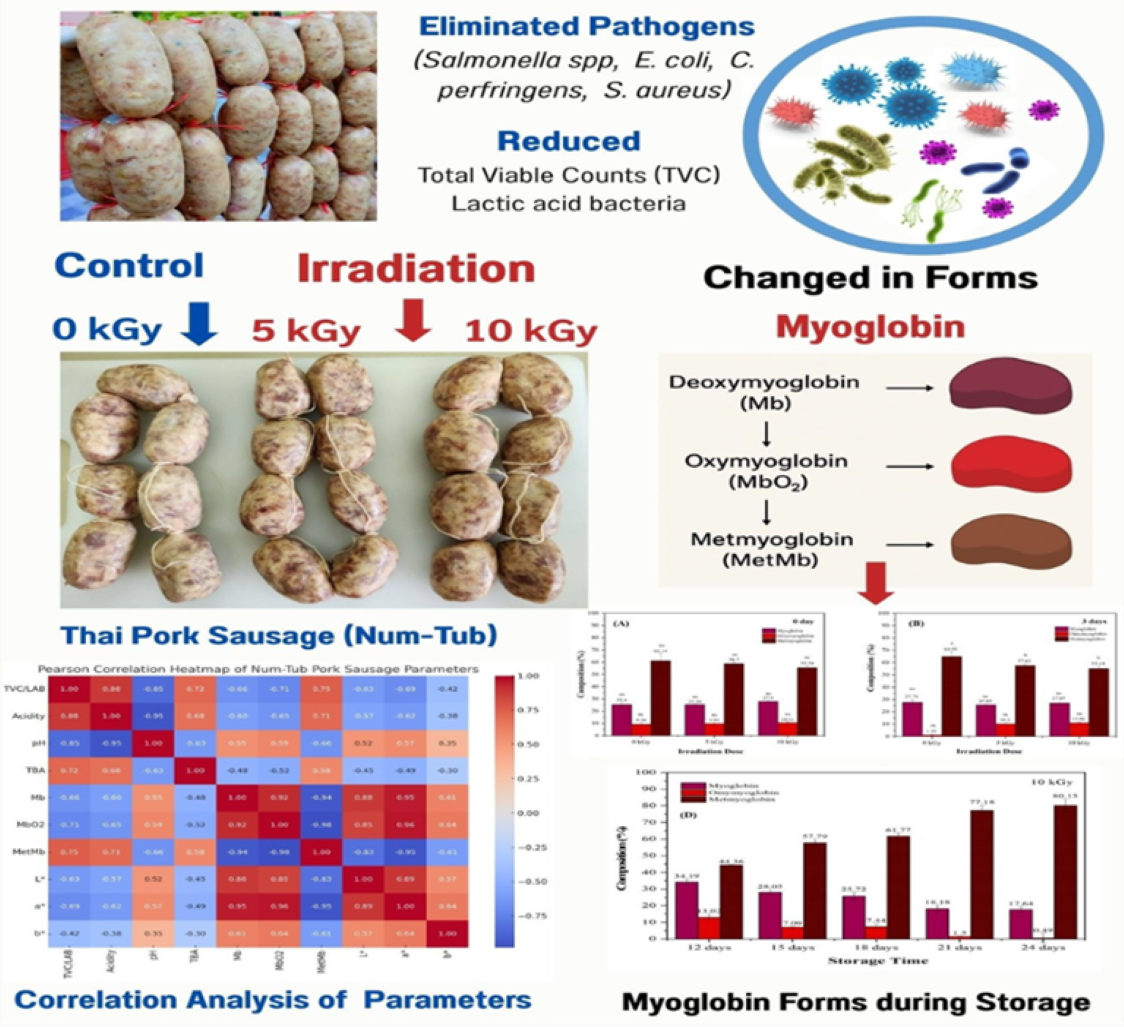
Num-Tub is a traditional Northeastern Thai pork sausage, often consumed fresh or fermented. The ingredients were naturally rich in protein, fat and moisture content. These conditions are conducive to the growth of beneficial and harmful microbes. Its perishable nature poses microbial safety challenges. Irradiation effectively extends the shelf life of Num-tub by reducing microbial contamination and inactivating spoilage microorganisms. This study investigated the effects of gamma irradiation at doses of 0, 5, and 10 kGy on the microbiological, chemical, and color attributes of vacuum-packed Num-Tub during 24 days at 28 ± 2 °C. Irradiation at 5 kGy reduced total viable counts (TVC) and lactic acid bacteria (LAB) to undetectable levels, though microbial regrowth occurred over time and eliminated key pathogens including Salmonella spp, E. coli, C. perfringens, S. aureus. However, this dose could not prevent microbial regrowth. In contrast, irradiation at 10 kGy improved microbial control and color (higher oxymyoglobin and redness) up to day 9 but significantly increased lipid oxidation. Correlation analysis indicated positive associations between microbial growth, acidity, lipid oxidation, and metmyoglobin formation, while pH, myoglobin, oxymyoglobin, and redness were negatively correlated. Gamma irradiation at 10 kGy is a non-thermal method that improves microbial safety by eliminating pathogens, suppressing lactic acid. It also increases oxymyoglobin levels, which enhances product redness. However, it may also lead to increased lipid oxidation during the 9-day storage period at ambient temperature. Further research should focus on integrating gamma irradiation with natural antioxidants or modified atmosphere packaging to mitigate lipid oxidation and pigment degradation. Additionally, sensory evaluation and consumer acceptance studies are essential to establish optimal irradiation protocols that balance safety, quality, and market viability.
HIGHLIGHTS
- Gamma irradiation improved microbial safety and extended shelf life of Num-Tub sausage.
- Irradiation at 5 kGy eliminated the pathogen and delayed acid production.
- Irradiation at 10 kGy effectively suppressed microbial regrowth but accelerated lipid oxidation.
- Irradiation induced oxymyoglobin formation until day 9, preserving redness and color quality.
- Microbial growth, acidity, and oxidation were closely correlated.
GRAPHICAL ABSTRACT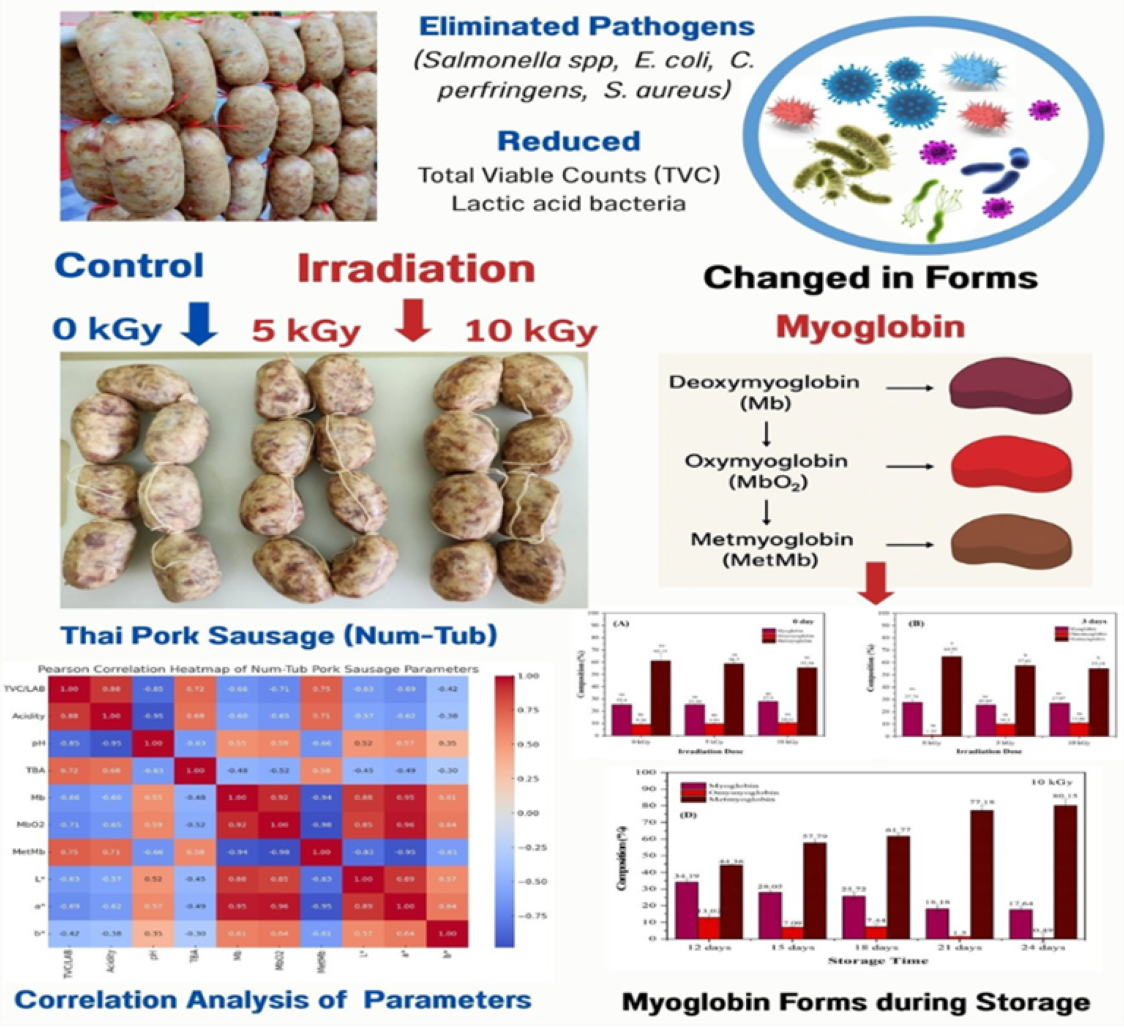
Downloads
References
KEA Abuzaid, F Shaltout, R Salem and EM El-Diasty. Microbial aspect of some processed meat products with special reference to aflatoxins. Benha Veterinary Medical Journal 2020; 39(2), 24-28.
KG Kuhn, M Torpdahl, Christina Frank, K Sigsgaard and S Ethelberg. An outbreak of Salmonella typhimurium traced back to salami, Denmark, April to June 2010. Eurosurveillance 2011; 16, 5-8.
ASM Abuelnaga, KAEH Abd El, MMH Soliman, HS Ibrahim, MMM Abd-Elaziz, AH Elgohary, RH Hedia and EAE Elgabry. Microbial contamination and adulteration detection of meat products in Egypt. World’s Veterinary Journal 2021; 11(4), 735-744.
S Chumpawadee, K Sommart, T Vongpralub and V Paatarajinda. Effect of synchronizing the rate of dietary energy and nitrogen release on ruminal fermentation, microbal protein synthesis and blood urea nitrogen in beef cattle. New dimensions and challenges for sustainable livestock farming volume III. In: Proceedings of the 11th AAAP Animal Science Congress, Kuala Lumpur, Malaysia. 2019, p. 364-366.
NM Sachindra, PZ Sakhare, KP Yashoda and D Narasimha Rao. Microbial profile of buffalo sausage during processing and storage. Food Control 2005; 16(1), 31-35.
AE Ghaly, D Dave, S Budge and M Brooks. Fish spoilage mechanisms and preservation techniques. American Journal of Applied Sciences 2010; 7(7), 859-877.
J Farkas. Irradiation for better foods. Trends in Food Science & Technology 2006; 17(4), 148-152.
MT Munir and M Federighi. Control of foodborne biological hazards by ionizing radiations. Foods 2020; 9(7), 878.
RP Rastogi, N Richa, A Kumar, MB Tyagi and RP Sinha. Molecular mechanisms of ultraviolet radiation‐induced DNA damage and repair. Journal of Nucleic Acids 2010; 1, 592980.
EA Otoo, FCK Ocloo and V Appiah. Effect of gamma irradiation on shelf life of smoked guinea fowl (Numida meleagris) meat stored at refrigeration temperature. Radiation Physics and Chemistry 2022; 194, 110041.
HJ Kim, M Kang and C Jo. Combined effects of electron beam irradiation and addition of onion peel extracts and flavoring on microbial and sensorial quality of pork jerky. Korean Journal of Agricultural Science 2012; 39(3), 341-347.
MH Shin, JW Lee, YM Yoon, JH Kim, BG Moon, JH Kim and BS Song. Comparison of quality of bologna sausage manufactured by electron beam or X-ray irradiated ground pork. Korean Journal for Food Science of Animal Resources 2014; 34(4), 464-471.
A AI Hammad, TM El-Mongy and AK Mabrouk. Shelf-life extension and improvement of the microbiological quality of fresh sausage by irradiation. Egyptian Journal of Radiation Sciences and Applications 2000; 13(1), 59-75.
DU Ahn, IS Kim and EJ Lee. Irradiation and additive combinations on the pathogen reduction and quality of poultry meat. Poultry science 2013; 92, 534-545.
R Domínguez, M Pateiro, M Gagaoua, FJ Barba, W Zhang and JM Lorenzo. A comprehensive review on lipid oxidation in meat and meat products. Antioxidants 2019; 8, 429.
R Indiarto, B Nurhadi, ES Tensiska and YT Istiqamah. Effect of liquid smoke on microbiological and physico-chemical properties of beef meatballs during storage. Food Research 2020; 4, 522-531.
R Indiarto and B Rezaharsamto. The physical, chemical, and microbiological properties of peanuts during storage: A review. International Journal of Scientific & Technology Research 2020; 9, 1909-1913.
FAO Joint. Consumer acceptance and market development of irradiated food in Asia and the Pacific. In: Proceedings of the final research co-ordination meeting, IAEA-TECDOC-1219, Joint FAO/IAEA Division of Nuclear Techniques in Food and Agriculture, Vienna, Austria. 2001.
Y Prachasitthisak, V Pringsulaka and S Chareon. Consumer acceptance of irradiated Nham. Food Irradiation Newsletter1989; 13(1), 65-67.
G Zhang, M Ferguson and RJ Blodgett. Aerobic plate count. Food and Drug Administration, Maryland, United States, 2001.
A Schumacher, C Lingle and KM Silbernagel. 3M™ petrifilm yeast and mold count plate for the enumeration of yeasts and molds in dried cannabis flower: AOAC official method SM 997.02. Journal of AOAC International 2023; 106(2), 412-419.
International Organization for Standardization. Microbiology of food and animal feeding stuffs - Horizontal method for the enumeration of Clostridiumperfringens - Colony-count technique, ISO 7937. International Organization for Standardization, Geneva, 2004.
P Feng, SD Weagant, MA Grant and W Burkhardt. Enumeration of Escherichia coli and the coliform bacteria. 8th ed. Food and Drug Administration, Maryland, United States, 2002.
Microbiology of the Food Chain—Horizontal Method for the Enumeration of Coagulase-Positive Staphylococci (Staphylococcus aureus and Other Species)—Part 1: Method Using Baird-Parker Agar Medium, BDSEN ISO 6888-1:2021, British Standards Institution, 2021.
OO Oludairo, JKP Kwaga, J Kabir, PA Abdu, A Gitanjali, A Perrets, V Cibin, AA Lettini and JOA Aiyedun. A review of the International Organization for Standardization (ISO) guidelines for the detection of Salmonella from faces. Journal of Applied Veterinary Sciences 2022; 7(4), 14-22.
ISO 15214. Microbiology of food and animal feeding stuffs: Horizontal method for the enumeration [sic] of mesophilic lactic acid bacteria: Colony-count technique at 30° C (ISO, 1998). ISO, Geneva, Switzerland, 1998.
MY Vera Peña and WL Rodriguez. Effect of pH on the growth of 3 lactic acid bacteria strains isolated from sour cream. Universitas Scientiarum 2020; 25(2), 341-358.
FE Boland. Acidity (titratable) of fruit products. Official Methods of Analysis of AOAC International 1995; 2, 10.
BG Tarladgis, BM Watts, MT Younathan and L Dugan. A distillation method for the quantitative determination of malonaldehyde in rancid foods. Journal of the American Oil Chemists Society 1960; 37(1), 44-48.
T Zhang, L Fan and Y Yu. The influence of myoglobin on the color of beef during the storage. Academic Journal of Agriculture & Life Sciences 2020; 1, 9-19.
JA Setyawan and E Oulan. Utilization of gamma irradiation in tuna fish for sushi/sashimi. Jurnal Ilmiah Aplikasi Isotop dan Radiasi 2018; 14(2), 77-81.
DW Thayer and G Boyd. Elimination of Escherichia coli O157: H7 in meats by gamma irradiation. Applied and Environmental Microbiology 1993; 59(4), 1030-1034.
PP Akhila, KV Sunooj, B Aaliya, M Navaf, C Sudheesh and S Sabu. Application of electromagnetic radiations for decontamination of fungi and mycotoxins in food products: A comprehensive review. Trends in Food Science and Technology 2021; 114, 399-409.
RD Ayivi and SA Ibrahim. Lactic acid bacteria: An essential probiotic and starter culture for the production of yoghurt. International Journal of Food Science and Technology 2022; 57(11), 7008-7025.
W Stumm and JJ Morgan. Aquatic chemistry: an introduction emphasizing chemical equilibria in natural waters (Stumm, Werner). Journal of Chemical. Education 1971; 48(12), A779.
S Cui and Z Fan. Lactic acid bacteria and fermented meat products. In: W Chen (Eds.). Lactic acid bacteria. Springer, Singapore, 2019, p. 211-225.
W Jia, X Wang, R Zhang, Q Shi and L Shi. Irradiation role on meat quality induced dynamic molecular transformation: From nutrition to texture. Food Reviews International 2023; 39(7), 4442-4464.
MA Haque, MA Hashem, MM Hossain, FJ Rima and AA Hossain. Effect of gamma irradiation on shelf life and quality of beef. Journal of Meat Science and Technology 2017; 5(2), 20-28.
R Indiarto, AN Irawan and E Subroto. Meat irradiation: A comprehensive review of its impact on food quality and safety. Foods 2023; 12(9), 1845.
M Byungrok and UKA Dong. Mechanism of lipid peroxidation in meat and meat products - A review. Food Science and Biotechnology 2005; 14, 152-163
C Ruedt, M Gibis and J Weiss. Meat color and iridescence: Origin, analysis, and approaches to modulation. Food Science and Food Safety 2023; 22(4), 3366-3394.
MF Nisar, MS Arshad, M Yasin, MK Khan, M Afzaal, S Sattar and HAR Suleria. Evaluation of gamma irradiation and moringa leaf powder on quality characteristics of meat balls under different packaging materials. Journal of Food Processing and Preservation 2020; 44(10), e14748.
J Aliakbarlu, S Mohammadi and S Khalili. A study on antioxidant potency and antibacterial activity of water extracts of some spices widely consumed in I ranian diet. Journal of Food Biochemistry 2014; 38(2), 159-166.
X Fan and BA Niemira. Gamma ray, electron beam, and X-ray irradiation in food safety engineering. In: A Demirci, H Feng and K Krishnamurthy (Eds.). Food engineering series. Springer, Cham, Switzerland, 2020, p. 471-492.
KA An, MS Arshad, Y Jo, N Chung and JH Kwon. E‐beam irradiation for improving the microbiological quality of smoked duck meat with minimum effects on physicochemical properties during storage. Journal of food science 2017; 82(4), 865-872.
KJ Reddy, K Jayathilakan and MC Pandey. Effect of ionizing radiation on the protein and lipid quality characteristics of mutton kheema treated with rice bran oil and sunflower oil. Radiation Physics and Chemistry 2015; 117, 217-224.
LM Rodsrigues, LA Sales, PR Fontes, RDAT Filho, MPD Andrade, ADLS Ramos and EM Ramos. Combined effects of gamma irradiation and aging on tenderness and quality of beef from Nellore cattle. Food Chemistry 2020; 313, 126137.
E Triyannanto, DN Adli, D Pratiwi, L Hakim, SN Permadi, T Kurniawan, AMFirmansyah, L Ivanti, DS Saputri and MM Sholikin. Characteristics of pork quality as influenced by gamma irradiation: a meta-analysis approach. Journal of Animal Health and Production 2014; 12(3), 348-359.
HM Qadr and NF Salih. A review of the irradiation effect on the quality and safety of different types of meat. Theory and Practice of Meat Processing 2025; 9(4), 314-322.
KC Nam and DU Ahn. Carbon monoxide-heme pigment is responsible for the pink color in irradiated raw turkey breast meat. Meat Science 2022; 60, 25-33.
Published
How to Cite
Issue
Section
License
Copyright (c) 2025 Walailak University

This work is licensed under a Creative Commons Attribution-NonCommercial-NoDerivatives 4.0 International License.





