
Highly Robust Alginate-based Magnetic Nanosorbents of Pd Catalysts for the 4-Nitrophenol Reduction
DOI:
https://doi.org/10.48048/tis.2024.7465Keywords:
Magnetite, Alginate, Amino-containing, Polymer, Nanosorbent, Catalyst, Pd, AdsorptionAbstract
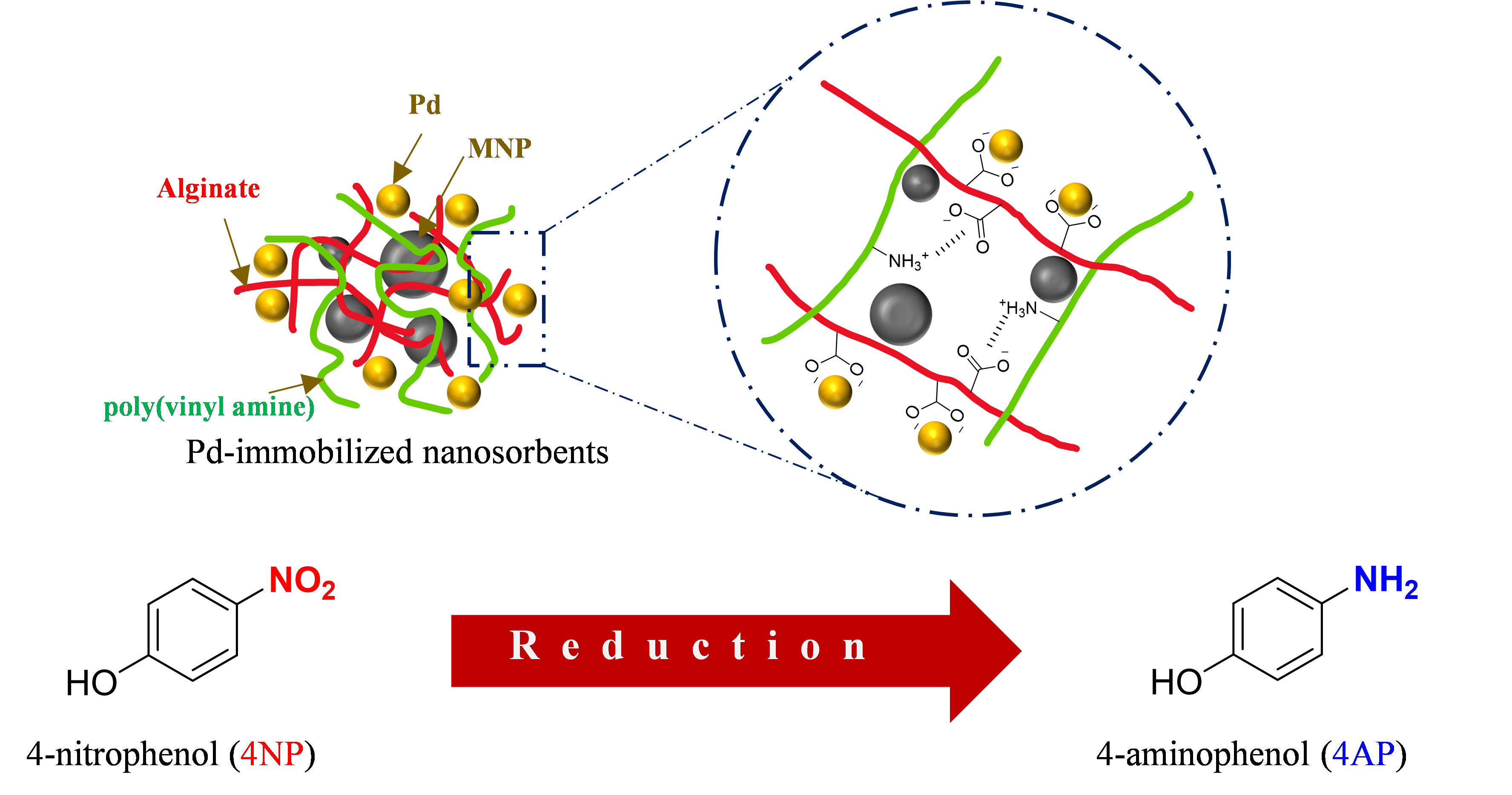
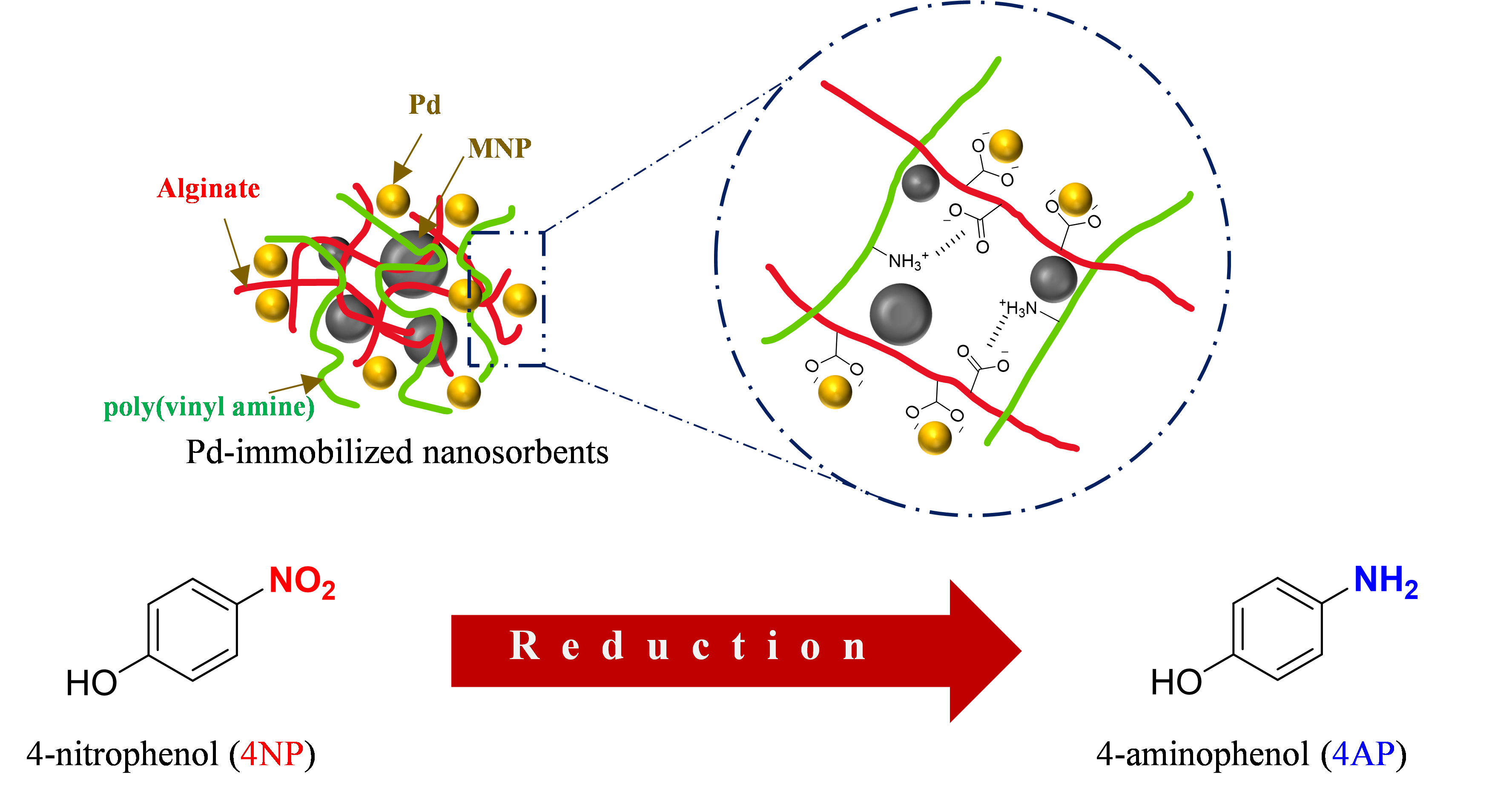
This work presents the synthesis of alginate-coated magnetite nanoparticle (MNP) containing amino-enriched moieties for the immobilization of palladium (Pd), and its use as a recyclable catalyst for the reduction of 4-nitrophenol (4NP) in water. The alginate grafted onto the surface of MNP contained carboxylate anions that served as coordination sites for Pd. Additionally, the incorporation of amino-enriched components, such as poly(vinyl amine) (PVAm) and 2-(dimethyl amino)ethyl methacrylate (DMAEMA), onto the alginate-coated MNPs resulted in additional interactions, including the formation of carboxylate-ammonium salts. In this study, the influence of these amino groups on the efficiency of Pd immobilization, catalytic activity and reusability of nanosorbents for 4NP reduction was investigated. The existence of Pd in the nanosorbents was detected by inductively coupled plasma atomic emission spectroscopy, transmission electron microscopy, and energy-dispersive X-ray techniques. The average size of MNPs was approximately 12.3 ± 2.9 nm, and for Pd, it was about 3.9 ± 0.8 nm. It was found that the incorporation of these amino-enriched moieties into the particles significantly enhanced the catalytic activity of the nanosorbents. Notably, MNP containing extended DMAEMA units exhibited excellent tolerance to 4NP reduction, with an insignificant loss of catalytic performance even after 20 consecutive reuses, maintaining a conversion of over 98 %.
HIGHLIGHTS
- Synthesis of alginate-based magnetite nanoparticle for the immobilization of Pd and its use as a catalyst for the reduction of 4-nitrophenol in water were presented
- The carboxylate groups in alginate provided the coordinating sites for Pd immobilization and improved the particle dispersibility in water
- The incorporation of amino-enriched components to the particle reduced the degree of Pd aggregation on the particle surface
- The catalysts had high catalytic performance for the reduction of 4-nitrophenol in water and exhibited highly robust properties with excellent reusability for up to 20 cycles with insignificant changes in their performance
GRAPHICAL ABSTRACT
Downloads
References
A Salamatmanesh, A Heydari and HT Nahzomi. Stabilizing Pd on magnetic phosphine-functionalized cellulose: DFT study and catalytic performance under deep eutectic solvent assisted conditions. Carbohydr. Polymer. 2020; 235, 115947.
M Ma, Y Yang, D Liao, P Lyu, J Zhang, J Liang and L Zhang. Synthesis, characterization and catalytic performance of core‐shell structure magnetic Fe3O4/P (GMA‐EGDMA)‐NH2/HPG‐COOH‐Pd catalyst. Appl. Organomet. Chem. 2019; 33, e4708.
M Xia, SM Kang, GW Lee, YS Huh and BJ Park. The recyclability of alginate hydrogel particles used as a palladium catalyst support. J. Ind. Eng. Chem. 2019; 73, 306-15.
H Veisi, T Ozturk, B Karmakar, T Tamoradi and S Hemmati. In situ decorated Pd NPs on chitosan-encapsulated Fe3O4/SiO2-NH2 as magnetic catalyst in Suzuki-Miyaura coupling and 4-nitrophenol reduction. Carbohydr. Polymer. 2020; 235, 115966.
T Baran and M Nasrollahzadeh. Facile synthesis of palladium nanoparticles immobilized on magnetic biodegradable microcapsules used as effective and recyclable catalyst in Suzuki-Miyaura reaction and p-nitrophenol reduction. Carbohydr. Polymer. 2019; 222, 115029.
TD Nguyen, TT Vo, CH Nguyen, VD Doan and CH Dang. Biogenic palladium nanoclusters supported on hybrid nanocomposite 2-hydroxypropyl-β-cyclodextrin/alginate as a recyclable catalyst in aqueous medium. J. Mol. Liq. 2019; 276, 927-35.
S Sadjadi, G Lazzara, MM Heravi and G Cavallaro. Pd supported on magnetic carbon coated halloysite as hydrogenation catalyst: Study of the contribution of carbon layer and magnetization to the catalytic activity. Appl. Clay Sci. 2019; 182, 105299.
HMA Hakkeem, A Babu, N Shilpa, AA Venugopal, AP Mohamed, S Kurungot and S Pillai. Tailored synthesis of ultra-stable Au@Pd nanoflowers with enhanced catalytic properties using cellulose nanocrystals. Carbohydr. Polymer. 2022; 292, 119723.
S Uruş. Synthesis of Fe3O4@SiO2@OSi(CH2)3NHRN(CH2PPh2)2PdCl2 type nanocomposite complexes: Highly efficient and magnetically-recoverable catalysts in vitamin K3 synthesis. Food Chem. 2016; 213, 336-43.
H Sun, G Wang, J Ge, N Wei, W Sui, Z Chen, H Jia, AM Parvez and C Si. Reduction of lignin heterogeneity for improved catalytic performance of lignin nanosphere supported Pd nanoparticles. Ind. Crops Prod. 2022; 180, 114685.
A Sangili, M Annalakshmi, SM Chen, P Balasubramanian and M Sundrarajan. Synthesis of silver nanoparticles decorated on core-shell structured tannic acid-coated iron oxide nanospheres for excellent electrochemical detection and efficient catalytic reduction of hazardous 4-nitrophenol. Compos. Part B Eng. 2019; 162, 33-42.
M Dinari and F Dadkhah. Swift reduction of 4-nitrophenol by easy recoverable magnetite-Ag/layered double hydroxide/starch bionanocomposite. Carbohydr. Polymer. 2020; 228, 115392.
U Mahanitipong and M Rutnakornpituk. Palladium‐immobilized polymer‐coated magnetic nanocomposites as reusable catalysts for the reduction of 4‐nitrophenol. Polymer Int. 2022; 71, 1119-26.
R Sahraei, T Shahalizade, M Ghaemy and H Mahdavi. Fabrication of cellulose acetate/Fe3O4@GO-APTS-poly(AMPS-co-MA) mixed matrix membrane and its evaluation on anionic dyes removal. Cellulose 2018; 25, 3519-32.
N Deepuppha, A Thongsaw, B Rutnakornpituk, WC Chaiyasith and M Rutnakornpituk. Alginate-based magnetic nanosorbent immobilized with aptamer for selective and high adsorption of Hg2+ in water samples. Environ. Sci. Pollut. Res. 2020; 27, 12030-8.
R Sahraei, ZS Pour and M Ghaemy. Novel magnetic bio-sorbent hydrogel beads based on modified gum tragacanth/graphene oxide: Removal of heavy metals and dyes from water. J. Cleaner Prod. 2017; 142, 2973-84.
S Meerod, N Deepuppha, B Rutnakornpituk and M Rutnakornpituk. Reusable magnetic nanocluster coated with poly(acrylic acid) and its adsorption with an antibody and an antigen. J. Appl. Polymer Sci. 2018; 135, 46160.
U Mahanitipong and M Rutnakornpituk. Palladium‐immobilized polymer‐coated magnetic nanocomposites as reusable catalysts for the reduction of 4‐nitrophenol. Polymer Int. 2022; 71, 1119-26.
S Paenkaew, T Kajornprai and M Rutnakornpituk. Water dispersible magnetite nanocluster coated with thermo‐responsive thiolactone‐containing copolymer. Polymer. Adv. Tech. 2020; 31, 1349-55.
T Theppaleak, G Tumcharern, U Wichai and M Rutnakornpituk. Synthesis of water dispersible magnetite nanoparticles in the presence of hydrophilic polymers. Polymer Bull. 2009; 63, 79-90.
P Theamdee, R Traiphol, B Rutnakornpituk, U Wichai and M Rutnakornpituk. Surface modification of magnetite nanoparticle with azobenzene-containing water dispersible polymer. J. Nanopart. Res. 2011; 13, 4463-77.
B Rutnakornpituk, U Wichai, T Vilaivan and M Rutnakornpituk. Surface-initiated atom transfer radical polymerization of poly(4-vinylpyridine) from magnetite nanoparticle. J. Nanopart. Res. 2011; 13, 6847-57.
J Tummachote, M Rutnakornpituk, D Channei, F Kielar and B Rutnalornpituk. Amino-containing polymer-coated magnetite nanoparticles as nano-adsorbents for bisphenol A: Synthesis, kinetic and thermodynamic study. J. Met. Mater. Miner. 2022; 32, 11-23.
N Deepuppha, A Kadnaim, B Rutnakornpituk and M Rutnakornpitak. Poly(ester urethane)-crosslinked carboxymethylchitosan as a highly water swollen hydrogel. J. Met. Mater. Miner. 2020; 30, 48-56.
R Sahraei, K Hemmati and M Ghaemy. Adsorptive removal of toxic metals and cationic dyes by magnetic adsorbent based on functionalized graphene oxide from water. RSC Adv. 2016; 6, 72487-99.
B Liu, T Wang, C Yin and Z Wei. Electrochemical analysis of p-nitrophenol in acidic or alkaline medium using silver nanoparticle decorated multi-walled carbon nanotubes. J. Mater. Sci. 2014; 49, 5398-405.
NI Ikhsan, P Rameshkumar and NM Huang. Controlled synthesis of reduced graphene oxide supported silver nanoparticles for selective and sensitive electrochemical detection of 4-nitrophenol. Electrochim. Acta 2016; 192, 392-9.
L Liu, R Chen, W Liu, J Wu and D Gao. Catalytic reduction of 4-nitrophenol over Ni-Pd nanodimers supported on nitrogen-doped reduced graphene oxide. J. Hazard. Mater. 2016; 320, 96-104.
AK Abay, X Chen and DH Kuo. Highly efficient noble metal free copper nickel oxysulfide nanoparticles for catalytic reduction of 4-nitrophenol, methyl blue, and rhodamine-B organic pollutants. New J. Chem. 2017; 41, 5628-38.
X Yang, H Zhong, Y Zhu, H Jiang, J Shen, J Huang and C Li. Highly efficient reusable catalyst based on silicon nanowire arrays decorated with copper nanoparticles. J. Mater. Chem. 2014; 2, 9040-7.
Z Jin, C Liu, K Qi and X Cui. Photo-reduced Cu/CuO nanoclusters on TiO2 nanotube arrays as highly efficient and reusable catalyst. Sci. Rep. 2017; 7, 39695.
S Khadsai, N Seeja, N Deepuppha, M Rutnakornpituk, T Vilaivan, M Nakkuntod and B Rutnakornpituk. Poly (acrylic acid)-grafted magnetite nanoparticle conjugated with pyrrolidinyl peptide nucleic acid for specific adsorption with real DNA. Colloid. Surface. B Biointerface. 2018; 165, 243-51.
G Wang, K Lv, T Chen, Z Chen and J Hu. Immobilizing of palladium on melamine functionalized magnetic chitosan beads: A versatile catalyst for p-nitrophenol reduction and Suzuki reaction in aqueous medium. Int. J. Biol. Macromol. 2021; 184, 358-68.
KJ Sreeram, M Nidhin and BU Nair. Synthesis of aligned hematite nanoparticles on chitosan-alginate films. Colloid. Surface. B Bioinerface. 2009; 71, 260-7.
GA Kloster, D Muraca, OM Londono, KR Pirota, MA Mosiewicki and NE Marcovich. Alginate based nanocomposites with magnetic properties. Compos. Part A Appl. Sci. Manuf. 2020; 135, 105936.
SH Sadr, S Davaran, E Alizadeh, R Salehi and A Ramazani. PLA-based magnetic nanoparticles armed with thermo/pH responsive polymers for combination cancer chemotherapy. J. Drug Deliv. Sci. Tech. 2018; 45, 240-54.
VH Nguyen, Y Haldorai, QL Pham and JJ Shim. Supercritical fluid mediated synthesis of poly (2-hydroxyethyl methacrylate)/Fe3O4 hybrid nanocomposite. Mater. Sci. Eng. B 2011; 176, 773-8.
M Hassanzadeh and M Ghaemy. Preparation of bio‐based keratin‐derived magnetic molecularly imprinted polymer nanoparticles for the facile and selective separation of bisphenol A from water. J. Separ. Sci. 2018; 41, 2296-304.
N Deepuppha, A Thongsaw, B Rutnakornpituk, WC Chaiyasith and M Rutnakornpituk. Alginate-based magnetic nanosorbent immobilized with aptamer for selective and high adsorption of Hg2+ in water samples. Environ. Sci. Pollut. Res. 2020; 27, 12030-8.
P Jiang, G Li, L Lv, H Ji, Z Li, S Chen and S Chu. Effect of DMAEMA content and polymerization mode on morphologies and properties of pH and temperature double-sensitive cellulose-based hydrogels. J. Macromol. Sci. A 2020; 57, 207-16.
A Hernández-Martínez and E Bucio. Novel pH-and temperature-sensitive behavior of binary graft DMAEMA/PEGMEMA onto LDPE membranes. Des. Monomer. Polymer. 2009; 12, 543-52.
T Yamashita and P Hayes. Analysis of XPS spectra of Fe2+ and Fe3+ ions in oxide materials. Appl. Surface Sci. 2008; 254, 2441-9.
Downloads
Published
How to Cite
Issue
Section
License
Copyright (c) 2023 Walailak University

This work is licensed under a Creative Commons Attribution-NonCommercial-NoDerivatives 4.0 International License.





