
Reusable and Robust Pd Catalysts Immobilized on Amino-Functionalized Magnetite Nanocomposites for Efficient Reduction Reactions
DOI:
https://doi.org/10.48048/tis.2026.12956Keywords:
Magnetite, Nanoparticle, Palladium, Carboxymethyl chitosan, Reduction, Magnetite, Nanoparticle, Palladium, Reduction, Carboxymethyl chitosanAbstract
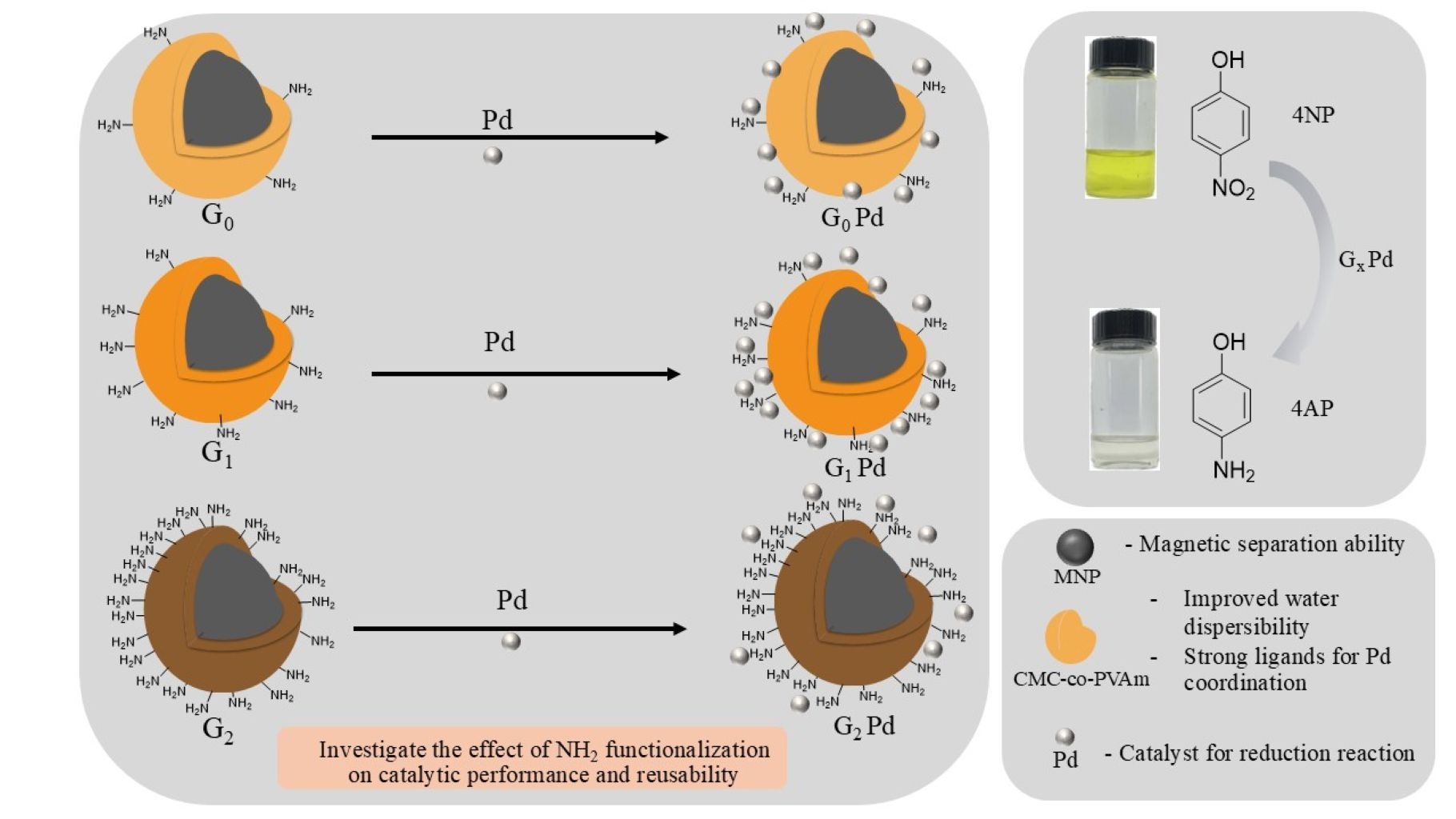
Magnetite nanoparticles (MNPs) coated with carboxymethyl chitosan (CMC) and amino-rich polymers were synthesized for the immobilization of Pd and employed as reusable catalysts for the reduction of 4-nitrophenol (4NP). The CMC coating enhanced the water dispersibility of the catalysts, while the amino-rich polymer provided abundant amino functional groups that served as strong ligands for Pd nanoparticle coordination. The catalysts were thoroughly characterized using photon correlation spectroscopy (PCS), Fourier-transform infrared spectroscopy (FTIR), and inductively coupled plasma optical emission spectroscopy (ICP-OES), confirming the successful formation of MNPs coated with CMC-grafted amino-rich polymer as a support for Pd nanoparticles. ICP-OES analysis revealed Pd loadings between 3.82 and 6.84 wt%, and energy-dispersive X-ray spectroscopy (EDS) further verified the presence of Pd on the catalyst surface. PCS results indicated that the Pd-coated MNPs carried a negative surface charge. The synthesized catalysts were easily recovered and separated from solution using an external magnet and demonstrated excellent catalytic activity in the reduction of 4NP. Among them, the first- and second-generation Pd-loaded catalysts (G1Pd and G2Pd) exhibited outstanding catalytic performance and could be efficiently reused for up to 11 cycles without significant loss of activity.
HIGHLIGHTS
- Synthesis of carboxymethyl chitosan-coated magnetite nanoparticles for the immobilization of Pd and its use as a catalyst for the reduction of 4-nitrophenol in water were presented.
- The carboxylate groups in carboxymethyl chitosan provided the coordinating sites for Pd immobilization and improved the particle dispersibility in water.
- The incorporation of amino-enriched components to the particle reduced the degree of Pd aggregation on the particle surface.
- The catalysts had high catalytic performance for the reduction of 4-nitrophenol in water and exhibited highly robust properties with excellent reusability for up to 11 cycles with insignificant changes in their performance.
GRAPHICAL ABSTRACT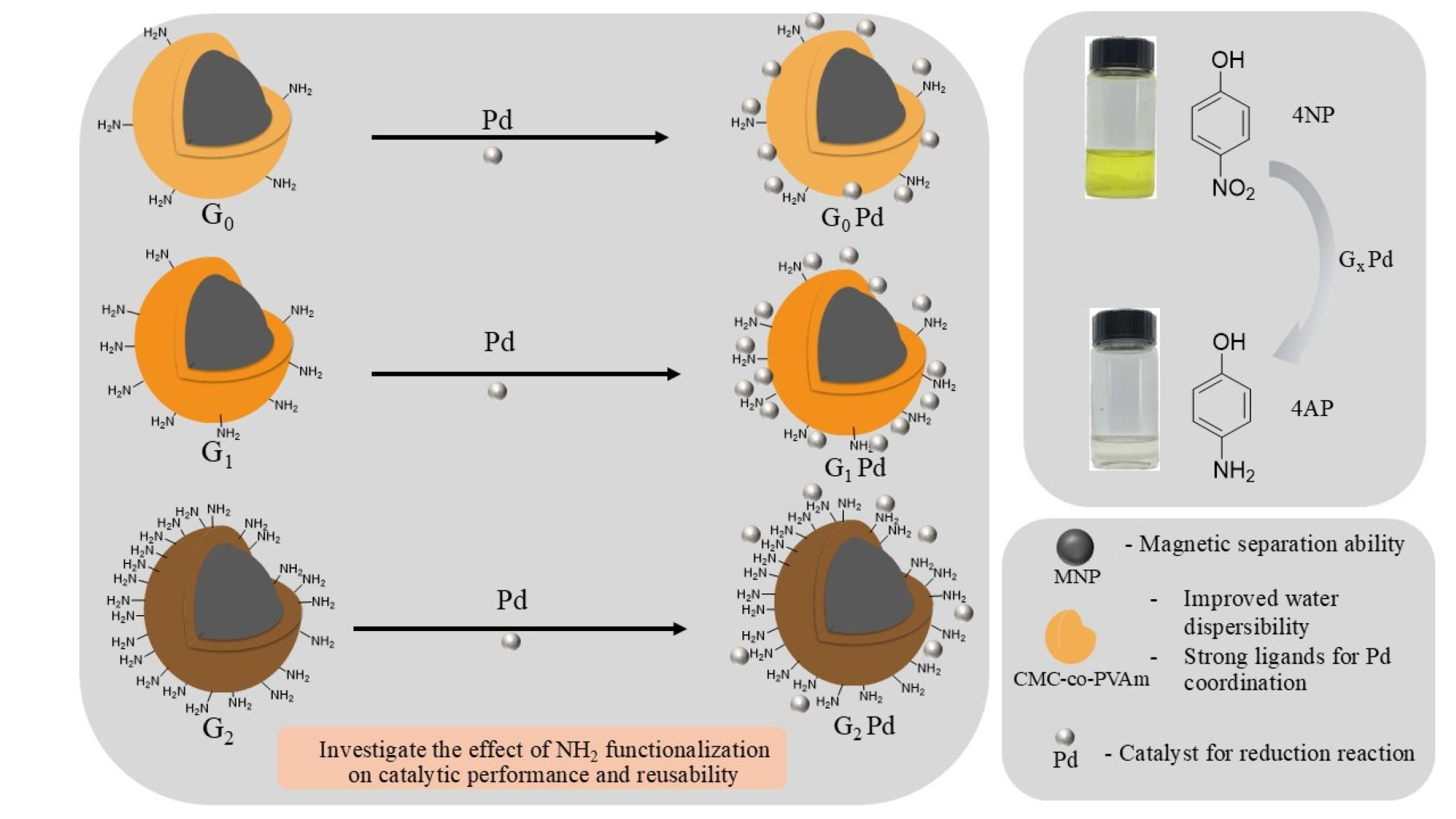
Downloads
References
W Xiao, X Jiang, X Liu, W Zhou, ZN Garba, I Lawan, L Wang and Z Yuan. Adsorption of organic dyes from wastewater by metal-doped porous carbon materials. Journal of Cleaner Production 2021; 284, 124773.
H Park, DA Reddy, Y Kim, S Lee, R Ma, M Lim and TK Kim. Hydrogenation of 4-nitrophenol to 4-aminophenol at room temperature: Boosting palladium nanocrystals efficiency by coupling with copper via liquid phase pulsed laser ablation. Applied Surface Science 2017; 401, 314-322.
N Ivanova, V Karastoyanov, I Betova and M Bojinov. Interaction of ethanolamine with magnetite through molecular dynamic simulations. Molecules 2025; 30(15), 3197.
M Gopiraman, S Saravanamoorthy, S Ullah, A Ilangovan, IS Kim and IM Chung. Reducing-agent-free facile preparation of Rh-nanoparticles uniformly anchored on onion-like fullerene for catalytic applications. RSC Advances 2020; 10(5), 2545-2559.
C Xu, Y Qiu, X Yang, Z Gao, Z Wang, C Liu, Y Sun, J Ma and L Liu. High-performance catalytic reduction of 4-nitrophenol to 4-aminophenol over pt nanoparticles supported on Co-Al LDH nanosheets. Crystals 2024; 14(3), 284.
CS Chen, TC Chen, KL Chiu, HC Wu, CW Pao, CL Chen, HC Hsu and HM Kao. Silver particles deposited onto magnetic carbon nanofibers as highly active catalysts for 4-nitrophenol reduction. Applied Catalysis B: Environmental 2022; 315, 121596.
HSHM Ali and SA Khan. Stabilization of various zero-valent metal nanoparticles on a superabsorbent polymer for the removal of dyes, nitrophenol, and pathogenic bacteria. ACS omega 2020; 5(13), 7379-7391.
NM Umesh, TW Chen, SM Chen, KK rani, R Devasenathipathy and SF Wang. Phosphate-mediated silver nanodentrites modified glassy carbon electrode for the determination of nitrophenol. International Journal of Electrochemical Science 2018; 13(5), 4946-4955.
P Zhao, X Feng, D Huang, G Yang and D Astruc. Basic concepts and recent advances in nitrophenol reduction by gold- and other transition metal nanoparticles. Coordination Chemistry Reviews 2015; 287, 114-136.
H Veisi, T Ozturk, B Karmakar, T Tamoradi and S Hemmati. RETRACTED: In situ decorated Pd NPs on chitosan-encapsulated Fe3O4/SiO2-NH2 as magnetic catalyst in Suzuki-Miyaura coupling and 4-nitrophenol reduction. Carbohydrate Polymers 2020; 235, 115966.
Y Huang, Y Kang, A El-Kott, AE Ahmed, A Khames and MA Zein. Decorated Cu NPs on Lignin coated magnetic nanoparticles: Its performance in the reduction of nitroarenes and investigation of its anticancer activity in A549 lung cancer cells. Arabian Journal of Chemistry 2021; 14, 103299.
U Mahanitipong, S Chanthip and M Rutnakornpituk. Carboxymethyl chitosan-magnetite nanocomposites immobilized with Pd as reusable catalysts for the reduction of 4-nitrophenol and methylene blue. Journal of Inorganic and Organometallic Polymers and Materials 2023; 33, 1716-1728.
U Mahanitipong and M Rutnakornpituk. Palladium-immobilized polymer-coated magnetic nanocomposites as reusable catalysts for the reduction of 4-nitrophenol. Polymer International 2022; 71(9), 1119-1126.
CZS Akdogan, B Gokcal, M Polat, KO Hamaloglu, C Kip and A Tuncel. Porous, oxygen vacancy enhanced CeO2–x microspheres with efficient enzyme-mimetic and photothermal properties. ACS Sustainable Chemistry & Engineering 2022; 10(29), 9492-9505.
X Yang, X Jiang, MS Bashir and XZ Kong. Preparation of highly uniform polyurethane microspheres by precipitation polymerization and Pd immobilization on their surface and their catalytic activity in 4-nitrophenol reduction and dye degradation. Industrial & Engineering Chemistry Research 2020; 59(7), 2998-3007.
L You, Y Mao and J Ge. Synthesis of stable SiO2@Au-Nanoring colloids as recyclable catalysts: Galvanic replacement taking place on the surface. Journal of Physical Chemistry C 2012; 116(19), 10753-10759.
MH Qi, ML Gao, L Liu and ZB Han. Robust bifunctional Core-shell MOF@POP catalyst for one-pot tandem reaction. Inorganic Chemistry 2018; 57(23), 14467-14470.
OA Attallah, MA Al-Ghobashy, M Nebsen and MY Salem. Removal of cationic and anionic dyes from aqueous solution with magnetite/pectin and magnetite/silica/pectin hybrid nanocomposites: Kinetic, isotherm and mechanism analysis. RSC Advances 2016; 6(14), 11461-11480.
N Rodkate and M Rutnakornpituk. Multi-responsive magnetic microsphere of poly(N-isopropylacrylamide)/carboxymethylchitosan hydrogel for drug controlled release. Carbohydrate Polymers 2016; 151, 251-259.
N Amirmahani, NO Mahmoodi, M Malakootian, A Pardakhty and N Seyedi. Introduction of PdCl2 supported on tartaric acid modified magnetite nanoparticles (Fe3O4@ TA-Pd) as a novel catalytic system in Suzuki-Miyaura coupling reaction. Materials Chemistry and Physics 2021; 267, 124698.
A Maleki, R Taheri-Ledari and R Ghalavand. Design and fabrication of a magnetite-based polymer-supported hybrid nanocomposite: A promising heterogeneous catalytic system utilized in known palladium-assisted coupling reactions. Combinatorial Chemistry & High Throughput Screening 2020; 23(2), 119-125.
J Rahimi, M Naderi, M Ijdani, M Heidari, M Azizi and A Maleki. Magnetite Pd-loaded nitrogen-rich porous organic polymer as a catalyst for Suzuki-Miyaura coupling reaction. Materials Today Chemistry 2023; 28, 101375.
P Theamdee, B Rutnakornpituk, U Wichai, M Nakkuntod and M Rutnakornpituk. Recyclable silver-magnetite nanocomposite for antibacterial application. Journal of Industrial and Engineering Chemistry 2015; 29, 63-70.
S Paenkaew, U Mahanitipong, M Rutnakornpituk and O Reiser. Magnetite nanoparticles functionalized with thermoresponsive polymers as a palladium support for olefin and nitroarene hydrogenation. ACS Omega 2023; 8(16), 14531-14540.
N Shaikh and P Pamidimukkala. Magnetic chitosan stabilized palladium nanostructures: Potential catalysts for aqueous Suzuki coupling reactions. International Journal of Biological Macromolecules 2021; 183, 1560-1573.
T Baran and M Nasrollahzadeh. Facile synthesis of palladium nanoparticles immobilized on magnetic biodegradable microcapsules used as effective and recyclable catalyst in Suzuki-Miyaura reaction and p-nitrophenol reduction. Carbohydrate Polymers 2019; 222, 115029.
TVJ Charpentier, A Neville, JL Lanigan, R Barker, MJ Smith and T Richardson. Preparation of magnetic carboxymethylchitosan nanoparticles for adsorption of heavy metal ions. ACS Omega 2016; 1(1), 77-83.
MH Jin, JH Park, D Oh, JS Park, KY Lee and DW Lee. Effect of the amine group content on catalytic activity and stability of mesoporous silica supported Pd catalysts for additive-free formic acid dehydrogenation at room temperature. International Journal of Hydrogen Energy 2019; 44(10), 4737-4744.
E Ye, F Lin, C Fu, X Zhou, Q Lin, H Pan and Z Chen. Enhancing Pd catalytic activity by amine group modification for efficient direct synthesis of H2O2. ACS Applied Materials & Interfaces 2024; 16(21), 27490-27503.
A Mokkarat, R Wanchanthuek, W Radchatawedchakoon, S Kruanetr and U Sakee. High catalytic activity and kinetic efficiency of Pd-Loaded amino-functionalized silica-coated magnetite nanoparticles for nitroarene hydrogenation. ACS Omega 2025; 10(36), 41756-41768.
S Liu, MX Guo, F Shao, YH Peng and SW Bian. Water-dispersible and magnetically recoverable Fe3O4/Pd@nitrogen-doped carbon composite catalysts for the catalytic reduction of 4-nitrophenol. RSC Advances 2016; 6(80), 76128-76131.
U Mahanitipong, J Tummachote, W Thoopbucha, W Inthanusorn and M Rutnakornpituk. Anionic polymer-coated magnetic nanocomposites for immobilization with palladium nanoparticles as catalysts for the reduction of 4-nitrophenol. Discover Nano 2023; 18, 138.
Y Yang and R Tang. Magnetically recyclable Pd/Fe3O4/g-C3N4 as efficient catalyst for the reduction of nitrophenol and Suzuki-Miyaura reaction at room temperature. Chemistry Letters 2018; 47(4), 544-547.
T Theppaleak, B Rutnakornpituk, U Wichai, T Vilaivan and M Rutnakornpituk. Magnetite nanoparticle with positively charged surface for immobilization of peptide nucleic acid and deoxyribonucleic acid. Journal of Biomedical Nanotechnology 2013; 9(9), 1509-1520.
B Rutnakornpituk, U Wichai, T Vilaivan and M Rutnakornpituk. Surface-initiated atom transfer radical polymerization of poly (4-vinylpyridine) from magnetite nanoparticle. Journal of Nanoparticle Research 2011; 13, 6847-6857.
T Theppaleak, G Tumcharern, U Wichai and M Rutnakornpituk. Synthesis of water dispersible magnetite nanoparticles in the presence of hydrophilic polymers. Polymer Bulletin 2009; 63, 79-90.
B Thong-On, B Rutnakornpituk, U Wichai and M Rutnakornpituk. Magnetite nanoparticle coated with amphiphilic bilayer surfactant of polysiloxane and poly (poly (ethylene glycol) methacrylate). Journal of Nanoparticle Research 2012; 14, 953.
S Meerod, B Rutnakornpituk, U Wichai and M Rutnakornpituk. Hydrophilic magnetic nanoclusters with thermo-responsive properties and their drug controlled release. Journal of Magnetism and Magnetic Materials 2015; 392, 83-90.
J Tummachote, U Mahanitipong, W Inthanusorn, B Rutnakornpituk and M Rutnakornpituk. Highly robust alginate-based magnetic nanosorbents of Pd catalysts for the 4-nitrophenol reduction. Trends in Sciences 2024; 21(4), 7465.
W Inthanusorn, J Tummachote, N Jangpon and M Rutnakornpituk. Cu-immobilized cellulose filter paper: Effect of polymer structure and functionality on catalytic activity and reusability for 4-nitrophenol reduction. Polymer-Plastics Technology and Materials 2024; 63(9), 1083-1095.
U Mahanitipong and M Rutnakornpituk. Palladium‐immobilized polymer‐coated magnetic nanocomposites as reusable catalysts for the reduction of 4‐nitrophenol. Polymer International 2022; 71(9), 1119-1126.
Y Zhu, WD Wang, X Sun, M Fan, X Hu and Z Dong. Palladium nanoclusters confined in MOF@ COP as a novel nanoreactor for catalytic hydrogenation. ACS Applied Materials & Interfaces 2020; 12(6), 7285-7294.
Y Luo and R Su. Preparation of NH2-MIL-101(Fe) metal organic framework and its performance in adsorbing and removing tetracycline. International Journal of Molecular Sciences 2024; 25(18), 9855.
S Nandi, P Patel, A Jakhar, NH Khan, AV Biradar, RI Kureshy and HC Bajaj. Cucurbit[6]uril‐Stabilized palladium nanoparticles as a highly active catalyst for chemoselective hydrogenation of various reducible groups in aqueous media. ChemistrySelect 2017; 2(31), 9911-9919.
T Liu, Z Cui, Y Liu and X Bai. In-situ fabrication of ultrafine Pd supported on nitrogen-doped reduced graphene oxide via nitrogen glow discharge plasma for catalytic reduction of 4-nitrophenol. Applied Catalysis A: General 2019; 588, 117278.
Z Han, L Dong, J Zhang, T Cui, S Chen, G Ma, X Guo and L Wang. Green synthesis of palladium nanoparticles using lentinan for catalytic activity and biological applications. RSC Advances 2019; 9(65), 38265-38270.
K Mallikarjuna, LV Reddy, S Al-Rasheed, A Mohammed, S Gedi and WK Kim. Green synthesis of reduced graphene oxide-supported palladium nanoparticles by Coleus amboinicus and its enhanced catalytic efficiency and antibacterial activity. Crystals 2021; 11(2), 134.
Published
How to Cite
Issue
Section
License
Copyright (c) 2026 Walailak University

This work is licensed under a Creative Commons Attribution-NonCommercial-NoDerivatives 4.0 International License.





