Impact of Dadih Administration on Clinical Features, Histopathology, DNA Oxidative Damage, and Collagen Density in an Aging Rattus norvegicus Rat Model
DOI:
https://doi.org/10.48048/tis.2027.14354Keywords:
Dadih, DNA, Histopathology, Collagen, Aging, ROS, SkinAbstract
Skin aging is among the most evident manifestations of the overall aging process which is linked to the development of numerous dermatological conditions. One of principal mechanisms underlying aging is oxidative stress. Increasing evidence suggests that dadih contains beneficial probiotic microorganisms, which can help attenuate free radical and enhance endogenous antioxidant capacity. This study was conducted to assess the impact of oral dadih supplementation on clinical appearance, skin histological structure, DNA integrity, and collagen density in a rat model experiencing the aging process. In this experimental study, thirty female Wistar rats were divided into 5 groups randomly, including a normal group, a control group, and 3 intervention groups receiving different treatment regimens. The aging condition was established through intraperitoneal administration of D-galactose at a dose of 150 mg/kg body weight for 8 weeks. Oral administration of dadih commenced 2 weeks prior to the induction phase at doses of 10 g/kg body weight once daily, 7.5 g/kg body weight twice daily, and 10 g/kg body weight twice daily. Evaluation of the anti-aging effects of dadih was conducted using observation of fur condition as a clinical indicator, quantification of oxidative DNA damage through measurement of 8-hydroxy-2'-deoxyguanosine (8-OHdG) concentrations using the ELISA technique, microscopic examination of skin tissue stained with hematoxylin and eosin and determination of collagen density using Sirius Red staining. The findings revealed that administration of dadih improved the external appearance of the animals, characterized by smoother and thicker fur. Histological assessment further demonstrated enhanced epidermal thickness, decreased flattening of rete ridges, and increased compactness of collagen fibers when compared with the untreated control group. Rats receiving dadih exhibited reduced levels of 8-OHdG and significantly greater collagen density. Among the treatment protocols evaluated, the regimen of 7.5 g/kg body weight administered twice daily produced the most pronounced protective effects.
HIGHLIGHTS
- This study evaluated the effects of dadih administration on skin aging using multiple aging indicators.
- Dadih improved the clinical appearance of rat fur, resulting in a smoother and thicker texture.
- Histopathological findings showed increased epidermal thickness, reduced rete ridge flattening, and denser collagen fibers.
- Dadih administration provided protection against DNA damage in the body.
- Dadih administration exhibited enhanced collagen density in the skin.
GRAPHICAL ABSTRACT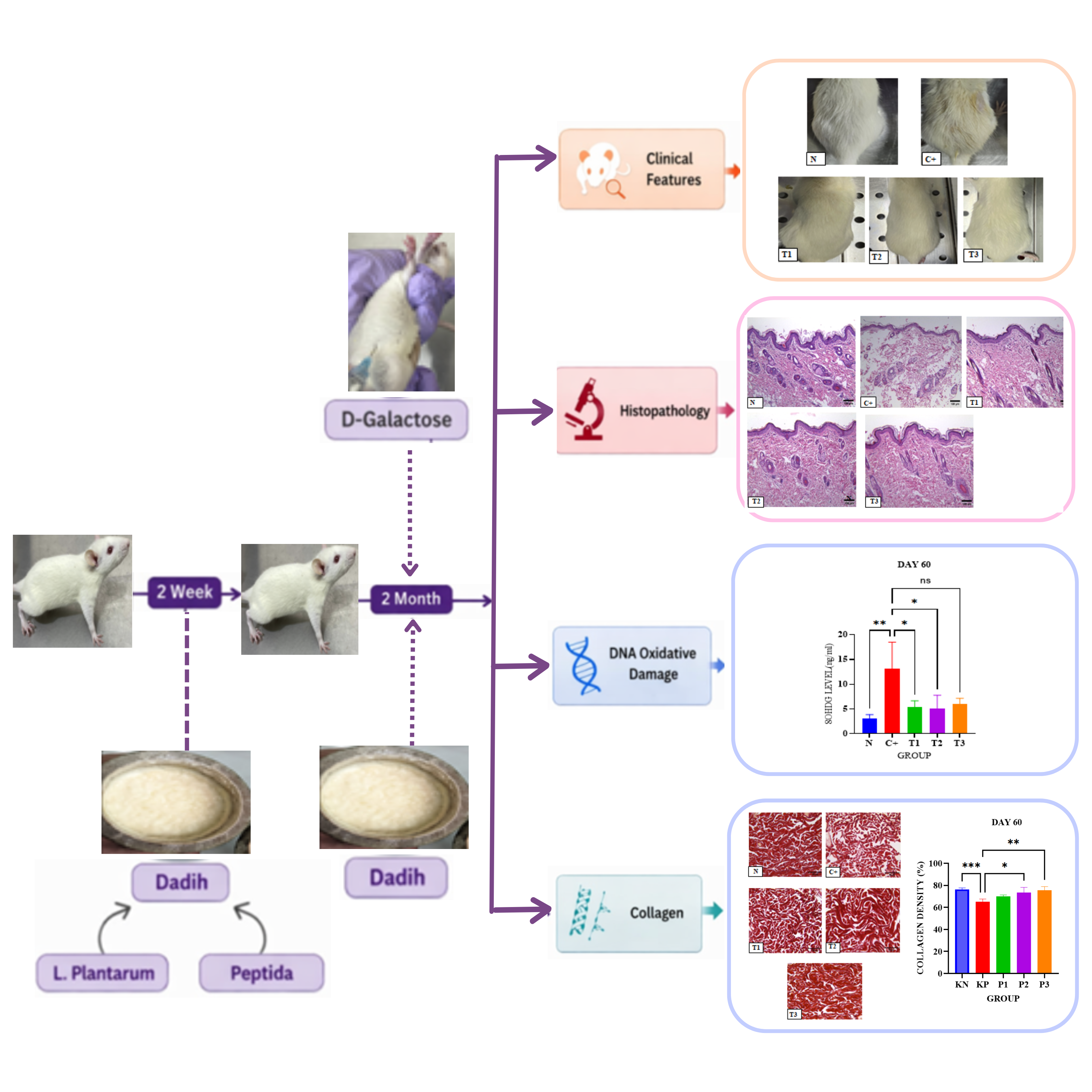
Downloads
References
J Brocklehurst. Ageing and health. In: D Hobman (Ed.). The social challenge of ageing. Routledge, London, 2024, p. 149-171.
APL Girsang, R Sulistyowati, NP Sulistyowati, FWR Dewi, SW Nugroho, KD Ramadani and H Wilson. Statistik penduduk lanjut usia 2022 (in Indonesian). Badan Pusat Statistik, Jakarta, Indonesia, 2022.
V Assis, IV de Sousa Neto, FM Ribeiro, R de Cassia Marqueti, OL Franco, S da Silva Aguiar and B Petriz. The emerging role of the aging process and exercise training on the crosstalk between gut microbiota and telomere length. International Journal of Environmental Research and Public Health 2022; 19(13), 7810.
SD Zeppa, D Agostini, F Ferrini, M Gervasi, E Barbieri, A Bartolacci, G Piccoli, R Saltarelli, P Sestili and V Stocchi. Interventions on gut microbiota for healthy aging. Cells 2022; 12(1), 34.
X Zhou, HH Du, L Ni, J Ran, J Hu, J Yu and X Zhao. Nicotinamide mononucleotide combined with Lactobacillus fermentum TKSN041 reduces the photoaging damage in murine skin by activating AMPK signaling pathway. Frontiers in Pharmacology 2021; 12, 1-17.
T Nanzadsuren, T Myatav, A Dorjkhuu, M Ganbat, C Batbold, B Batsuuri and K Byamba. Skin aging risk factors: A nationwide population study in Mongolia risk factors of skin aging. Plos One 2022; 17(1), e0249506.
M Kandwal. Health research in the state of Odisha, India: A decadal bibliometric analysis (2011‑2020). Journal of Family Medicine and Primary Care 2022; 6(2), 169-170.
C Li, Y Fan, S Li, X Zhou, KY Park, X Zhao and H Liu. Antioxidant effect of soymilk fermented by Lactobacillus plantarum HFY01 on D-galactose-induced premature aging mouse model. Frontiers in Nutrition 2021; 8, 667643.
N Gupta, NSA El-Gawaad, LO Mallasiy, H Gupta, VK Yadav, S Alghamdi and NF Qusty. Microbial dysbiosis and the aging process: A review on the potential age-deceleration role of Lactiplantibacillus plantarum. Frontiers in Microbiology 2024; 15, 1260793.
SN Yusharyahya. Mekanisme penuaan kulit sebagai dasar pencegahan dan pengobatan kulit menua (in Indonesian). eJournal Kedokteran Indonesia 2021; 9(2), 150.
AH Safitri, RA Sayyida, S Setyawan and N Tyagita. Effects of porang glucomannan combined with a high-protein diet on oxidative stress, inflammation, and aging markers in D-galactose-induced rats. Narra J 2025; 5(1), e1995.
AE Gunes, O Yılmaz, C Erbas, SN Dagli and H Celik. High serum 8-hydroxy-2'-deoxyguanosine levels predict DNA damage and aging in professional divers. Revista da Associação Médica Brasileira 2021; 67(11), 1701-1705.
X Guo, H Cui, H Zhang, X Guan, Z Zhang, C Jia, J Wu, H Yang, W Qiu, C Zhang, Z Yang, Z Chen and G Mao. Protective effect of folic acid on oxidative DNA damage. Medicine 2015; 94(45), e1872.
J Kaźmierczak-Barańska, K Boguszewska and BT Karwowski. Nutrition can help DNA repair in the case of aging. Nutrients 2020; 12(11), 3364.
DN Kumalasari and D Damayanti. The role of probiotics in skin aging. International Journal of Research Publications 2022; 111(1), 236-245.
X Fang, M Yue, J Wei, Y Wang, D Hong, B Wang, X Zhou and T Chen. Evaluation of the anti-aging effects of a probiotic combination isolated from centenarians in a SAMP8 mouse model. Frontiers in Immunology 2021; 12(2), 792746.
Y Sun, X Wang, L Li, C Zhong, Y Zhang, X Yang, M Li and C Yang. The role of gut microbiota in intestinal disease: from an oxidative stress perspective. Frontiers in Microbiology 2024; 15, 1328324.
Y Ratanapokasatit, W Laisuan, T Rattananukrom, A Petchlorlian, I Thaipisuttikul and M Sompornrattanaphan. How microbiomes affect skin aging: The updated evidence and current perspectives. Life 2022; 12(7), 936.
NM de Carvalho, DL Oliveira, CM Costa, ME Pintado and AR Madureira. Strategies to assess the impact of sustainable functional food ingredients on gut microbiota. Foods 2023; 12(11), 2209.
B Azzimonti, C Ballacchino, P Zanetta, MA Cucci, C Monge, M Grattarola, C Dianzani, G Barrera and S Pizzimenti. Microbiota, oxidative stress, and skin cancer: An unexpected triangle. Antioxidants 2023; 12(3), 546.
YR Woo and HS Kim. Interaction between the microbiota and the skin barrier in aging skin: A comprehensive review. Frontiers in Physiology 2024; 15, 1322205.
HW Lim, YH Huang, G Kyeong, M Park and CJ Lim. Comparative insights into the skin beneficial properties of probiotic Lactobacillus isolates of skin origin. BioMed Research International 2022; 2022, 7728789.
X Zhou, H Sun, F Tan, R Yi, C Zhou, Y Deng, J Mu and X Zhao. Anti-aging effect of Lactobacillus plantarum HFY09-fermented soymilk on D-galactose-induced oxidative aging in mice through modulation of the Nrf2 signaling pathway. Journal of Functional Foods 2021; 78, 104386.
R Amelia, Y Siana, R Ruthsyahadati, G Khudri, I Suryanis, H Harun and YE Pratama. The future revolution of dadiah and metformin to repairing gut histopathology by promoting IgA expression of diabetic rats. Trends in Sciences 2025; 22(5), 9331.
S Usmiati and Risfaheri. Pengembangan dadih sebagai pangan fungsional probiotik asli Sumatera Barat (in Indonesian). Jurnal Penelitian dan Pengembangan Pertanian 2015; 32(1), 20-29.
R Amelia, K Philip, YE Pratama and E Purwati. Characterization and probiotic potential of lactic acid bacteria isolated from dadiah sampled in West Sumatra. Food Science and Technology 2021; 41(2), 746-752.
MD Sonik, V Neldi and P Ramadhani. Efektivitas dadih (yogurt khas sumatra barat) sebagai probiotik (in Inonesian). Jurnal Farmasi Higea 2023; 5(1), 77.
H Harun, Y Yanwirasti, B Purwanto and EP Rahayuningsih. The effect of giving dadih on malondialdehyde levels and renal interstitial fibrosis at aging kidney. Medical Sciences 2020; 8, 293-296.
R Amelia, FM Said, F Yasmin, H Harun and T Tofrizal. The anti-inflammatory activity of probiotic dadiah to activate sirtuin-1 in inhibiting diabetic nephropathy progression. Journal of Diabetes & Metabolic Disorders 2023; 22(2), 1425-1442.
KJ Triangga Apsari, IGA Dewi Ratnayanti, IGKN Arijana and IW Sugiritama. Topical application of purple cabbage (Brassica oleracea L. var. capitata f. rubra) ethanol cream extract of dermic collagen on male Wistar rats (Rattus norvegicus) exposed to ultraviolet B. Intisari Sains Medis 2020; 11(1), 253-258.
AS Soejanto. Pemberian krim ekstrak metanolik buah delima merah (Punica granatum) menghambat penurunan jumlah kolagen dermis kulit mencit (Mus musculus) yang dipapar sinar ultraviolet B (in Inonesian). Indonesian Journal of Anti Aging Medicine 2017; 1(1), 1-9.
E Roza, SN Aritonang, Y Yellita, H Susanty, Rizqan and YE Pratama. Potential of dadiah kapau from Agam District, West Sumatra, Indonesia as a source of probiotics for health. Biodiversitas Journal of Biological Diversity 2022; 23(1), 564-571.
D Zhang, C Li, R Shi, F Zhao and Z Yang. Lactobacillus fermentum JX306 restrain d-galactose-induced oxidative stress of mice through its antioxidant activity. Polish Journal of Microbiology 2020; 69(2), 205-215.
T Hu, R Chen, Y Qian, K Ye, X Long, KY Park and X Zhao. Antioxidant effect of Lactobacillus fermentum HFY02-fermented soy milk on D-galactose-induced aging mouse model. Food Science and Human Wellness 2022; 11(5), 1362-1372.
X Zhou, H Du, M Jiang, C Zhou, Y Deng, X Long and X Zhao. Antioxidant effect of Lactobacillus fermentum CQPC04-fermented soy milk on D-galactose-induced oxidative aging mice. Frontiers in Nutrition 2021; 8, 727467.
E Rosmarwati, EY Ellistasari and A Kusumawardani. Gambaran klinis dan histopatologi kulit tikus Sprague-Dawley pada kelompok tikus muda, tua, dan tikus model tua induksi D-galaktosa (in Inonesian). Herb-Medicine Journal: Terbitan Berkala Ilmiah Herbal, Kedokteran dan Kesehatan 2023; 5(3), 1-8.
X Zhao, R Yi, X Zhou, J Mu, X Long, Y Pan, JL Song and KY Park. Preventive effect of Lactobacillus plantarum KSFY02 isolated from naturally fermented yogurt from Xinjiang, China, on d-galactose–induced oxidative aging in mice. Journal of Dairy Science 2019; 102(7), 5899-5912.
V Ivanishchev, A Ustymenko and G Butenko. Morphometric analysis of skin in ovariectomized mice of different ages. Cell and Organ Transplantology 2022; 10(1), 54-60.
K Tsukahara, H Nakagawa, S Moriwaki, S Kakuo, A Ohuchi, Y Takema and G Imokawa. Cutaneous Biology Ovariectomy is sufficient to accelerate spontaneous skin ageing and to stimulate ultraviolet irradiation-induced photoageing of murine skin. British Journal of Dermatology 2004; 151, 984-994.
S Stevenson and J Thornton. Effect of estrogens on skin aging and the potential role of SERMs. Clinical Interventions in Aging 2007; 2(3), 283-297.
I Ozyazgan, N Liman, N Dursun and I Gunes. The effects of ovariectomy on the mechanical properties of skin in rats. Maturitas 2002; 43, 65-74.
Q Ge, B Yang, R Liu, D Jiang, H Yu, M Wu and W Zhang. Antioxidant activity of Lactobacillus plantarum NJAU-01 in an animal model of aging. BMC Microbiology 2021; 21(1), 182.
XX Lin, Y Xia, G Wang, Z Xiong, H Zhang, F Lai and L Ai. Lactobacillus plantarum AR501 alleviates the oxidative stress of D‐galactose‐induced aging mice liver by upregulation of Nrf2‐mediated antioxidant enzyme expression. Journal of Food Science 2018; 83(7), 1990-1998.
H Han, Z Liu, J Yin, J Gao, L He, C Wang, R Hou, X He, G Wang, T Li and Y Yin. D-galactose induces chronic oxidative stress and alters gut microbiota in weaned piglets. Frontiers in Physiology 2021; 12, 634283.
P Li, Y Ma, X Wang, X Li, X Wang, J Yang and G Liu. The protective effect of PL 1-3 on D-galactose-induced aging mice. Frontiers in Pharmacology 2024; 14, 1304801.
B Umbayev, S Askarova, A Almabayeva, T Saliev, AR Masoud and D Bulanin. Galactose-induced skin aging: The role of oxidative stress. Oxidative Medicine and Cellular Longevity 2020; 2020(1), 7145656.
N Cai, Y Wu and Y Huang. Induction of accelerated aging in a mouse model. Cells 2022; 11(9), 1418.
WY Lin, JH Lin, YW Kuo, PFR Chiang and HH Ho. Probiotics and their metabolites reduce oxidative stress in middle-aged mice. Current Microbiology 2022; 79(4), 104.
YS Li, MF Song, H Kasai and K Kawai. 8-Hydroxyguanine in urine and serum as an oxidative stress marker: effects of diabetes and aging. Journal of UOEH 2013; 35(2), 119-127.
LJ Medubi, OO Medubi, FA Akinpelu, BO Owolabi, TN Ojo and VO Ugboh. Probiotics modulate testicular redox status, DNA oxidation, the pentose phosphate pathway, and Fas/CD95 signaling in dexamethasone-treated rats. KIU Journal of Health Sciences 2025; 5(1), 64-77.
Q Zhang, C Yang, M Zhang, X Lu, W Cao, C Xie, X Li, J Wu, C Zhong and S Geng. Protective effects of ginseng stem-leaf saponins on D-galactose-induced reproductive injury in male mice. Aging 2021; 13(6), 8916-8928.
H Kasai. Analysis of a form of oxidative DNA damage, 8-hydroxy-2′-deoxyguanosine, as a marker of cellular oxidative stress during carcinogenesis. Mutation Research 2022; 387(3), 147-163.
X Tao, Z Zhu, L Wang, C Li, L Sun, W Wang and W Gong. Biomarkers of aging and relevant evaluation techniques: A comprehensive review. Aging and Disease 2024; 15(3), 977-1005.
Y Chen, J Li, X Liu, Z Geng, K Xu and J Su. Advances in biomarkers and diagnostic significance of organ aging. Fundamental Research 2025; 5(2), 683-696.
SY Chalid and F Hartiningsih. Potensi dadih susu kerbau fermentasi sebagai antioksidan dan antibakteri (in Indonesian). In: Prosiding Semirata FMIPA Universitas Lampung, Lampung, Indonesia. 2013, p. 369-375.
F Li, G Huang, F Tan, R Yi, X Zhou, J Mu and X Zhao. Lactobacillus plantarum KSFY06 on d‐galactose‐induced oxidation and aging in Kunming mice. Food Science & Nutrition 2020; 8(1), 379-389.
CH Kang, JS Kim, HM Park, S Kim and NS Paek. Antioxidant activity and short-chain fatty acid production of lactic acid bacteria isolated from Korean individuals and fermented foods. 3 Biotech 2021; 11(5), 217.
C Kunst, S Schmid, M Michalski, D Tümen, J Buttenschön, M Müller and K Gülow. The influence of gut microbiota on oxidative stress and the immune system. Biomedicines 2023; 11(5), 1388.
Z Ahmad and Damayanti. Skin aging: Pathophysiology and clinical manifestations. Berkala Ilmu Kesehatan Kulit dan Kelamin - Periodical of Dermatology and Venereology 2018; 30(3), 208-215.
F Papaccio, A D'Arino, S Caputo and B Bellei. Focus on the contribution of oxidative stress in skin aging. Antioxidants 2022; 11(6), 1121.
HM Kim, DE Lee, SD Park, YT Kim, YJ Kim, JW Jeong, SS Jang, YT Ahn, JH Sim, CS Huh, DK Chung and JH Lee. Oral administration of Lactobacillus plantarum HY7714 protects hairless mouse against ultraviolet B-induced photoaging. Journal of Microbiology and Biotechnology 2014; 24(11), 1583-1591.
Downloads
Published
How to Cite
Issue
Section
License
Copyright (c) 2026 Walailak University

This work is licensed under a Creative Commons Attribution-NonCommercial-NoDerivatives 4.0 International License.