
Hormetic Effect of Mixed Subtypes 1&3 of Blastocystis sp. Antigen Exposure on N-Cadherin Expression in the HT-29 Colorectal Cancer Cell Line and Its Relationship with Cell Migration
DOI:
https://doi.org/10.48048/tis.2025.9983Keywords:
Blastocystis sp., Colorectal cancer, HT-29, N-cadherin, Cell migration, Sumatera, IndonesiaAbstract
Colorectal cancer is one of the most common malignancies and the second leading cause of cancer-related deaths worldwide. The disease is associated with intestinal protozoan infections, including Blastocystis sp. Mixed subtypes 1&3 of Blastocystis sp. are frequently found in the fecal specimens of colorectal cancer patients in West Sumatera, Indonesia. The mechanism by which these protozoa influence the pathogenesis and course colorectal cancer is still unclear even it is debatable whether Blastocystis sp. are protecting or promoting cancer. This study aimed to determine the effects of mixed subtypes 1 and 3 of Blastocystis sp. antigen on N-cadherin expression and the migration of the HT-29 colorectal cancer cell line. It was in vitro experimental study and used a post-test only control group design. The experiment was conducted via a post-test only control group design. HT-29 cells were divided into 1 control group and 5 treatment groups and subjected to various concentrations of Blastocystis sp. antigen (0.005, 0.01, 0.05, 0.1 and 0.5 μg/mL). N-cadherin gene expression was measured via qRT-PCR, while cell migration was determined via a scratch assay and analyzed via Image J software. The effects of the antigens on N-cadherin expression and cell migration were analyzed via 1 Way Anova, followed by Tukey’s test. The results revealed that the highest and lowest expression levels of N-cadherin were detected in the 0.5 and 0.01 μg/mL groups, respectively. The highest and lowest migration rates were found at 0.5 and 0.05 μg/mL, respectively. There was a significant difference in the expression of N-cadherin and the migration of HT-29 cells after the administration of mixed subtypes 1 and 3 Blastocystis sp. various concentrations. Furthermore, there was a correlation between N-cadherin and the migration of HT-29 cells. These results showed that Blastocystis sp. had promoted cancer at certain concentrations and indicated a hormetic effect after reaching optimal concentrations, influencing cell migration via N-cadherin.
HIGHLIGHTS
- Mixed subtype 1&3 Blastocystis sp. influenced N-cadherin mRNA expression and migration of HT-29 colorectal cancer cells.
- Infection of Blastocystis sp. which is known as comensal intestinal protozoa should not be ignored because at celluler level it can influence migration of cancer cells by inducing epithelial mesenchymal transition (EMT).
GRAPHICAL ABSTRACT
Downloads
References
R Marcellinaro, D Spoletini, M Grieco, P Avella, M Cappuccio, R Troiano, G Lisi, GM Garbarino and M Carlini. Colorectal cancer: Current updates and future perspectives. Journal of Clinical Medicine 2023; 13(1), 40.
F Bray, M Laversanne, H Sung, J Ferlay, RL Siegel, I Soerjomataram and A Jemal. Global cancer statistics 2022: GLOBOCAN estimates of incidence and mortality worldwide for 36 cancers in 185 countries. Cancer Journal for Clinicians 2022; 74(3), 229-263.
E Nofita. 2024, Kajian gen Zonula Okludin (ZO-1), protein nuclear factor kappa beta (NF-kB) dan apoptosis sel epitel usus akibat infeksi campur Blastocystis subtipe 1&3 (in Indonesian). Ph. D. Dissertation. Fakultas Kedokteran Universitas Andalas, Padang, Indonesia.
RT Mohamed, MA El-Bali, AA Mohamed, MA Abdel-Fatah, MA El-Malky, NM Mowafy, DA Zaghlool, RA Bakri and SA Al-Harthi. Subtyping of Blastocystis sp. isolated from symptomatic and asymptomatic individuals in Makkah, Saudi Arabia. Parasites and Vectors 2017; 10(1), 174.
TÖ Öner, M Karabey, H Can, AD Döşkaya, M Karakavuk, A Gül, AE Köseoğlu, M Döşkaya, C Ün, AY Gürüz, S Kaya, B Pektaş and AA Gökmen. Molecular investigation of Blastocystis sp. and its subtypes in cancer patients under chemotherapy in Aegean region, Turkey. Acta Tropica 2022; 233, 106577.
M Rudzińska and K Sikorska. Epidemiology of blastocystis infection: A review of data from Poland in relation to other reports. Pathogens 2023; 12(8), 1050.
V Kumarasamy, UR Kuppusamy, P Jayalakshmi, C Samudi, ND Ragavan and S Kumar. Exacerbation of colon carcinogenesis by Blastocystis sp. PLoS One 2017; 12(8), e0183097.
M Lepczynska. The 2 faces of Blastocystis spp.: Is it the cause of colorectal cancer (CRC) or a consequence of it? Polish Annals of Medicine 2024; 31(2), 145-151.
V Kumarasamy, UR Kuppusamy, P Jayalakshmi, and SK Govind. Blastocystis sp. reduces the efficacy of 5-fluorouracil as a colorectal cancer chemotherapeutic treatment. Experimental Parasitology 2023; 251, 108564.
V Kumarasamy, WM Atroosh, D Anbazhagan, MMI Abdalla and M Azzani. Association of Blastocystis hominis with colorectal cancer: A systematic review of in vitro and in vivo evidences. World Journal Gastrointestinal Oncology 2022; 14(3), 734.
KH Rai and J Ahmed. A correlative study of n-cadherin expression with different grades of oral squamous cell carcinoma projecting as a marker of epithelial to mesenchymal transition in tumor progression. Asian Pacific Journal Cancer Prevention 2019; 20(8), 2327.
C Noronha, AS Ribeiro, R Taipa, DS Castro, J Reis, C Faria and J Paredes. Cadherin expression and EMT: A focus on gliomas. Biomedicines 2021; 9(10), 1328.
S Mustafa, S Koran and L AlOmair. Insights into the role of matrix metalloproteinases in cancer and its various therapeutic aspects: A review. Frontiers in Molecular Biosciences 2022; 9, 896099.
V Skarkova, B Vitovcova, P Matouskova, M Manethova, P Kazimirova, A Skarka, V Brynychova, P Soucek, H Vosmikova and E Rudolf. Role of n-cadherin in epithelial-to-mesenchymal transition and chemosensitivity of colon carcinoma cells. Cancers 2022; 14(20), 5146.
M Assidi. High n-cadherin protein expression in ovarian cancer predicts poor survival and triggers cell invasion. Frontiers in Oncology 2022; 12, 870820.
W Luminturahardjo, DW Soeatmadji, K Mintaroem, P Rahajoe and F Sandra. N-cadherin as an important marker in colorectal cancer: An investigation of b-catenin and cadherin expressions of SW-480 and HCT-116 cell lines. The Indonesian Biomedical Journal 2021; 13(3), 289-294.
LDN Nguyen, N Gantois, TT Hoang, BT Do, J Desramaut, D Naguib, TN Tran, AD Truong, G Even, G Certad, M Chabé and E Viscogliosi. First epidemiological survey on the prevalence and subtypes distribution of the enteric parasite Blastocystis sp. in Vietnam. Microorganisms 2023; 11(3), 731.
SF Mossallam, SAT El-Mansoury, MM Tolba, AA Kohla and SI Khedr. In vitro susceptibility of human Blastocystis subtypes to simeprevir. Saudi Journal of Biological Sciences 2021; 28(4), 2491-2501.
MA Hassan, EM Rizk and RM Wassef. Modified culture methodology for specific detection of Blastocystis hominis in stool samples. Journal of Egyptian Society of Parasitology 2016; 46(3), 541-548.
A Rajamanikam, HS Hooi, M Kudva, C Samudi and S Kumar. Resistance towards metronidazole in Blastocystis sp.: A pathogenic consequence. PLoS One 2019; 14(2), e0212542.
H Mohammad Rahimi, A Yadegar, H Asadzadeh Aghdaei, H Mirjalali and MR Zali. Modulation of microRNAs and claudin-7 in Caco-2 cell line treated with Blastocystis sp., subtype 3 soluble total antigen. BMC Microbiology 2022; 22(1), 111.
S Afrin, F Giampieri, TY Forbes-Hernández, M Gasparrini, A Amici, D Cianciosi, JL Quiles and M Battino. Manuka honey synergistically enhances the chemopreventive effect of 5-fluorouracil on human colon cancer cells by inducing oxidative stress and apoptosis, altering metabolic phenotypes and suppressing metastasis ability. Free Radical Biology and Medicine 2018; 126, 41-54.
KJ Livak and TD Schmittgen. Analysis of relative gene expression data using real-time quantitative PCR and the 2(-delta delta C(T)) method. Methods 2001; 25(4), 402-408.
R Kavarthapu and ML Dufau. Essential role of endogenous prolactin and CDK7 in estrogen-induced upregulation of the prolactin receptor in breast cancer cells. Oncotarget 2017; 8(16), 27353-27363.
A Suarez-Arnedo, FT Figueroa, C Clavijo, P Arbeláez, JC Cruz and C Muñoz-Camargo. An image J plugin for the high throughput image analysis of in vitro scratch wound healing assays. PLoS One 2020; 15(7), e0232565.
SC Bondy. The hormesis concept: Strengths and shortcomings. Biomolecules 2023; 13(10), 1512.
S Tang, S Li, B Tang, X Wang, Y Xiao and RA Cheke. Hormetic and synergistic effects of cancer treatments revealed by modelling combinations of radio - or chemotherapy with immunotherapy. BMC Cancer 2023; 23(1), 1040.
X Chang, S Tamauchi, A Nakagawa, W Xinyuan, K Yoshida, A Yokoi, N Yoshikawa and H Kajiyama. Chemotherapeutic hormesis induced by the tumor microenvironment in refractory ovarian cancer. Scientific Reports 2025; 15(1), 596.
Y Guéguen, A Bontemps and TG Ebrahimian. Adaptive responses to low doses of radiation or chemicals: Their cellular and molecular mechanisms. Cellular and Molecular Life Sciences 2019; 76(7), 1255-1273.
P Pal, S Jana, I Biswas, DP Mandal and S Bhattacharjee. Biphasic effect of the dietary phytochemical linalool on angiogenesis and metastasis. Molecular and Cellular Biochemistry 2022; 477(4), 1041-1052.
Y Shimoyama, K Tamai, R Shibuya, M Nakamura, K Yamaguchi, Y Kakuta, Y Kinouchi, I Sato, A Kudo, T Shimosegawa and K Satoh. Periostin attenuates tumor growth by inducing apoptosis in colitis-related colorectal cancer. Oncotarget 2018; 9(28), 20008-20017.
K Kim, KO Jung, S Oh, YH Kim, SY Lee, S Hong, SH Cho, H Kim, S Rhee, GJ Cheon, KW Kang, JK Chung and H Youn. Radiation-induced exosomal miR-21 enhances tumor proliferation and invasiveness in breast cancer: Implications for poor prognosis in radiotherapy patients. Experimental Hematology & Oncology 2024; 13(1), 120.
TJ Yu, JY Tang, F Ou-Yang, YY Wang, SSF Yuan, K Tseng, LC Lin and HW Chang. Low concentration of withaferin a inhibits oxidative stress-mediated migration and invasion in oral cancer cells. Biomolecules 2020; 10(5), 777.
K Liubchenko, K Kordbacheh, N Khajehdehi, T Visnjevac, F Ma, JS Khan, M Storey, A Abd-Elsayed and O Visnjevac. Naltrexone’s impact on cancer progression and mortality: A systematic review of studies in humans, animal models, and cell cultures. Advances in Therapy 2021; 38(2), 904-924.
Y Wan, J Liu, Y Mai, Y Hong, Z Jia, G Tian, Y Liu, H Liang and J Liu. Current advances and future trends of hormesis in disease. npj Aging 2024; 10(1), 26.
WS Rodenburg and JD van Buul. Rho GTPase signalling networks in cancer cell transendothelial migration. Vascular Biology 2021; 3(1), R77-R95.
G Krzysiek‐Maczka, A Targosz, U Szczyrk, M Strzałka, Z Sliwowski, T Brzozowski, J Czyz and A Ptak-Belowska. Role of helicobacter pylori infection in cancer‐associated fibroblast‐induced epithelial‐mesenchymal transition in vitro. Helicobacter 2018; 23(6), e12538.
C Da, K Wu, C Yue, P Bai, R Wang, G Wang, M Zhao, Y Lv and P Hou. N-cadherin promotes thyroid tumorigenesis through modulating major signaling pathways. Oncotarget 2016; 8(5), 8131.
H Ye, X Zhou, B Zhu, T Xiong, W Huang, F He, H Li, L Chen, L Tang and Z Ren. Toxoplasma gondii suppresses proliferation and migration of breast cancer cells by regulating their transcriptome. Cancer Cell International 2024; 24(1), 144.
N Kaushik, MJ Kim, RK Kim, N Kumar Kaushik, KM Seong, SY Nam and SJ Lee. Low-dose radiation decreases tumor progression via the inhibition of the JAK1/STAT3 signaling axis in breast cancer cell lines. Scientific Reports 2017; 7(1), 43361.
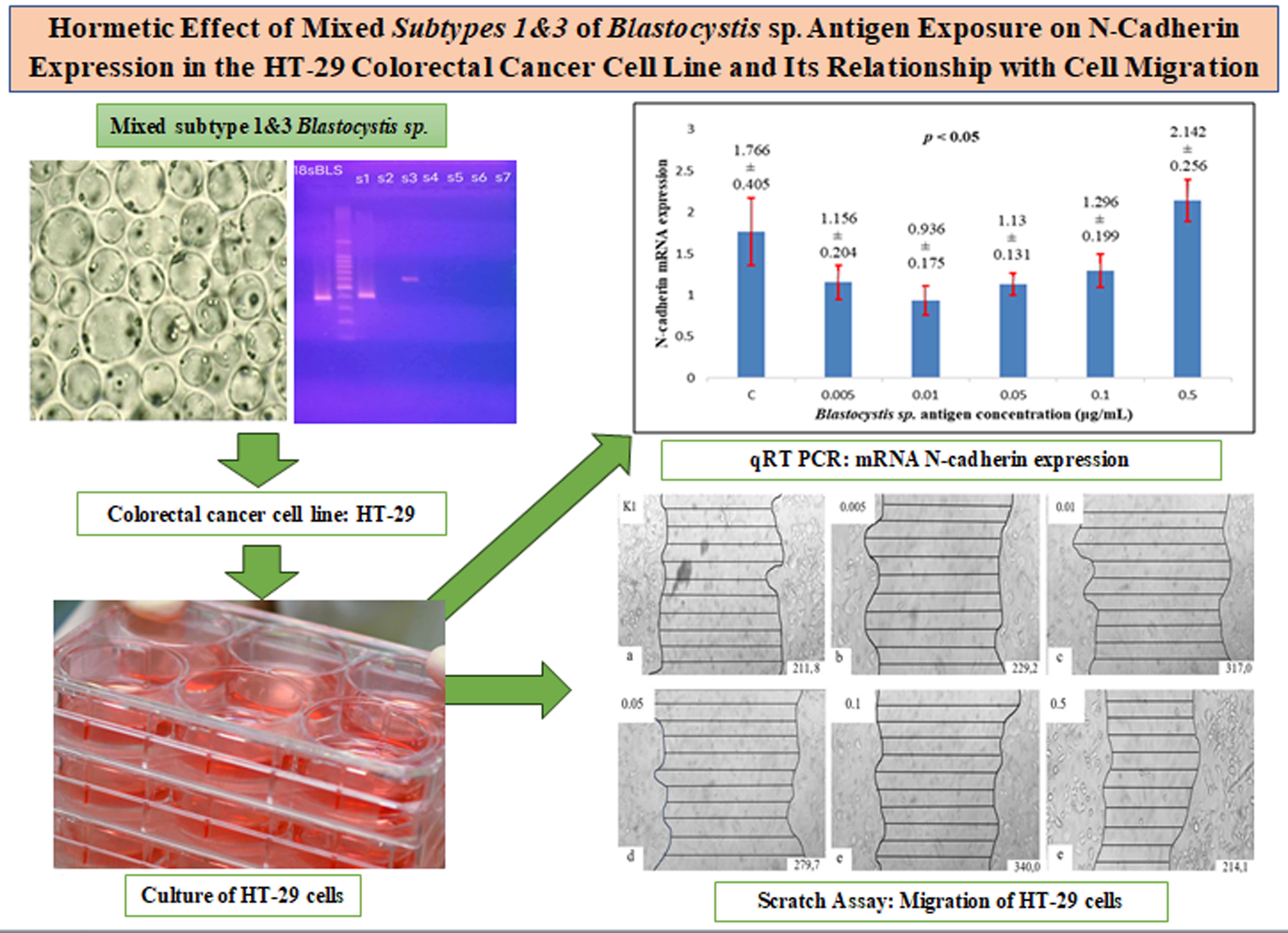
Published
How to Cite
Issue
Section
License
Copyright (c) 2025 Walailak University

This work is licensed under a Creative Commons Attribution-NonCommercial-NoDerivatives 4.0 International License.





