
Indigenous Enzyme-Producing Microorganisms as Potential Biocontrol Agents Against Weedy Rice Germination
DOI:
https://doi.org/10.48048/tis.2027.13915Keywords:
Weedy rice, Rhizosphere engineering, Enzyme-mediated inhibition, Amylase, Cellulase, Biological weed control, Seed vigor suppressionAbstract
Weedy rice (Oryza spp.) remains one of the most challenging constraints in rice production systems due to its genetic similarity to cultivated rice, which limits the effectiveness of conventional chemical control. This study introduces a novel biological strategy based on indigenous enzyme-producing microorganisms capable of selectively suppressing weedy rice during early developmental stages. A total of 66 microbial isolates were obtained from paddy soil and weedy rice soaking water in Ang Thong Province, Thailand. Functional screening identified 42 amylase-producing and 29 cellulase-producing isolates. Selected high-performance strains exhibited substantial extracellular enzyme activities, reaching 30.15 U/mL for amylase (24 h) and 16.79 U/mL for cellulase (36 h). Unlike conventional biocontrol approaches targeting foliar pathogens or post-emergence weeds, this study focuses on enzymatic interference during seed germination and early seedling establishment. Flask-based bioassays demonstrated that microbial inoculation significantly reduced weedy rice germination and seedling vigor, particularly under mixed planting conditions with cultivated rice. Germination of weedy rice declined from 31.67% in non-inoculated controls to 25.00% following microbial treatment. Seedling length decreased from 8.85 to 6.93 cm, and the vigor index was reduced by 38.2%. Importantly, cultivated rice exhibited minimal growth inhibition, indicating a selective suppressive effect. The findings suggest a previously underexplored mechanism of weed suppression mediated by rhizosphere-active extracellular enzymes, potentially disrupting reserve mobilization and early root development in weedy rice. This selective, enzyme-driven inhibition represents a promising alternative to herbicide-dependent systems and provides a mechanistic framework for developing sustainable, microbiome-based weed management strategies. Field validation and metabolomic profiling are warranted to further elucidate the molecular basis of selectivity.
HIGHLIGHTS
- Indigenous enzyme-producing microbes were isolated from rice rhizosphere soil.
- High extracellular amylase and cellulase disrupted early weed establishment.
- Selective suppression of weedy rice occurred under competitive conditions.
- Seed vigor reduction suggests interference with reserve mobilization.
- Provides a mechanistic basis for microbiome-based weed management.
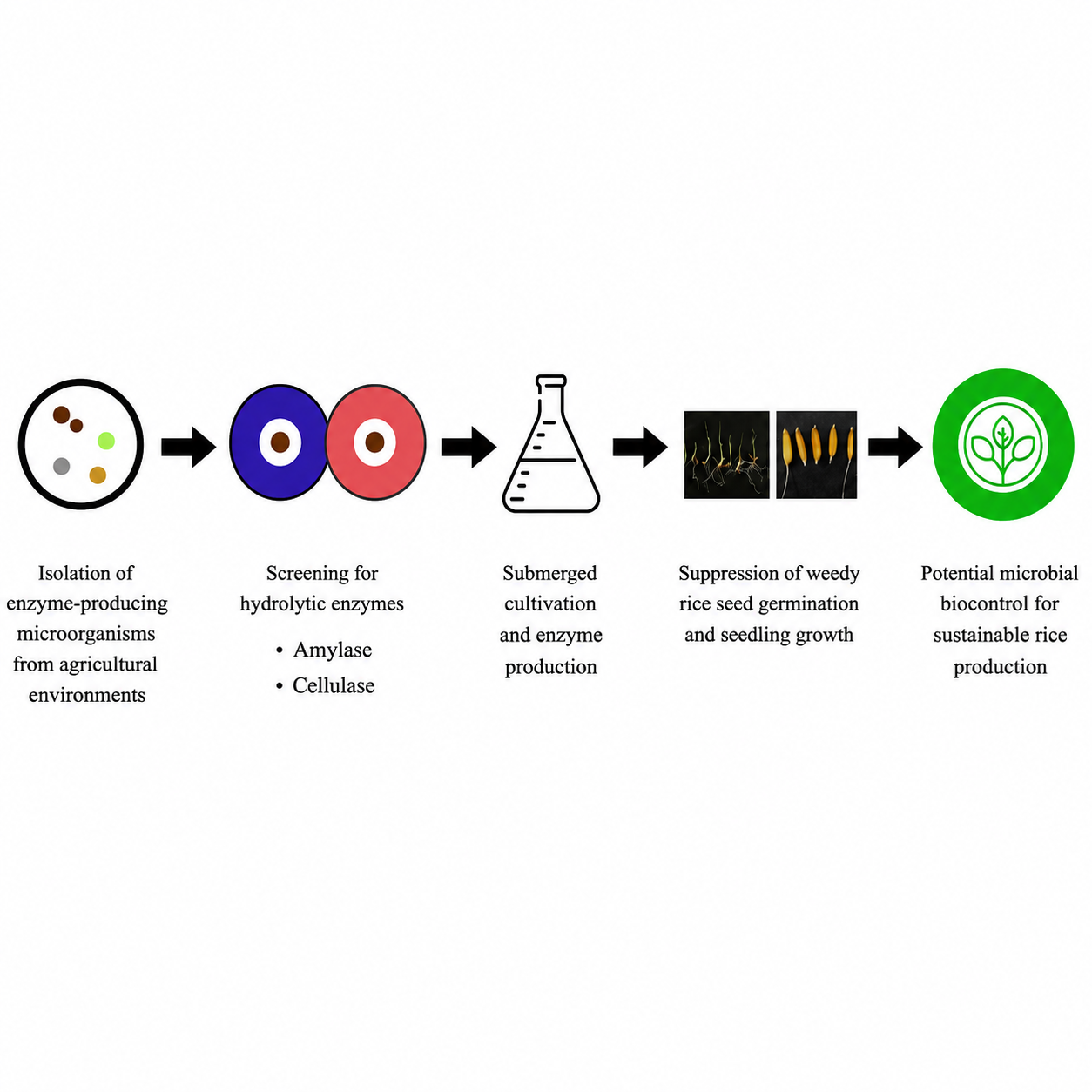
GRAPHICAL ABSTRACT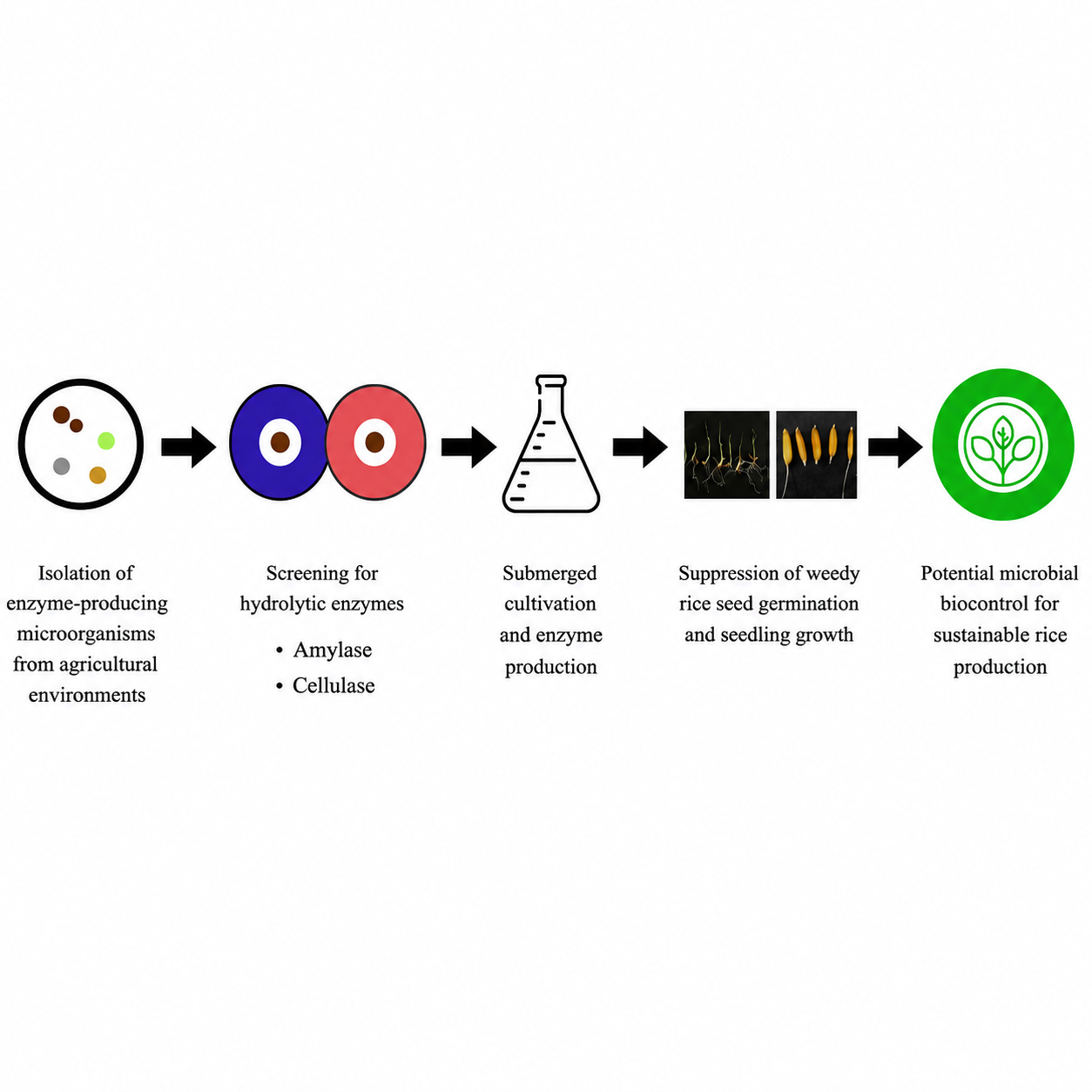
Downloads
References
N Roma-Burgos, MPS Sudo, KM Olsen, I Werle and BK Song. Weedy rice (Oryza spp.): What’s in a name? Weed Science 2021; 69(5), 505-513.
BS Chauhan. Strategies to manage weedy rice in Asia. Crop Protection 2013; 48, 51-56.
JC Delouche, NR Burgos, DR Gealy, GZDS Martín, R Labrada, M Larinde and C Rosell. Weedy rices: Origin, biology, ecology and control. Food and Agriculture Organization 2007. https://www.fao.org/4/a1023e/a1023e00.htm
SB Powles and Q Yu. Evolution in action: Plants resistant to herbicides. Annual Review of Plant Biology 2010; 61, 317-347.
AC Kennedy, BN Johnson and TL Stubbs. Host range of a deleterious rhizobacterium for biological control of downy brome. Weed Science 2001; 49(6), 792-797.
SO Duke, FE Dayan, JG Romagni and AM Rimando. Natural products as sources of herbicides: Current status and future trends. Weed Research 2000; 40(1), 99-111.
R Charudattan. Biological control of weeds by means of plant pathogens: Significance for integrated weed management in modern agro-ecology. BioControl 2001; 46(2), 229-260.
M Ongena and P Jacques. Bacillus lipopeptides: Versatile weapons for plant disease biocontrol. Trends in Microbiology 2008; 16(3), 115-125.
N Promma, P Yeesin, S Saeng-Ngam and S Krajangsang. Optimization of biological substance production from bacillus subtilis strain OK1101 in A 10 L stirred fermenter. Srinakharinwirot University Journal of Sciences and Technology 2025; 17(2), 1-14.
S Compant, C Clément and A Sessitsch. Plant growth-promoting bacteria in the rhizo-and endosphere of plants: Their role, colonization, mechanisms involved and prospects for utilization. Soil Biology and Biochemistry 2010; 42(5), 669-678.
R Gupta, P Gigras, H Mohapatra, VK Goswami and B Chauhan. Microbial α-amylases: A biotechnological perspective. Process Biochemistry 2003; 38(11), 1599-1616.
A Pandey, P Nigam, CR Soccol, VT Soccol, D Singh and R Mohan. Advances in microbial amylases. Biotechnology and Applied Biochemistry 2000; 31(2), 135-152.
S Sethi, A Datta, BL Gupta and S Gupta. Optimization of cellulase production from bacteria isolated from soil. International Scholarly Research Notices 2013; 2013, 985685.
LR Lynd, PJ Weimer, WHV Zyl and IS Pretorius. Microbial cellulose utilization: Fundamentals and biotechnology. Microbiology and Molecular Biology Reviews 2002; 66(3), 506-577.
PA Roger and J Ladha. Biological N2 fixation in wetland rice fields: Estimation and contribution to nitrogen balance. Plant and Soil 1992; 141, 41-55.
AA Abdul‐Baki and JD Anderson. Vigor determination in soybean seed by multiple criteria1. Crop Science 1973; 13(6), 630-633.
A Limaye. Drishti, A volume exploration and presentation tool. In: Proceedings of the SPIEDevelopments in X-Ray Tomography VIII, 2012; 8506.
J Wu, C Ma and F Li. Microbial community structure and function in paddy soil as affected by water-saving irrigation mode. European Journal of Soil Biology 2022; 113, 103450.
S Zecchin, J Wang, M Martin, M Romani, B Planer-Friedrich and L Cavalca. Microbial communities in paddy soils: Differences in abundance and functionality between rhizosphere and pore water, the influence of different soil organic carbon, sulfate fertilization and cultivation time, and contribution to arsenic mobility and speciation. FEMS Microbiology Ecology 2023; 99(11), 121.
V Juliyanti, R Itakura, K Kotani, SY Lim, G Suzuki, CW Chong, BK Song and S Rahman. Comparative analysis of root associated microbes in tropical cultivated and weedy rice (Oryza spp.) and temperate cultivated rice. Scientific Reports 2024; 14(1), 9656.
Y Wu, J Sun, P Yu, W Zhang, Y Lin and D Ma. The rhizosphere bacterial community contributes to the nutritional competitive advantage of weedy rice over cultivated rice in paddy soil. BMC Microbiology 2022; 22(1), 232.
HR Temsaah, AF Azmy, M Raslan, AE Ahmed and WG Hozayen. Isolation and characterization of thermophilic enzymes producing microorganisms for potential therapeutic and industrial use. Journal of Pure & Applied Microbiology 2018; 12(4), 1687-1702.
N Bhardwaj, B Kumar, K Agrawal and P Verma. Current perspective on production and applications of microbial cellulases: A review. Bioresources and Bioprocessing 2021; 8(1), 95.
J Dai, A Dong, G Xiong, Y Liu, MS Hossain, S Liu, N Gao, S Li, J Wang and D Qiu. Production of highly active extracellular amylase and cellulase from Bacillus subtilis ZIM3 and a recombinant strain with a potential application in tobacco fermentation. Frontiers in Microbiology 2020; 11, 1539.
P Buzzini and R Margesin. Cold-adapted Yeasts. Biodiversity, Adaptation Strategies and Biotechnological Significance. Springer Berlin, Heidelberg, 2014.
FG Priest. Extracellular enzyme synthesis in the genus Bacillus. Bacteriological Reviews 1977; 41(3), 711-753.
M Schallmey, A Singh and OP Ward. Developments in the use of Bacillus species for industrial production. Canadian Journal of Microbiology 2004; 50(1), 1-17.
AL Koch. Turbidity measurements of bacterial cultures in some available commercial instruments. Analytical Biochemistry 1970; 38(1), 252-259.
JM van Dijl and M Hecker. Bacillus subtilis: From soil bacterium to super-secreting cell factory. Microbial Cell Factories 2013; 12, 3.
Z Xiao, T Zou, S Lu and Z Xu. Soil microorganisms interacting with residue-derived allelochemicals effects on seed germination. Saudi Journal of Biological Sciences 2020; 27(4), 1057-1065.
A Dar, ZA Zahir, M Ahmad, A Hussain, MT Jaffar and RJ Kremer. Bacterial allelopathy: An approach for biological control of weeds. Journal of Applied Microbiology 2024; 135(9), lxae219.
C Fang, Y Zhuang, T Xu, Y Li, Y Li and W Lin. Changes in rice allelopathy and rhizosphere microflora by inhibiting rice phenylalanine ammonia-lyase gene expression. Journal of Chemical Ecology 2013; 39(2), 204-212.
RJ Kremer and T Souissi. Cyanide production by rhizobacteria and potential for suppression of weed seedling growth. Current Microbiology 2001; 43(3), 182-186.
H Kato-Noguchi and RJ Peters. The role of momilactones in rice allelopathy. Journal of Chemical Ecology 2013; 39(2), 175-185.
C Das. Exploring the allelopathic potential of rice for sustainable agriculture: A review. Acta Botanica Plantae 2025; 4(3), 107-113.
F Rahaman, AS Juraimi, MY Rafii, K Uddin, L Hassan, AK Chowdhury, SMR Karim, BY Rini, O Yusuff, HMK Bashar and A Hossain. Allelopathic potential in rice-a biochemical tool for plant defence against weeds. Frontiers in Plant Science 2022; 13, 1072723.
NMI Othman, R Othman and HMM Saud. Effect of zinc-solubilizing bacteria and organic acids on zinc uptake and growth of rice applied with zinc sulfate. Food Research 2020; 4(S5), 153-163.
BM Sadeq, KZ Tan, S Kasim, MY Wong, NMI Othman, JT Alkooranee, SS Chompa, A Akter and E Rahman. Humic Acid-amended formulation improves Shelf-life of plant Growth-promoting rhizobacteria (PGPR) under laboratory conditions. Pertanika Journal of Science & Technology 2023; 31(3), 1137-1155.
Downloads
Published
How to Cite
Issue
Section
License
Copyright (c) 2026 Walailak University

This work is licensed under a Creative Commons Attribution-NonCommercial-NoDerivatives 4.0 International License.