
Biodegradable Bioplastics Synthesized from BSFL Pupae Chitosan and OPEFB Cellulose: Influence of Citric Acid on Material Properties
DOI:
https://doi.org/10.48048/tis.2026.13914Keywords:
Black Soldier Fly Larvae;, Chitosan pupae, Cellulose OPEFB, Citric Acid, Polymer, Bioplastic, Hydrogen-bonding, Bioplastic, Black soldier fly larvae, Chitosan pupae, Cellulose OPEFB, Citric acid, Polymer, Hydrogen-bondingAbstract
The development of biodegradable plastics from renewable resources has gained increasing attention as a strategy to reduce dependence on petroleum-based materials. In this study, bioplastics were prepared using chitosan derived from black soldier fly (BSF, Hermetia illucens) pupae and cellulose extracted from oil palm empty fruit bunches (OPEFB), with citric acid (CA) incorporated as a network-modifying agent. The objective of this work was to evaluate the influence of citric acid concentration on the structural, mechanical, physical, and biodegradation properties of the resulting bioplastic films. Bioplastics were synthesized from BSF-derived chitosan (1.5% (w/v)), starch (3% (w/v)), and OPEFB cellulose (0.06 g), with CA added at concentrations ranging from 0 to 10 wt% relative to total polymer content. The results showed that CA addition significantly influenced film performance (p > 0.05). The tensile strength increased significantly from 0.13 to 0.64 MPa at 2.5 wt% CA, indicating improved intermolecular interactions within the polymer matrix. In contrast, elongation at break decreased with increasing CA concentration, suggesting reduced polymer chain mobility. Physical characterization revealed that the incorporation of CA reduced moisture content and swelling degree, with the lowest values observed at 2.5 wt% CA. FTIR analysis indicated that hydrogen-bond-mediated interaction contributed significantly to the polymer network, although direct quantitative confirmation of the dominant interaction mechanism was not performed. Morphological observations confirmed that moderate CA addition produced a more compact and homogeneous structure, whereas excessive CA resulted in surface irregularities. Biodegradation tests further demonstrated that citric acid affected degradation behavior by altering polymer network density and hydrophilicity. Overall, the results suggest that controlled addition of citric acid plays an important role in tailoring the properties of bioplastics derived from BSF pupae chitosan and OPEFB cellulose, highlighting the potential of integrating insect biomass and agricultural residues for sustainable bioplastic production.
HIGHLIGHTS
- Bioplastic was developed from BSFL pupae chitosan and OPEFB cellulose.
- Citric acid enhanced hydrogen bonding and reduced water-related properties.
- Optimal bioplastic performance was achieved with 2.5 wt% citric acid.
- Excess citric acid (5 wt% - 10 wt%) reduced bioplastic physical properties.
- Insect- and agricultural-waste materials were valorized for sustainable bioplastics.
GRAPHICAL ABSTRACT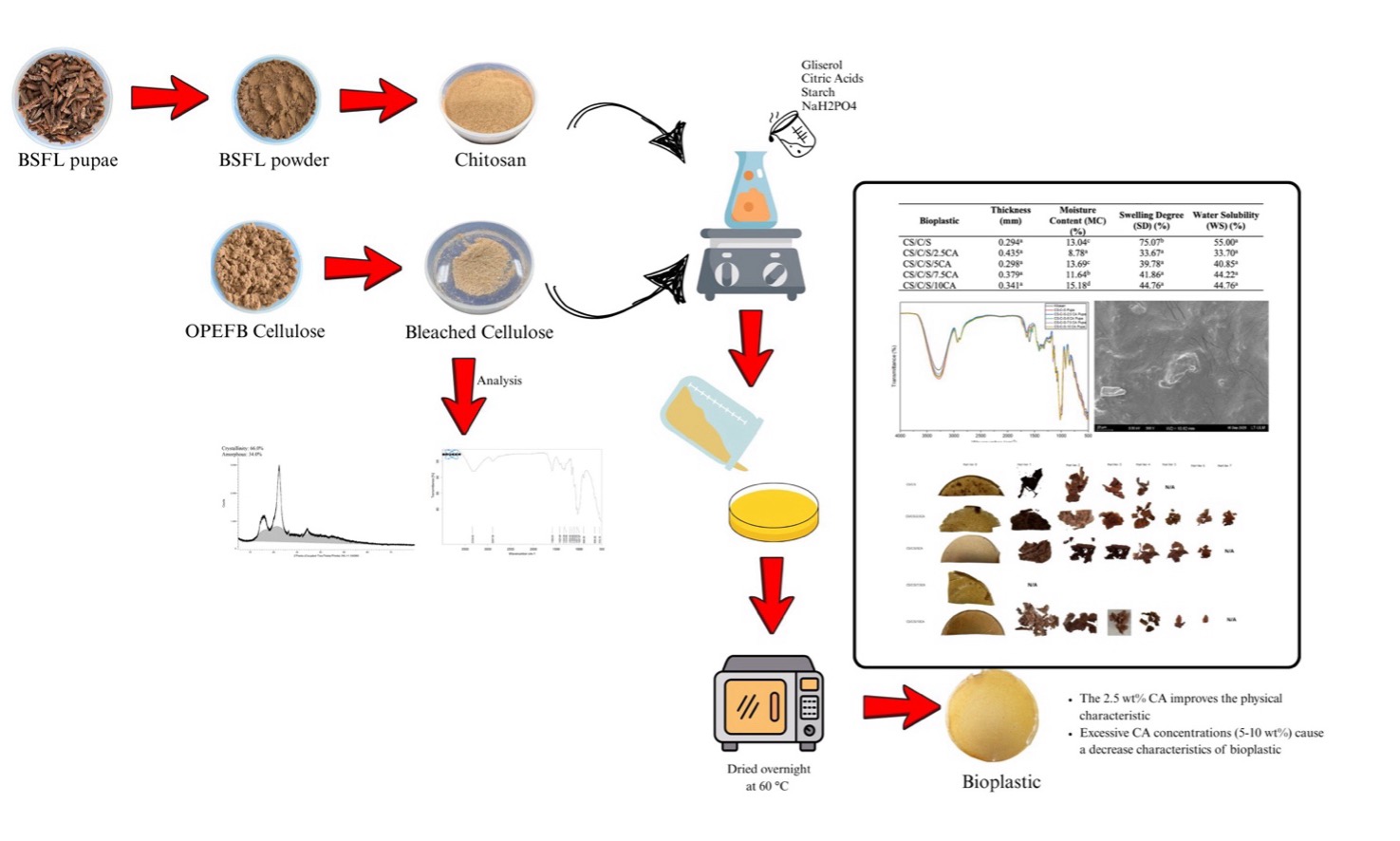
Downloads
References
BR Nogueira, BP Backx and T Delazare. Starch, pectin and chitosan-based bioplastics with silver nanoparticles: An eco-friendly alternative for the food industry. Sustainable Chemistry for the Environment 2025; 10, 100246.
SX Tan, HC Ong, A Andriyana, S Lim, YL Pang, F Kusumo and GC Ngoh. Characterization and parametric study on mechanical properties enhancement in biodegradable chitosan-reinforced starch-based bioplastic film. Polymers 2022; 14(2), 278.
J Pires, CDD Paula, VGL Souza, AL Fernando and I Coelhoso. Understanding the barrier and mechanical behavior of different nanofillers in chitosan films for food packaging. Polymers 2021; 13(5), 721.
R Ratna, M Mutia, D Darwin, AA Munawar, F Fitriani and L Handayani. Utilization of tofu liquid waste for the manufacture of bioplastic food packaging. Case Studies in Chemical and Environmental Engineering 2024; 10, 100830.
H Hernando, Marpongahtun, E Julianti, A Nuryawan, SA Amaturrahim, AFR Piliang, MR Yanhar, R Goei, N Soykeabkaew, AMA Saputra and S Gea. Impact of glycerol on oil palm trunk starch bioplastics enhanced with citric-acid epoxidized palm oil oligomers. Case Studies in Chemical and Environmental Engineering 2024; 10, 100839.
D Nuvoli, G Montevecchi, F Lovato, F Masino, MVD Borght, M Messori and A Antonelli. Protein films from black soldier fly (Hermetia illucens, Diptera: Stratiomyidae) prepupae: Effect of protein solubility and mild crosslinking. Journal of the Science of Food and Agriculture 2021; 101(11), 4506-4513.
N Wrońska, N Katir, M Nowak-Lange, A El-Kadib and K Lisowska. Biodegradable chitosan-based films as an alternative to plastic packaging. Foods 2023; 12(18), 3519.
WC Chen, SNMS Mohd Judah, SK Ghazali, DI Munthoub, H Alias and Z Mohamad. The effects of citric acid on thermal and mechanical properties of crosslinked starch film. Chemical Engineering Transactions 2021; 83, 199-204.
J Yang, S Xu, W Wang, X Ran, YC Ching, X Sui, Y Wei, R Wang and NM Al-Hada. Preparation and characterization of bioplastics from silylated cassava starch and epoxidized soybean oils. Carbohydrate Polymers 2023; 300, 120253.
H Wu, Y Lei, J Lu, R Zhu, D Xiao, C Jiao, R Xia, Z Zhang, G Shen, Y Liu, S Li and M Li. Effect of citric acid induced crosslinking on the structure and properties of potato starch/chitosan composite films. Food Hydrocolloids 2019; 97, 105208.
A Franco, C Scieuzo, R Salvia, AM Petrone, E Tafi, A Moretta, E Schmitt and P Falabella. Lipids from Hermetia illucens, an innovative and sustainable source. Sustainability 2021; 13(18), 10198.
M Kalová and M Borkovcová. Voracious larvae Hermetia illucens and treatment of selected types of biodegradable waste. Acta Universitatis Agriculturae et Silviculturae Mendelianae Brunensis 2013; 61(1), 77-83.
A Xiong, L Ruan, K Ye, Z Huang and C Yu. Extraction of chitin from black soldier fly (Hermetia illucens) and its puparium by using biological treatment. Life 2023; 13(7), 1424.
R Rachmawaty, S Sahribulan, SE Putri and WF Arisma. Formation of chitosan from black soldier fly (Hermetia illucens) pupae using microwaves radiation energy. Jurnal Aisyah: Jurnal Ilmu Kesehatan 2023; 8(2), 1173-1180.
RK Dewi, S Oktawati, A Gani, E Suhartono, N Hamrun, NA Rohmanna, S Riezqy and G Sugiarto. Synthesis, characterization, and in silico nanochitosan of pupa black soldier fly (Hermetia illucens) as bone graft material for bone remodeling post tooth extraction. Journal of Chemical Health Risks 2023; 13(4), 2370-2377.
R Sulaeman, RRZDW Putri, R Damayanti, F Fauzan, MR Hadiyan and Y Maharani. Characterization of eco-friendly straw based on chitosan from pupae exuviae of black soldier fly (Hermetia illucens). AgriHealth: Journal of Agri-Food, Nutrition and Public Health 2024; 5(2), 92-100.
A Simon, R Pramitasari, DSB Anugrah and DE Waturangi. Development of intelligent packaging films utilising chitosan derived from black soldier fly exuviae and anthocyanin from red dragon fruit peel for monitoring banana ripeness. International Journal of Biological Macromolecules 2025; 319, 145610.
S Affes, I Aranaz, N Acosta, Á Heras, M Nasri and H Maalej. Chitosan derivatives-based films as pH-sensitive drug delivery systems with enhanced antioxidant and antibacterial properties. International Journal of Biological Macromolecules 2021; 182, 730-742.
D Ianniciello, AP Montosa, RDM Barbosa, FG Villén, R Salvia, C Scieuzo, C Viseras and P Falabella. Development of chitosan-clay nanocomposite films from Hermetia illucens: Analysis of chemical, physical, and mechanical properties. International Journal of Biological Macromolecules 2025; 311, 143496.
E Marinho. Cellulose: A comprehensive review of its properties and applications. Sustainable Chemistry for the Environment 2025; 11, 100283.
EA Agustiany, DS Nawawi, AD Martino, FP Sari and W Fatriasari. Lignin-chitosan-based bioplastics from oil palm empty fruit bunches for seed coating. Biocatalysis and Agricultural Biotechnology 2024; 62, 103435.
M Nurdin, H Abimanyu, H Putriani, LOMI Setiawan, M Maulidiyah, D Wibowo, A Ansharullah, M Natsir, LOA Salim, Z Arham and F Mustapa. Optimization of OPEFB lignocellulose transformation process through ionic liquid [TEA][HSO4] based pretreatment. Scientific Reports 2021; 11(1), 11338.
N Sharmin, JT Rosnes, L Prabhu, U Böcker and M Sivertsvik. Effect of citric acid cross linking on the mechanical, rheological and barrier properties of chitosan. Molecules 2022; 27(16), 5118.
S Khadsai, R Janmanee, P Sam-Ang, Y Nuanchawee, W Rakitikul, W Mankhong, W Likittrakulwong and P Ninjiaranai. Influence of crosslinking concentration on the properties of biodegradable modified cassava starch-based films for packaging applications. Polymers 2024; 16(12), 1647.
K Miller, CL Reichert, M Schmid and M Loeffler. Impact of citric acid on the structure, barrier, and tensile properties of esterified/cross-linked potato peel-based films and coatings. Polymers 2024; 16(24), 3506.
AR El-Feky, M Ismaiel, M Yılmaz, FM Madkour, A El-Nemr and HA Ibrahim. Biodegradable plastic formulated from chitosan of Aristeus antennatus shells with castor oil as a plasticizer agent and starch as a filling substrate. Scientific Reports 2024; 14(1), 11161.
C Pedrazzani, L Righi, F Vescovi, L Maistrello and A Caligiani. Black soldier fly as a new chitin source: Extraction, purification and molecular/structural characterization. LWT 2024; 191, 115618.
R Rosa and ML Nunes. Nutritional quality of red shrimp, Aristeus antennatus (Risso), pink shrimp, Parapenaeus longirostris (Lucas), and Norway lobster, Nephrops norvegicus (Linnaeus). Journal of the Science of Food and Agriculture 2004; 84(1), 89-94.
SA Siddiqui, L van Greunen, A Zeiri, B Yudhistira, A Ahmad and M Monnye. The potential of chitin and chitosan from dead black soldier fly (BSF) (Hermetia illucens) for biodegradable packaging material - A critical review. Process Safety and Environmental Protection 2024; 189, 1342-1367.
CE Rodríguez, V Zaremska, T Klammsteiner, I Kampatsikas, N Münstermann, O Weichold and S Gruber. Chitosan obtained from black soldier fly larval cuticles expands the value chain and is effective as a biocontrol agent to combat plant pathogens. Carbohydrate Polymers 2025; 349, 123023.
A Abdulkarim, MT Isa, S Abdulsalam, AJ Muhammad and AO Ameh. Extraction and characterisation of chitin and chitosan from mussel shell. Extraction 2013; 3(2), 108-114.
M Rinaudo. Chitin and chitosan: Properties and applications. Progress in Polymer Science 2006; 31(7), 603-632.
J Dutta. A facile approach for the determination of degree of deacetylation of chitosan using acid-base titration. Heliyon 2022; 8(7), e09924.
A Tapia, R Seña, H Zambrano and V Paredes. Extraction and characterization of chitosan obtained from shells of crab (Callinectes bocourti and Callinectes sapidus). International Journal of Biological Macromolecules 2025; 320, 145963.
MS Hossain and A Iqbal. Production and characterization of chitosan from shrimp waste. Journal of the Bangladesh Agricultural University 2014; 12(1), 153-160.
I Aranaz, AR Alcántara, MC Civera, C Arias, B Elorza, A Heras Caballero and N Acosta. Chitosan: An overview of its properties and applications. Polymers 2021; 13(19), 3256.
R Md Salim, J Asik and MS Sarjadi. Chemical functional groups of extractives, cellulose and lignin extracted from native Leucaena leucocephala bark. Wood Science and Technology 2021; 55(2), 295-313.
V Fiore, T Scalici and A Valenza. Characterization of a new natural fiber from Arundo donax L. as potential reinforcement of polymer composites. Carbohydrate Polymers 2014; 106, 77-83.
SG Kostryukov, HB Matyakubov, YY Masterova, AS Kozlov, MK Pryanichnikova, AA Pynenkov and NA Khluchina. Determination of lignin, cellulose, and hemicellulose in plant materials by FTIR spectroscopy. Journal of Analytical Chemistry 2023; 78(6), 718-727.
S Yao, BJ Wang and YM Weng. Preparation and characterization of mung bean starch edible films using citric acid as cross-linking agent. Food Packaging and Shelf Life 2022; 32, 100845.
A Awadhiya, D Kumar and V Verma. Crosslinking of agarose bioplastic using citric acid. Carbohydrate Polymers 2016; 151, 60-67.
Y Li, W Yokoyama, J Wu, J Ma and F Zhong. Properties of edible films based on pullulan–chitosan blended film-forming solutions at different pH. RSC Advances 2015; 5(128), 105844-105850.
RC Nissa, AK Fikriyyah, AHD Abdullah and S Pudjiraharti. Preliminary study of biodegradability of starch-based bioplastics using ASTM G21-70, dip-hanging, and Soil Burial Test methods. IOP Conference Series: Earth and Environmental Science 2019; 277(1), 012007.
Downloads
Published
How to Cite
Issue
Section
License
Copyright (c) 2026 Walailak University

This work is licensed under a Creative Commons Attribution-NonCommercial-NoDerivatives 4.0 International License.