
Antibiofilm Effect of Curcumin-Derived Carbon Dots against Pseudomonas aeruginosa on the Urinary Catheter
DOI:
https://doi.org/10.48048/tis.2026.13774Keywords:
Biofilms, Carbon dots, Catheter-associated urinary tract infection, Curcumin, Nanoparticles, Pseudomonas aeruginosa, Urinary cathetersAbstract
Pseudomonas aeruginosa (P. aeruginosa) is a major opportunistic pathogen in patients with prolonged urinary catheterization. Its intrinsic multidrug resistance and robust biofilm-forming capacity on catheter surfaces contribute to persistent colonization and recurrent catheter-associated urinary tract infections. Although Curcuma longa–derived curcumin exhibits antibiofilm activity, its clinical utility is limited by poor bioavailability. Carbon dots (CDs) have emerged as effective platforms for enhancing antimicrobial delivery. However, study on the effect of antibiofilm of curcumin-derived carbon dots (cur-CDs), particularly on medical devices, is limited. This study aimed to evaluate the antibiofilm efficacy of cur-CDs against P. aeruginosa ATCC 9027 biofilms formed on urinary catheter surfaces. Cur-CDs were characterized using UV–visible spectroscopy, Fourier-Transform Infrared Spectroscopy, photoluminescence spectroscopy, and Transmission Electron Microscopy. Biofilm inhibition was assessed using a tissue culture plate assay at cur-CDs concentrations ranging from 5, 10, 20, 30, 40 and 50 µg/mL. Biofilm biomass was quantified spectrophotometrically, viable biofilm-associated bacteria were enumerated by colony-forming unit analysis, and biofilm architecture was examined by field emission scanning electron microscopy. Cur-CDs exhibited a significant, concentration-dependent antibiofilm effect, resulting in marked reductions in biofilm biomass (p < 0.0001) and viable bacterial counts (p = 0.001). This enhanced antibiofilm activity may be attributed to the nanoscale properties of cur-CDs, which potentially improve curcumin stability and facilitate interactions with bacterial membranes and the biofilm matrix. Overall, cur-CDs effectively inhibit P. aeruginosa biofilm formation on urinary catheter surfaces and support their potential application as an antibiofilm strategy for mitigating catheter-associated urinary tract infections.
HIGHLIGHTS
- Curcumin-derived carbon dots (cur-CDs) developed as a novel antibiofilm nanomaterial.
- Cur-CDs inhibit Pseudomonas aeruginosa biofilm on urinary catheter surfaces.
- Significant reductions in biofilm biomass and viable bacterial counts observed.
- FESEM confirms structural disruption of catheter-associated biofilms.
- Cur-CDs show promise for preventing Catheter-Associated Urinary Tract Infection.
GRAPHICAL ABSTRACT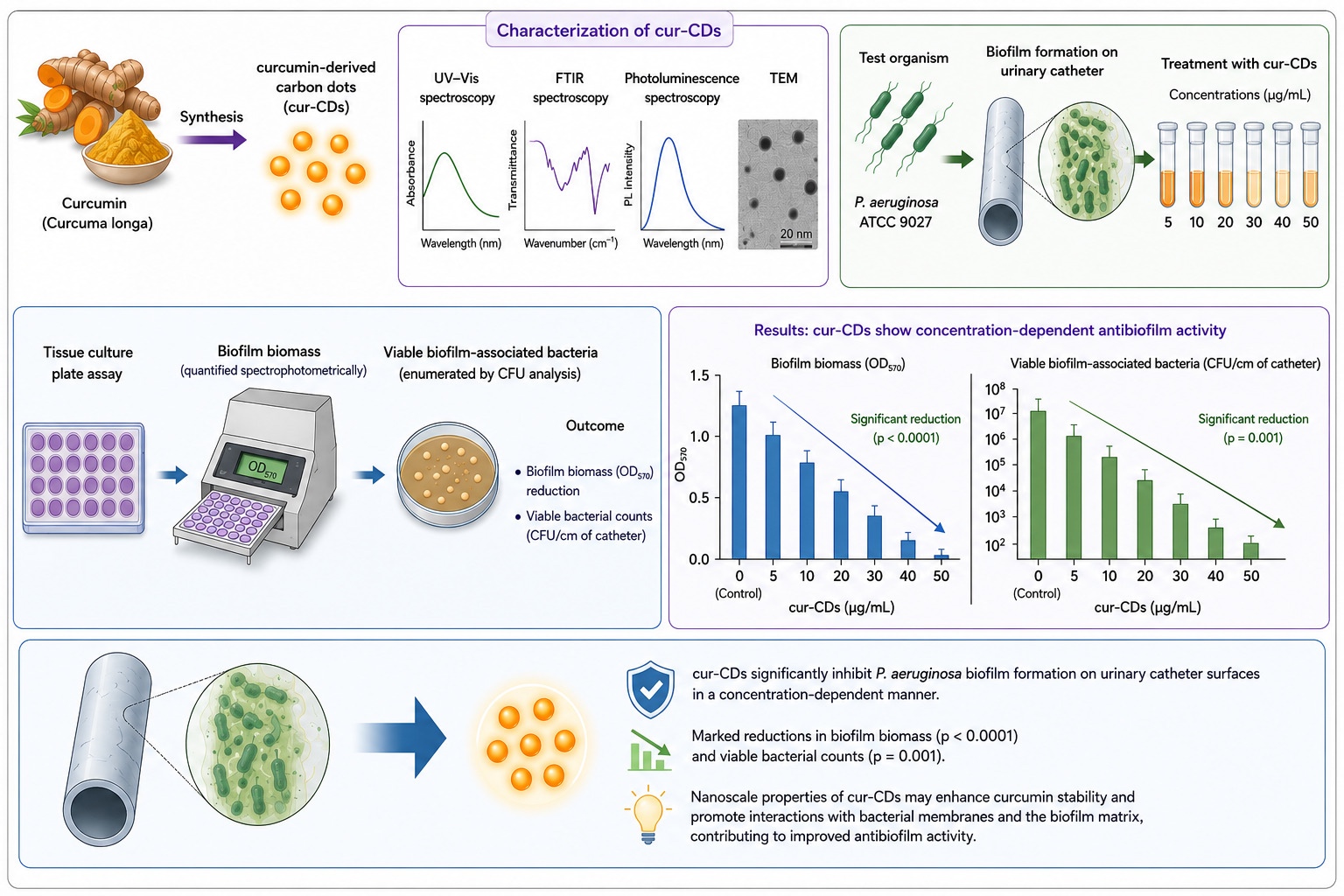
Downloads
References
H Rubi, G Mudey and R Kunjalwar. Catheter-associated urinary tract infection (CAUTI). Cureus 2022; 14(10), e30385.
NA Obaid, SA Abuhussain, KK Mulibari, F Alshanqiti, SA Malibari, SS Althobaiti, M Alansari, E Muneef, L Almatrafi, A Alqarzi, N Alotaibi, AM Mostafa and A Hagag. Antimicrobial-resistant pathogens related to catheter-associated urinary tract infections in intensive care units: A multi-center retrospective study in the western region of Saudi Arabia. Clinical Epidemiology and Global Health 2023; 21, 101291.
World Health Organization. Global report on infection prevention and control 2024. World Health Organization, Geneva, Switzerland, 2024.
C Suetens, T Karki and D Plachouras. Point prevalence survey of healthcare associated infections and antimicrobial use in European acute care hospitals 2022-2023. ECDC Surveillance, Stockholm, Sweden, 2024.
ML Ling, P Ching, A Apisarnthanarak, N Jaggi, G Harrington and SM Fong. APSIC guide for prevention of catheter associated urinary tract infections (CAUTIs). Antimicrobial Resistance & Infection Control 2023; 12(1), 52.
N Bouhrour, PH Nibbering and F Bendali. Medical device-associated biofilm infections and multidrug-resistant pathogens. Pathogens 2023; 13(5), 393.
GT Werneburg. Catheter-associated urinary tract infections: Current challenges and future prospects. Research and Reports in Urology 2022; 14, 109-133.
AA Gheorghita, DJ Wozniak, MR Parsek and PL Howell. Pseudomonas aeruginosa biofilm exopolysaccharides: Assembly, function, and degradation. FEMS Microbiology Reviews 2023; 47(6), fuad060.
FF Tuon, LR Dantas, PH Suss and VSR Ribeiro. Pathogenesis of the Pseudomonas aeruginosa biofilm: A review. Pathogens 2022; 11(3), 300.
EN Sholikhah. Indonesian medicinal plants as sources of secondary metabolites for pharmaceutical industry. Journal of Medical Sciences 2016; 48(4), 226-239.
ME Abd El-Hack, MT El-Saadony, AA Swelum, M Arif, MMA Ghanima, M Shukry, A Noreldin, AE Taha and KA El-Tarabily. Curcumin, the active substance of turmeric: Its effects on health and ways to improve its bioavailability. Journal of the Science of Food and Agriculture 2021; 101(14), 5747-5762.
S Shome, AD Talukdar and H Upadhyaya. Antibacterial activity of curcumin and its essential nanoformulations against some clinically important bacterial pathogens: A comprehensive review. Biotechnology and Applied Biochemistry 2022; 69(6), 2357-2386.
V Sawant, H Faleke, B Bhattarai, S Strickland, D Pappas and GF Christopher. Evaluating antibiofilm efficacy of carbon dots against Pseudomonas aeruginosa based on precursor molecule selection. Colloids and Surfaces B: Biointerfaces 2025; 254, 114811.
JK Trigo-Gutierrez, Y Vega-Chacón, AB Soares and EGDO Mima. Antimicrobial activity of curcumin in nanoformulations: A comprehensive review. International Journal of Molecular Sciences 2021; 22(13), 7130.
MH Sadaqat, AM Mobarez and M Nikkhah. Curcumin carbon dots inhibit biofilm formation and expression of esp and gelE genes of Enterococcus faecium. Microbial Pathogenesis 2022; 173, 105860.
E Pericolini, B Colombari, G Ferretti, R Iseppi, A Ardizzoni, M Girardis, A Sala, S Peppoloni and E Blasi. Real-time monitoring of Pseudomonas aeruginosa biofilm formation on endotracheal tubes in vitro. BMC Microbiology 2018; 18(1), 84.
AS Santika, FA Permatasari, B Khalfianisa, R Umami, BW Nuryadin, H Rachmawati and F Iskandar. N, O-functionalized curcumin-derived carbon dots for reactive oxygen species regulation: Mechanistic insights into biomedical applications. ACS Applied Bio Materials 2025; 8(6), 5194-5204.
AS Santika, FA Permatasari, V Valencia, A Fibriani and F Iskandar. Toward a molecular-level understanding of nitrogen functionalities in carbon dots for enhanced antibacterial activity and GSH detection. Biomaterials Advances 2025; 180, 214592.
A Fibriani, AAP Taharuddin, R Stephanie, N Yamahoki, J Laurelia, PH Wisnuwardhani, DF_Agustiyanti, M Angelina, Y Rubiyana, RA Ningrum, A Wardiana, F Iskandar, FA Permatasari and EA Giri-Rachman. Curcumin-derived carbon-dots as a potential COVID-19 antiviral drug. Heliyon 2023; 9(9), e20089.
D Rachmawati, MZ Fahmi, MI Abdjan, EB Wasito, I Siswanto, N Mazlan, J Rohmah and A Baktir. In vitro assessment on designing novel antibiofilms of Pseudomonas aeruginosa using a computational approach. Molecules 2022; 27(24), 8935.
S Swedan, Z Shubair and A Almaaytah. Synergism of cationic antimicrobial peptide WLBU2 with antibacterial agents against biofilms of multi-drug resistant Acinetobacter baumannii and Klebsiella pneumoniae. Infection and Drug Resistance 2019; 12, 2019-2030.
CR Thorn, A Wignall, Z Kopecki, A Kral, CA Prestidge and N Thomas. Liquid crystal nanoparticles enhance tobramycin efficacy in a murine model of Pseudomonas aeruginosa biofilm wound infection. ACS Infectious Diseases 2022; 8(4), 841-854.
KD Mandakhalikar, JN Rahmat, E Chiong, KG Neoh, L Shen and PA Tambyah. Extraction and quantification of biofilm bacteria: Method optimized for urinary catheters. Scientific Reports 2018; 8(1), 8069.
D Santosaningsih, Y Mulyastuti, S Poejiani, RF Putri, L Dewi, H Arifani, YL Ni’mah and A Baktir. The biofilm inhibition properties of glucosamine gold nanoparticles in combination with meropenem against Pseudomonas aeruginosa on the endotracheal tube: A model of biofilm-related ventilator-associated pneumonia. Materials 2024; 17(7), 1604.
R Umami, FA Permatasari, S Fadilah, ECS Mahen, A Fibriani, T Hirano, T Ogi and F Iskandar. Rapid solvent-free synthesis of carbon dots with yellow to red emission for LED spectral conversion. Diamond and Related Materials 2025; 159(B), 112859.
I Mong, V Ramoo, S Ponnampalavanar, MC Chong and WNFW Nawawi. Knowledge, attitude and practice in relation to catheter‐associated urinary tract infection (CAUTI) prevention: A cross‐sectional study. Journal of Clinical Nursing 2022; 31(1-2), 209-219.
S Rajaramon, K Shanmugam, R Dandela and AP Solomon. Emerging evidence-based innovative approaches to control catheter-associated urinary tract infection: A review. Frontiers in Cellular and Infection Microbiology 2023; 13, 1134433.
W He, P Ma, L Li, D Wang, X Li, X Wen, Y Zuo, Q Guo, Y Zhang, R Cheng and Z Wang. Efficacy and safety of preventing catheter-associated urinary tract infection by inhibiting catheter bacterial biofilm formation: a multicenter randomized controlled trial. Antimicrobial Resistance & Infection Control 2024; 13, 96.
Y Su, JT Yrastorza, M Matis, J Cusick, S Zhao, G Wang and J Xie. Biofilms: Formation, research models, potential targets, and methods for prevention and treatment. Advanced Science 2022; 9(29), 2203291.
E Silva, JA Teixeira, MO Pereira, CM Rocha and AM Sousa. Evolving biofilm inhibition and eradication in clinical settings through plant-based antibiofilm agents. Phytomedicine 2023; 119, 154973.
Q Zhang, Q Zong, X Feng, M Luo, W Sun and Y Zhai. Antibacterial and antifouling materials for urinary catheter coatings. Acta Biomaterialia 2025; 192, 28-47.
WK Redman, GS Welch, AC Williams, AJ Damron, WO Northcut and KP Rumbaugh. Efficacy and safety of biofilm dispersal by glycoside hydrolases in wounds. Biofilm 2021; 3, 100061.
Y Zou, Y Qu, Y Zhang and Q Yu. Multifunctional antibiofilm materials: Surface engineering and nanotherapeutic strategies for biofilm prevention and eradication. Acta Biomaterialia 2025; 203, 155-180.
F Lu, Y Ma, H Wang, M Zhang, B Wang, Y Zhang, H Huang, F Liao, Y Liu and Z Kang. Water-solvable carbon dots derived from curcumin and citric acid with enhanced broad-spectrum antibacterial and antibiofilm activity. Materials Today Communications 2021; 26, 102000.
G Otis, S Bhattacharya, O Malka, S Kolusheva, P Bolel, A Porgador and R Jelinek. Chemical modification of carbon dots for selective labeling and growth inhibition of Pseudomonas aeruginosa by aminoguanidine carbon dots. ACS Infectious Diseases 2019; 5(2), 292-302.
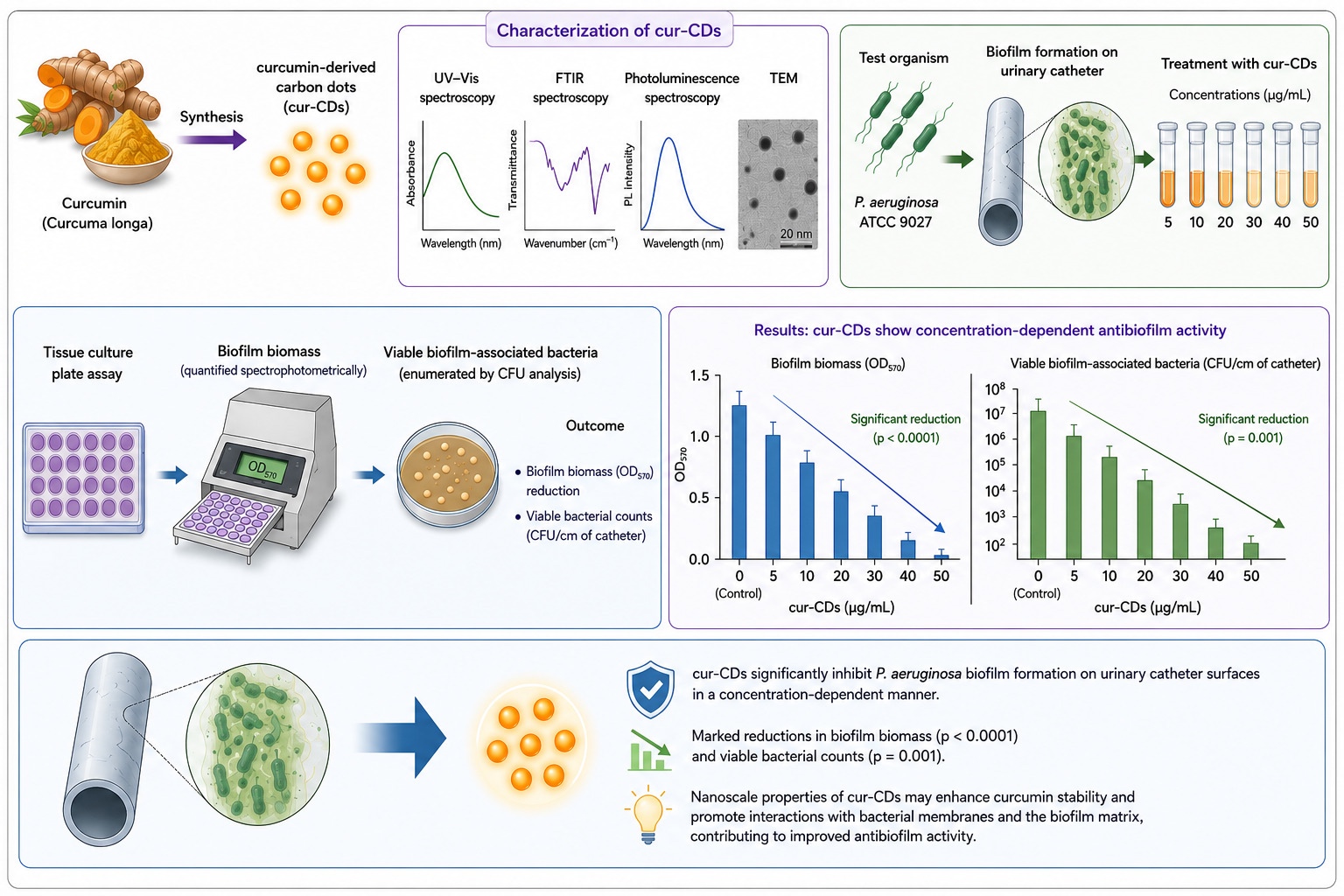
Downloads
Published
How to Cite
Issue
Section
License
Copyright (c) 2026 Walailak University

This work is licensed under a Creative Commons Attribution-NonCommercial-NoDerivatives 4.0 International License.