Attachment of 2-Aminoethyl Sulfate Fragments to Polyaldehyde Starch: Structure-Charge-Anticoagulant Relationships
DOI:
https://doi.org/10.48048/tis.2026.13693Keywords:
Starch derivatives, Polysaccharides, Chemical modification, Sulfate-containing starch conjugates, Polyanionic properties, Anticoagulant activityAbstract
Starch is a natural polysaccharide containing reactive functional groups that enable chemical modification and targeted tuning of its physicochemical and biological properties. Incorporation of sulfate groups enhances the polyanionic character of the polymer and promotes interactions in biological environments. Although sulfated polysaccharides have been widely studied, anticoagulant systems based on conjugation of sulfate-containing fragments with polyaldehyde starch remain relatively underexplored. In this study, water-soluble polyanionic starch derivatives were synthesized via attachment of 2-aminoethyl sulfate fragments to polyaldehyde starch obtained by controlled acid hydrolysis followed by periodate oxidation. The degree of substitution (DS) was systematically varied to investigate structure-charge-activity relationships. Comprehensive physicochemical characterization (FTIR, 1H NMR, XRD, SEM, GPC, ζ-potential, viscosity and pKa measurements) confirmed successful functionalization, reduced crystallinity, and formation of negatively charged polymer systems. In vitro coagulation assays (APTT, TT and PT) demonstrated significant prolongation of clotting times. Anticoagulant activity increased with DS and decreased molecular weight, reflecting the combined influence of charge density and macromolecular mobility. Highly substituted derivatives exhibited activity approaching that of heparin under the tested experimental conditions. In vivo studies using a thromboplastin-induced model confirmed the anticoagulant effect of Conjugate-65. Acute toxicity evaluation following intravenous administration indicated LD50 > 2,000 mg/kg, suggesting low toxicity. These results indicate that polyaldehyde starch derivatives bearing 2-aminoethyl sulfate fragments represent promising candidates for the development of plant-derived anticoagulant biomaterials.
HIGHLIGHTS
- Water-soluble sulfated polyaldehyde starch conjugates were synthesized
- Structure-charge-anticoagulant relationships were systematically established
- Higher sulfate density and lower molecular weight enhanced anticoagulant activity
- The optimized conjugate exhibited heparin-like anticoagulant activity in vitro
- The optimized conjugate demonstrated low toxicity and effective in vivo anticoagulation.
GRAPHICAL ABSTRACT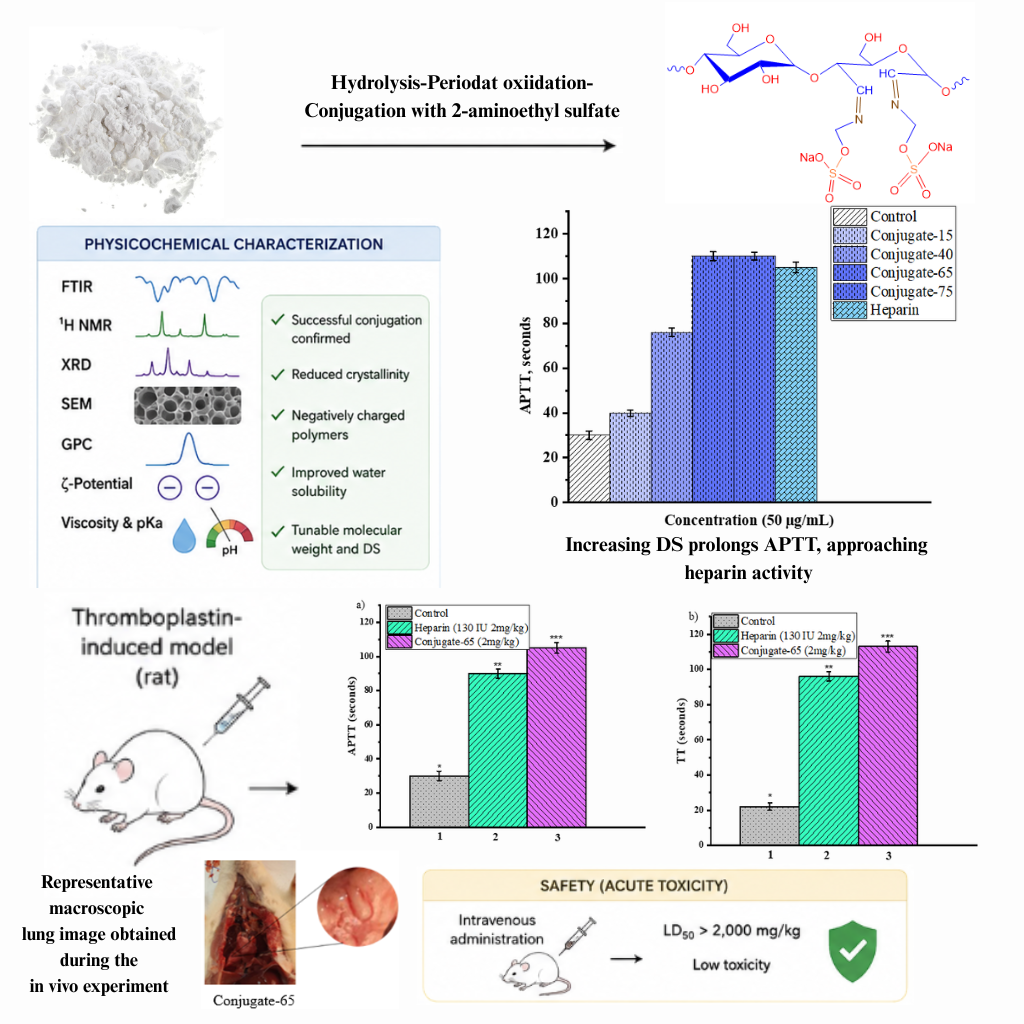
Downloads
References
BF Far, MR Naimi-Jamal, M Safaei, K Zarei, M Moradi and HY Nezhad. A review on biomedical application of polysaccharide-based hydrogels with a focus on drug delivery systems. Polymers 2022; 14(24), 5432.
S Suri and A Singh. Modification of starch by novel and traditional ways: Influence on the structure and functional properties. Sustainable Food Technology 2023; 1(3), 348-362.
M El Farkhani, S Dadou, Y El Miz, A Elyoussfi, ME Miz, A Salhi, M Koudad and N Benchat. A review of the chemical modification and applications of starch. BIO Web of Conferences 2024; 109, 01020.
H Yong and J Liu. Recent advances on the preparation conditions, structural characteristics, physicochemical properties, functional properties and potential applications of polyaldehyde starch: A review. International Journal of Biological Macromolecules 2024; 259(1), 129261.
M Haroon, L Wang, H Yu, NM Abbasi, Z Abdin, M Saleem, RU Khan, RS Ullah, Q Chen and J Wu. Chemical modification of starch and its application as an adsorbent material. RSC Advances 2016; 6(82), 78264.
MMH Rumon, AA Akib, SD Sarkar, MAR Khan, MM Uddin, D Nasrin and CK Roy. Polysaccharide-based hydrogels for advanced biomedical engineering applications. ACS Polymers Au 2024; 4(6), 463-486.
YD Berezhnaya, AS Kazachenko, AS Kazachenko, YN Malyar and VS Borovkova. Sulfation of various polysaccharide structures: Different methods and perspectives. Molecules 2024; 6(4), 1823.
RS Alfinaikh, KA Alamry and MA Hussein. Sustainable and biocompatible hybrid materials-based sulfated polysaccharides for biomedical applications: A review. RSC Advances 2025; 15(6), 4708-4767.
KA Kristiansen, A Potthast and BE Christensen. Periodate oxidation of polysaccharides for modification of chemical and physical properties. Carbohydrate Research 2010; 345(10), 1264-1271.
N Masina, YE Choonara, P Kumar, LS Toit, M Govender, S Indermun and V Pillay. A review of the chemical modification techniques of starch. Carbohydrate Polymers 2017; 157, 1226-1236.
RM John, ALT Raj, Y Dinakarkumar, A Selvaraj and M Radhakrishnan. Review on seaweed derived sulfated and non-sulfated marine polysaccharides as multifunctional food ingredients: Structure-function relationships, bioactivities and applications in functional foods. International Journal of Biological Macromolecules 2025; 330(2), 148071.
S Gunasekaran, S Govindan and P Ramani. Sulfated modification, characterization and bioactivities of an acidic polysaccharide fraction from an edible mushroom. Carbohydrate Polymers 2021; 17(1), 59-64.
T Yasushi. Sulfation of silk fibroin by chlorosulfonic acid and the anticoagulant activity. Biomaterials 2004; 25(3), 377-383.
H Yong and J Liu. Recent advances on the preparation conditions, structural characteristics, physicochemical properties, functional properties and potential applications of dialdehyde starch: A review. International Journal of Biological Macromolecules 2024; 259(1), 129261.
J Kurczewska. Recent reports on polysaccharide-based materials for drug delivery. Polymers 2022; 14(19), 4189.
Y Chen, J Zhu, W Wang and Q Liu. Structurally modified polysaccharides: physicochemical properties, biological activities, structure-activity relationship, and applications. Journal of Agricultural and Food Chemistry 2024; 72(7), 3259-3276.
MM Ahmad. Recent trends in chemical modification and antioxidant activities of plants-based polysaccharides: A review. Carbohydrate Polymer Technologies and Applications 2021; 2, 100045.
C Samaniego-Rafaele, R Salvador-Reyes, G Quispe-Santivañez and M Barriga-Sánchez. Modified tuber starches as sustainable biopolymers for the encapsulating bioactive compounds: A comprehensive review. Polymers 2025; 17(24), 3257.
Y Zuo, W Liu, J Xiao, X Zhao, Y Zhu and Y Wu. Preparation and characterization of polyaldehyde starch by one-step acid hydrolysis and oxidation. International Journal of Biological Macromolecules 2017; 103, 1257-1264.
J Yu, PR Chang, X Ma and X Liu. Preparation and properties of dialdehyde starch and thermoplastic dialdehyde starch. Carbohydrate Polymers 2010; 79(2), 296-300.
O Abdelhedi, M Jridi, H Najjaa, N Zouari, H Sebai and M Nasri. Sulfated polysaccharides from the viscera of Mustelus shark: Characterization and antioxidant, anticoagulant and anti-proliferative activities. Bioactive Carbohydrates and Dietary Fibre 2024; 31(4), 100399.
OR Akhmedov, SA Shomurotov, AS Turaev and AV Sidarenka. Dependence of antimicrobial effects of guanidine-containing pectin derivatives from some structural characteristics. Drug Development and Registration 2022; 11(2), 38-45.
OR Akhmedov, SA Shomurotov and AS Turaev. Features of synthesis and antimicrobial properties of guanidine-containing carboxymethylcellulose derivatives. Russian Journal of Bioorganic Chemistry 2022; 48, 1379-1386.
LAB Rawlinson, SM Ryan, G Mantovani, JA Syrett, DM Haddleton and DJ Brayden. Antibacterial effects of poly(2-(dimethylamino ethyl)methacrylate) against selected gram-positive and gram-negative bacteria. Biomacromolecules 2010; 11(2), 443-453.
JA Abdurakhmanov, SA Shomurotov, OR Akhmedov, ZA Khabibullayev, AS Turaev, AS Khusenov and UD Mukhitdinov. Synthesis of new starch derivatives containing 2-aminoethyl hydrogen sulfate. Khimiya Rastitelnogo Syrya 2025; 1, 68-77.
LB Azimova, AV Filatova, OI Radjabov, AY Otajonov, DT Djurabaev and AS Turaev. Obtaining and studying physical and chemical properties of films based on collagen and melanin. Khimiya Rastitelnogo Syrya 2025; 4, 101-109.
LB Azimova, AV Filatova, AS Turaev and DT Djurabaev. Isolation and study of the polysaccharide complex isolated from Aesculus hippocastanum L. Chemistry of Plant Raw Material 2021; 3, 115-122.
OR Akhmedov, JA Abdurakhmanov, SA Shomurotov and AS Turaev. Study of the regularities of synthesis and comparative physical-chemical characteristics of polyaldehydes chitosan. ChemChemTech 2025; 68(5), 128-136.
OR Akhmedov, JA Abdurakhmanov, SA Shomurotov, L You, AS Turaev, JK Makhkamov, OR Radjabov and AS Khusenov. New synthetic routes, wound healing and hemostatic properties of N-guanidinium chitosan. Trends in Sciences 2026; 23(4), 12110.
R Lever and CP Page. Novel drug development opportunities for heparin. Nature Reviews Drug Discovery 2002; 1, 140-148.
VS Lekshmi and GM Kurup. Anticoagulant activities of sulfated polysaccharides from the edible marine algae Padina tetrastromatica and Ulva fasciata: A combined in vitro and in vivo approach. Journal of Pharmacognosy and Phytochemistry 2019; 8(1), 693-698.
CL Peixoto, VKF Monteiro, JOS Júnior, LL Bezerra, GMC de Castro, NKV Monteiro, RDA Moreira, AMA Martins, L Belayev and RB Oriá. The antithrombotic potential of sulfated-polysaccharides from red seaweed Hypnea musciformis (Wulfen) J.V. Lamouroux: An in vitro, in silico and in vivo study. ACS Omega 2026; 11(4), 5181-5192.
RJ Linhardt. Heparin: Structure and activity. Journal of Medicinal Chemistry 2003; 46, 2551-2564.
S Govindan, J Thomas, PT Pratheesh and GM Kurup. Ex vivo anticoagulant activity of the polysaccharide isolated from Ulva fasciata. International Journal of Life, Biomedical Research 2012; 1, 201-225.
JAG Rodrigues, OV de Sousa, LWF Fernandes, GRC dos Santos, PAS Mourao and NMB Benevides. In vivo toxicological evaluation of crude sulfated polysaccharide from Caulerpa cupressoides var. lycopodium in Swiss mice. Acta Scientiarum. Technology 2013; 35(4), 603-610.
LB Azimova, AV Filatova, NL Vypova and AS Turaev. Immunotropic activity and acute toxicity of melanin isolated from horse chestnut (Aesculus hippocastanum L.) seed coats. Pharmaceutical Chemistry Journal 2024; 58(6), 925-934.
X Hu, AM Jazani and JK Oh. Recent advances in development of imine-based acid-degradable polymeric nanoassemblies for intracellular drug delivery. Polymer 2021; 230(5), 124024.
Downloads
Published
How to Cite
Issue
Section
License
Copyright (c) 2026 Walailak University

This work is licensed under a Creative Commons Attribution-NonCommercial-NoDerivatives 4.0 International License.