
Immobilization of Serratiopeptidase on Polyaldehyde Dextran: Optimization of Immobilization Parameters and Enhancement of Controlled Proteolytic Performance
DOI:
https://doi.org/10.48048/tis.2026.14058Keywords:
Bioconjugates, Enzyme immobilization, Polyaldehyde dextran, Polysaccharides, Proteolytic activity, SerratiopeptidaseAbstract
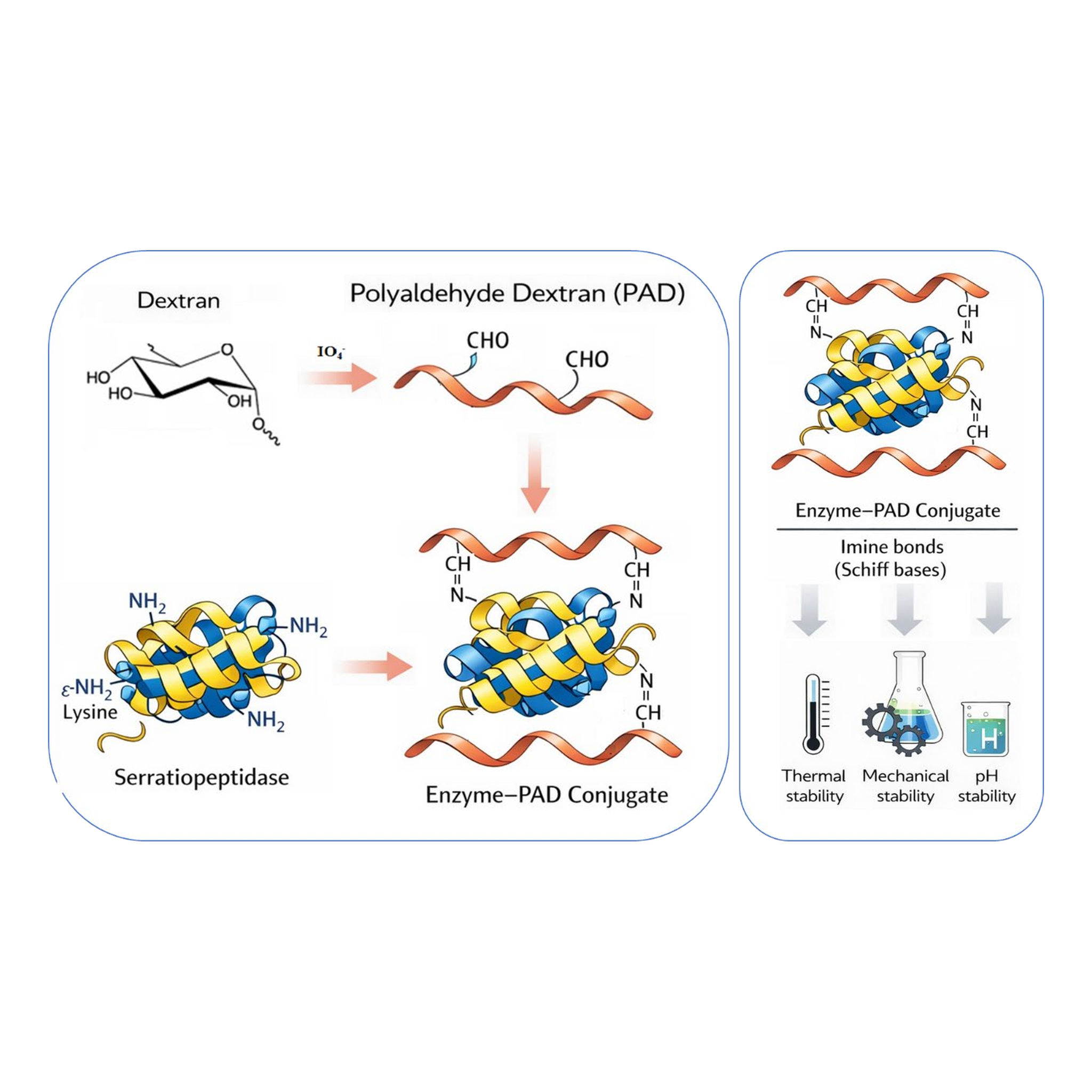
In this study, serratiopeptidase was covalently immobilized on polyaldehyde dextran (PAD) to improve handling stability and obtain a more reproducible proteolytic response under defined biochemical assay conditions. PAD was selected as a hydrophilic, water-soluble polysaccharide carrier because, unlike many particulate silica or inorganic supports, it permits mild aqueous Schiff-base coupling while providing a flexible hydrated microenvironment that may reduce enzyme self-association. PAD was prepared by periodate oxidation of dextran to an oxidation degree of approximately 25% - 30%, determined by hydroxylamine hydrochloride titration. Immobilization was performed at 20 - 25 °C for 6 - 24 h using enzyme-to-carrier ratios of 0.5 - 4.0 mg serratiopeptidase per 0.5 g PAD and coupling pH values of 4.0 - 10.0. Quantitative comparisons were performed as mean +/− SD from triplicate measurements and analyzed by one-way ANOVA with Tukey post hoc testing. The best functional balance was obtained at an enzyme-to-carrier ratio of 1:3 and pH 6.5 - 7.5, where apparent immobilization efficiency reached approximately 85% - 90% while proteolytic activity was retained. FTIR spectroscopy supported PAD formation and enzyme attachment through changes in aldehyde- and imine-associated bands, although these data are interpreted as supportive rather than conclusive structural proof. Casein digestion assays showed that PAD-immobilized serratiopeptidase produced a more proportional concentration-activity response and an apparent activity enhancement of 2.1 - 3.1-fold compared with the free enzyme. Apparent kinetic analysis gave Km values of approximately 0.52 mM for free serratiopeptidase and 0.84 mM for the immobilized preparation, with an apparent Vmax of about 0.96 umol/min for the immobilized form; kcat was not calculated because the catalytically accessible immobilized enzyme concentration was not directly determined. The immobilized preparation retained > 80% activity at pH 6.0 - 8.0, about 70% activity after 1 h at 50 °C, and about 85% activity after 30 days at 4 °C. These findings suggest that PAD is a useful polysaccharide carrier for stabilized serratiopeptidase systems, while future work should address direct leaching, reusability, substrate specificity, and application-specific validation.
HIGHLIGHTS
- Serratiopeptidase was covalently immobilized on polyaldehyde dextran via Schiff base
- Immobilization parameters were optimized to balance binding efficiency and catalytic
- The immobilized preparation showed a proportional concentration-activity response, with an apparent activity enhancement of 2.1 - 3.1-fold compared with the free enzyme under the tested assay conditions.
- The immobilized preparation retained > 80% activity at pH 6.0 - 8.0, about 70% activity after 1 h at 50 °C, and about 85% activity after 30 days at 4 °C.
- Polyaldehyde dextran provided a mild hydrophilic matrix for experimentally controllable serratiopeptidase stabilization and dosing.
GRAPHICAL ABSTRACT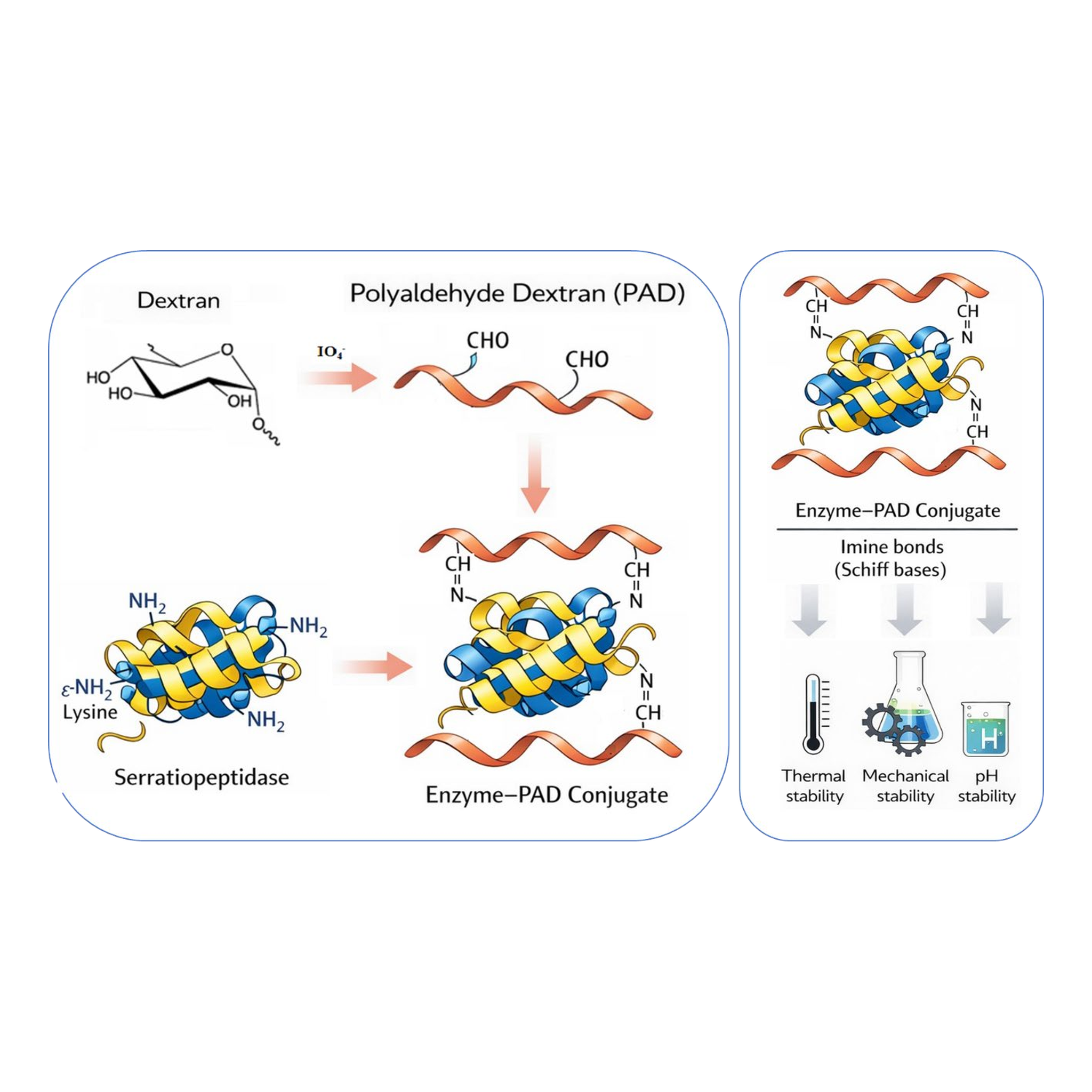
Downloads
References
HR Yang, MN Zahan, Y Yoon, K Kim, DH Hwang, WH Kim, IR Rho, E Kim and C Kang. Unveiling the potent fibrino(geno)lytic, anticoagulant, and antithrombotic effects of papain, a cysteine protease from Carica papaya latex using kappa-carrageenan rat tail thrombosis model. International Journal of Molecular Sciences 2023; 24(23), 16770.
C Sharma, NK Jha, MFN Meeran, CR Patil, SN Goyal and S Ojha. Serratiopeptidase, a serine protease anti-inflammatory, fibrinolytic, and mucolytic drug, can be a useful adjuvant for management in COVID-19. Frontiers in Pharmacology 2021; 12, 603997.
SR Nair and CS Devi. Serratiopeptidase: An integrated view of multifaceted therapeutic enzyme. Biomolecules 2022; 12(10), 1468.
J Bie, B Sepodes, PCB Fernandes and MHL Ribeiro. Enzyme immobilization and co-immobilization: Main framework, advances and some applications. Processes 2022; 10(3), 494.
RC Rodrigues, A Berenguer-Murcia, D Carballares, R Morellon-Sterling and R Fernandez-Lafuente. Stabilization of enzymes via immobilization: Multipoint covalent attachment and other stabilization strategies. Biotechnology Advances 2021; 52, 107821.
X Sun and F Jiang. Periodate oxidation-mediated nanocelluloses: Preparation, functionalization, structural design, and applications. Carbohydrate Polymers 2024; 341, 122305.
M Li, H Tang, X Geng, J Zhou, S Mou, C Li, J Chang, M Xu, C Wang, R Fu and Y Wang. All-natural hydrogel composed of carboxymethyl chitosan and oxidized dextran for promoting wound healing by immune-microenvironment regulation. Carbohydrate Polymers 2025; 347, 122731.
VG Tacias-Pascacio, D Castaneda-Valbuena, O Tavano, P Abellanas-Perez, D de Andrades, JA Santiz-Gomez, A Berenguer-Murcia and R Fernandez-Lafuente. A review on the immobilization of bromelain. International Journal of Biological Macromolecules 2024; 273, 133089.
JJ Melchor-Moncada, S Vasquez-Giraldo, A Zuluaga-Velez, LM Orozco, LA Veloza and JC Sepulveda-Arias. Bioconjugation of serratiopeptidase with titanium oxide nanoparticles: Improving stability and antibacterial properties. Journal of Functional Biomaterials 2024; 15(10), 300.
S Zafrida, SN Ethica, AR Ernanto and W Wijanarka. Optimization of crude protease production from Bacillus thuringiensis HSFI-12 and thrombolytic activity its enzyme dialysate. Trends in Sciences 2022; 19(23), 1952.
S Samaimai, S Krajangsang, V Kitpreechavanich, J Borthong and T Lomthong. Degradation of poly(butylene succinate) and poly(butylene succinate)/poly(lactide) blends using serine protease produced from Laceyella sacchari LP175. Trends in Sciences 2021; 18(20), 37.
T Panyachanakul, V Kitpreechavanich, W Lorliam and S Krajangsang. Improvement of thermo-stability and solvent tolerant property of Streptomyces sp. A3301 lipase by immobilization techniques with application in poly(lactic acid) polymerization by using biological process. Trends in Sciences 2024; 21(11), 8377.
AA Sudarta, PAP Sari, TC Halim and A Setiawati. Advances of chitosan-based hydrogel scaffolds for cartilage tissue engineering: Preparation, modification, and future perspective. Trends in Sciences 2024; 21(10), 8208.
MD Rossary, JKP Djunaedi, TP Riyantoro and A Setiawati. Tailoring strategy of chitosan-based hydrogel for improving wound healing: A systematic review. Trends in Sciences 2025; 22(11), 11023.
Fitriagustiani, AZ Mustopa, S Budiarti, MF Warsito, RD Pratiwi, DF Agustiyanti and M Nurfatwa. Formulation and characterization of alginate coated chitosan nanoparticles as therapeutic protein for oral delivery system. Trends in Sciences 2022; 19(18), 5797.
H Budi, AF Arsyada, H Saptono, K Soerja and K Azlan. Synthesis and characterization of chitosan-alginate hydrogel adsorbent for paracetamol removal from wastewater. Trends in Sciences 2025; 22(12), 10767.
LD Pangestu, IMD Mahariawan, M Fakhri, AR Faqih, A Yuniarti and AM Hariati. Optimization of polysaccharides matrix for enhancing physicochemical properties and stability of synbiotic encapsulation. Trends in Sciences 2026; 23(5), 11649.
P Lasopha and S Lasopha. Development of bacterial cellulose herbal wound dressing. Trends in Sciences 2024; 21(2), 7375.
O Akhmedov, J Abdurakhmanov, S Shomurotov, L You, A Turaev, J Makhkamov, O Radjabov and A Khusenov. New synthetic routes, wound healing and hemostatic properties of N-guanidinium chitosan. Trends in Sciences 2026; 23(4), 12110.
NNS Suhaimi, NA Zulkepli, F Salim, N Mokhtar, DDP Putri and MK YaKub. In vitro antibiofilm and anti-quorum sensing effects of bromelain against dual-species biofilms of Streptococcus mutans and Fusobacterium nucleatum. Trends in Sciences 2026; 23(6), 12398.
VG Tacias-Pascacio, C Ortiz, N Rueda, A Berenguer-Murcia, N Acosta, I Aranaz, C Civera, R Fernandez-Lafuente and AR Alcantara. Dextran aldehyde in biocatalysis: More than a mere immobilization system. Catalysts 2019; 9(7), 622.
T Prabhakar, J Giaretta, R Zulli, RJ Rath, S Farajikhah, S Talebian and F Dehghani. Covalent immobilization: A review from an enzyme perspective. Chemical Engineering Journal 2025; 503, 158054.
OH Lowry, NJ Rosebrough, AL Farr and RJ Randall. Protein measurement with the Folin phenol reagent. Journal of Biological Chemistry 1951; 193(1), 265-275.
J Charney and RM Tomarelli. A colorimetric method for the determination of the proteolytic activity of duodenal juice. Journal of Biological Chemistry 1947; 171(2), 501-505.
H Lineweaver and D Burk. The determination of enzyme dissociation constants. Journal of the American Chemical Society 1934; 56(3), 658-666.
Downloads
Published
How to Cite
Issue
Section
License
Copyright (c) 2026 Walailak University

This work is licensed under a Creative Commons Attribution-NonCommercial-NoDerivatives 4.0 International License.