
Histopathology of the Coffee Berry Borer Hypothenemus hampei (Ferrari) Infected by the Entomopathogenic Fungi Beauveria bassiana
DOI:
https://doi.org/10.48048/tis.2026.13692Keywords:
Beauveria bassiana, Coffee berry borer, Entomopathogenic fungi, Histopathology, Apoptosis, Biological control, Cuticle degradation, ThailandAbstract
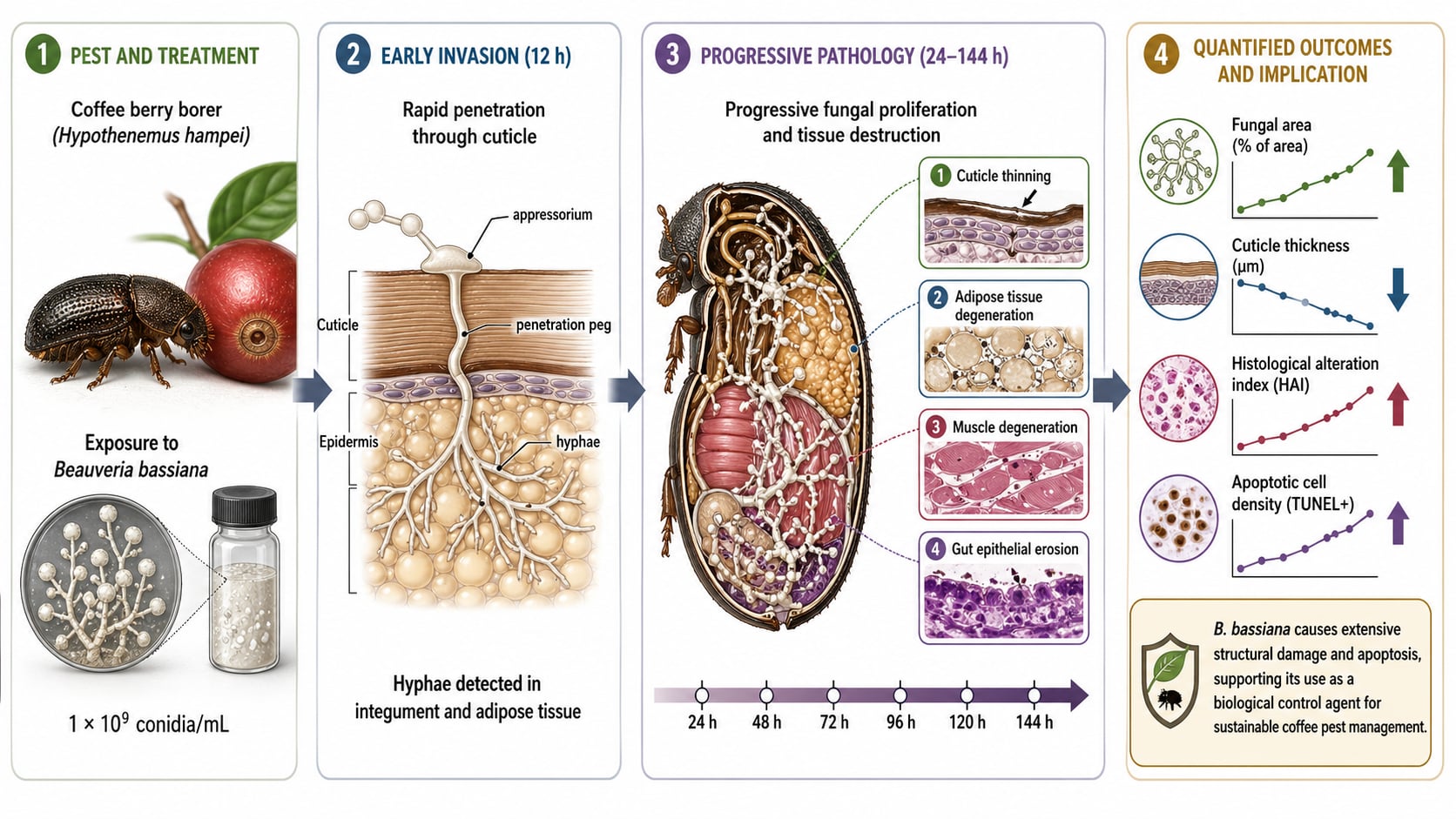
The coffee berry borer (Hypothenemus hampei) is one of the most destructive pests of coffee worldwide, causing severe economic losses. The entomopathogenic fungus Beauveria bassiana has been widely used as a biological control agent; however, detailed histopathological responses of H. hampei to fungal infection remain poorly understood. This study investigated the morpho-histopathological alterations and apoptosis in adult H. hampei following exposure to B. bassiana. Beetles were immersed in a spore suspension (1×10⁹ conidia/mL) and sampled at multiple time points up to 144 h post-exposure. Histological analyses were performed using hematoxylin-eosin, PAS, Masson’s trichrome, and Grocott’s methenamine silver staining. Apoptotic cells were detected using TUNEL assay, and tissue damage was evaluated using the histological alteration index (HAI). Fungal hyphae were detected in the integument and adipose tissue as early as 12 h post-exposure. From 24 to 144 h, progressive fungal proliferation, cuticle thinning, muscle degeneration, adipose tissue degeneration, and gut epithelial erosion were observed. Quantitative analysis revealed a significant increase in fungal area and a marked reduction in cuticle thickness (p < 0.001). Apoptotic cell density increased in a time-dependent manner, with strong immunoreactivity observed after 60 h. These findings demonstrate that B. bassiana rapidly penetrates and disrupts host tissues, leading to extensive structural damage and apoptosis. Understanding the infection dynamics of B. bassiana provides important insights for optimizing biological control strategies and enhancing sustainable pest management in coffee agroecosystems.
HIGHLIGHTS
- First detailed morpho-histopathological analysis ofBeauveria bassiana infection in Hypothenemus hampei.
- Rapid fungal penetration of the cuticle and adipose tissue were observed within 12 h post-exposure.
- Significant reduction in cuticle thickness and expansion of fungal area from 48 - 144 h.
- Time-dependent increase in histological alteration index (HAI) and apoptotic cell density.
- Findings clarify infection dynamics supporting the biological control development.
GRAPHICAL ABSTRACT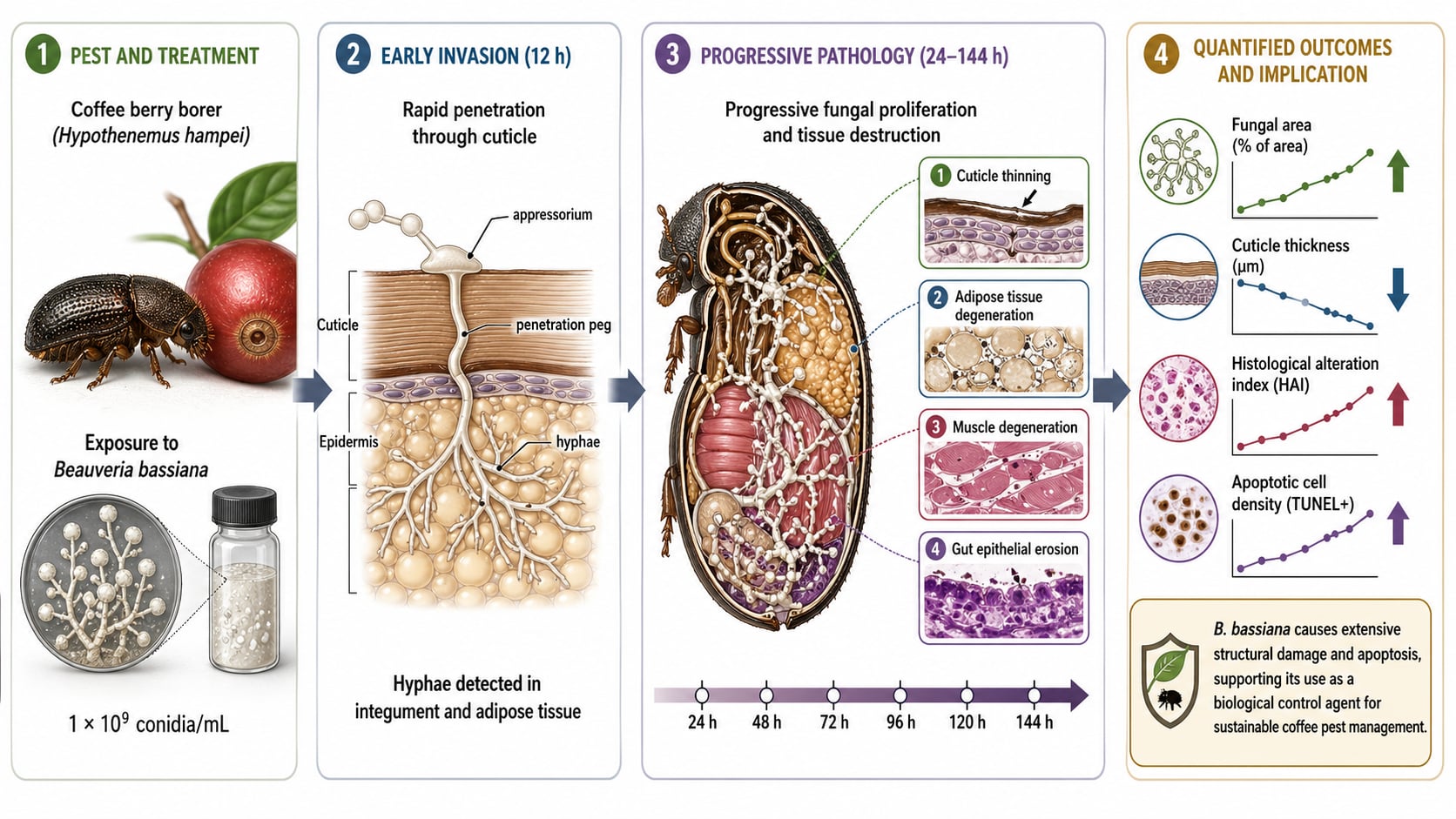
Downloads
References
MA Johnson, CP Ruiz-Diaz, NC Manoukis and JCV Rodrigues. Coffee berry borer (Hypothenemus hampei), a global pest of coffee: Perspectives from historical and recent invasions, and future priorities. Insects 2020; 11(12), 882.
JF Barrera. Coffee pests and their management. In: JL Capinera (Ed.). Encyclopedia of entomology. Springer, Dordrecht, Netherlands, 2008, p. 961-998.
P Benavides, C Góngora and A Bustillo. IPM program to control coffee berry borer Hypothenemus hampei, with emphasis on highly pathogenic mixed strains of Beauveria bassiana, to overcome insecticide resistance in Colombia. In: F Perveen (Ed.). Insecticides - advances in integrated pest management. IntechOpen, London, 2012, p. 511-540.
A Buranapanitchaphan and C Yaowaluk. Infestation of coffee berry borer and controlling efficiency of attractants. Journal of Agricultural Science 2014; 30, 223-231.
N Thaochan and A Chandrapatya. The phenotypic and metabolic properties of Metarhizium guizhouense on Corcyra cephalonica. Mycosphere 2016; 7(2), 214-225.
N Thaochan and A Ngampongsai. Effects of autodisseminated Metarhizium guizhouense PSUM02 on mating propensity and mating competitiveness of Bactrocera cucurbitae (Diptera: Tephritidae). Biocontrol Science and Technology 2015; 25(6), 629-644.
N Thaochan, A Ngampongsai, CS Prabhakar and Q Hu. Beauveria bassiana PSUB01 simultaneously displays biocontrol activity against Lipaphis erysimi (Kalt.) (Hemiptera: Aphididae) and promotes plant growth in Chinese kale under hydroponic growing conditions. Biocontrol Science and Technology 2021; 31(10), 997-1015.
W De LaRosa, R Alatorre, JF Barrera and C Toriello. Effect of Beauveria bassiana and Metarhizium anisopliae (Deuteromycetes) upon the coffee berry borer (Coleoptera: Scolytidae) under field conditions. Journal of Economic Entomology 2000; 93(5), 1409-1414.
S Paudel, S Mansfield, LF Villamizar, TA Jackson and SDG Marshall. Can biological control overcome the threat from newly invasive coconut rhinoceros beetle populations (Coleoptera: Scarabaeidae)? A review. Annual of the Entomological Society of America 2021; 114(2), 247-256.
LFC Ribeiro, J Tavares, SAV Silva, LFAA Alvez, EA Loth and RMC Brancalhão. Infection of silkworm larvae by the entomopathogenic fungus Metarhizium anisopliae. Crop Protection 2017; 47(4), e20151485.
Y Duan, H Wu, Z Ma, L Yang and D Ma. Scanning electron microscopy and histopathological observations of Beauveria bassiana infection of Colorado potato beetle larvae. Microbial Pathogenesis 2017; 111, 435-439.
CM Lacey, LA Lacey and DR Roberts. Route of invasion and histopathology of Metarhizium anisopliae in Culex quinquefasciatus. Journal of Invertebrate Pathology 1988; 52(1), 108-118.
R Ibrahim, S Alahmadi, YS Binnaser and D Shawer. Seasonal prevalence and histopathology of Beauveria bassiana infecting larvae of the leopard moth, Zeuzera pyrina L. (Lepidoptera: Cossidae). Egyptian Journal of Biological Pest Control 2019; 29(1), 65.
SM Smith, RA Beaver and AI Cognato. A monograph of the Xyleborini (Coleoptera, Curculionidae, Scolytinae) of the Indochinese Peninsula (except Malaysia) and China. ZooKeys 2020; 983, 1-442.
Thaochan, A Ngampongsai, CS Prabhakar and Q Hu Q. Beauveria bassiana PSUB01 simultaneously displays biocontrol activity against Lipaphis erysimi (Kalt.) (Hemiptera: Aphididae) and promotes plant growth in Chinese kale under hydroponic growing conditions. Biocontrol Science and Technology 2021; 31(10), 997-1015.
SK Suvarna, C Layton and JD Bancroft. Bancroft’s theory and practice of histological techniques. Elsevier, Amsterdam, Netherlands, 2013, p. 40-95.
A Pintong, S Ampawong, N Komalamisra, P Sriwichai, S Popruk and J Ruangsittichai. Insecticidal and histopathological effects of Ageratum conyzoides weed extracts against dengue vector, Aedes aegypti. Insects 2020; 11(4), 224.
DR Dietrich and HO Krieger. Histological analysis of endocrine disruptive effects in small laboratory fish. John Wiley & Sons, New Jersey, United States, 2009, p. 254-265.
MC Rojo and ME Gonzalez. In situ detection of apoptotic cells by TUNEL in the gill epithelium of the developing brown trout (Salmo trutta). Journal of Anatomy 1998; 193(3), 391-398.
DW Roberts and RA Humber. Etomogenous fungi. In: GT Cole and WB Kendrick (Eds.). The biology of conidial fungi. Academic Press, New York, 1981, p. 201-236.
RA de Souza, D Pratissoli, LM de A Junior, J de A Pinheiro, JO Ataíde, LAG Tamashiro, MA dos Santos and AP Damascena. Mortality of coffee berry borer, Hypothenemus hampei in field, with pre and post application of entomopathogenic fungus Beauveria bassiana (Balsamo) associated to emulsifiers. International Journal of Advanced Engineering Research and Science 2020; 7(5), 80-85.
FM Chang, HL Lu and YS Nai. Evaluation of potential entomopathogenic fungus, Beauveria bassiana, for controlling the coffee berry borer Hypothenemus hampei (Ferrari) (Coleoptera: Curculionidae) in Taiwan. Journal of Asia-Pacific Entomology 2023; 26(4), 102118.
Y Liu, Y Yang and B Wang. Entomopathogenic fungi Beauveria bassiana and Metarhizium anisopliae play roles of maize (Zea mays) growth promoter. Scientific Reports 2022; 12(1), 15706.
AV Toledo, AMM de Remes Lenicov and CC López Lastra. Histopathology caused by the entomopathogenic fungi, Beauveria bassiana and Metarhizium anisopliae, in the adult planthopper, Peregrinus maidis, a maize virus vector. Journal of Insect Science 2010; 10(1), 35.
B Deka, C Baruah and A Babu. Entomopathogenic microorganisms: their role in insect pest management. Egyptian Journal of Biological Pest Control 2021; 31(1), 121.
G Xiao, SH Ying, P Zheng, ZL Wang, S Zhang, XQ Xie, Y Shang, RJ Leger, GP Zhao, C Wang and MG Feng. Genomic perspectives on the evolution of fungal entomopathogenicity in Beauveria bassiana. Scientific Reports 2012; 2(1), 483.
AE Hajek and RJ St Leger. Interactions between fungal pathogens and insect hosts. Annual Review of Entomology 1994; 39(1), 293-322.
S Senarat, P Bunsap, P Poolprasert, A Inchan, N Charoenphon, P Sornying and N Thaochan. Histopathological study of host-pathogen interactions between Cordyceps javanica PSUC002 and Hypothenemus hampei. Journal of Fungi 2025; 11(6), 423.
Published
How to Cite
Issue
Section
License
Copyright (c) 2026 Walailak University

This work is licensed under a Creative Commons Attribution-NonCommercial-NoDerivatives 4.0 International License.





