
Synergistic Effects of Alpha-Pinene and D-Limonene on Negative Triple Breast Cancer Cell Death Through Enhanced ROS Level
DOI:
https://doi.org/10.48048/tis.2026.13679Keywords:
α-pinene, Cell survival, d-limonene, Reactive oxygen species, Triple-negative breast cancer cellsAbstract
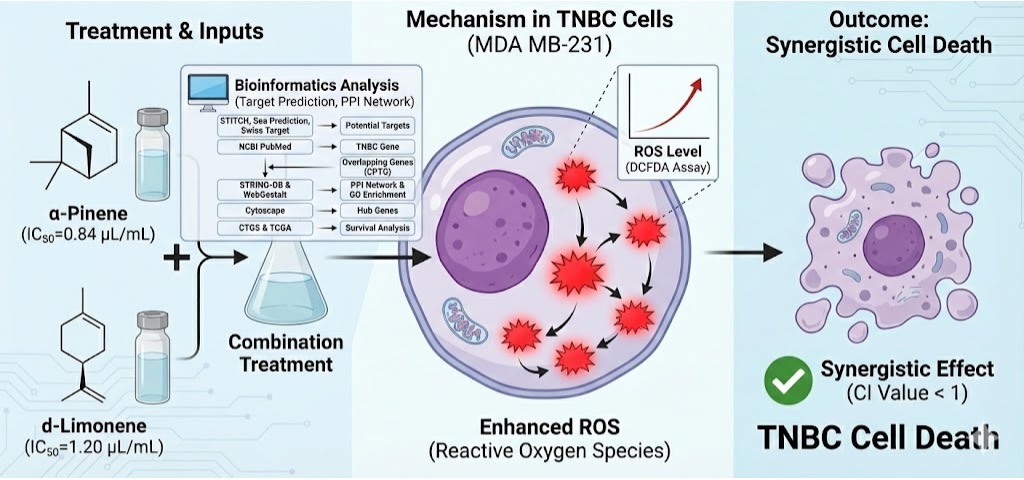
Triple-negative breast cancer (TNBC) accounts for approximately 10% - 15% of all breast cancers and is associated with high recurrence rates and poor prognosis, contributing disproportionately to breast cancer mortality worldwide. Its limited therapeutic options and aggressive behavior underscore the need for novel combinatorial strategies. α-Pinene and d-limonene have demonstrated anticancer activity in several models; however, their combined effects on TNBC remain unclear. This study aimed to evaluate the synergistic cytotoxic effects of α-pinene and d-limonene and predict their potential molecular targets in TNBC. Cytotoxicity of single and combined treatments was assessed in MDA-MB-231 cells using an MTT assay across defined concentration ranges, followed by combination analysis using the Chou-Talalay method. Intracellular reactive oxygen species (ROS) levels were measured using the DCFDA assay after specified treatment durations. Target prediction was conducted using SMILES-based similarity across STITCH, SEA, and SwissTargetPrediction, while TNBC-associated genes were curated from TCGA (via UALCAN) and literature sources. Overlapping genes were analyzed using WebGestalt for GO and KEGG enrichment, STRING for protein-protein interaction networks, and Cytoscape-CytoHubba for hub gene identification, with survival analysis performed using TCGA datasets. α-Pinene and d-limonene exhibited cytotoxic effects with IC50 values of 0.84 and 1.20 μL/mL, respectively. Combination treatment demonstrated synergism (CI < 1) and significantly increased ROS levels compared to single treatments (p < 0.05), indicating enhanced oxidative stress. Bioinformatics analysis identified the PPAR signaling pathway as enriched among predicted targets. Five hub genes (PPARG, NOS3, ESR1, PPARA, and CYP19A1) were associated with TNBC-related pathways and patient survival. These findings suggest that the combination of α-pinene and d-limonene may exert synergistic cytotoxic effects in TNBC cells, potentially through modulation of ROS and PPAR-related pathways. However, these mechanisms remain predictive and require further experimental validation.
HIGHLIGHTS
- Combined treatment significantly elevates intracellular ROS (DCFDA assay), exceeding single treatments
- The PPAR signaling pathway is enriched among CPTG, indicating critical for TNBC cell survival
- Top 5 hub genes PPARG, NOS3, ESR1, PPARA, CYP19A1, correlated with reduced TNBC survival
- The multitarget mechanism involves ROS accumulation, which disrupts the PPAR signaling pathway and modulates key hub genes (PPARG, NOS3, ESR1, PPARA, CYP19A1), ultimately triggering apoptosis in TNBC cells.
GRAPHICAL ABSTRACT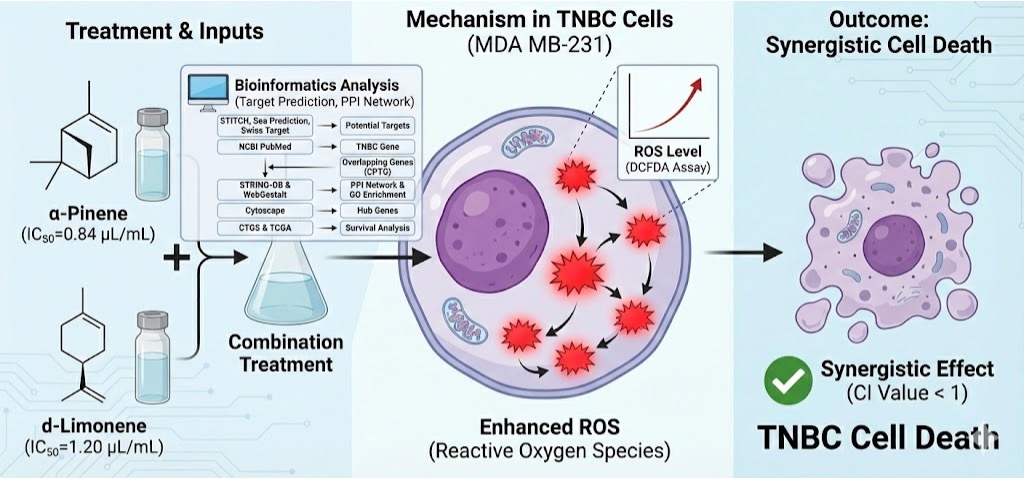
Downloads
References
GC Nwagu, S Bhattarai, M Swahn, S Ahmed and R Aneja. Prevalence and mortality of triple-negative breast cancer in West Africa: Biologic and sociocultural factors. JCO Global Oncology 2021; 7, 1129-1140.
KL Lee, YC Kuo, YS Ho and YH Huang. Triple-negative breast cancer: Current understanding and future therapeutic breakthrough targeting cancer stemness. Cancers 2019; 11(9), 1334.
CL Griffiths and JL Olin. Triple negative breast cancer: A brief review of its characteristics and treatment options. Journal of Pharmacy Practice 2012; 25(3), 319-323.
M Nedeljković and A Damjanović. Mechanisms of chemotherapy resistance in Triple-Negative breast Cancer-How we can rise to the challenge. Cells 2019; 8(9), 957.
B Lim, Y Greer, S Lipkowitz and N Takebe. Novel apoptosis-inducing agents for the treatment of cancer, a new arsenal in the toolbox. Cancers 2019; 11(8), 1087.
G Pistritto, D Trisciuoglio, C Ceci, A Garufi and G DʼOrazi. Apoptosis as anticancer mechanism: Function and dysfunction of its modulators and targeted therapeutic strategies. Aging 2016; 8(4), 603-619.
YA Larasati, N Yoneda-Kato, I Nakamae, T Yokoyama, E Meiyanto and JY Kato. Curcumin targets multiple enzymes involved in the ROS metabolic pathway to suppress tumor cell growth. Scientific Reports 2018; 8, 2039.
DY Choi, YJ Lee, JT Hong and HJ Lee. Antioxidant properties of natural polyphenols and their therapeutic potentials for Alzheimer’s disease. Brain Research Bulletin 2012; 87(2-3), 144-153.
P Farhadi, R Yarani, S Dokaneheifard and K Mansouri. The emerging role of targeting cancer metabolism for cancer therapy. Tumor Biology 2020; 42(10).
S Arfin, NK Jha, SK Jha, KK Kesari, J Ruokolainen, S Roychoudhury, B Rathi and D Kumar. Oxidative stress in cancer cell metabolism. Antioxidants 2021; 10(5), 642.
N Gautam, AK Mantha and S Mittal. Essential oils and their constituents as anticancer agents: A mechanistic view. BioMed Research International 2014; 2014, 154106.
N Koolaji, B Shammugasamy, A Schindeler, Q Dong, F Dehghani and P Valtchev. Citrus peel flavonoids as potential cancer prevention agents. Current Developments in Nutrition 2020; 4(5), nzaa025.
J Liu, J Bai, G Jiang, X Li, J Wang, D Wu, L Owusu, E Zhang and W Li. Anti-tumor effect of Pinus massoniana bark proanthocyanidins on ovarian cancer through induction of cell apoptosis and inhibition of cell migration. PLoS One 2015; 10(11), 0142157.
Y Tan, M Wang, K Yang, T Chi, Z Liao and P Wei. PPAR-α modulators as current and potential cancer treatments. Frontiers in Oncology 2021; 11, 599995.
Y Liu, JK Colby, X Zuo, J Jaoude, D Wei and I Shureiqi. The role of ppar-δ in metabolism, inflammation, and cancer: Many characters of a critical transcription factor. International Journal of Molecular Sciences 2018; 19(11), 3339.
A Ghorbani, M Nazari, M Jeddi-Tehrani and H Zand. The citrus flavonoid hesperidin induces p53 and inhibits NF-κB activation in order to trigger apoptosis in NALM-6 cells: Involvement of PPARγ-dependent mechanism. European Journal of Nutrition 2012; 51, 39-46.
YZ Chen, JY Xue, CM Chen, BL Yang, QH Xu, F Wu, F Liu, X Ye, X Meng, GY Liu, ZZ Shen, ZM Shao and J Wu. PPAR signaling pathway may be an important predictor of breast cancer response to neoadjuvant chemotherapy. Cancer Chemotherapy and Pharmacology 2012; 70, 637-644.
G Augimeri, C Giordano, L Gelsomino, P Plastina, I Barone, S Catalano, S Andò and D Bonofiglio. The role of PPARγ ligands in breast cancer: From basic research to clinical studies. Cancers 2020; 12(9), 2623.
Y Sakamoto, J Kanatsu, M Toh, A Naka, K Kondo and K Iida. The dietary isoflavone daidzein reduces expression of pro-inflammatory genes through PPARα/γ and JNK pathways in adipocyte and macrophage co-cultures. PLoS One 2016; 11(2), 0149678.
Q Xu, M Li, M Yang, J Yang, J Xie, X Lu, F Wang and W Chen. α-pinene regulates miR-221 and induces G2/M phase cell cycle arrest in human hepatocellular carcinoma cells. Bioscience Reports 2018; 38(6), 20180980.
D Hermansyah, DA Paramita, AM Muhar and ND Amalina. Curcuma longa extract inhibits migration by reducing MMP-9 and Rac-1 expression in highly metastatic breast cancer cells. Research in Pharmaceutical Sciences 2024; 19(2), 157-166.
DA Paramita, D Hermansyah, DA Paramita and ND Amalina. Regulation of p53 and survivin by Curcuma longa extract to caspase-3 dependent apoptosis in triple negative breast cancer cells. Med Glas 2022; 19(2), 189-196.
D Hermansyah, D Munir, A Lelo, A Putra and ND Amalina. The synergistic antitumor effects of curcuma longa and phyllanthus niruri extracts on promoting apoptotic pathways in breast cancer stem cells. The Thai Journal of Pharmaceutical Sciences 2022; 46(5), 541-550.
DN Gouveia, JS Costa, MA Oliveira, TK Rabelo, AM de Oliveira e Silva, AA Carvalho, R Miguel-Dos-Santos, S Lauton-Santos, L Scotti, MT Scotti, MRV dos Santos, LJ Quintans-Júnior, RLCDA Junior and AG Guimarães. α-Terpineol reduces cancer pain via modulation of oxidative stress and inhibition of iNOS. Biomedicine and Pharmacotherapy 2018; 105, 652-661.
X Yu, H Lin, Y Wang, W Lv, S Zhang, Y Qian, X Deng, N Feng, H Yu and B Qian. D-limonene exhibits antitumor activity by inducing autophagy and apoptosis in lung cancer. OncoTargets and Therapy 2018; 11, 1833-1847.
D Lipsa, P Leva, J Barrero-Moreno and M Coelhan. Inflammatory effects induced by selected limonene oxidation products: 4-OPA, IPOH, 4-AMCH in human bronchial (16HBE14o-) and alveolar (A549) epithelial cell lines. Toxicology Letters 2016; 262, 70-79.
D Hermansyah, A Putra, D Munir, A Lelo, ND Amalina and I Ali. Synergistic effect of Curcuma longa extract in combination with Phyllanthus niruri extract in Regulating Annexin A2, Epidermal Growth Factor Receptor, Matrix Metalloproteinases, and Pyruvate Kinase M1/2 signaling pathway on breast cancer stem cell. Open Access Macedonian Journal of Medical Sciences 2021; 9, 271-285.
H Moghtaderi, H Sepehri and F Attari. Combination of arabinogalactan and curcumin induces apoptosis in breast cancer cells in vitro and inhibits tumor growth via overexpression of p53 level in vivo. Biomedicine and Pharmacotherapy 2017; 88, 582-594.
ND Amalina, S Wahyuni and Harjito Cytotoxic effects of the synthesized Citrus aurantium peels extract nanoparticles against MDA-MB-231 breast cancer cells. Journal of Physics: Conference Series 2021; 1918, 032006.
S Mursiti, ND Amalina and A Marianti. Inhibition of breast cancer cell development using Citrus maxima extract through increasing levels of Reactive Oxygen Species (ROS). Journal of Physics: Conference Series 2021; 1918, 052005.
M Ikawati, RI Jenie, RY Utomo, ND Amalina, GPN Ilmawati, M Kawaichi and E Meiyanto. Genistein enhances cytotoxic and antimigratory activities of doxorubicin on 4T1 breast cancer cells through cell cycle arrest and ROS generation. Journal of Applied Pharmaceutical Science 2020; 10(10), 95-104.
B Cahyono, ND Amalina, M Suzery and DN Bima. Exploring the capability of Indonesia natural medicine secondary metabolite as potential inhibitors of SARS-CoV-2 proteins to prevent virulence of COVID-19: In silico and bioinformatic approach. Open Access Macedonian Journal of Medical Sciences 2021; 9, 336-342.
E Kang, DH Lee, YJ Jung, SY Shin, D Koh and YH Lee. α-Pinene inhibits tumor invasion through downregulation of nuclear factor (NF)-κB-regulated matrix metalloproteinase-9 gene expression in MDA-MB-231 human breast cancer cells. Applied Biological Chemistry 2016; 59, 511-516.
M Suzery, B Cahyono and ND Amalina. Citrus sinensis (L) peels extract inhibits metastasis of breast cancer cells by targeting the downregulation matrix metalloproteinases-9. Open Access Macedonian Journal of Medical Sciences 2021; 9, 464-469.
K Chandra Sekhar, A Rajanikanth, N Bobby and JR Kanala. Anticancer potential of d-limonene and hispolon against colon cancer cell lines. Current Trends in Biotechnology and Pharmacy 2020; 14(3), 302-310.
H Yang, RM Villani, H Wang, MJ Simpson, MS Roberts, M Tang and X Liang. The role of cellular reactive oxygen species in cancer chemotherapy. Journal of Experimental and Clinical Cancer Research 2018; 37, 266.
J Hou, Y Zhang, Y Zhu, B Zhou, C Ren, S Liang and Y Guo. α-Pinene induces apoptotic cell death via caspase activation in human ovarian cancer cells. Medical Science Monitor 2019; 25, 6631-6638.
HP Monteiro, EG Rodrigues, AKCA Reis, LSL Jr, FT Ogata, AIS Moretti, PE da Costa, ACS Teodoro, MS Toledo and A Stern. Nitric oxide and interactions with reactive oxygen species in the development of melanoma, breast, and colon cancer: A redox signaling perspective. Nitric Oxide 2019; 89, 1-13.
ND Amalina, M Suzery and B Cahyono. Cytotoxic activity of hyptis pectinata extracts on MCF-7 human breast cancer cells. Indonesian Journal of Cancer Chemoprevention 2020; 11(1), 1-6.
S Andriyani, K Rujitoningtyas, HU Wigati and ND Amalina. The potential of moringa leaf extract to prevent aging targeted cellular senescence. International Journal of Cell and Biomedical Science 2023; 1(3), 76-85.
D Fanale, V Amodeo, S Caruso. The interplay between metabolism, PPAR signaling pathway, and cancer. International Journal of Molecular Sciences 2017; 18(10), 2258.
L Tian, X Jiao, C Wang, D Li, A Ertel, J Achinger-Kawecka, S Addya, RE Soccio, ER Chen, B Győrffy, G Di Sante. PPARγ acetylation governs mammary adenocarcinoma tumor growth via acetylated residues that determine DNA sequence-specific binding. Oncogene. 2025; 44(37), 3476-92.
F Yin, S Wakino, Z Liu, S Kim, WA Hsueh, AR Collins, AJV Herle and RE Law. Troglitazone inhibits growth of MCF-7 breast carcinoma cells by targeting G1 cell cycle regulators. Biochemical and Biophysical Research Communications 2001; 286(5), 916-922.
K Nikhi, S Sharan, AK Singh, A Chakraborty and P Roy. Anticancer activities of pterostilbene-isothiocyanate conjugate in breast cancer cells: Involvement of PPARγ. PLoS One 2014; 9(8), 104592.
RI Jenie, ND Amalina, A Hermawan, M Suzery, A Putra and E Meiyanto. Caesalpinia sappan reduces the stemness of breast cancer stem cells involving the elevation of intracellular reactive oxygen species. Research in Pharmaceutical Sciences 2023; 18(6), 708-721.
ND Amalina, IA Salsabila, UM Zulfin, RI Jenie and E Meiyanto. In vitro synergistic effect of hesperidin and doxorubicin downregulates epithelial-mesenchymal transition in highly metastatic breast cancer cells. Journal of the Egyptian National Cancer Institute 2023; 35, 6.
J Gao, Q Liu, Y Xu, X Gong, R Zhang, C Zhou, Z Su, J Jin, H Shi, J Shi and Y Hou. PPARα induces cell apoptosis by destructing Bcl2. Oncotarget 2015; 6, 44635-44642.
HA Elrod and SY Sun. PPARγ and apoptosis in cancer. PPAR Research 2008; 2008, 704165.
KL Cook, PAG Clarke, J Parmar, R Hu, JL Schwartz-Roberts, M Abu-Asab, A Wärri, WT Baumann and R Clarke. Knockdown of estrogen receptor-α induces autophagy and inhibits antiestrogen-mediated unfolded protein response activation, promoting ROS-induced breast cancer cell death. FASEB Journal 2014; 28(9), 3891-3905.
MK Sundaram, MA Khan, U Alalami, P Somvanshi, T Bhardwaj, S Pramodh, R Raina, Z Shekfeh, S Haque and A Hussain. Phytochemicals induce apoptosis by modulation of nitric oxide signaling pathway in cervical cancer cells. European Review for Medical and Pharmacological Sciences 2020; 24(22), 11827-11844.
Downloads
Published
How to Cite
Issue
Section
License
Copyright (c) 2026 Walailak University

This work is licensed under a Creative Commons Attribution-NonCommercial-NoDerivatives 4.0 International License.





