
Enhanced Third Degree Burn Wound Healing by Hypoxic Mesenchymal Stem Cells' Secretome: IL-10 Upregulation and TNF-α/PGE2 Suppression
DOI:
https://doi.org/10.48048/tis.2024.8288Keywords:
Mesenchymal stem cells, IL-10, TNF-α, PGE2, Third degree burn woundAbstract
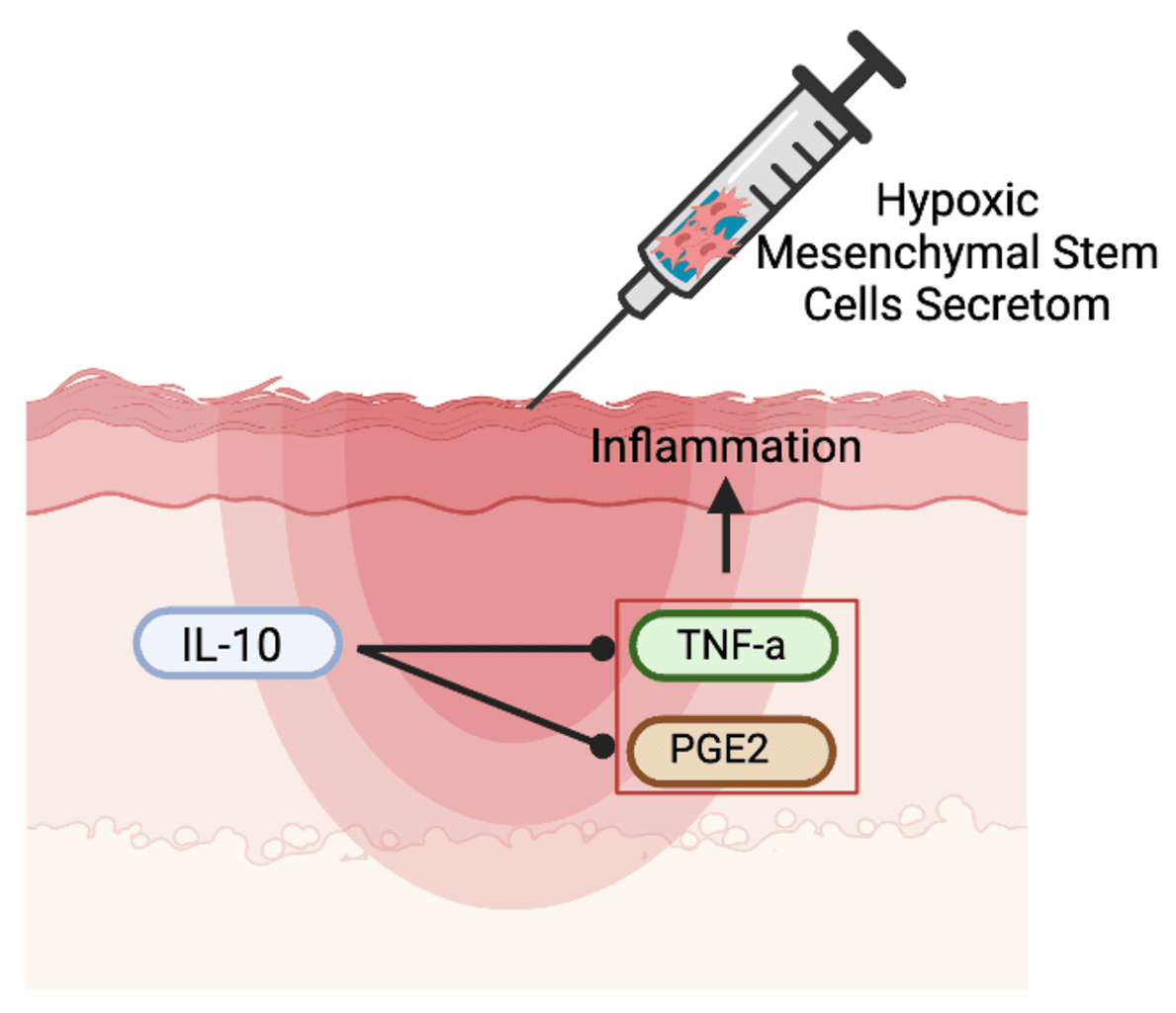
Background: Severe third-degree burns pose a notable obstacle in clinical settings, frequently leading to hindered healing of wounds and the development of scars. In this research, we explored how the secretome of hypoxic mesenchymal stem cells (HS-MSCs) could be improved the healing of burn wounds. Methods: In this study, we used 20 male Wistar rats that induced third degree wound by metal 80 exposure for 10 s. These rats divided into 4 groups: Healthy, control, HS-MSCs 100 µL, and HS-MSCs 200 µL groups. We injected the HS-MSCs, which carry various beneficial molecules like IL-10, TGF-β, PDGF, and VEGF, directly into the skin in a third-degree burn rat model on day 1 after burn induction, and harvest on day 14. Results: Our research discovered that using HS-MSCs resulted in a dosage-related rise in IL-10, an anti-inflammatory cytokine, alongside a notable decrease in TNF-α and PGE2, pro-inflammatory cytokines. These effects quickened the healing process by improving re-epithelialization and minimizing scar formation. Conclusions: Our findings indicate that HS-MSCs show promise as a treatment for severe burns by potentially controlling inflammation and fostering a regenerative healing process. More investigation is needed to understand the exact mechanisms and to explore how HS-MSCs could be applied in clinical treatments.
HIGHLIGHTS
- HS-MSCs suppress inflammation and promote regenerative healing in severe burns
- HS-MSCs accelerated re-epithelialization and reduced scarring
GRAPHICAL ABSTRACT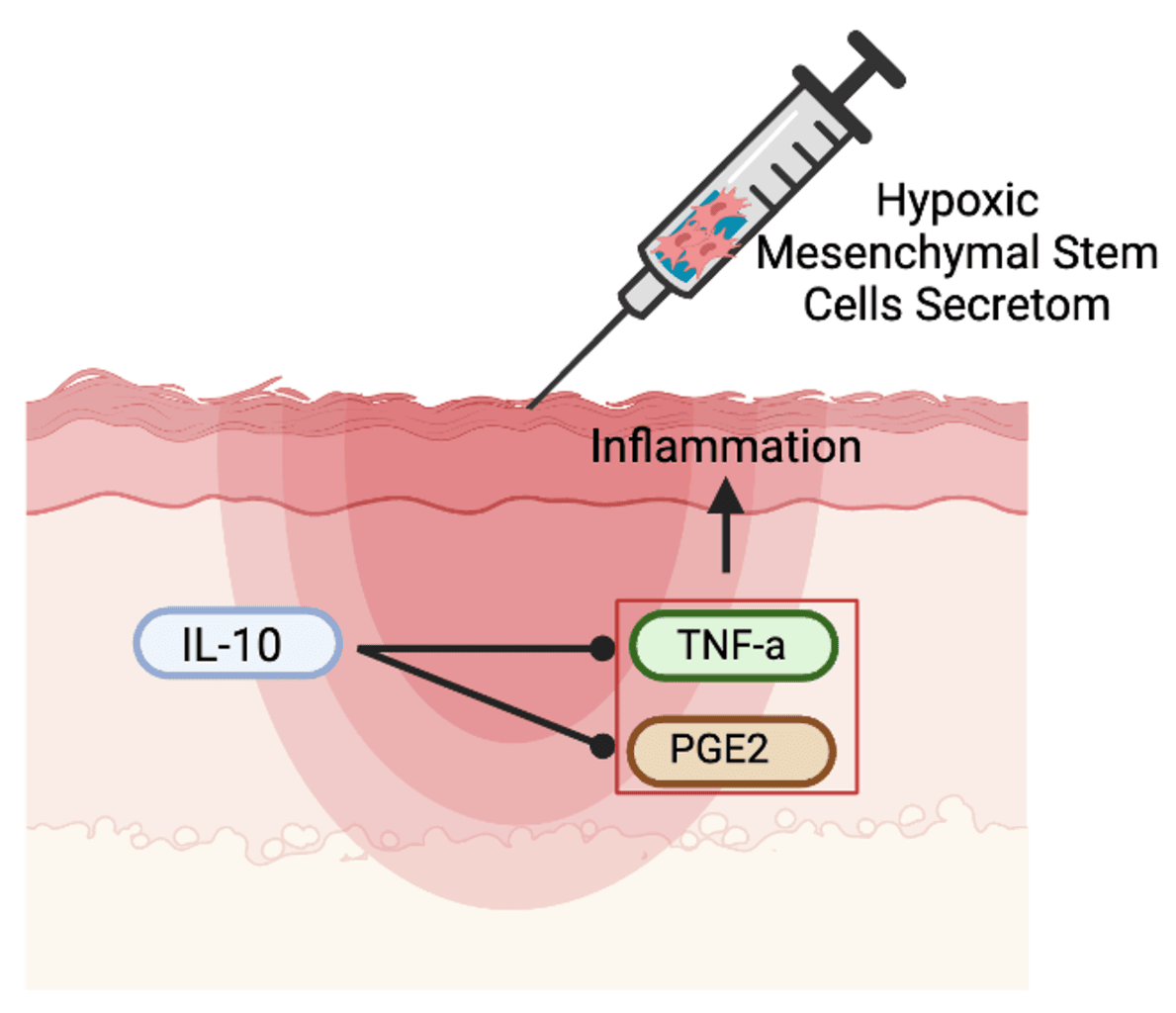
Downloads
References
G Jeschke, R Pinton, R Kraft, AB Natheste, CC Finnerty, RL Gamelli, NS Gibran MB Klein, BD Aroldo, RG Tompkins and DN Herndon. Morbidity and survival probability in burn patients in modern burn care. Crit. Care Med. 2015; 43, 808-15.
NA Forbinake, CS Ohandza, KN Fai, VN Agbor, BK Asonglefac, D Aroke and G Beyiha. Mortality analysis of burns in a developing country: A CAMEROONIAN experience. BMC Publ. Health 2020; 20, 1269.
ME Braza and MP Fahrenkopf. Split-thickness skin graft. StatPearls Publishing, Florida, 2024.
Q Zhai, F Zhou, MM Ibrahim, J Zhao, X Liu, J Wu, L Chen and S Qi. An immune-competent rat split thickness skin graft model: Useful tools to develop new therapies to improve skin graft survival. Am. J. Transl. Res. 2018; 10, 1600-10.
S Reddy, F El-Haddawi, M Fancourt, G Farrant, W Gilkison, N Henderson, S Kyle and D Mosquera. The incidence and risk factors for lower limb skin graft failure. Dermatol. Res. Pract. 2014; 2014, 582080.
ME Mohamed, B Almobarak and M Hassan. Treatment of extensive post-burn deformities using extra-large sheets of full thickness skin grafts. Clin. Pract. 2017; 14, 249-56.
OF Osman and S Emara. Extended use of full-thickness skin grafts, employing variable donor sites. World J. Plast. Surg. 2018; 7, 159-65.
P Wu, B Zhang, H Shi, H Qian and W Xu. MSC-exosome: A novel cell-free therapy for cutaneous regeneration. Cytotherapy 2018; 20, 291-301.
X He, Z Dong, Y Cao, H Wang, S Liu, L Liao, Y Jin, L Yuan and B Li. MSC-derived exosome promotes M2 polarization and enhances cutaneous wound healing. Stem Cells Int. 2019; 2019, 7132708.
G Zhao, F Liu, Z Liu, K Zuo, B Wang, Y Zhang, X Han, A Lian, Y Wang, M Liu, F Zou, P Li, X Liu, M Jin and JY Liu. MSC-derived exosomes attenuate cell death through suppressing AIF nucleus translocation and enhance cutaneous wound healing. Stem Cell Res.Ther. 2020; 11, 147.
GD Prayitno, K Lestari, CR Sartika, T Djuwantono, A Widjaya, R Muharam, YM Hidayat, D Wulandari, R Haifa, NF Naura, KT Marbun and A Zahrah. Potential of mesenchymal stem cells and their secretomes in decreasing inflammation markers in polycystic ovary syndrome treatment: A systematic review. Medicines 2022; 10, 3.
P Ahangar, SJ Mills and AJ Cowin. Mesenchymal stem cell secretome as an emerging cell-free alternative for improving wound repair. Int. J. Mol. Sci. 2020; 21, 7038.
X Rong, J Li, Y Yang, Y Shi and T Jiang. Human fetal skin-derived stem cell secretome enhances radiation-induced skin injury therapeutic effects by promoting angiogenesis. Stem Cell Res. Ther. 2019; 10, 383.
A Putra, FB Ridwan, AI Putridewi, AR Kustiyah, K Wirastuti, NAC Sadyah, I Rosdiana and D Munir. The role of tnf-α induced mscs on suppressive inflammation by increasing tgf-β and il-10. Open Access Maced. J. Med. Sci. 2018; 6, 1779-83.
A Putra, I Alif, MA Nazar, A Prasetio, RC Chandra, S Irawan, D Amalina, EP Sari, AR Kustiyaah and IPA Nasution. IL-6 and IL-8 suppression by bacteria-adhered mesenchymal stem cells co-cultured with PBMCs under TNF-α exposure. Scitepress 2021; 1, 311-7.
L Restimulia, S Ilyas, D Munir, A Putra, T Madiadipoera, F Farhat, RJ Sembriring, M Ichwan and ND Amalina. The CD4+CD25+FoxP3+ regulatory T cells regulated by MSCs suppress plasma cells in a mouse model of allergic rhinitis. Med. Arch. 2021; 75, 256-61.
L Restimulia, S Ilyas, D Munir, A Putra, T Madiadipoera, F Farhat, RJ Sembiring, M Ichwan and ND Amaalina. Rats’ umbilical-cord mesenchymal stem cells ameliorate mast cells and Hsp70 on ovalbumin-induced allergic rhinitis rats. Medicinski Glasnik 2022; 19, 52-9.
MD Darlan, D Munir, A Putra, I Alif, ND Amalin, NK Jusuf and IB Rutra. Revealing the decrease of indoleamine 2,3-dioxygenase as a major constituent for B cells survival post-mesenchymal stem cells co-cultured with peripheral blood mononuclear cell (PBMC) of systemic lupus erythematosus (SLE) patients. Medicinski Glasnik 2022; 19, 12-8.
YW Prajoko, A Putra, BT Dirja, AM Muhar and ND Amalina. The ameliorating effects of MSCs in controlling treg-mediated B-cell depletion by indoleamine 2, 3-dioxygenase induction in PBMC of SLE patients. Open Access Maced. J. Med. Sci. 2022; 10, 6-11.
E Daryanti, A Putra, T Sumarawati, ND Amalina, A Prasetio and HA Sidiq. The comparison of normoxic and hypoxic mesenchymal stem cells in regulating platelet-derived growth factors and collagen serial levels in skin excision animal models. Open Access Maced. J. Med. Sci. 2023; 11, 181-7.
A Utami, A Putra, JW Wibowo, ND Amalina and RCS Irawan. Hypoxic secretome mesenchymal stem cells inhibiting interleukin-6 expression prevent oxidative stress in type 1 diabetes mellitus. Medicinski Glasnik 2023; 20, 148-55.
Z Zukhiroh, A Putra, C Chodidjah, T Sumarawati, P Subchan, S Trisnadi, N Hidayah and ND Amalina. Effect of secretome-hypoxia mesenchymal stem cells on regulating SOD and MMP-1 mRNA expressions in skin hyperpigmentation rats. Open Access Maced. J. Med. Sci. 2022; 10, 1-7.
M Fredianto, H Herman, YD Ismiarto, A Putra, I Alif, ND Amalina and MA Nazar. Secretome of hypoxia-preconditioned mesenchymal stem cells enhance the expression of HIF-1a and bFGF in a rotator cuff tear model. Medicinski Glasnik 2023; 20, 242-8.
H Sunarto, S Trisnadi, A Putra, NAC Sa’dyah, A Tjipta and C Chodidjah. The role of hypoxic mesenchymal stem cells conditioned medium in increasing vascular endothelial growth factors (VEGF) levels and collagen synthesis to accelerate wound healing. Indones. J. Cancer Chemoprevent. 2020; 11, 134-43.
T Sungkar, A Putra, D Lindarto and RJ Sembiring. Intravenous umbilical cord-derived mesenchymal stem cells transplantation regulates hyaluronic acid and interleukin-10 secretion producing low-grade liver fibrosis in experimental rat. Med. Arch. 2020; 74, 177-82.
P Drawina, A Putra, T Nasihun, YW Prajok, BT Dirja and ND Amalina. Increased serial levels of platelet‐derived growth factor using hypoxic mesenchymal stem cell‐conditioned medium to promote closure acceler‐ ation in a full‐thickness wound. Indones. J. Biotechnol. 2022; 27, 36-42.
X Fu, L Fang, X Li, B Cheng and Z Sheng. Enhanced wound-healing quality with bone marrow mesenchymal stem cells autografting after skin injury. Wound Repair Regen. 2006; 14, 325-35.
M Saraiva and O’Garra. The regulation of IL-10 production by immune cells. Nat. Rev. Immunol. 2010; 10, 170-81.
S Yang, M Park, I Yoon, S Kim, S Hong, J Shin, H Nam, Y Kim, B Kim and C Park. Soluble mediators from mesenchymal stem cells suppress T cell proliferation by inducing IL-10. Exp.Mol. Med. 2009; 41, 315-24.
S Veenbergen, P Li, HC Raatgeep, DJ Lindenbergh-Kortleve, Y Simons-Oosterhuis, A Farrel, LMM Costes, ME Joosse, LA Freeman, Y Wakabayashi, J Zhu, LD Ridder, GJ Driessen, JC Escher, WJ Leonard and JN Samsom. IL-10 signaling in dendritic cells controls IL-1β-mediated IFNγ secretion by human CD4+ T cells: Relevance to inflammatory bowel disease. Mucosal Immunol. 2019; 12, 1201-11.
A Aryan, M Bayat, S Bonakdar, S Taheri, N Haghparast, M Bagheri, A Piryaei and M Abdollahifar. Human bone marrow mesenchymal stem cell conditioned medium promotes wound healing in deep second-degree burns in male rats. Cells Tissues Organs 2019; 206, 317-29.
Y Li, WD Xia, LVD Merwe, WT Dai and C Lin. Efficacy of stem cell therapy for burn wounds: A systematic review and meta-analysis of preclinical studies. Stem Cell Res. Ther. 2020; 11, 322.
KL Singampalli, S Balaji, X Wang,UM Parikh, A Kaul, J Gilley, RK Birla, PL Bollyky and SG Kesani. The role of an IL-10/Hyaluronan axis in dermal wound healing. Front. Cell Dev. Biol. 2020; 8, 636.
P Wipff, DB Rifkin, J Meister and B Hinz. Myofibroblast contraction activates latent TGF-β1 from the extracellular matrix. J. Cell Biol. 2007; 179, 1311-23.
AV Shinde, C Humeres and NG Frangogiannis. The role of α-smooth muscle actin in fibroblast-mediated matrix contraction and remodeling. Biochim. Biophys. Acta Mol. Basis Dis. 2017; 1863, 298-309.
S Riis, R Newman, H Ipek, JI Andersen, D Kuninger, S Boucher, MC Vemuri, CP Pennisi, V Zachar and T Fink. Hypoxia enhances the wound-healing potential of adipose-derived stem cells in a novel human primarykeratinocyte-based scratch assay. Int. J. Mol. Med. 2017; 39, 587-94.
JL Henriksen, NB Sørensen, T Fink, V Zachar and SR Porsborg. Systematic review of stem-cell-based therapy of burn wounds: lessons learned from animal and clinical studies. Cells 2020; 9, 2545.
A Tsuchiya, S Takeuchi, T Watanabe, T Yoshida, S Nojiri, M Ogawa and S Terai. Mesenchymal stem cell therapies for liver cirrhosis: MSCs as “conducting cells” for improvement of liver fibrosis and regeneration. Inflamm. Regen. 2019; 39, 1-6.
A Putra, D Pertiwi, MN Milla, UD Indrayani, D Jannah, M Sahariyani, S Trisnadi and JW Wibowo. Hypoxia-preconditioned MSCs have superior effect in ameliorating renal function on acute renal failure animal model. Open Access Maced. J. Med. Sci. 2019; 7, 305-10.
K English, JM Ryan, L Tobin, MJ Murphy, FP Barry and BP Mahon. Cell contact, prostaglandin E2 and transforming growth factor beta 1 play non-redundant roles in human mesenchymal stem cell induction of CD4+CD25Highforkhead box P3+ regulatory T cells. Clin. Exp. Immunol. 2009; 156, 149-60.
YW Prajoko, A Putra, A Prasetio and ND Amalina. Hypoxic mesenchymal stem cells (MSCS)-induced interleukin (IL)-10 alleviate systemic lupus erythematosus (SLE) infl ammation through inhibiting interferon (IFN)-gamma production. Medicinski Glasnik 2024; 21, 20-7.
W Widyaningsih, A Putra, S Priyantini, AM Muhar, T Sumarawati, S Trisnadi, ND Amalina, I Alif, A Prasetio and RC Irawan. Secretome of Hypoxia-Preconditioned Mesenchymal Stem Cells Ameliorates Hyperglycemia in Type 2 Diabetes Mellitus Rats. Trends Sci. 2024; 21, 7278.
AM Muhar, A Putra, SM Warli and D Munir. Hypoxia-mesenchymal stem cells inhibit intra-peritoneal adhesions formation by upregulation of the il-10 expression. Open Access Maced. J. Med. Sci. 2019; 7, 3937-43.
Downloads
Published
How to Cite
Issue
Section
License
Copyright (c) 2024 Walailak University

This work is licensed under a Creative Commons Attribution-NonCommercial-NoDerivatives 4.0 International License.





