Integrated In Vitro and In Silico Evaluation of the Vasorelaxant Mechanisms of Pulicarin and Chrysoeriol via Modulation of Ca²⁺ Entry in Rat Aortic Smooth Muscle
DOI:
https://doi.org/10.48048/tis.2027.13371Keywords:
Vasorelaxation, Voltage-dependent Ca2 channels, Receptor-operated Ca2 channels, Pulicarin, Chrysoeriol, Aortic smooth muscleAbstract
Flavonoids are increasingly recognized for their vasoprotective properties, yet the precise molecular mechanisms underlying their vascular actions remain insufficiently defined. This study examined the vasorelaxant effects of two naturally occurring flavonoids, pulicarin and chrysoeriol, combining functional in vitro assays with in silico molecular docking. In isolated rat aortic rings, both compounds produced a clear concentration-dependent inhibition of KCl (50 mM)-induced contraction, a model that selectively activates voltage-dependent Ca²⁺ channels (VDCCs). Pulicarin reduced contraction by 7.9 ± 3.2% at 5 µM and 72.8 ± 3.1% at 30 µM (IC₅₀ = 17.58 µM), whereas chrysoeriol produced 3.1 ± 3.9% and 74.8 ± 3.2% relaxation at the same concentrations (IC₅₀ = 18.18 µM). Co-incubation with verapamil further diminished KCl-evoked contraction, indicating partial overlap with classical VDCC blockade. In phenylephrine-stimulated rings, both flavonoids markedly suppressed receptor-operated Ca²⁺ channel (ROCC)-mediated contraction, reducing phentolamine-resistant tone to 37.5 ± 4.2% and 39.7 ± 3.6%, respectively. In endothelium-intact tissues, pulicarin and chrysoeriol produced robust relaxation (74.6 ± 3.3% and 72.4 ± 3.6%), which was significantly attenuated in endothelium-denuded preparations and in the presence of L-NAME, demonstrating partial dependence on endothelial nitric oxide signaling. Docking analyses revealed high-affinity binding of both flavonoids to VDCC pore-forming regions and regulatory residues, supporting their inhibitory action on Ca²⁺ influx. Collectively, these findings indicate that pulicarin and chrysoeriol exert potent vasorelaxant effects via combined VDCC and ROCC inhibition together with endothelium-dependent NO signaling.
HIGHLIGHTS
- Pulicarin and chrysoeriol exhibit potent concentration-dependent vasorelaxant activity in isolated rat aortic rings.
- Both flavonoids effectively inhibit KCl-induced contraction, indicating direct modulation of voltage-dependent Ca²⁺ channels (VDCCs).
- Receptor-operated Ca²⁺ entry is markedly suppressed, as demonstrated by significant reduction of phenylephrine-evoked, phentolamine-resistant tone.
- Endothelium-dependent nitric oxide signaling partially contributes to the vasorelaxant effects, as evidenced by attenuation after endothelium removal and L-NAME treatment.
- In silico molecular docking confirms high-affinity binding of pulicarin and chrysoeriol to key VDCC pore-forming and regulatory residues.
- Integrated in vitro and in silico analyses reveal a dual mechanism of action, combining Ca²⁺ channel inhibition with endothelial NO-mediated vasodilation.
GRAPHICAL ABSTRACT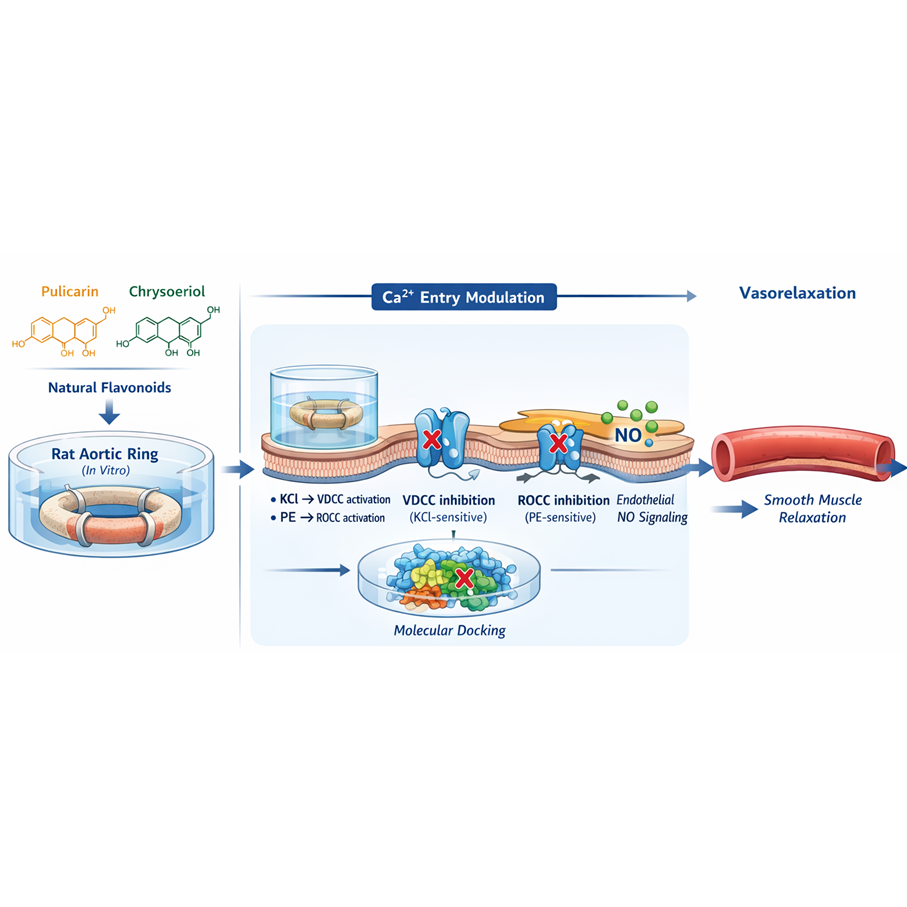
Downloads
References
I Abdullaev, U Gayibov, S Omonturdiev, S Fotima, S Gayibova and T Aripov. Molecular pathways in cardiovascular disease under hypoxia: Mechanisms, biomarkers, and therapeutic targets. The Journal of Biomedical Research 2025; 39(3), 254-269.
I Abdurazakova, A Zaynabiddinov, I Abdullaev, U Gayibov, Z Ziyoyiddinov, L Maxmudov and S Zhurakulov. Hemodynamic and molecular effects of F-43 in experimental hypertension. Trends in Sciences 2026; 23(7), 12698.
AV Mahmudov, OS Abduraimov, SB Erdonov, UG Gayibov and LY Izotova. Bioecological features of Nigella sativa L. in different conditions of Uzbekistan. Plant Science Today 2022; 9(2), 421-426.
AA Azamatov, FM Tursunkhodzhaeva, SN Zhurakulov, ZD Boboev, KF Kuchimov, UK Aytmuratova, IS Ortikov, RS Abdurazakova, VI Vinogradova, IZ Abdullaev and UG Gayibov. Anti-Inflammatory Potential of 1-Aryl-6,7-Dimethoxy-1,2,3,4-Tetrahydroisoquinolines: Structure-Activity Relationship and COX-2 Binding. Molecules 2026; 31(11), 1956.
L Makhmudov, N Tagayalieva, I Abdullaev, U Gayibov, K Baratov, S Usmonov, G Rakhmonova, R Yaqubova, N Vypova and S Karimova. In silico Pharmacokinetics and In vivo Anti-inflammatory Activity of C-4 Composition. Biomedical and Pharmacology Journal 2026; 19(1), 410-427.
A Abdullaev, I Abdullaev, A Bogbekov, U Gayibov, S Omonturdiev, S Gayibova, M Turahodjayev, K Ruziboev and T Aripov. Antioxidant potential of Rhodiola heterodonta extract: Activation of Nrf2 pathway via integrative in vivo and in silico studies. Trends in Sciences 2025; 22(5), 9521.
G Mirzaalimova, A Zaynabiddinov, S Omonturdiev, D Inomjonov, I Abdullaev, U Gayibov and M Kholmirzayeva. In silico and In vitro Activity of Leonurus turkestanicus on the Aortic Smooth Muscle Ion Channels. Trends in Sciences 2026; 23(5), 12146.
D Inomjonov, I Abdullaev, S Omonturdiev, A Abdullaev, L Maxmudov, M Zaripova, M Abdullayeva, D Abduazimova, S Menglieva, S Gayibova, M Sadbarxon, U Gayibov and T Aripov. In vitro and in vivo studies of Crataegus and Inula helenium extracts: Their effects on rat blood pressure. Trends in Sciences 2025; 22(3), 9158.
S Sodiqova, S Kadirova, A Zaynabiddinov, I Abdullaev, L Makhmudov, U Gayibov, M Yuldasheva, M Xolmirzayeva, R Rakhimov, A Mutalibov and H Karimjonov. Channelopathy activity of A-41 (propyl ester of gallic acid): Experimental and computational study of antihypertensive activity. Trends in Sciences 2025; 22(9), 10496.
R Sayidaliyeva, S Kadirova, A Zaynabiddinov, I Abdullaev, L Makhmudov, U Gayibov, M Yuldasheva, M Kholmirzayeva, R Rakhimov, A Mutalibov and H Karimjonov. A-51 as a natural calcium channel blocker: An integrative study targeting hypertension. Trends in Sciences 2025; 22(11), 10760.
A Khasanov, I Abdullaev, S Kadirova, M Mamajanov, A Zaynabiddinov, S Omonturdiev, L Makhmudov, D Inomjonov, U Gayibov, R Esanov and A Matchanov. N-2 polyphenol targets vascular calcium channels to exert antihypertensive effects: In vitro and in vivo evaluation. Trends in Sciences 2025; 22(12), 10782.
Y Mirzayeva, I Abdullaev, U Gayibov, S Omonturdiev, Z Allaniyazova, S Umrkulova and P Usmanov. In Vitro and Computational Evaluation of 1-O-Benzoylkarakoline on Vascular Calcium Transport. Trends in Sciences 2025; 23(3), 11850.
M Zaripova, I Abdullaev, A Bogbekov, U Gayibov, S Omonturdiev, R Makhmudov, N Ergashev, G Jabbarova, S Gayibova and T Aripov. In vitro and in silico studies of Gnaphalium uliginosum extract: Inhibition of α-amylase and α-glucosidase as a potential strategy for metabolic syndrome regulation. Trends in Sciences 2025; 22(8), 10098.
S Omonturdiev, I Abdullaev, A Khasanov, A Abdullaev, D Inomjanov, U Gayibov, S Gayibova, K Baratov, Y Mirzaeva, M Allamuratov, P Usmanov and T Aripov. Molecular Mechanisms and Experimental Protocols in the Study of Vasorelaxant Activity in Aortic Smooth Muscle Cells. Trends in Sciences, 2025; 23(2), 11549.
I Abdurazakova, A Zaynabiddinov, I Abdullaev, L Makhmudov, U Gayibov, S Omonturdiev, G Abdullayev, M Xolmirzayeva and S Zhurakulov. Pharmacological Evaluation of F45 on the Cardiovascular System Using In Vitro, In Vivo Models and Molecular Dockings. Trends in Sciences, 2025; 22(12), 10924.
MR Zaripova, SN Gayibova, RR Makhmudov, AA Mamadrahimov, NL Vypova, UG Gayibov, SM Miralimova and TF Aripov. Characterization of Rhodiola heterodonta (Crassulaceae): Phytocomposition, antioxidant and antihyperglycemic activities. Preventive Nutrition and Food Science 2024; 29(2), 135-145.
S Sodiqova, A Zaynabiddinov, I Abdullaev, U Gayibov and Z Ziyoyiddinov. Antihypertensive Effects of Compound A-42 via Regulation of Calcium-Dependent Ion Transport Systems. Trends in Sciences, 2026; 23(9), 12797.
G Yao, X Zheng, Y Hu, Y Zhao, B Kong, Y Ti and PL Bu. FBLN7 mediates vascular smooth muscle cell phenotype switching and vascular remodeling in hypertension. Theranostics 2024; 14(19), 7569-7588.
TF Aripov, UG Gayibov, SN Gaibova, YI Oshchepkova and SI Salikhov. In vitro antioxidant and antiradical activity of the total polyphenols of Rhus coriaria L. leaves (substances of the antiviral drug “Rutan”). Khimiya Rastitel’nogo Syr’ya 2024; 4, 138-148.
UG Gayibov, EJ Komilov, RN Rakhimov, NA Ergashev, NG Abdullajanova, MI Asrorov and TF Aripov. Influence of a new polyphenol compound from Euphorbia plant on mitochondrial function. Journal of Microbiology, Biotechnology and Food Sciences 2019; 8(4), 1021-1025.
O Sirojiddin, A Izzatullo, G Ulugbek, I Dolimjon, G Sabina, M Rustamjon, A Takhir, Eİ Torunoğlu and EC Aytar. Cardiovascular effects of Matricaria chamomilla extract: Calcium channel modulation and vasorelaxant activity. The Science of Nature 2026; 113, 14.
M Mamajanov, I Abdullaev, G Sotimov, S Mavlanova, Q Niyozov, M Mirzaolimov, A Najimov, E Mirzaolimov, M Raximberganov and U Abdullayev. Mitochondrial and Pharmacokinetic Insights into 3,5,7,2’,6’-Pentahydroxyflavanone: Respiratory Modulation, Calcium Handling, and Membrane Stability. Trends in Sciences 2025; 22(12), 10984.
AG Vakhobjonovna, KE Jurayevich, AIZ Ogli, EN Azamovich, MR Rasuljonovich and AM Islomovich. Tannins as modulators in the prevention of mitochondrial dysfunction. Trends in Sciences 2025; 22(8), 10436.
I Abdurazakova, A Zaynabiddinov, I Abdullaev, L Makhmudov, U Gayibov, S Omonturdiev, G Abdullayev, M Xolmirzayeva and S Zhurakulov. Pharmacological Evaluation of F45 on the Cardiovascular System Using In Vitro, In Vivo Models and Molecular Dockings. Trends in Sciences 2025; 22(12), 10924.
U Gayibov, SN Gayibova, KP Ma’Murjon, FS Tuxtaeva, UR Yusupova, GMK Djabbarova, ZA Mamatova, NA Ergashev and TF Aripov. Influence of quercetin and dihydroquercetin on some functional parameters of rat liver mitochondria. Journal of Microbiology, Biotechnology and Food Sciences 2021; 11(1), e2924.
Downloads
Published
How to Cite
Issue
Section
License
Copyright (c) 2026 Walailak University

This work is licensed under a Creative Commons Attribution-NonCommercial-NoDerivatives 4.0 International License.