
Channelopathy Activity Of A-41(Propyl Ester of Gallic Acid): Experimental and Computational Study of Antihypertensive Activity
DOI:
https://doi.org/10.48048/tis.2025.10496Keywords:
Endothelium, Ion transport, Isometric contraction, Molecular docking, Smooth muscle, Vasorelaxation, Voltage-gated, Ca2 ion channelsAbstract
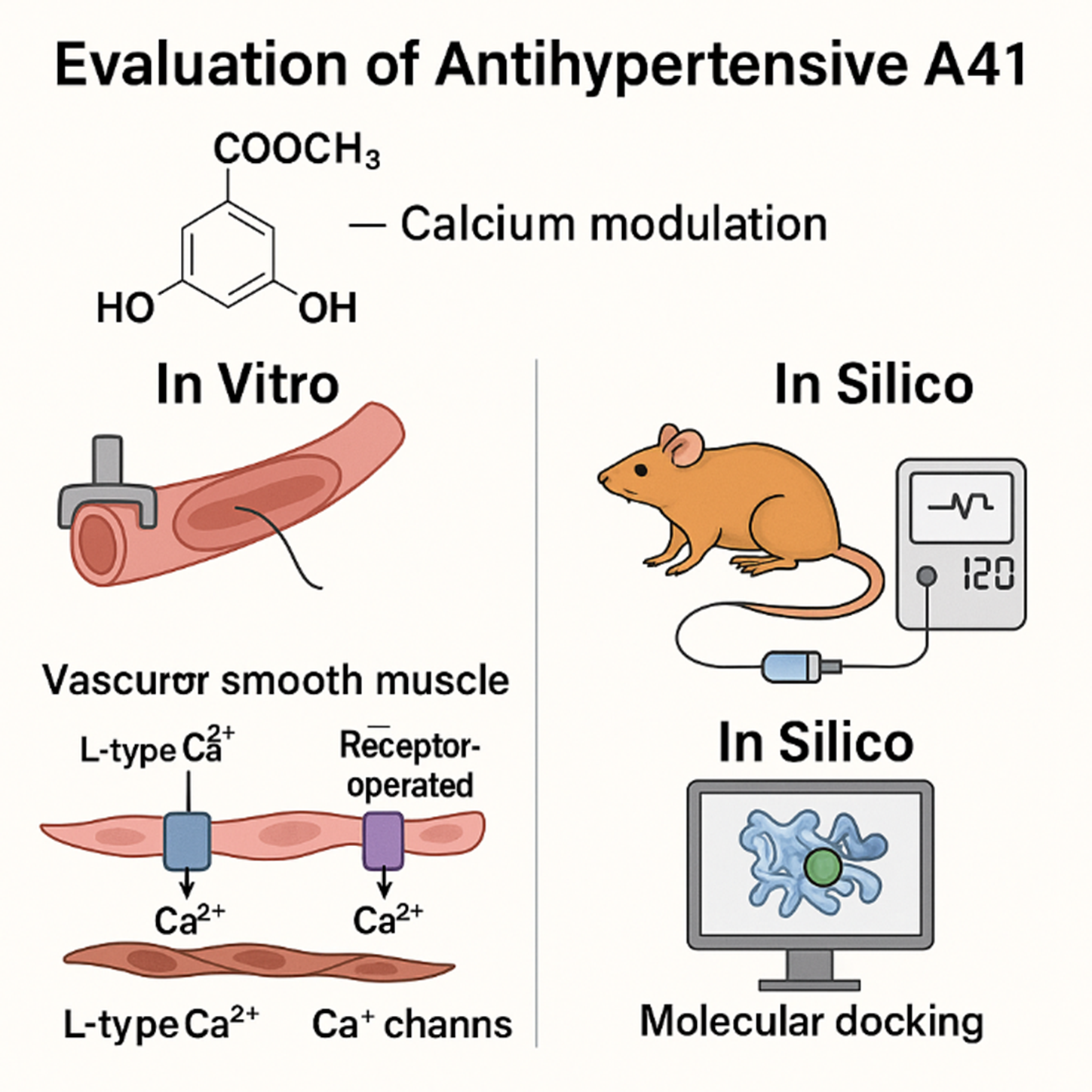
This study aimed to evaluate the antihypertensive potential of the natural compound A41, a bioactive molecule, using integrated in vitro, in vivo, and in silico approaches. The rationale for selecting A41 is based on preliminary screening that suggested its strong calcium-modulating activity, a key factor in vascular tone regulation. In vitro experiments were performed on isolated rat aortic rings to investigate A41’s effect on vascular smooth muscle ion channels, particularly voltage-operated L-type Ca²⁺ channels and receptor-operated Ca²⁺ channels. The study also explored endothelium-dependent pathways. Selective ion channel blockers were applied to confirm the involvement of specific mechanisms. A41 significantly inhibited Ca²⁺ entry through L-type Ca²⁺ channels under hypertensive conditions, achieving 82.2 ± 2.0 % relaxation at 35 μM, with an IC₅₀ of 22.10 μM. Additionally, receptor-operated Ca²⁺-induced contractions were reduced by 87.0 ± 2.7 % at 50 μM. Molecular docking simulations demonstrated high binding affinity of A41 to calcium-regulating proteins, including the sodium-calcium exchanger (NCX) and plasma membrane Ca²⁺ ATPase, with binding free energies of −6.6 kcal/mol and estimated inhibitory constants (Kᵢ) of 14.558 μM. In vivo studies were conducted using male Wistar rats (n = 6) in an adrenaline-induced hypertension model. Intravenous administration of A41 (dose: 50 mg/kg) produced a marked antihypertensive effect, lowering systolic blood pressure to 82.8 ± 8.3 mmHg and diastolic pressure to 61.3 ± 5.9 mmHg within 3 h. Together, these findings demonstrate that A41 exerts antihypertensive effects by modulating calcium transport mechanisms in vascular smooth muscle, involving both ion channels and calcium-handling proteins, supporting its potential as a candidate for hypertension therapy.
HIGHLIGHTS
- A41 was investigated for antihypertensive activity using integrated in vitro, in vivo, and in silico approaches.
- In vitro studies assessed A41’s effects on L-type and receptor-operated Ca²⁺ channels in isolated rat aortic rings.
- In vivo evaluation was conducted in an adrenaline-induced hypertension model in male Wistar rats.
- In silico molecular docking targeted key aortic ion channels involved in calcium regulation.
- The study aimed to elucidate the calcium-modulating mechanisms underlying A41’s vascular effects.
GRAPHICAL ABSTRACT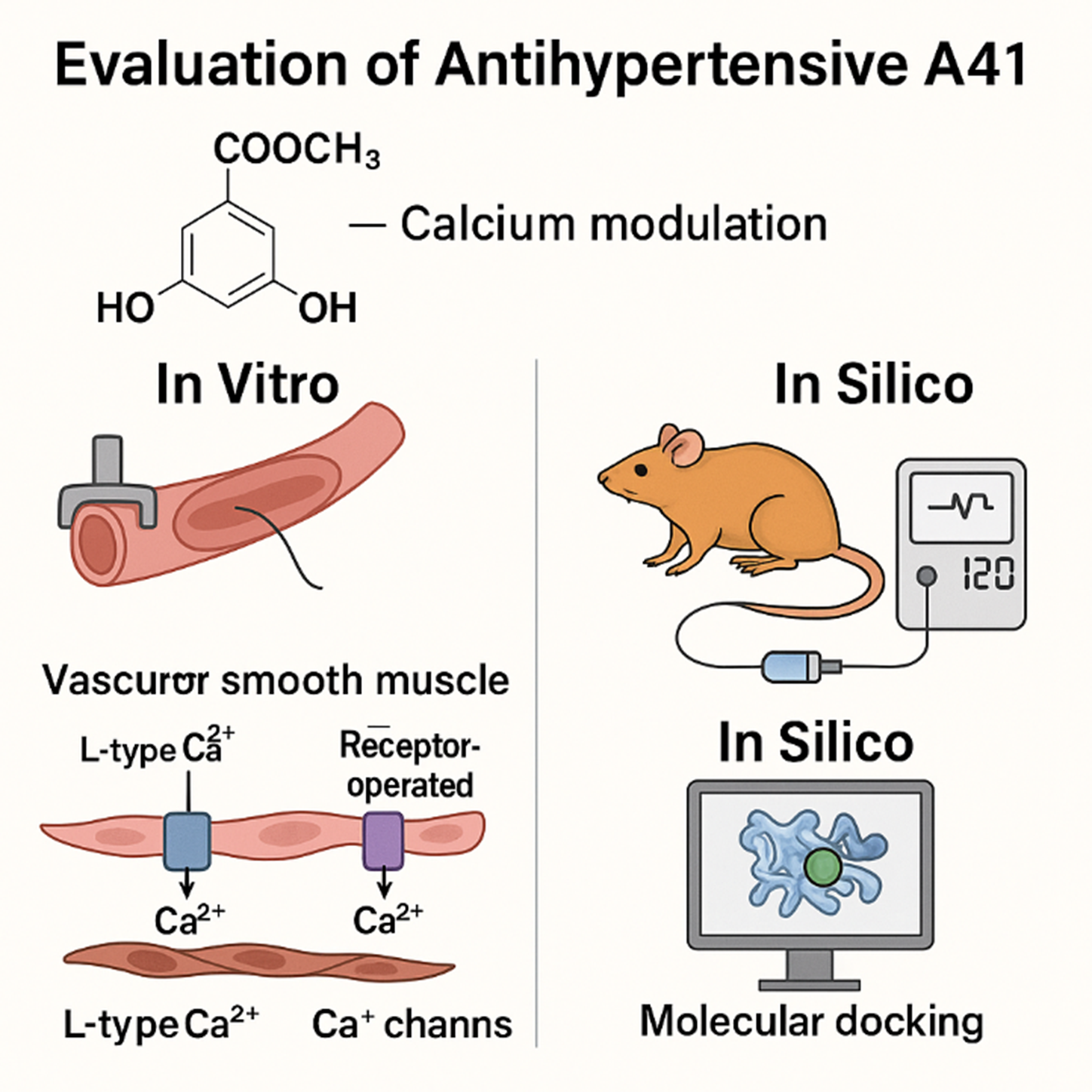
Downloads
References
MD Cesare, P Perel, S Taylor, C Kabudula, H Bixby, TA Gaziano, DV McGhie, J Mwangi, B Pervan, J Narula, D Pineiro and FJ Pinto. Global Heart 2024; 19(1), 11.
IZOGL Abdullaev, UG Gayibov, SZ Omonturdiev, SF Azamjonovna, SN Gayibova and TF Aripov. Molecular pathways in cardiovascular disease under hypoxia: Mechanisms, biomarkers, and therapeutic targets. The Journal of Biomedical Research 2025; 39(2), 1-16.
CJ Hutchings, P Colussi and TG Clark. Ion channels as therapeutic antibody targets. MAbs 2019;11(2), 265-296.
AA Abdullaev, DR Inamjanov, DS Abduazimova, SZ Omonturdiyev, UG Gayibov, SN Gayibova and TF Aripov. Sílybum mariánum’s impact on physiological alterations and oxidative stress in diabetic rats. Biomedical & Pharmacology Journal 2024; 17(2), 1291-1300.
BK Joseph, KM Thakali, CL Moore and SW Rhee. Ion channel remodeling in vascular smooth muscle during hypertension: Implications for novel therapeutic approaches. Pharmacological Research 2013; 70(1), 126-138.
O Gaibullayeva, A Islomov, D Abdugafurova, B Elmurodov, B Mirsalixov, L Mahmudov, I Adullaev, K Baratov, S Omonturdiev and S Sa’dullayeva. Inula helenium L. root extract in sunflower oil: Determination of its content of water-soluble vitamins and immunity-promoting effect. Biomedical & Pharmacology Journal 2024; 17(4), 2729-2737.
AQQ Azimova, AX Islomov, SA Maulyanov, DG Abdugafurova, LU Mahmudov, IZ o`g`li Abdullaev, AS Ishmuratova, SQQ Siddikova and IR Askarov. Determination of vitamins and pharmacological properties of Vitis vinifera L. plant fruit part (mixed varieties) syrup-honey. Biomedical and Pharmacology Journal 2024; 17(4), 2779-2786.
AV Mahmudov, OS Abduraimov, SB Erdonov, UG Gayibov and LY Izotova. Bioecological features of Nigella sativa L. in different conditions of Uzbekistan. Plant Science Today 2022; 9(2), 421-426.
OS Zoirovich, AIZ Ugli, ID Raxmatillayevich, ML Umarjonovich, ZM Ravshanovna, G Sabina, Narimanovna, GU Gapparjanovich and AT Fatikhovich. The effect of Ájuga Turkestánica on the rat aortic smooth muscle ion channels. Biomedical & Pharmacology Journal 2024; 17(2), 1213-1222.
D Inomjonov, I Abdullaev, S Omonturdiev, A Abdullaev, L Maxmudov, M Zaripova, M Abdullayeva, D Abduazimova, S Menglieva, S Gayibova, M Sadbarxon, U Gayibov and T Aripov. In vitro and in vivo studies of crategus and inula helenium extracts: Their effects on rat blood pressure. Trends in Sciences 2025; 22(3), 9158.
A Abdullaev, I Abdullaev, A Bogbekov, U Gayibov, S Omonturdiev, S Gayibova, M Turahodjayev, K Ruziboev and T Aripov. Antioxidant potential of rhodiola heterodonta extract: Activation of Nrf2 pathway via integrative in vivo and in silico studies. Trends in Sciences 2025; 22(5), 9521.
HM Berman, J Westbrook, Z Feng, G Gilliland, TN Bhat, H Weissig, IN Shindyalov and PE Bourne. The protein data bank. Nucleic Acids Research 2000; 28(1), 235-242.
H Zohny, J McMillan and M King. Ethics of generative AI. Journal of Medical Ethics 2023; 49(2), 79-80.
M Iman, A Saadabadi and A Davood. Molecular docking analysis and molecular dynamics simulation study of ameltolide analogous as a sodium channel blocker. Turkish Journal of Chemistry 2015; 39(2), 10.
J Palacios, D Asunción-Alvarez, D Aravena, M Chiong, MA Catalán, C Parra, F Cifuentes and A Paredes. A new oxime synthesized from Senecio nutans SCh. Bip (chachacoma) reduces calcium influx in the vascular contractile response in rat aorta. RSC Advances 2024; 14(14), 9933-9942.
J Striessnig, NJ Ortner and A Pinggera. Pharmacology of L-type calcium channels: Novel drugs for old targets? Current Molecular Pharmacology 2015; 8(2), 110-122.
M Al-Khrasani, DA Karadi, AR Galambos, B Sperlagh and ES Vizi. The pharmacological effects of phenylephrine are indirect, mediated by noradrenaline release from the cytoplasm. Neurochemical Research 2022; 47(11), 3272-3284.
UG Gayibov, SN Gayibova, HMU Karimjonov, AAU Abdullaev, DS Abduazimova, RN Rakhimov, HS Ruziboev, MA Xolmirzayeva, AE Zaynabiddinov and TF Aripov. Antioxidant and cardioprotective properties of polyphenolic plant extract of Rhus glabra L. Plant Science Today 2024; 11(3), 655-662.
TF Aripov, UG Gayibov, SN Gayibova, AA Abdullaev, DS Abduazimova, NS Berdiev, JF Ziyavitdinov, YI Oshchepkova and SH Salikhov. Antiradical and antioxidant activity of the preparation “Rutan” from Rhus coriaria L. Journal of Theoretical and Clinical Medicine 2023; 4, 164-170.
AV Mahmudov, OS Abduraimov, SB Erdonov, AL Allamurotov, OT Mamatqosimov, UG Gayibov and L Izotova. Seed productivity of Linum usitatissimum L. in different ecological conditions of Uzbekistan. Plant Science Today 2022; 9(4), 1090-1101.
AG Vakhobjonovna, KE Jurayevich, Ogli, AIZ Ogli, EN Azamovich, MR Rasuljonovich and AM Islomovich. Tannins as modulators in the prevention of mitochondrial dysfunction. Trends in Sciences 2025; 22(8), 10436.
PJ Tonge. Drug-target kinetics in drug discovery. ACS Chemical Neuroscience 2018; 9(1), 29-39.
EM El-Assri, Y El-Assri, RE Brahimi, ME Fadili, A Baghouz, HA Abuelizz, S Er-Rahmani, A Lahkimi and A Bouia. Molecular characterization, chemical profile and biological properties of essential oils from Chamaemelum nobile (L.) flowers of Morocco: In vitro and in silico studies. Frontiers in Chemistry 2025; 13, 1539872.
M Zaripova, I Abdullaev, A Bogbekov, U Gayibov, S Omonturdiev, R Makhmudov, N Ergashev, G Jabbarova, S Gayibova and T Aripov. In Vitro and in Silico Studies of Gnaphalium U. Extract: Inhibition of α-amylase and α-glucosidase as a Potential Strategy for Metabolic Syndrome Regulation. Trends in Sciences 2025; 22(8), 10098.
UG Gayibov, EJ Komilov, RN Rakhimov, NA Ergashev, NG Abdullajanova, MI Asrorov and TF Aripov. Influence of new polyphenol compound from Euphorbia plant on mitochondrial function. Journal of Microbiology Biotechnology and Food Sciences 2019, 8(4): 1021-1025.
S Shao and RS Hegde. Membrane protein insertion at the endoplasmic reticulum. Annual Review of Cell and Developmental Biology 2011; 27, 25-56.
EM Capes, R Loaiza and HH Valdivia. Ryanodine receptors. Skelet Muscle 2011; 1(1), 18.
Y Umidakhon, B Erkin, G Ulugbek, N Bahadir and A Karim. Correction of the mitochondrial NADH oxidase activity, peroxidation and phospholipid metabolism by haplogenin-7-glucoside in hypoxia and ischemia. Trends in Sciences 2022; 19(21), 6260.
MK Pozilov, UG Gayibov, MI Asrarov, N Abdulladjanova, HS Ruziboev and TF Aripov. Physiological alterations of mitochondria under diabetes condition and its correction by polyphenol gossitan. Journal of Microbiology Biotechnology and Food Sciences 2022; 12(2), e2224.
L Daverkausen-Fischer and F Pröls. Regulation of calcium homeostasis and flux between the endoplasmic reticulum and the cytosol. Journal of Biological Chemistry 2022; 298(7), 102061.
Z Shakiryanova, R Khegay, U Gayibov, A Saparbekova, Z Konarbayeva, A Latif1 and O Smirnova. Isolation and study of a bioactive extract enriched with anthocyanin from red grape pomace (Cabernet Sauvignon). Agronomy Research 2023; 21(3), 1293-1303.
U Gayibov, SN Gayibova, MMK Pozilov, FS Tuxtaeva, UR Yusupova, GMK Djabbarova, ZA Mamatova, NA Ergashev and TF Aripov. Influence of quercetin and dihydroquercetin on some functional parameters of rat liver mitochondria. Journal of Microbiology, Biotechnology and Food Sciences 2021; 11(1), e2924.
DG Harrison, M Bader, LO Lerman, G Fink, SA Karumanchi, JF Reckelhoff, MLS Sequeira-Lopez and RM Touyz. Tail-cuff versus radiotelemetry to measure blood pressure in mice and rats. Hypertension 2024; 81(1), 3-5.
M Zaripova, S Gayibova, R Makhmudov, A Mamadrahimov, N Vypova, U Gayibov, S Miralimova and T Aripov. Characterization of Rhodiola heterodonta (Crassulaceae): Phytocomposition, antioxidant and antihyperglycemic activities. Preventive Nutrition and Food Science 2024; 29(2), 135-145.
Published
How to Cite
Issue
Section
License
Copyright (c) 2025 Walailak University

This work is licensed under a Creative Commons Attribution-NonCommercial-NoDerivatives 4.0 International License.





