
Antioxidant Potential of Rhodiola Heterodonta Extract: Activation of Nrf2 Pathway Via Integrative In Vivo and In Silico Studies
DOI:
https://doi.org/10.48048/tis.2025.9521Keywords:
Antioxidant, Nrf2/Keap1/ARE signaling, HPLC, Rhodiola.hAbstract
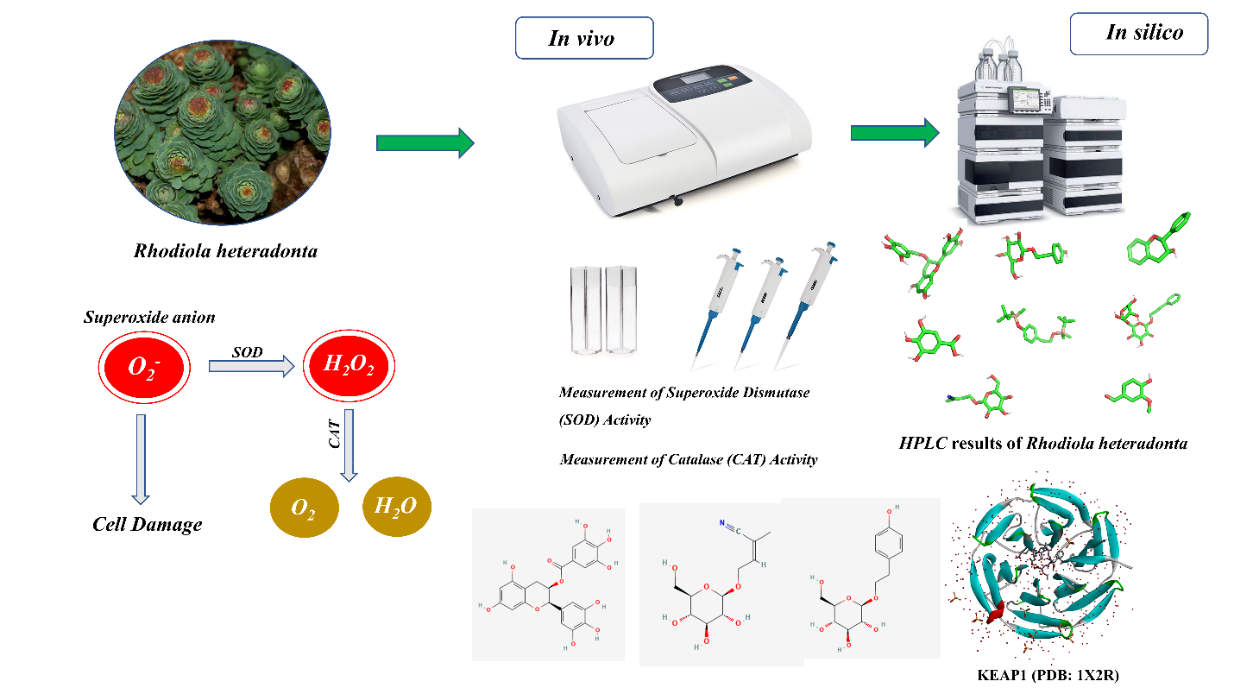
This study investigates the antioxidant potential of Rhodiola.h extract using a combination of in vivo and in silico approaches. HPLC analysis was conducted to determine the phytochemical composition of the extract. In vivo assays demonstrated significant enzyme activation, with superoxide dismutase (SOD) activity increased by 63.07 ± 1.5 % and catalase activity increased by 58.7 ± 1.6 %. In addition, experiments evaluated malondialdehyde (MDA) levels, highlighting the extract’s ability to reduce lipid peroxidation. Molecular docking studies revealed strong binding affinities of epigallocatechin ( 7.09 kcal/mol), rosavin ( 6.71 kcal/mol), and salidroside ( 6.34 kcal/mol) with the Keap1 protein, a key regulator of the Nrf2 signaling pathway. Pharmacokinetic analysis showed high gastrointestinal absorption for salidroside and flavonoids, underscoring their bioavailability. These findings suggest that R. heterodonta extract holds promise for activating antioxidant response elements and mitigating oxidative stress-related damage.
HIGHLIGHTS
- Improvement of Antioxidant System.
- Activation of NRF2Patway via extracts.
- Dual approaching in vitro and in silico.
GRAPHICAL ABSTRACT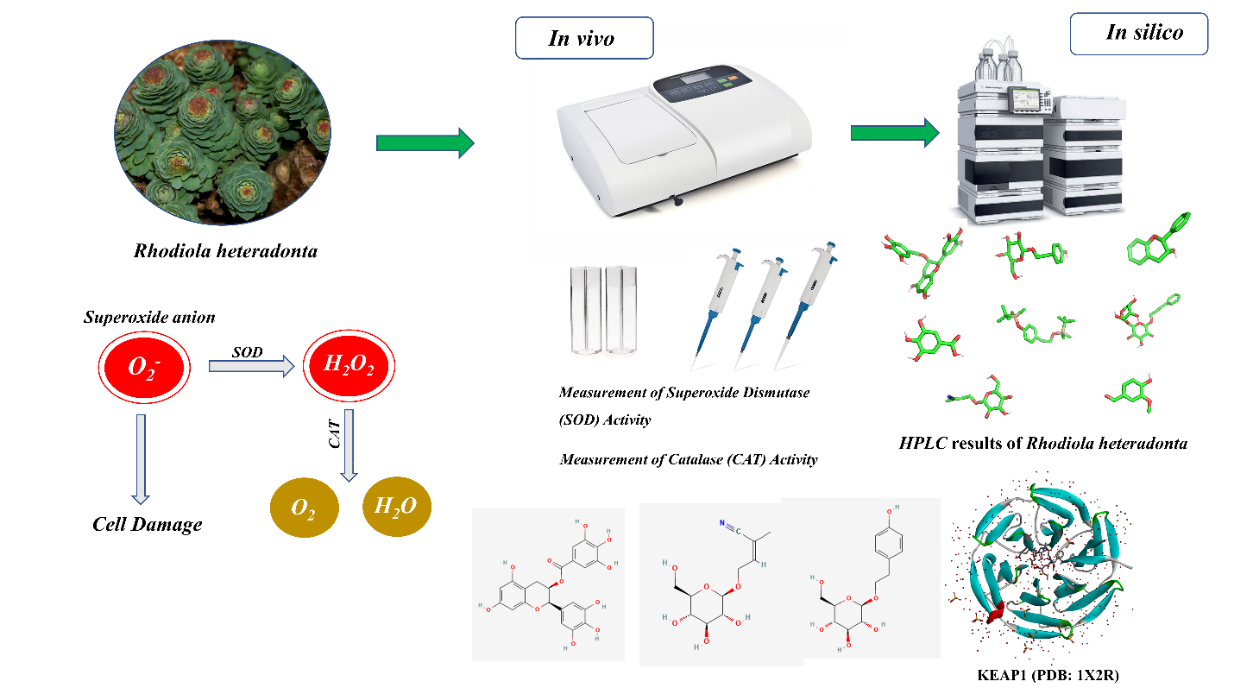
Downloads
References
OS Zoirovich, AIZ Ugli, ID Raxmatillayevich, ML Umarjonovich1, ZM Ravshanovna, GS Narimanovna, GU Gapparjanovich and AT Fatikhovich. The effect of Ajuga Turkestánica on the rat aortic smooth muscle ion channels. Biomedical and Pharmacology Journal 2024; 17(2), 1213-1222.
AA Abdullaev, DR Inamjanov, DS Abduazimova, SZ Omonturdiyed, UG Gayibov, SN Gayibova and TF Aripov. Silybum Marianum’s impact on physiological alterations and oxidative stress in diabetic rats. Biomedical and Pharmacology Journal 2024; 17(2), 1291-1300.
T Guan, N Li, X Xu, D Xing, B Wang, L Xiao, W Yang, G Chu, A Yusuf, J Zhang and W Yue. Involvement of the Keap1-Nrf2-ARE pathway in the antioxidant activity of sinomenine. Archives of Biochemistry and Biophysics 2024; 753, 109928.
Izzatullo Ziyoyiddin o`g`li Abdullaev, Ulugbek Gapparjanovich Gayibov, Sirojiddin Zoirovich Omonturdiev, Sobirova Fotima Azamjonovna, Sabina Narimanovna Gayibova, Takhir Fatikhovich Aripov. Molecular pathways in cardiovascular disease under hypoxia: Mechanisms, biomarkers, and therapeutic targets[J]. The Journal of Biomedical Research. DOI: 10.7555/JBR.38.20240387
E Bhakkiyalakshmi, K Dineshkumar, S Karthik, D Sireesh, W Hopper, R Paulmurugan and KM Ramkumar. Pterostilbene-mediated Nrf2 activation: Mechanistic insights on Keap1: Nrf2 interface. Bioorganic & Medicinal Chemistry 2016; 24(16), 3378-3386.
MM Khalaf, SM Hassan, AM Sayed and AM Abo-Youssef. Ameliorate impacts of scopoletin against vancomycin-induced intoxication in rat model through modulation of Keap1-Nrf2/HO-1 and IkappaBalpha-P65 NF-kappaB/P38 MAPK signaling pathways: molecular study, molecular docking evidence and network pharmacology analysis. International Immunopharmacology 2022; 102, 108382.
MR Zaripova, SN Gayibova, RR Makhmudov, AA Mamadrahimov, NI Vypova, UG Gayibov, SM Miralimova and TF Aripov. Characterization of rhodiola heterodonta (crassulaceae): Phytocomposition, antioxidant and antihyperglycemic activities. Preventive Nutrition and Food Science 2024; 29(2), 135-145.
H Lv, C Zhu, W Wei, X Lv, Q Yu, X Deng and X Ci. Enhanced Keap1-Nrf2/Trx-1 axis by daphnetin protects against oxidative stress-driven hepatotoxicity via inhibiting ASK1/JNK and Txnip/NLRP3 inflammasome activation. Phytomedicine 2020; 71, 153241.
L Ren, H Luo, J Zhao, S Huang, J Zhang and C Shao. An integrated in vitro/in silico approach to assess the anti-androgenic potency of isobavachin. Food and Chemical Toxicology 2023; 176, 113764.
Y Liang, Q Jiang, Y Gong, Y Yu, H Zou, J Zhao, T Zhang and J Zhang. In vitro and in silico assessment of endocrine disrupting effects of food contaminants through pregnane X receptor. Food and Chemical Toxicology 2023; 175, 113711.
S Liu, J Pi and Q Zhang. Signal amplification in the KEAP1-NRF2-ARE antioxidant response pathway. Redox Biology 2022; 54, 102389.
L Ren, J Zhang and T Zhang. Immunomodulatory activities of polysaccharides from Ganoderma on immune effector cells - science direct. Food Chemistry 2020; 340, 127933.
E Crisman, P Duarte, E Dauden, A Cuadrado, MI Rodriguez-Franco, MG Lopez and R Leon. KEAP1-NRF2 protein–protein interaction inhibitors: Design, pharmacological properties and therapeutic potential. Medicinal Research Reviews 2023; 43(1), 237-287.
L He, P Huan, J Xu, Y Chen, L Zhang, J Wang, L Wang and Z Jin. Hedysarum polysaccharide alleviates oxidative stress to protect against diabetic peripheral neuropathy via modulation of the keap1/Nrf2 signaling pathway. Journal of Chemical Neuroanatomy 2022; 126, 102182.
Y Qi, S Fu, D Pei, Q Fang, W Xin, X Yuan, Y Cao, Q Shu, X Mi and F Luo. Luteolin attenuated cisplatin- induced cardiac dysfunction and oxidative stress via modulation of Keap1/Nrf2 signaling pathway. Free Radical Research 2022; 56(2), 209-221.
A Chakkittukandiyil, DV Sajini, A Karuppaiah and D Selvaraj. The principal molecular mechanisms behind the activation of Keap1/Nrf2/ARE pathway leading to neuroprotective action in Parkinson’s disease. Neurochemistry International 2022; 156, 105325.
O Gaibullayeva, A Islomov, D Abdugafurova, B Elmurodov, B Mirsalixov, L Mahmudov, I Adullaev, K Baratov, S Omonturdiev and S Sa’dullayeva. Inula helenium l. root extract in sunflower oil: Determination of its content of water-soluble vitamins and immunity-promoting effect. Biomedical and Pharmacology Journal 2024; 17(4), 2729-2737.
Thermo Fisher Scientific: HPLC Basics Thermo Fisher Scientific - US. Detailed explanation of HPLC operation, including isocratic and gradient methods, and applications in various industries. Thermo Fisher Scientific: HPLC Basics Thermo Fisher Scientific - US, Massachusetts, 2025.
AQQ Azimova, AX Islomov, SA Maulyanov, DG Abdugafurova, LU Mahmudov, IZO Abdullaev, A Ishmuratova, SQQ Siddikova and IR Askarov. Determination of vitamins and pharmacological properties of vitis vinifera L. Plant fruit part (mixed varieties) syrup-honey. Biomedical and Pharmacology Journal 2024; 17(4), 2779-2786.
Inomjonov, D., Abdullaev,I., Omonturdiev, S., Abdullaev, A., Maxmudov, L., Zaripova, M., Abdullayeva, M., Abduazimova, D., Menglieva, S., Gayibova, S., Sadbarxon, M., Gayibov, U., & Aripov, T. (2025). In Vitro and In Vivo Studies of Crategus and Inula helenium extracts: Their Effects on Rat Blood Pressure. Trends in Sciences, 22(3), 9158.
UG Gayibov, SN Gayibova, HM Karimjonov, AA Abdullaev, DS Abduazimova, RN Rakhimov, HS Ruziboev, MA Xolmirzayeva, AE Zaynabiddinov and TF Aripov. Antioxidant and cardioprotective properties of polyphenolic plant extract of Rhus glabra L. Plant Science Today 2024; 11(3), 655-662.
C Beauchamp and I Fridovich. Superoxide dismutase: Improved assays and an assay applicable to acrylamide gels. Analytical Biochemistry 1971; 44(1), 276-287.
RF Beers and IW Sizer. A spectrophotometric method for measuring the breakdown of hydrogen peroxide by catalase. Journal of Biological Chemistry 1952; 195(1), 133-140.
SS Hosseini, A Gol and M Khaleghi. The effects of Lactobacillus acidophilus ATCC 4356 on the oxidative stress of the reproductive system in diabetic male rats. International Journal of Reproductive BioMedicine 2019; 17(7), 493-502.
Y Umidakhon, B Erkin, G Ulugbek, N Bahadir and A Karim. Correction of the mitochondrial NADH oxidase activity, peroxidation and phospholipid metabolism by haplogenin-7-glucoside in hypoxia and ischemia. Trends in Sciences 2022; 19(21), 6260.
M Bello and JA Morales-Gonzalez. Molecular recognition between potential natural inhibitors of the Keap1-Nrf2 complex. International Journal of Biological Macromolecules 2017; 105, 981-992.
O Trott and AJ Olson. AutoDock Vina: Improving the speed and accuracy of docking with a new scoring function, efficient optimization, and multithreading. Journal of Computational Chemistry 2010; 31(2), 455-461.
T Zhang, S Zhong, L Hou, Y Wang, X Xing, T Guan, J Zhang and T Li. Computational and experimental characterization of estrogenic activities of 20(S, R)-protopanaxadiol and 20(S, R)-protopanaxatriol. Journal of Ginseng Research 2020 44(5), 690-696.
Y Leng, L Ren, S Niu, T Zhang and J Zhang. In vitro and in silico investigations of endocrine disruption induced by metabolites of plasticizers through glucocorticoid receptor. Food and Chemical Toxicology 2021; 155, 112413.
A Daina, O Michielin and V Zoete. SwissADME: A free web tool to evaluate pharmacokinetics, drug-likeness and medicinal chemistry friendliness of small molecules. Scientific Reports 2017; 7, 42717.
I Muegge. Selection criteria for drug-like compounds. Medicinal Research Reviews 2003; 23(3), 302-321.
S Tian, J Wang, Y Li, D Li, L Xu and T Hou. The application of in silico drug-likeness predictions in pharmaceutical research. Advanced Drug Delivery Reviews 2015; 86, 2-10.
H Li, S Zhang and Y Zhang. Identification and quantification of bioactive compounds in Rhodiola heterodonta by HPLC. Journal of Chromatography B 2015; 997, 32-40.
M Gargouri, MB Salem and F Limem. Alloxan-induced diabetes in rats leads to increased lipid peroxidation and decreased superoxide dismutase activity in the liver. Biochemical and Biophysical Research Communications 2016; 470(4), 937-942.
AV Mahmudov, OS Abduraimov, SB Erdonov, UG Gayibov and LY Izotova. Bioecological features of nigella sativa L. in different conditions of Uzbekistan. Plant Science Today 2022; 9(2), 421-426.
UG Gayibov, EJ Komilov, RN Rakhimov, NA Egashev, NG Abdullajanova, MI Asrorov and TF Aripov. Influence of new polyphenol compound from Euphorbia plant on mitochondrial function. The Journal of Microbiology, Biotechnology and Food Sciences 2019; 8(4), 1021-1025.
UG Gayibov, SN Gayibova, MK Pozilov, NA Ergashev and TF Aripov. Influence of quercetin and dihydroquercetin on some functional parameters of rat liver mitochondria. Journal of microbiology, biotechnology and food sciences 2021; 11(1), e2924.
TF Aripov, UG Gayibov, SN Gayibova, AA Abdullaev, DS Abduazimova, NS Berdiev, JF Ziyavitdinov, YI Oshchepkova and SH Salikhov. Antiradical and antioxidant activity of the preparation “Rutan” from Rhus coriaria L. Journal of Theoretical and Clinical Medicine. 2023; 4, 164-170.
Published
How to Cite
Issue
Section
License
Copyright (c) 2025 Walailak University

This work is licensed under a Creative Commons Attribution-NonCommercial-NoDerivatives 4.0 International License.





