
Neuroprotective Potential of p-MCA in Drosophila
DOI:
https://doi.org/10.48048/tis.2026.13267Keywords:
p-MCA, Alzheimer’s disease, Neuroprotection, D. melanogaster, Oxidative stress, Drug discovery, Neurodegenerative disordersAbstract
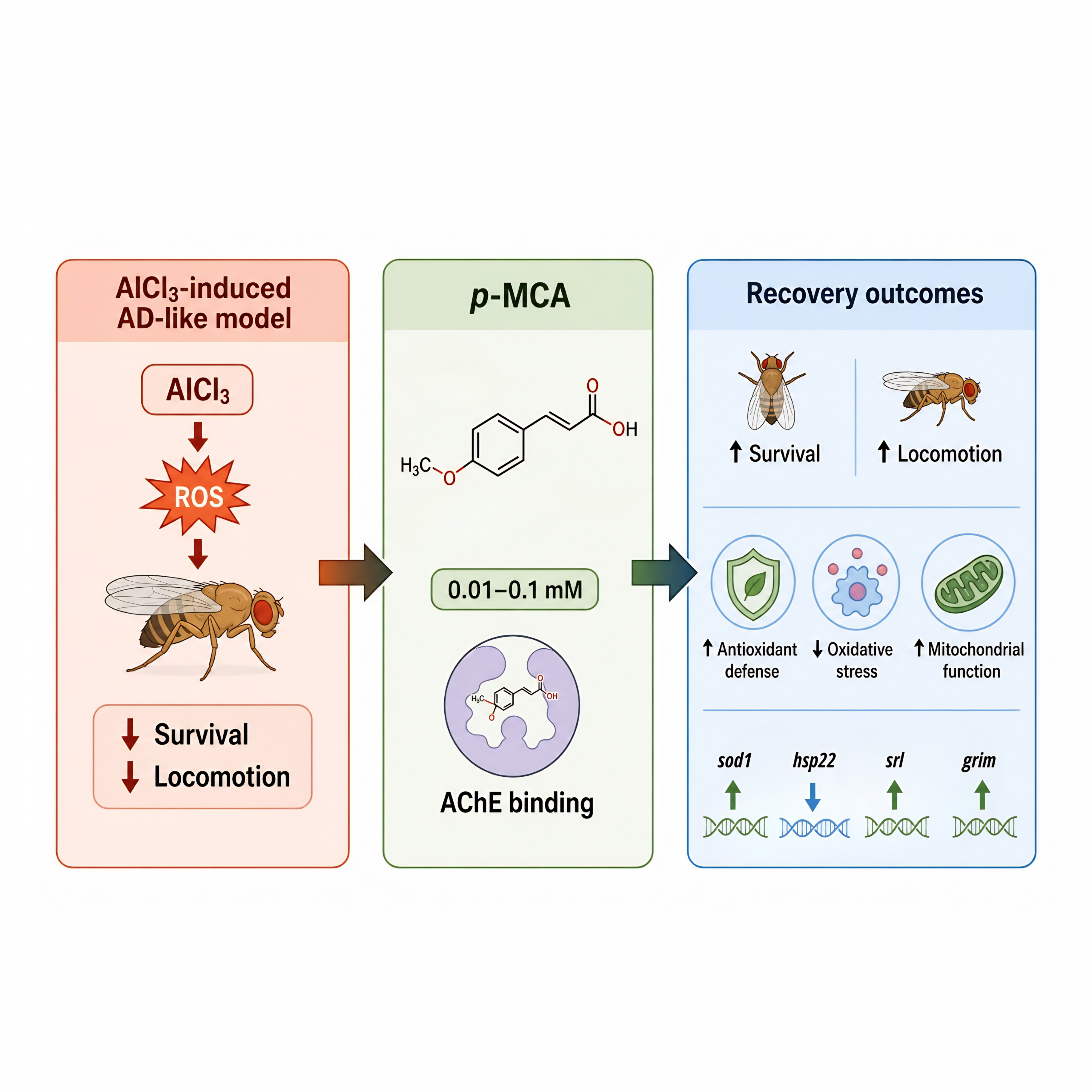
p-methoxycinnamic acid (p-MCA), a bioactive compound from Kaempferia galanga, was evaluated for its neuroprotective effects in an Alzheimer’s disease (AD)-like model of Drosophila melanogaster, supported by in silico docking and molecular dynamics simulations. Toxicity screening identified 10 mM AlCl3 (aluminium chloride) as an effective concentration to induce neurodegenerative phenotypes without excessive mortality. p-MCA (0.01-0.1 mM) significantly improved survival, locomotor performance, and phototactic responses in AlCl3-exposed flies. Gene expression analysis showed upregulation of antioxidant (sod1, hsp22) and anti-aging (srl) genes, along with modulation of the apoptosis-related gene grim, indicating regulation of oxidative stress and cellular homeostasis. Computational analysis demonstrated stable binding of p-MCA to acetylcholinesterase (ΔG = ‒7.2 kcal/mol), comparable to 10-40. Collectively, these findings indicate that p-MCA mitigates AlCl3-induced neurotoxicity through multi-target mechanisms and supports its further evaluation in neurodegenerative disease models.
HIGHLIGHTS
- Demonstrates neuroprotective effects in a Drosophila Alzheimer’s model.
- Improves lifespan, locomotor activity, and cognitive performance under AlCl₃ exposure.
- Modulates expression of sod1, srl, grim, and hsp22
- Shows stable binding to AChE comparable to 10-40 in docking analysis.
- Suggests multitarget mechanisms through integrated in vivo and in silico
GRAPHICAL ABSTRACT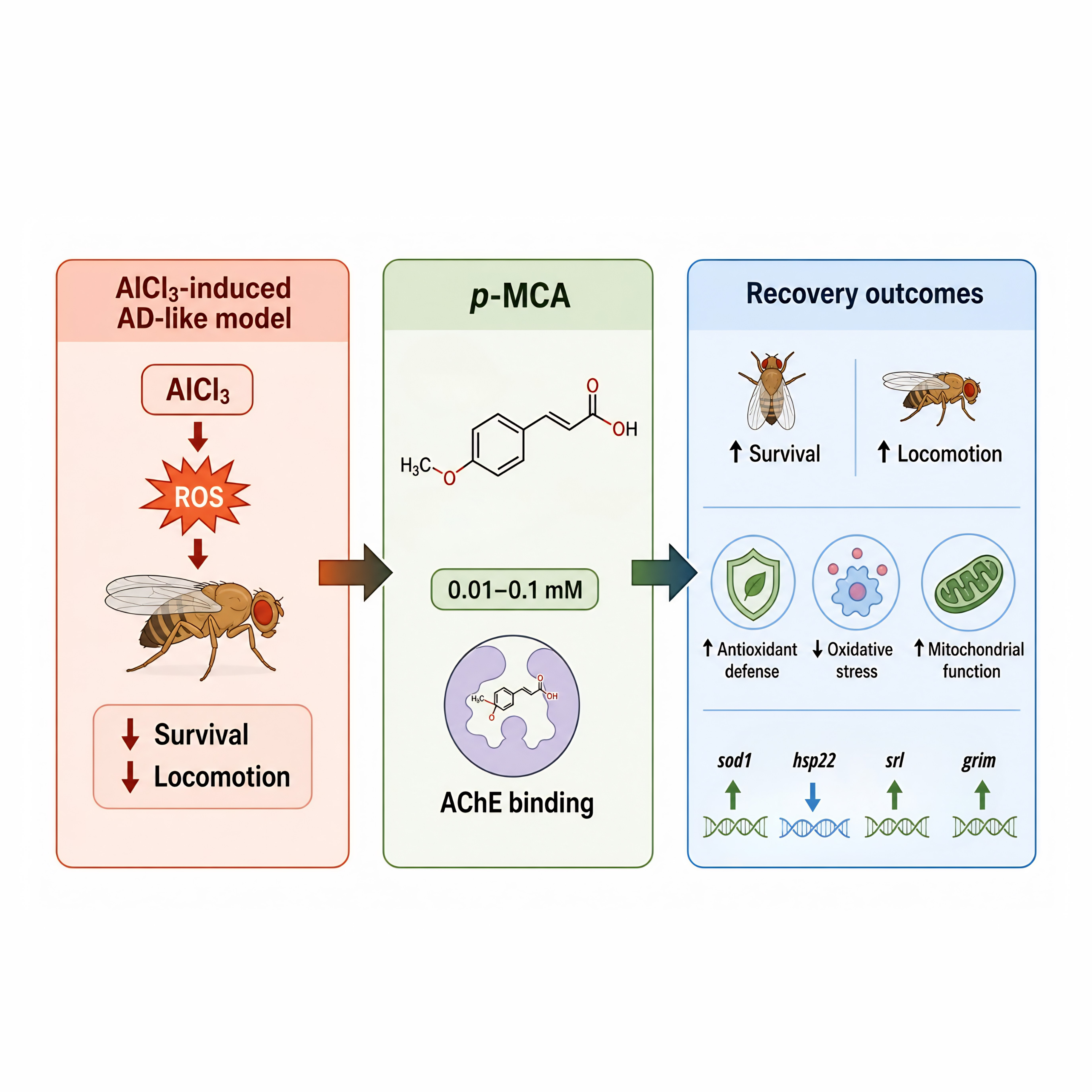
Downloads
References
J Guo, X Huang, L Dou, M Yan, T Shen, W Tang and J Li. Aging and aging-related diseases: From molecular mechanisms to interventions and treatments. Signal Transduction and Targeted Therapy 2022; 7, 391.
Y Li, X Tian, J Luo, T Bao, S Wang and X Wu. Molecular mechanisms of aging and anti-aging strategies. Cell Communication and Signaling 2024; 22, 285.
E Passeri, K Elkhoury, M Morsink, K Broersen, M Linder, A Tamayol, C Malaplate, FT Yen and E Arab-Tehrany. Alzheimer’s disease: Treatment strategies and their limitations. International Journal of Molecular Sciences 2022; 23(22), 13954.
DC Miculas, PA Negru, SG Bungau, T Behl, SSU Hassan and DM Tit. Pharmacotherapy evolution in Alzheimer’s disease: Current framework and relevant directions. Cells 2023; 12(1), 131.
JW Kinney, SM Bemiller, AS Murtishaw, AM Leisgang AM Salazar and BT Lamb. Inflammation as a central mechanism in Alzheimerʼs disease. Alzheimer’s & dementia 2018; 4, 575-590.
Y Zhang, H Chen, R Li, K Sterling and W Song. Amyloid β-based therapy for Alzheimer’s disease: Challenges, successes and future. Signal Transduction and Targeted Therapy 2023; 8, 248.
PT Kamatham, R Shukla, DK Khatri and LK Vora. Pathogenesis, diagnostics, and therapeutics for Alzheimerʼs disease: Breaking the memory barrier. Ageing Research Reviews 2024; 101, 102481.
E Hogervorst, E Schröder-Butterfill, YS Handajani, P Kreager and TB W Rahardjo. Dementia and dependency vs. proxy indicators of the active ageing index in Indonesia. International Journal of Environmental Research and Public Health 2021; 18(16), 8235.
J Zhang, Y Zhang, J Wang, Y Xia, J Zhang and L Chen. Recent advances in Alzheimer’s disease: Mechanisms, clinical trials and new drug development strategies. Signal Transduction and Targeted Therapy 2024; 9, 211.
B Miziak, B Błaszczyk and SJ Czuczwar. Some candidate drugs for pharmacotherapy of Alzheimer’s disease. Pharmaceuticals 2021; 14(5), 458.
LK Huang, SP Chao and CJ Hu. Clinical trials of new drugs for Alzheimer disease. Journal of Biomedical Science 2020; 27, 18.
A Płowuszyńska and A Gliszczyńska. Recent developments in therapeutic and nutraceutical applications of p-MCA from plant origin. Molecules 2021; 26(13), 3827.
T Begum, R Gogoi, N Sarma, SK Pandey and M Lal. Novel ethyl p-methoxy cinnamate rich Kaempferia galanga (L.) essential oil and its pharmacological applications: Special emphasis on anticholinesterase, anti-tyrosinase, α-amylase inhibitory, and genotoxic efficiencies. PeerJ 2023; 11, 14606.
A Finelli, A Kelkar, HJ Song, H Yang and M Konsolaki. A model for studying Alzheimerʼs Aβ42-induced toxicity in D. melanogaster. Molecular and Cellular Neuroscience 2004; 26(3), 365-375.
UB Pandey and CD Nichols. Human disease models in D. melanogaster and the role of the fly in therapeutic drug discovery. Pharmacological Reviews 2011; 63(2), 411-436.
H Bolus, K Crocker, G Boekhoff-Falk and S Chtarbanova. Modeling neurodegenerative disorders in D. melanogaster. International Journal of Molecular Sciences 2020; 21(9), 3055.
LM Luheshi, GG Tartaglia, AC Brorsson, AP Pawar, IE Watson, F Chiti, M Vendruscolo, DA Lomas, CM Dobson and DC Crowther. Systematic in vivo analysis of the intrinsic determinants of amyloid β pathogenicity. PLoS Biology 2007; 5(11), 290.
F Nainu, E Salim, RM Asri, A Hori and T Kuraishi. Neurodegenerative disorders and sterile inflammation: Lessons from a Drosophila model. The Journal of Biochemistry 2019; 166(3), 213-221.
NR Rumata, D Purwaningsih, A Asbah, MF As’Ad, D Chadran, TB Emran and F Nainu. Phenotypical and molecular assessments on the pharmacological effects of curcumin in D. melanogaster. Narra J 2023; 3(2), 117.
C Welch, E Johnson, A Tupikova, J Anderson, B Tinsley, J Newman, E Widman, A Alfareh, A Davis, L Rodriguez, C Visger, JP Miller-Schulze, W Lee and K Mulligan. Bisphenol a affects neurodevelopmental gene expression, cognitive function, and neuromuscular synaptic morphology in D. melanogaster. Neurotoxicology 2022; 89, 67-78.
LL Vang, AV Medvedev and J Adler. Simple ways to measure behavioral responses of Drosophila to stimuli and use of these methods to characterize a novel mutant. PLoS One 2012; 7(5), 37495.
C Solana-Manrique, MD Moltó, P Calap-Quintana, FJ Sanz, JV Llorens and N Paricio. Drosophila as a model system for the identification of pharmacological therapies in neurodegenerative diseases. Springer, Singapore, 2019, p. 433-467.
M Aswada, R Nugrahaa, R Yuliantya, Ismaila, YM Evarya, Kasmiatib and ZP Tachrimc. Potency of bisindoles from caulerpa racemosa in handling diabetes-related complications: In silico ADMET properties and molecular docking simulations. Turkish Computational and Theoretical Chemistry 2024; 8(3), 99-107.
CDK Amengor, P Biniyam, AA Brobbey, FK Kekessie, FK Zoiku, S Hamidu, P Gyan and BM Abudey. N‐substituted phenylhydrazones kill the ring stage of Plasmodium falciparum. BioMed Research International 2024; 2024, 6697728.
N Mert-Ozupek, G Calibasi-Kocal, N Olgun, Y Basbinar, L Cavas and H Ellidokuz. In-silico molecular interactions among the secondary metabolites of Caulerpa spp. and colorectal cancer targets. Frontiers in Chemistry 2022; 10, 1046313.
H Rasyid, NH Soekamto, S Firdausiah, R Mardiyanti, B Bahrun, Siswanto, M Aswad, WD Saputri, AAT Suma, NH Syahrir and RV Listyarini. Revealing the potency of 1, 3, 5-Trisubstituted pyrazoline as antimalaria through combination of in silico studies. Sains Malaysiana 2023; 52(10), 2855-2867.
A Drakontaeidi and E Pontiki. Multi-target-directed cinnamic acid hybrids targeting Alzheimer’s disease. International Journal of Molecular Sciences 2024; 25(1), 582.
J Xu, X Su, SK Burley and XFS Zheng. Nuclear SOD1 in growth control, oxidative stress response, amyotrophic lateral sclerosis, and cancer. Antioxidants 2022; 11(2), 427.
A Houldsworth. Role of oxidative stress in neurodegenerative disorders: A review of reactive oxygen species and prevention by antioxidants. Brain Communications 2024; 6(1), 356.
T Alqahtani, SL Deore, AA Kide, BA Shende, R Sharma, RD Chakole, LS Nemade, NK Kale, S Borah, SS Deokar, A Behera, DD Bhandari, N Gaikwad, AK Azad and A Ghosh. Mitochondrial dysfunction and oxidative stress in Alzheimer’s disease, and Parkinson’s disease, Huntington’s disease and amyotrophic lateral sclerosis-an updated review. Mitochondrion 2023; 71, 83-92.
S Tripathi and S Sinha. Small heat shock protein and D. melanogaster development. Advances in Zoology and Botany 2023; 11(4), 246-256.
CJ Sproston, JE Rak, EC Marin, S Kondo and DW Williams. Hemilineage-specific deployment of the pro-apoptotic RHG genes reaper and grim during neurogenesis sculpts segment and sex-specific neural network composition in Drosophila. Development 2025; 152(21), dev204902.
OB Ogunsuyi, OC Olagoke, BA Afolabi, G Oboh, OM Ijomone, NV Barbosa and JBT da Rocha. Dietary inclusions of Solanum vegetables mitigate aluminum-induced redox and inflammation-related neurotoxicity in D. melanogaster model. Nutritional Neuroscience 2022; 25(10), 2077-2091.
EJ Calabrese, P Pressman, AW Hayes, G Dhawan, R Kapoor, E Agathokleous, LA Baldwin and V Calabrese. The chemoprotective hormetic effects of rosmarinic acid. Open Medicine 2024; 19(1), 20241065.
P Perrone and S D’Angelo. Hormesis and health: Molecular mechanisms and the key role of polyphenols. Food Chemistry Advances 2025; 7, 101030.
Y Liu. Zebrafish as a model organism for studying pathologic mechanisms of neurodegenerative diseases and other neural disorders. Cellular and Molecular Neurobiology 2023; 43, 2603-2620.
A Samih, MADM Ferreira and Z Nikoloski. Gene expression and protein abundance: Just how associated are these molecular traits? Biotechnology Advances 2026; 86, 108720.
N Dhiman, S Deshwal, R Vikas, NK Singhal and S Rajat. Zebrafish as a model organism to study sporadic Alzheimerʼs disease: Behavioural, biochemical and histological validation. Experimental Neurology 2025; 383, 115034.
Published
How to Cite
Issue
Section
License
Copyright (c) 2026 Walailak University

This work is licensed under a Creative Commons Attribution-NonCommercial-NoDerivatives 4.0 International License.





