
Drug Repurposing of Antihistamines as Antibiotic Adjuvants to Inhibit Biofilm Formation in Methicillin-Resistant Staphylococcus aureus: An In Silico and In Vitro Approach
DOI:
https://doi.org/10.48048/tis.2026.13430Keywords:
Staphlococcus aureus, Antibiofilm, Drug repurposing, Antihistamines, In silico, In vitro, FexofenadineAbstract
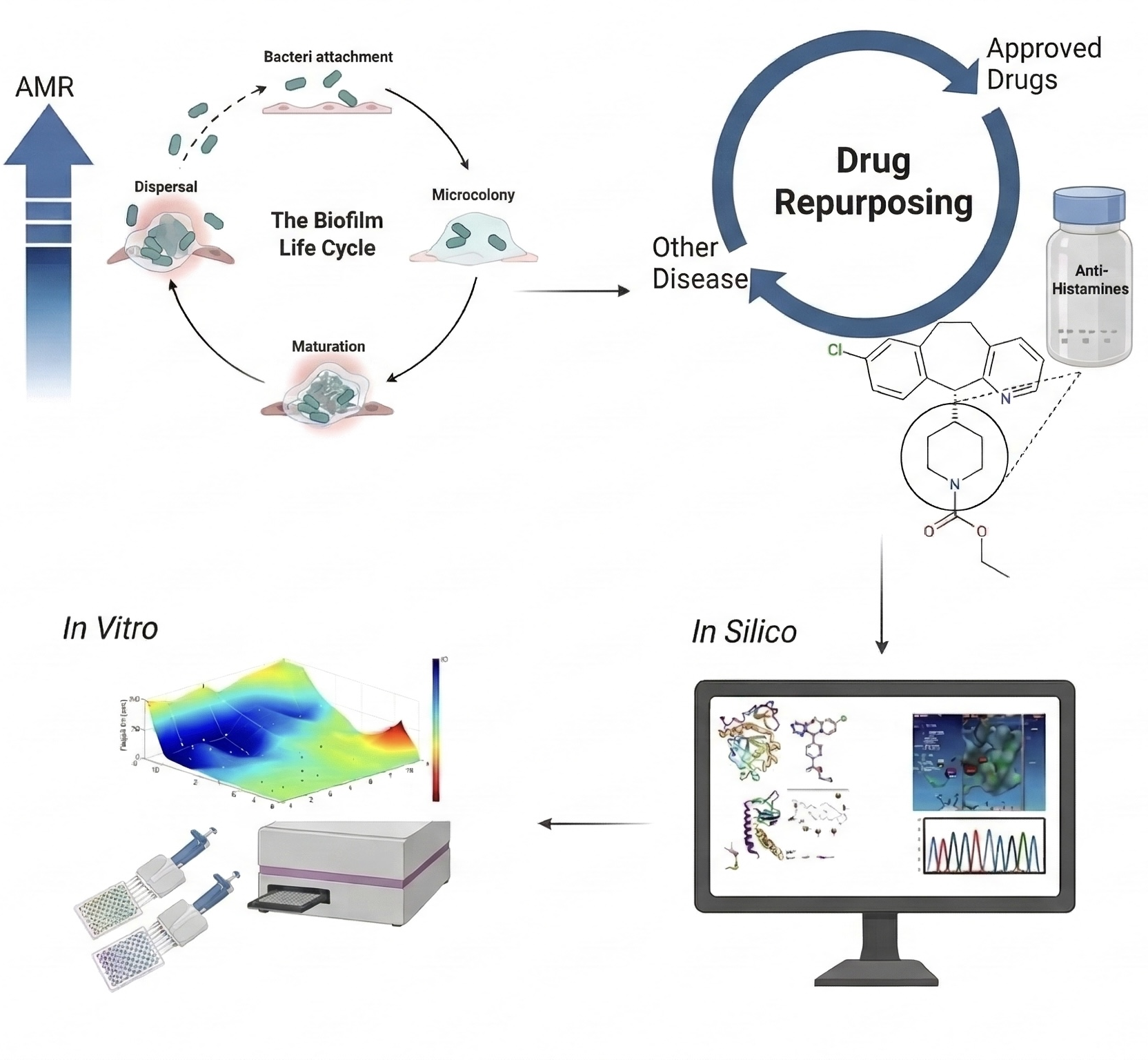
Methicillin-Resistant Staphylococcus aureus is an opportunistic pathogen that remains a serious threat to human health due to its high virulence, antibiotic resistance, and strong ability to form biofilms. Biofilm formation reduces the susceptibility of bacteria to conventional therapies and plays a critical role in persistent chronic infections. Drugs repurposing using antihistamines offers an efficient strategy to identify antibiotic adjuvants that can enhance antibiofilm efficacy. This study evaluates the potential of antihistamines, specifically fexofenadine, as an antibiotic adjuvant against biofilm-forming MRSA using integrated in silico and in vitro approaches. Molecular docking analysis targeting the biofilm regulator proteins AgrA (PDB ID: 4G4K) and SarA (PDB ID: 2FRH) showed that fexofenadine has high binding affinity, forming strong hydrogen and non-covalent interactions, and maintaining a stable complex during molecular dynamics simulations. In vitro checkerboard assay showed a synergistic effect between 0.5 µg/mL fexofenadine and 0.5 µg/mL cefoxitin, reducing planktonic bacterial growth by approximately 70% compared to the control. In the biofilm assay, the combination of fexofenadine 1 µg/mL and cefoxitin 16 µg/mL significantly inhibited biofilm formation by 70%, as indicated by lighter crystal violet staining. The in-silico results suggest that fexofenadine may interact with the biofilm regulatory proteins AgrA and SarA, which are anticipated to be involved in the quorum sensing system of Staphylococus aureus, while in vitro findings confirm its synergistic antibiofilm activity with cefoxitin. Overall, this study highlights the potential repurposing of antihistamines, particularly fexofenadine as an antibiofilm combination strategy to enhance therapeutic efficacy against antibiotic-resistant S.aureus infections.
HIGHLIGHTS
- Antihistamine repurposing as a cefoxitin adjuvant against MRSA using in silico and in vitro
- Molecular docking shows fexofenadine has high binding affinity to AgrA −6.9 and SarA −6.2 kcal/mol, with stable interactions confirmed by molecular dynamics, indicating its contribution as a cefoxitin adjuvant in antibiofilm therapy
- Fexofenadine combined with cefoxitin reduces planktonic growth and biofilm formation by 10%
GRAPHICAL ABSTRACT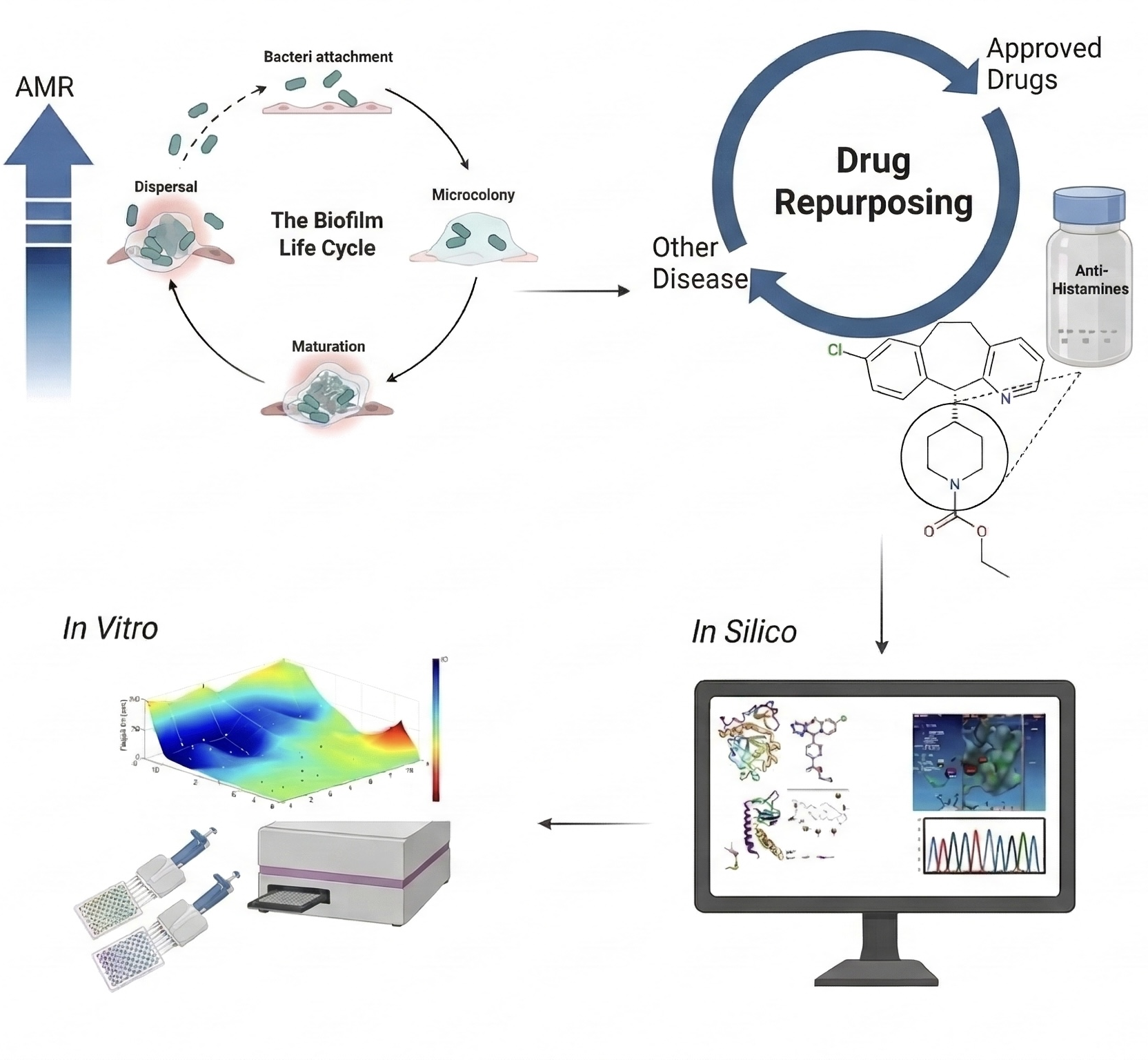
Downloads
References
SS Alnejadi and AH Saleh. Gene expression of carbapenemase-encoding genes in multi-drug resistant Staphylococcus aureus from clinical sources. European Journal of Medical Genetics and Clinical Biology 2024; 1(5), 179-186.
BA Clent, Y Wang, HC Britton, F Otto, CJ Swain, MH Todd and MH Todd. Molecular docking with open access software: Development of an online laboratory handbook and remote workflow for chemistry and pharmacy master’s students to undertake computer-aided drug design. Journal of Chemical Education 2021; 98(9), 2899-2905.
HR Nasution, AW Septama, T Ernawati, NA Khairunnisa, SE Nugraha and DS Utami. Ethanolic extract of Curcuma domestica Val. and Curcuma xanthorrhiza Roxb.: A comparative study in vitro and in silico antibacterial effect against methicillin-resistant Staphylococcus aureus. Trends in Sciences 2025; 22(5), 9458.
B Kim, HJ Lee, SH Jo, MG Kim, Y Lee, W Lee, W Kim, HS Joo, YG Kim, JS Kim and YH Yang. Study of SarA by DNA affinity capture assay (DACA) employing 3 promoters of key virulence and resistance genes in methicillin-resistant Staphylococcus aureus. Antibiotics 2022; 11(12), 1714.
L Li, A Cheung, AS Bayer, L Chen, W Abdelhady, BN Kreiswirth, MR Yeaman and YQ Xiong. The global regulon sarA regulates beta-lactam antibiotic resistance in methicillin-resistant Staphylococcus aureus in vitro and in endovascular infections. The Journal of Infectious Diseases 2016; 214(9), 1421-1429.
MA Diaz, EG Vega-Hissi, MA Blazquez, MR Alberto and ME Arena. Restraining Staphylococcus aureus virulence factors and quorum sensing through lactic acid bacteria supernatant extracts. Antibiotics 2024; 13(4), 297.
P Liu, X Kang, CH Chen, X Luo, C Li and G Wang. Quercetin targets SarA of methicillin-resistant Staphylococcus aureus to mitigate biofilm formation. Microbiology Spectrum 2024; 12(1), e02722-23.
H Sang, H Jin, P Song, W Xu and F Wang. Gallic acid exerts antibiofilm activity by inhibiting methicillin-resistant Staphylococcus aureus adhesion. Scientific Reports 2024; 14(1), 17220.
W Abdelraheem, S Abdelraheem and S Zaki. Phenotypic and genotypic detection of biofilm formation and methicillin resistance among Staphylococcus aureus isolates. Microbes and Infectious Diseases 2021; 2(3), 485-496.
G Wang, L Li, X Wang, X Li, Y Zhang, J Yu, J Jiang, X You and YQ Xiong. Hypericin enhances beta-lactam antibiotics activity by inhibiting sarA expression in methicillin-resistant Staphylococcus aureus. Acta Pharmaceutica Sinica B 2019; 9(6), 1174-1182.
W Abdelhady, AS Bayer, K Seidl, DE Moormeier, KW Bayles, A Cheung, MR Yeaman and YQ Xiong. Impact of vancomycin on sarA-mediated biofilm formation: Role in persistent endovascular infections due to methicillin-resistant Staphylococcus aureus. The Journal of Infectious Diseases 2014; 209(8), 1231-1240.
Y Li, S Li, K Yang, R Guo, X Zhu, Y Shi and A Huang. Antibiofilm mechanism of a novel milk-derived antimicrobial peptide against Staphylococcus aureus by downregulating agr quorum sensing system. Journal of Applied Microbiology 2022; 133(4), 2198-2209.
J Qin, L Yu, F Peng, X Ye, G Li, C Sun, F Cheng, C Peng and X Xie. Tannin extracted from Penthorum chinense Pursh, a potential drug with antimicrobial and antibiofilm effects against methicillin-sensitive Staphylococcus aureus and methicillin-resistant Staphylococcus aureus. Frontiers in Microbiology 2023; 14, 1134207.
FM Ballah, MS Islam, ML Rana, MA Ullah, FB Ferdous, FH Neloy, S Ievy, MA Sobur, AMMT Rahman, MM Khatun, M Rahman and MT Rahman. Virulence determinants and methicillin resistance in biofilm-forming Staphylococcus aureus from various food sources in Bangladesh. Antibiotics 2022; 11(11), 1666.
K Azmi, W Qrei and Z Abdeen. Screening of genes encoding adhesion factors and biofilm production in methicillin resistant strains of Staphylococcus aureus isolated from Palestinian patients. BMC Genomics 2019; 20(1), 578.
AH Jonker, D O’Connor, MM Cavaller-Bellaubi, C Fetro, M Gogou, PAC T’Hoen, M de Kort, H Stone, N Valentine and AMG Pasmooij. Drug repurposing for rare: Progress and opportunities for the rare disease community. Frontiers in Medicine 2024; 11, 1352803.
H Kawauchi, K Yanai, DY Wang, K Itahashi and K Okubo. Antihistamines for allergic rhinitis treatment from the viewpoint of nonsedative properties. International Journal of Molecular Sciences 2019; 20(1), 213.
A Schafer, H Cheng, R Xiong, V Soloveva, C Retterer, F Mo, S Bavari, G Thatcher and L Rong. Repurposing potential of 1st generation H1-specific antihistamines as anti-filovirus therapeutics. Antiviral Research 2018; 157, 47-56.
N Cutrona, K Gillard, R Ulrich, M Seemann, HB Miller and MS Blackledge. From antihistamine to anti-infective: Loratadine inhibition of regulatory PASTA kinases in staphylococci reduces biofilm formation and potentiates beta-lactam antibiotics and vancomycin in resistant strains of Staphylococcus aureus. ACS Infectious Diseases 2019; 5(8), 1397-1410.
Y Shang, J Guo, Y Zhao, J Chen, Q Meng, D Qu, J Zheng, Z Yu, Y Wu and Q Deng. Clemastine inhibits the biofilm and hemolytic of Staphylococcus aureus through the GdpP protein. Microbiology Spectrum 2022; 10(2), e0054121.
GG Bruer, P Hagedorn, M Kietzmann, AF Tohamy, V Filor, E Schultz, S Mielke-Kuschow and J Meissner. Histamine H1 receptor antagonists enhance the efficacy of antibacterials against Escherichia coli. BMC Veterinary Research 2019; 15(1), 55.
SS Butt, Y Badshah, M Shabbir and M Rafiq. Molecular docking using Chimera and AutoDock Vina software for nonbioinformaticians. JMIR Bioinformatics and Biotechnology 2020; 1(1), e14232.
H Land and MS Humble. Chapter 4 in biocatalytic investigations. Biocatalytic Investigations 2018; 1685, 43-67.
T Chipenzi, G Baloyi, T Mudondo, S Sithole, GF Chi and S Mukanganyama. An evaluation of the antibacterial properties of tormentic acid congener and extracts from Callistemon viminalis on selected ESKAPE pathogens and effects on biofilm formation. Advances in Pharmacological and Pharmaceutical Sciences 2020; 2020, 8848606.
P Aelenei, CM Rimbu, CE Horhogea, A Lobiuc, AN Neagu, SI Dunca, I Motrescu, G Dimitriu, AC Aprotosoaie and A Miron. Prenylated phenolics as promising candidates for combination antibacterial therapy: Morusin and kuwanon G. Saudi Pharmaceutical Journal 2020; 28(10), 1172-1181.
ZX Luo, Y Li, MF Liu and R Zhao. Ciprofloxacin enhances the biofilm formation of Staphylococcus aureus via an agrC-dependent mechanism. Frontiers in Microbiology 2023; 14, 1328947.
F Zhang, W Dong, F Wang, J Yu, F Jiang, J Tang, Y Qian and H Shen. The topical tranexamic acid have potential hazard of promoting biofilm formation of Staphylococcus aureus in microenvironment of the prosthetic joint. BioMed Research International 2021; 2021, 5748069.
L Liu, X Shen, J Yu, X Cao, Q Zhan, Y Guo and F Yu. Subinhibitory concentrations of fusidic acid may reduce the virulence of S. aureus by down-regulating sarA and saeRS to reduce biofilm formation and alpha-toxin expression. Frontiers in Microbiology 2020; 11, 25.
MM Saleh, N Yousef, SM Shafik and HA Abbas. Attenuating the virulence of the resistant superbug Staphylococcus aureus bacteria isolated from neonatal sepsis by ascorbic acid, dexamethasone, and sodium bicarbonate. BMC Microbiology 2022; 22(1), 268.
A Valliammai, A Selvaraj, U Yuvashree, C Aravindraja and SK Pandian. sarA-dependent antibiofilm activity of thymol enhances the antibacterial efficacy of rifampicin against Staphylococcus aureus. Frontiers in Microbiology 2020; 11, 1744.
MJ Campbell, KE Beenken, AM Ramirez and MS Smeltzer. Increased production of aureolysin and staphopain A is a primary determinant of the reduced virulence of Staphylococcus aureus sarA mutants in osteomyelitis. mBio 2024; 15(4), e0338323.
PS Ganesh, K Veena, R Senthil, K Iswamy, EM Ponmalar, V Mariappan, AS Smiline Girija, J Vadivelu, S Nagarajan, D Challabathula and EM Shankar. Biofilm-associated Agr and Sar quorum sensing systems of Staphylococcus aureus are inhibited by 3-hydroxybenzoic acid derived from Illicium verum. ACS Omega 2022; 7(17), 14653-14665.
D Sun, L Xu, M Tong, Z Wei, W Zhang, J Liang, X Liu and Y Wang. De novo design of mIDH1 inhibitors by integrating deep learning and molecular modeling. Frontiers in Pharmacology 2024; 15, 1491699.
CA Sarri, GE Papadopoulos and Z Mamuris. West Nile virus-associated HLA-DRB1 alleles in the Greek population: A structural perspective. Microbiology and Immunology 2023; 67(3), 154-159.
P Garg, VK Vanamamalai, I Jali and S Sharma. In silico prediction of the animal susceptibility and virtual screening of natural compounds against SARS-CoV-2: Molecular dynamics simulation based analysis. Frontiers in Genetics 2022; 13, 906955.
ZB Zhang, YL Xia, GH Dong, YX Fu and SQ Liu. Exploring the cold-adaptation mechanism of serine hydroxymethyltransferase by comparative molecular dynamics simulations. International Journal of Molecular Sciences 2021; 22(4), 1781.
RG Maset, A Hapeshi, J Lapage, N Harrington, J Littler, S Perrier and F Harrison. Combining SNAPs with antibiotics shows enhanced synergistic efficacy against S. aureus and P. aeruginosa biofilms. npj Biofilms and Microbiomes 2023; 9(1), 36.
R Rajendran, C Williams, DF Lappin, O Millington, M Martins and G Ramage. Extracellular DNA release acts as an antifungal resistance mechanism in mature Aspergillus fumigatus biofilms. Eukaryotic Cell 2013; 12(3), 420-429.
T Heinonen, S Hargraves, M Georgieva, C Widmann and N Jacquier. The antimicrobial peptide TAT-RasGAP317-326 inhibits the formation and expansion of bacterial biofilms in vitro. Journal of Global Antimicrobial Resistance 2021; 25, 227-231.
F Shang, L Li, L Yu, J Ni, X Chen and T Xue. Effects of Stigmata maydis on the methicillin resistant Staphylococcus aureus biofilm formation. PeerJ 2019; 7, e6461.
M Setiabudy, DAPS Masyeni, AAG Indraningrat, K Suryawan, IKAI Adhiputra and MABA Rahman. Biofilm formation in Staphylococcus aureus and coagulase-negative Staphylococcus. Folia Medica Indonesiana 2023; 59(3), 222-228.
MMM Raja, N Reehana and AF Begum. Multidrug resistant Staphylococcus aureus isolated from UTI site and its biofilm inhibition activity with nanomaterials in reference with standard antibiotics. International Journal of Zoology Investigations 2022; 8, 152-159.
K Gao, B Su, J Dai, P Li, R Wang and X Yang. Anti-biofilm and anti-hemolysis activities of 10-Hydroxy-2-decenoic acid against Staphylococcus aureus. Molecules 2022; 27(5), 1485.
EM Grimsey and LJ Piddock. Do phenothiazines possess antimicrobial and efflux inhibitory properties? FEMS Microbiology Reviews 2019; 43(6), 577-590.
AKJ Jie, M Hussein, GG Rao, J Li and T Velkov. Drug repurposing approaches towards defeating multidrug-resistant gram-negative pathogens: Novel polymyxin/non-antibiotic combinations. Pathogens 2022; 11(12), 1420.
B Racz and G Spengler. Repurposing antidepressants and phenothiazine antipsychotics as efflux pump inhibitors in cancer and infectious diseases. Antibiotics 2023; 12(1), 137.
JI Perlmutter, LT Forbes, DJ Krysan, K Ebsworth-Mojica, JM Colquhoun, JL Wang, PM Dunman and DP Flaherty. Repurposing the antihistamine terfenadine for antimicrobial activity against Staphylococcus aureus. Journal of Medicinal Chemistry 2014; 57(20), 8540-8562.
C Rauch, L Lucio, BB de Fer and M Lheritier-Barrand. Bioequivalence of 2 pediatric formulations of fexofenadine hydrochloride oral suspension. Clinical Pharmacology in Drug Development 2023; 12(12), 1194-1203.
M Batool, A Zamir, F Alqahtani, T Ahmad, H Saeed and MF Rasool. Clinical pharmacokinetics of fexofenadine: A systematic review. Pharmaceutics 2024; 16(12), 1619.
Published
How to Cite
Issue
Section
License
Copyright (c) 2026 Walailak University

This work is licensed under a Creative Commons Attribution-NonCommercial-NoDerivatives 4.0 International License.





