
Synergistic Effects of Clinacanthus nutans Leaf Aqueous Extract and Paclitaxel on The Cell Cycle and Apoptosis of Breast Cancer Stem Cells Expressing CD44+/CD24−
DOI:
https://doi.org/10.48048/tis.2026.13206Keywords:
C. nutans leaf, Aqueous extract, Breast cancer stem cells, PaclitaxelAbstract
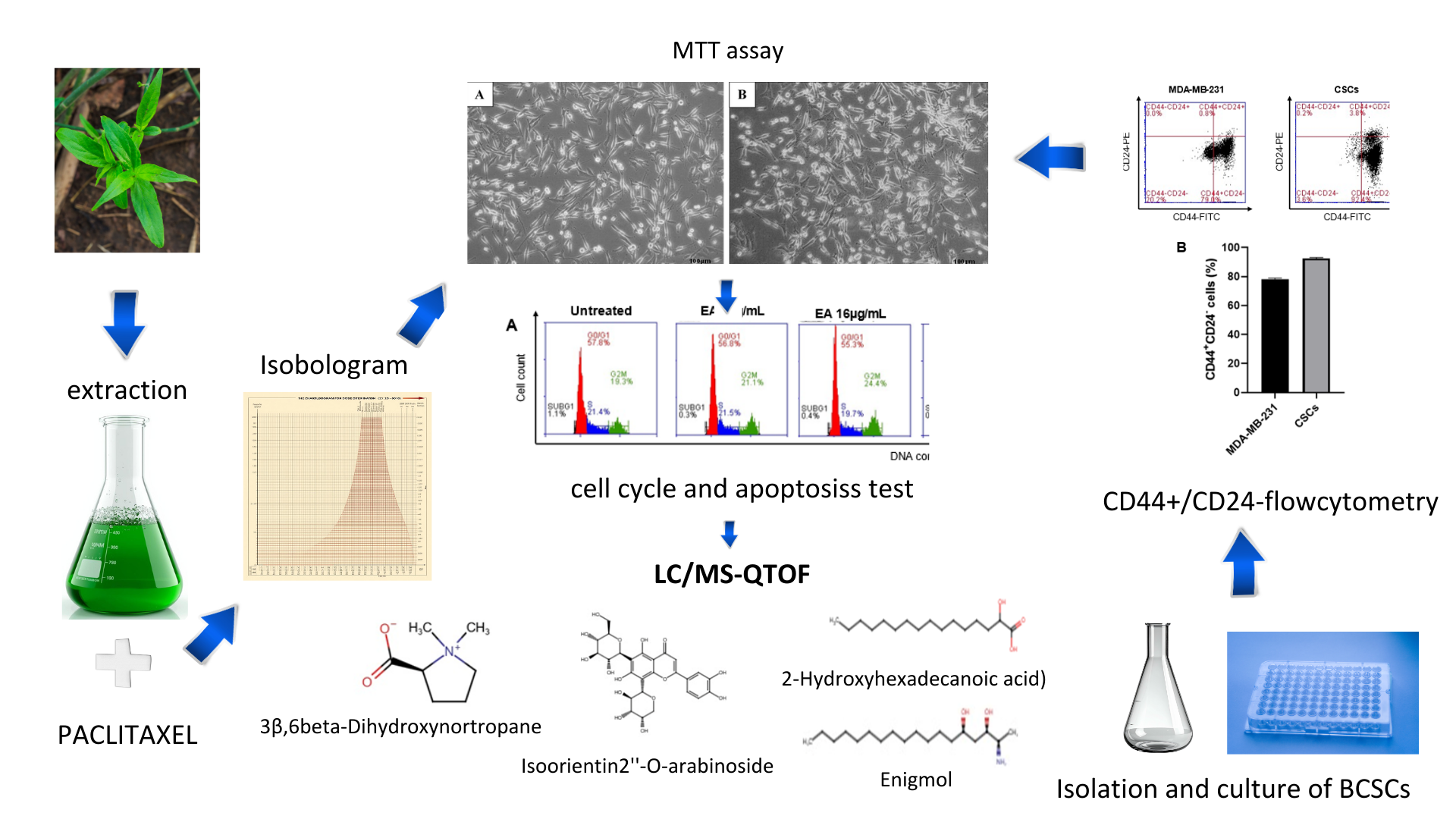
We investigated the combination effect of Clinacanthus nutans (C. nutans) leaf aqueous extract and paclitaxel on breast cancer stem cells (BCSCs) cell cycle and apoptosis, and identify potential anti-cancer active compounds in C. nutans leaves. We performed cell cycle and apoptosis test by using flow cytometry to determine the synergistic effects of the combination. The potential anti-cancer compounds in C. nutans leaf aqueous extract was determined using an LC-MS/QTOF system. BCSCs expressing CD44+/CD24- viability decreased after the administration of C. nutans leaf aqueous extract and paclitaxel. The combination group had a higher number of cells in S-phase compared to the control group. We found a significant difference in the percentage of number of cells between groups in G2/M phase. More early and late apoptotic cells were observed in the combination group than in only C. nutans leaf aqueous extract or control groups. We found the upregulation of P53 and downregulation of MDM2 in C. nutans leaf aqueous extract group. We found six bioactive compounds namely 3β,6beta-dihydroxynortropane, isoorientin 2''-O-arabinoside, 2-hydroxyhexadecanoic acid, 2-aminohexadecanoic acids, enigmol and spisulosine. C. nutans leaf aqueous extract synergized with paclitaxel, interfered with the cell cycle (mainly in G2/M phase), and induced early and late apoptosis in BCSCs. The synergistic effects are believed to be due to the presence of 3β,6beta-dihydroxynortropane, isoorientin 2″-O-arabinoside, 2-hydroxyhexadecanoic acid, 2-aminohexadecanonic acid, enigmol, and spisulosine that exert anti-cancer effects.
HIGHLIGHTS
- C. nutans leaves water extract synergized with Paclitaxel to inhibit the breast cancer stem cells (BCSCs) viability
- The combination of nutans leaves water extract and paclitaxel worked by interfered with the cell cycle mainly in the G2/M phase
- The combination also induced early and late apoptosis of BCSCs
- The synergistic effects are believed due to 3β,6beta-dihydroxynortropane, isoorientin 2″-O-arabinoside, 2-hydroxyhexadecanoic acid, 2-aminohexadecanonic acid, enigmol in C.nutans leaves water extract
GRAPHICAL ABSTRACT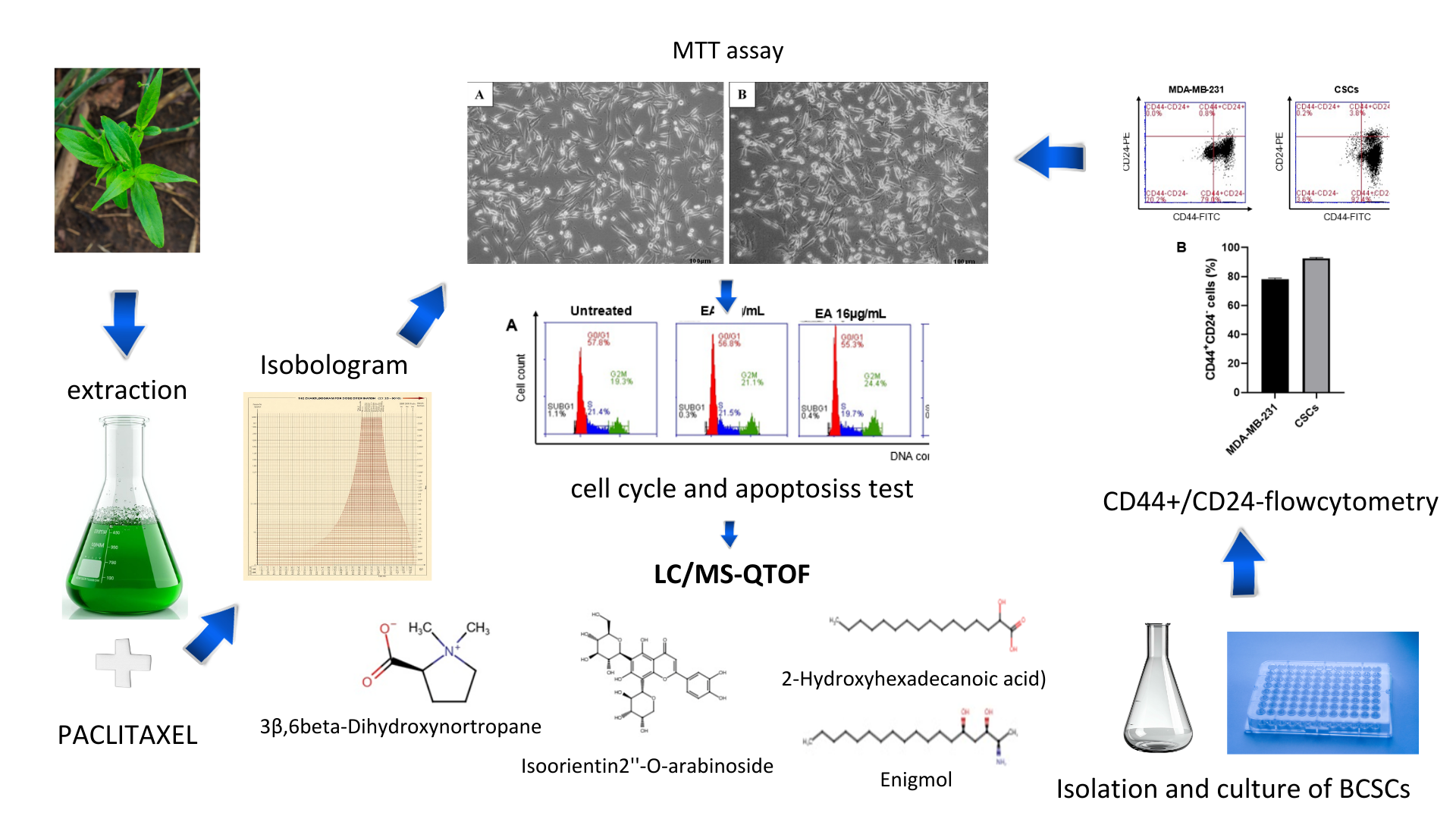
Downloads
References
D Courtney, MG Davey, BM Moloney, MK Barry, K Sweeney, RP Mclaughlin, CM Malone, AJ Lowery and MJ Kerin. Breast cancer recurrence: Factors impacting occurrence and survival. Irish Journal of Medical Sciences 2022; 191(6), 2501-2510.
FW Hunter, HR Barker, B Lipert, F Rothe, G Gebhart, MJ Piccart-Gebhart, C Sotiriou and SMF Jamieson. Mechanisms of resistance to trastuzumab emtansine (T-DM1) in HER2-positive breast cancer. British Journal Cancer 2020; 122, 603-612.
M Álvarez-Fernández and M Malumbres. Mechanisms of sensitivity and resistance to CDK4/6 inhibition. Cancer Cell 2020; 37(4), 514-529.
M Colleoni, Z Sun, KN Price, P Karlsson, JF Forbes, B Thurlimann, L Gianni, M Castiglione, RD Gelber, AS Coates and A Goldhirsch. Annual hazard rates of recurrence for breast cancer during 24 years of follow-up: Results from the international breast cancer study group trials I to V. Journal of Clinical Oncology 2016; 34(9), 927-935.
MCV Maaren, LD Munck, LJA Strobbe, GS Sonke, PJ Westenend, ML Smidt, PMP Poortmans and S Siesling. Ten-year recurrence rates for breast cancer subtypes in the Netherlands: A large population-based study. International Journal of Cancer 2019; 144(2), 263-272.
JS Crabtree and L Miele. Breast cancer stem cells. Biomedicines 2018; 6(3), 77.
CJ O’Conor, T Chen, I González, D Cao and Y Peng. Cancer stem cells in triple-negative breast cancer: A potential target and prognostic marker. Biomarkers in Medicine 2018; 12(7), 813-820.
MY Hsu, CH Hsieh, YT Huang, SY Chu, CM Chen, WJ Lee and SJ Liu. Enhanced paclitaxel efficacy to suppress triple-negative breast cancer progression using metronomic chemotherapy with a controlled release system of electrospun Poly-d-l-Lactide-Co-Glycolide (PLGA) nanofibers. Cancers 2021; 13(13), 3350.
PL Chou, YP Huang, MH Cheng, KM Rau and YP Fang. Improvement of paclitaxel-Associated adverse reactions (ADRs) via the Use of Nano-based drug delivery systems: A systematic review and network Meta-analysis. International Journal of Nanomedicine 2020; 15, 1731-1743.
DA McGrowder, FG Miller, CR Nwokocha, MS Anderson, C Wilson-Clarke, K Vaz, L Anderson-Jackson and J Brown. Medicinal herbs used in traditional management of breast cancer: Mechanisms of action. Medicines 2020; 7(8), 47.
SY Quah, JH Chin, GA Akowuah, SI Khalivulla, SW Yeong and MC Sabu. Cytotoxicity and cytochrome P450 inhibitory activities of Clinacanthus nutans. Drug Metabolism and Personalized Therapy 2017; 32(1), 59-65.
A Alam, S Ferdosh, K Ghafoor, A Hakim, AS Juraimi, A Khatib and ZI Sarker. Clinacanthus nutans: A review of the medicinal uses, pharmacology and phytochemistry. Asian Pacific Journal of Tropical Medicine 2016; 9(4), 402-409.
NFABB Bakar, ZL Yeo and F Hussin. Synergistic effects of combined cisplatin and Clinacanthus nutans extract on triple negative breast cancer cells. Journal of Taibah University Medical Sciences 2023; 18(6), 1220-1236.
SS Widjaja, Rusdiana, M Ichwan. Enhanced cytotoxic effects of Clinacanthus nutans and doxorubicin in combination toward breast cancer cell lines. Journal of Advanced Pharmaceutical Technology & Research 2021; 12(2), 156.
MK Zenjanab, S Alimohammadvand, A Doustmihan, S Kianian, BS Oskouei, M Mazloomi, M Akbari and R Jahanban-Esfahlan. Paclitaxel for breast cancer therapy: A review on effective drug combination modalities and nano drug delivery platforms. Journal of Drug Delivery Science and Technology 2024; 95, 105567.
NZ Ismail, H Arsad, MR Samian and MR Hamdan. Determination of phenolic and flavonoid contents, antioxidant activities and GC-MS analysis of Clinacanthus nutans (Acanthaceae) in different locations. AGRIVITA Journal of Agricultural Science 2017; 39(3), 334-335.
YK Yong, JJ Tan, SS The, SH Mah, GCL Ee, HS Chiong and Z Ahmad. Clinacanthus nutans extracts are antioxidant with antiproliferative effect on cultured human cancer cell lines. Evidence-Based Complementary and Alternative Medicine 2013; 2013, 462751.
SNAM Roslan, Y Zakaria and H Abdullah. Cytotoxicity of Clinacanthus nutans and mechanism of action of its active fraction towards human cervical cancer cell line, HeLa. Jurnal Sains Kesihatan Malaysia 2018; 16(2), 39-50.
S Syarifah, AS Rambe, A Putra, M Ichwan, YS Pane, AM Muhar, A Khatib, D Munir, M Rusda and MM Amin. Aqueous extract have superior cytotoxic effect than ethanolic extract of Clinacanthus Nutans leaves in breast cancer stem cells. Acta Informatica Medica 2023; 32(1), 4-10.
NH Haron, ZM Toha, R Abas, MR Hamdan, N Azman, M Khairuddean and H Arsad. In vitro cytotoxic activity of Clinacanthus nutans leaf extracts against hela cells. Asian Pacific Journal of Cancer Prevention 2019; 20(2), 601-609.
D Hermansyah, A Putra, D Munir, A Lelo, ND Amalina and I Alif. Synergistic effect of curcuma longa extract in combination with phyllanthus niruri extract in regulating annexin A2, epidermal growth factor receptor, matrix metalloproteinases, and pyruvate kinase M1/2 signaling pathway on breast cancer stem cell. Open Access Macedonian Journal of Medical Sciences 2021; 9, 271-285.
PV Pham, NLC Phan, NT Nguyen, NH Truong, TT Duong, DV Le, KD Truong and NK Phan. Differentiation of breast cancer stem cells by knockdown of CD44: Promising differentiation therapy. Journal of Translational Medicine 2011; 9, 209.
T Mosmann. Rapid colorimetric assay for cellular growth and survival: Application to proliferation and cytotoxicity assays. Journal of Immunological Methods 1983; 65(1-2), 55-63.
R Rahmé. Assaying cell cycle status using flow cytometry. Methods in Molecular Biology 2021; 2267, 165-179.
I Lakshmanan and SK Batra. Protocol for apoptosis assay by flow cytometry using annexin V staining method materials and reagents. Bio-Protocal 2016; 3(6), e374.
I Lakshmanan, MP Ponnusamy, S Das, S Chakraborty, D Haridas, P Mukhopadhyay, SM Lele and SK Batra. MUC16 induced rapid G2/M transition via interactions with JAK2 for increased proliferation and anti-apoptosis in breast cancer cells. Oncogene 2012; 31(7), 805-817.
S Murugesu, Z Ibrahim, QU Ahmed, BF Uzir, NIK Yusoff, V Perumal, Abas, K Shaari and A Khatib. Identification of α-glucosidase inhibitors from Clinacanthus nutans leaf extract using liquid chromatography-mass spectrometry-based metabolomics and protein-ligand interaction with molecular docking. Journal of Pharmaceutical Analysis 2019; 9(2), 91-99.
S Kumar, A Singh and B Kumar. Identification and characterization of phenolics and terpenoids from ethanolic extracts of Phyllanthus species by HPLC-ESI-QTOF-MS/MS. Journal of Pharmaceutical Analysis 2017; 7(4), 214-222.
ADC Paula, C Leitão, O Marques, AM Rosa, AH Santos, A Rema, MDF Faria, A Rocha, JL Costa, M Lima and C Lopes. Molecular characterization of CD44+/CD24−/Ck+/CD45− cells in benign and malignant breast lesions. Virchows Archiv 2017; 470(3), 311-322.
U Testa, G Castelli and E Pelosi. Lung cancers: Molecular characterization, clonal heterogeneity and evolution, and cancer stem cells. Cancers 2018; 10(8), 248.
B Li, SX Dou, JW Yuan and H Li. Intracellular transport is accelerated in early apoptotic cells. Proceedings of the National Academy of Sciences of the United States of America 2018; 115(48), 12118-12123.
J Su, S Wu, H Wu, L Li and T Guo. CD44 is functionally crucial for driving lung cancer stem cells metastasis through Wnt/β-catenin-FoxM1-Twist signaling. Molecular Carcinogenesis 2016; 55(12), 1962-1973.
N Fultang, M Chakraborty and B Peethambaran. Regulation of cancer stem cells in triple negative breast cancer. Cancer Drug Resistance 2021; 4(2), 321-342.
L Zhao, JLS Au and MG Wientjes. Comparison of methods for evaluating drug-drug interaction. Frontiers in Bioscience 2010; 2(1), 241-249.
TC Chou. The combination index (CI < 1) as the definition of synergism and of synergy claims. Synergy 2018; 7, 49-50.
NNAS Zainuddin, H Muhammad, NNF Hassan, NH Othman and Y Zakaria. Clinacanthus nutans Standardized Fraction Arrested SiHa Cells at G1/S and Induced Apoptosis via Upregulation of p53. Journal of Pharmacy and Bioallied Sciences 2020; 12(S2), S768-S776.
TM Khing, WS Choi, DM Kim, WW Po, W Thein, CY Shin and UD Sohn. The effect of paclitaxel on apoptosis, autophagy and mitotic catastrophe in AGS cells. Scientific Reports 2021; 11(1), 23490.
FY Alqahtani, FS Aleanizy, EE Tahir, HM Alkahtani and BT Alquadeib. Paclitaxel. Profiles of Drug Substances, Excipients and Related Methodology 2019; 44, 205-238.
G Li, D Xu, J Sun, S Zhao and D Zheng. Paclitaxel inhibits proliferation and invasion and promotes apoptosis of breast cancer cells by blocking activation of the PI3K/AKT signaling pathway. Advances in Clinical and Experimental Medicine 2020; 29(11), 1337-1345.
DL Yong, B Xu and TR Lu. Anticancer drug development, pharmacology updating. EC Pharmacology and Toxicology 2020; 2, 1-6.
S Elmore. Apoptosis: A review of programmed cell death. Toxicologic Pathology 2007; 35(4), 495-516.
G Bjelakovic and K Vuka. Apoptosis: Programmed cell death mechanism of cell death – apoptosis and necrosis. Facta universitatis series: Medicine and Biology 2005; 12(1), 6-11.
IKH Poon, MD Hulett and CR Parish. Molecular mechanisms of late apoptotic/necrotic cell clearance. Cell Death Differ 2010; 17(3), 381-397.
H Dariushnejad, N Roshanravan, HM Wasman, M Cheraghi, L Pirzeh and V Ghorbanzadeh. Silibinin, synergistically enhances Vinblastine-mediated apoptosis in triple negative breast cancer cell line: Involvement of Bcl2/Bax and Caspase-3 Pathway. International Journal of Hematology-Oncology and Stem Cell Research 2024; 18(2), 174-182.
A Sharma, M Kaur and JK Katnoria. Polyphenols in food: Cancer prevention and apoptosis induction. Current Medicinal Chemistry 2018; 25(36), 4740-4757.
MS D’Arcy. Cell death: A review of the major forms of apoptosis, necrosis and autophagy. Cell Biology International 2019; 43(6), 582-592.
S Arullappan, P Rajamanickam, N Thevar and CC Kodimani. In Vitro screening of cytotoxic, antimicrobial and antioxidant activities of Clinacanthus nutans (Acanthaceae) leaf extracts. Tropical Journal of Pharmaceutical Research 2014; 13(9), 1455-1461.
L Yuan, S Wei, J Wang and X Liu. Isoorientin induces apoptosis and autophagy simultaneously by reactive oxygen species (ROS)-Related p53, PI3K/Akt, JNK, and p38 signaling pathways in HepG2 cancer cells. Journal of Agricultural and Food Chemistry 2014; 62(23), 5390-5400.
European Patent Specification. Hydroxyhexadecanoic acid for the treatment of cancer. European Patent Specification, Germany, 2025.
NFABB Bakar, ZL Yeo, F Hussin, P Madhavan, V Lim, K Jemon and P Prabhakaran. Synergistic effects of combined cisplatin and Clinacanthus nutans extract on triple negative breast cancer cells. Journal of Taibah University Medical Sciences 2023; 18(6), 1220-1236.
B Bharath, K Perinbam, S Devanesan, MS Alsalhi and M Saravanan. Evaluation of the anticancer potential of Hexadecanoic acid from brown algae Turbinaria ornata on HT–29 colon cancer cells. Journal of Molecular Structure 2021; 1235(2), 130229.
H Symolon, A Bushnev, Q Peng, H Ramaraju, SG Mays, JC Allegood, ST Pruett, MC Sullards, DL Dillehay, DC Liotta and AH Merrill. Enigmol: A novel sphingolipid analog with anti-cancer activity against cancer cell lines and in vivo models for intestinal and prostate cancer. Molecular Cancer Therapeutics 2017; 10(4), 648-657.
EJ Miller, SG Mays, MT Bailie, RB Howard, DG Culver, M Saindane, ST Pruett, JJ Holt, DS Menaldino, TJ Evers, GP Reddy, RF Arrendale, MG Natchus, JA Petros and DC Liotta. Discovery of a fluorinated enigmol analog with enhanced in vivo pharmacokinetic and Anti-tumor properties. ACS Medicinal Chemistry Letters Journal 2016; 7(5), 537-542.
LW Hii, FFL Chung, CW Mai, PY Ng and CO Leong. Sphingosine kinase 1 signaling in breast cancer: A potential target to tackle breast cancer stem cells. Frontiers in Molecular Biosciences 2021; 8, 748470.
A Ganesher, P Chaturvedi, R Sahai, S Meena, K Mitra, D Datta and G Panda. New spisulosine derivative promotes robust autophagic response to cancer cells. European Journal of Medicinal Chemistry 2020; 188, 112011.
M Sanchez, N Picard, K Sauvé and A Tremblay. Coordinate regulation of estrogen receptor β degradation by Mdm2 and CREB-binding protein in response to growth signals. Oncogene 2013; 32(1), 117-126.
P Nussbaumer. Medicinal chemistry aspects of drug targets in sphingolipid metabolism. ChemMedChem 2008; 3(4), 543-551.
H Symolon, A Bushnev, Q Peng, H Ramaraju, SG Mays, JC Allegood, ST Pruett, MC Sullards, DL Dillehay, DC Liotta and AH Merrill. Enigmol: A novel sphingolipid analog with anti-cancer activity against cancer cell lines and in vivo models for intestinal and prostate cancer. Molecular Cancer Therapeutics 2017; 10(4), 648-657.
DHF Brabander, K Verheyden, V Mortier, BL Bizec, W Verbeke, D Courtheyn and H Noppe. Phytosterols and anabolic agents versus a designer drugs. Analytica Chimica Acta 2007; 586(1-2), 49-56.
P Adamson. All-trans-retinoic acid pharmacology and its impact on the treatment of acute promyelocytic leukemia. Oncologist 1996; 1(5), 305-314.
D Uchida, H Kawamata, K Nakashiro, F Omotehara, S Hino, MO Hoque, NM Begum, H Yoshida, M Sato and T Fujimori. Low-dose retinoic acid enhances in vitro invasiveness of human oral squamous-cell-carcinoma cell lines. British Journal of Cancer 2001; 85(1), 122-128.
Downloads
Published
How to Cite
Issue
Section
License
Copyright (c) 2026 Walailak University

This work is licensed under a Creative Commons Attribution-NonCommercial-NoDerivatives 4.0 International License.





