
Comparative Study on Anti-Inflammatory Activity and Phytochemical Constituents of Essential Oil, Steamed and Non-Steamed Extracts of Zingiber Ottensii Valeton
DOI:
https://doi.org/10.48048/tis.2026.12879Keywords:
Zingiber ottensii, Thai traditional medicine, Chemical constituent, Steamed extract, Anti-inflammation, HPLC, GC/MS, Zerumbone, Zingiber ottensii, Thai traditional medicine, Chemical constituent, Steamed extract, Anti-inflammation, HPLC, GC/MS, ZerumboneAbstract
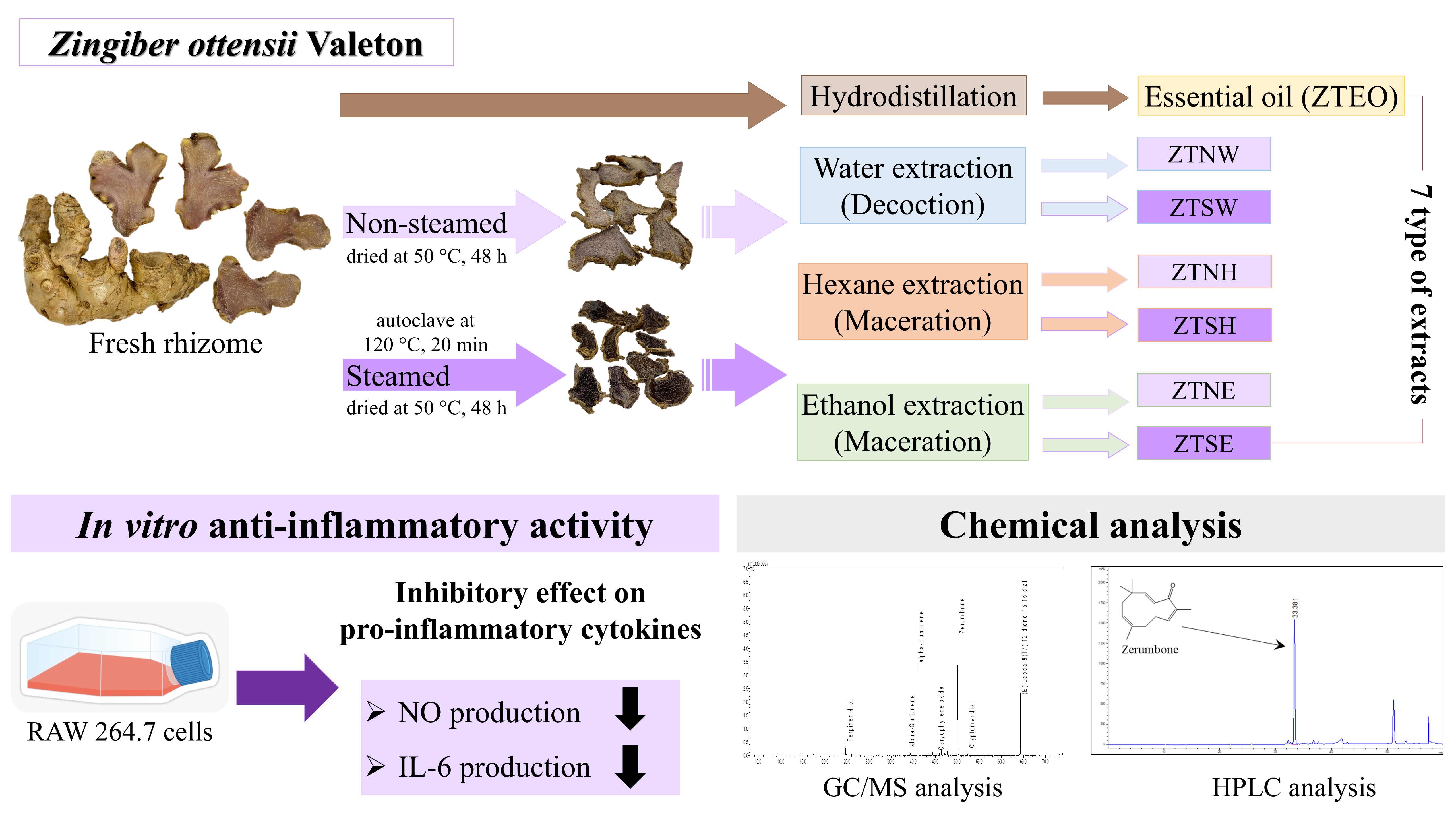
The rhizome of Zingiber ottensii Valeton (ZT) has traditionally been used to treat wounds and various digestive disorders, including flatulence, stomachache, and peptic ulcers, as well as to alleviate inflammatory conditions. However, the impact of the steaming process - commonly employed in Thai folk medicine to prepare ZT rhizomes - on their anti-inflammatory activity and chemical constituents has not yet been scientifically investigated. Therefore, this study aimed to compare the anti-inflammatory activities, analyze the chemical composition, and quantify bioactive constituents of essential oil, including steamed and non-steamed extracts. In vitro anti-inflammatory activities were assessed by measuring NO inhibition using Griess reagent in RAW 264.7 cells, as well as IL-6, TNF-α and PGE2 production using an ELISA test kit. Chemical composition was analyzed using GC/MS, and bioactive constituents in the extracts were quantified by HPLC. Among all ZT extracts, the essential oil (ZTEO) exhibited the strongest inhibitory effect on NO and IL-6 production. In comparison, the non-steamed hexane (ZTNH) and ethanol (ZTNE) extracts were significantly more effective than the steamed hexane (ZTSH) and ethanol (ZTSE) extracts in suppressing these inflammatory mediators. Zerumbone also demonstrated remarkable efficacy in inhibiting NO and IL-6, being at least 57-fold more potent than diclofenac. GC-MS analysis revealed notable differences in the chemical profiles of steamed and non-steamed ZT extracts and essential oil. Zerumbone and α-humulene were identified as the major sesquiterpenes in all tested samples, while terpinen-4-ol was absent in both the steamed hexane and ethanol extracts. The HPLC results further confirmed a significant decrease in zerumbone content in the steamed extracts compared to their non-steamed counterparts. Overall, the steaming process appeared to reduce both the anti-inflammatory activity and zerumbone content of Zingiber ottensii rhizomes, suggesting that non-steamed rhizomes are preferable for preserving their bioactive compounds and therapeutic potential.
HIGHLIGHTS
- The essential oil, hexane and ethanol extracts of Zingiber ottensii Valeton (ZT) rhizome exhibited potent anti-inflammatory properties, primarily through the inhibition of key pro-inflammatory mediators, NO and IL-6.
- The non-steamed ZT extracts were significantly more effective than the steamed extracts in suppressing NO and IL-6 inflammatory mediators.
- Zerumbone and α-humulene were found to be the main monocyclic sesquiterpene constituents in ZT essential oil, as well as in hexane and ethanol extracts.
- Zerumbone demonstrated remarkable efficacy in inhibiting both NO and IL-6 productions, being at least 57-fold more potent than diclofenac.
- Steaming was found to reduce both the biological activity and zerumbone content of ZT extracts compared to their non-steamed counterpart.
GRAPHICAL ABSTRACT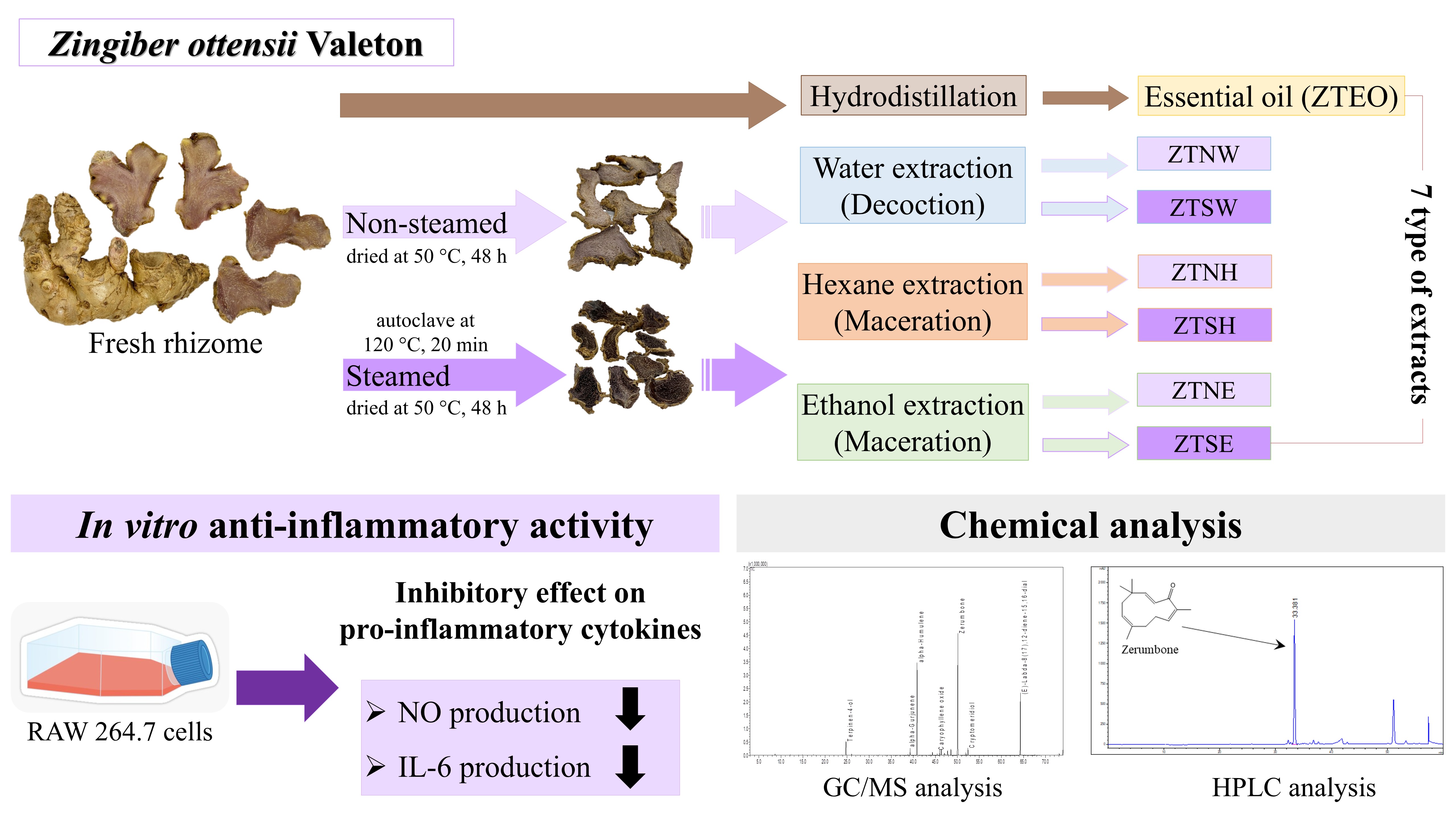
Downloads
References
VP Chavda, J Feehan and V Apostolopoulos. Inflammation: The cause of all diseases. Cells 2024; 13(22), 1906.
CLR Soares, P Wilairatana, LR Silva, PS Moreira, NMMV Barbosa, PR da Silva, HDM Coutinho, IRA de Meneze and CFB Felipe. Biochemical aspects of the inflammatory process: A narrative review. Biomedicine & Pharmacother¬apy 2023; 168, 115764.
JL Wautier and MP Wautier. Pro- and anti-inflammatory prostaglandins and cytokines in humans: A mini review. International Journal of Molecular Sciences 2023; 24(11), 9647.
R Sohail, M Mathew, KK Patel, SA Reddy, Z Haider, M Naria, A Habib, ZU Abdin, WR Chaudhry and A Akbar. Effects of non-steroidal anti-inflammatory drugs (NSAIDs) and gastroprotective NSAIDs on the gastrointestinal tract: A narrative review. Curēus 2023; 15(4), e37080.
A Wongpia, P Kongsuwan and T Luangsuphabool. Chemical profiling of essential oils of Zingiber ottensii Valeton collected from Yala province, southern Thailand. AgriScience and Society Journal 2025; 1(1), 40-49.
W Thitinarongwate, W Nimlamool, P Khonsung, R Mektrirat and P Kunanusorn. Anti-inflammatory activity of essential oil from Zingiber ottensii Valeton in animal models. Molecules 2022; 27(13), 4260.
P Panyajai, F Chueahongthong, N Viriyaadhammaa, W Nirachonkul, S Tima, S Chiampanichayakul, S Anuchapreeda and S Okonogi. Anticancer activity of Zingiber ottensii essential oil and its nanoformulations. PLoS One 2022; 17(1), e0262335.
TV Chen, T Boonma and NTT Hien. An overview of the chemical compositions and biological activities of essential oils from selected Zingiber species (Zingiberaceae). Natural Product Communications 2025; 20(3), 1934578X251329422.
C Chantaranothai, T Palaga, A Karnchanatat and P Sangvanich. Inhibition of nitric oxide production in the macrophage-like RAW 264.7 cell line by protein from the rhizomes of Zingiberaceae plants. Preparative Biochemistry & Biotechnology 2013; 43(1), 60-78.
A Karnchanatat, N Tiengburanatam, A Boonmee, S Puthong and P Sangvanich. Zingipain, A cysteine protease from Zingiber ottensii Valeton rhizomes with antiproliferative activities against fungi and human malignant cell lines. Preparative Biochemistry & Biotechnology 2011; 41(2), 138-153.
J Ruttanapattanakul, N Wikan, K Chinda, T Jearanaikulvanich, N Krisanuruks, M Muangcha, S Okonogi, S Potikanond and W Nimlamool. Essential oil from Zingiber ottensii induces human cervical cancer cell apoptosis and inhibits MAPK and PI3K/AKT signaling cascades. Plants 2021; 10(7), 1419.
F Tunnisa, D Nur Faridah, A Afriyanti, D Rosalina, MA Syabana, N Darmawan and ND Yuliana. Antioxidant and antidiabetic compounds identification in several Indonesian underutilized Zingiberaceae spices using SPME-GC/MS-based volatilomics and in silico methods. Food Chemistry: X 2022; 14, 100285.
K Akiyama, H Kikuzaki, T Aoki, A Okuda, NH Lajis and N Nakatani. Terpenoids and a diarylheptanoid from Zingiber ottensii. Journal of Natural Products 2006; 69(11), 1637-1640.
W Thitinarongwate, R Mektrirat, W Nimlamool, P Khonsung, S Pikulkaew, S Okonogi and P Kunanusorn. Phytochemical and safety evaluations of Zingiber ottensii Valeton essential oil in zebrafish embryos and rats. Toxics 2021; 9(5), 102.
N Pimrat, S Panthong and A Itharat. Effect of steaming process on chemical content and biological activity of Curcuma zedoaria extract. Asian Medical Journal and Alternative Medicine 2021; 21(1), 45-54.
N Roekruangrit, N Jaiarree, A Itharat, A Wanichsetakul, P Wanichsetakul and W Pipatrattanaseree. Comparative study on antioxidant activities and phytochemical components of steamed and non-steamed ginger extracts. Asian Medical Journal and Alternative Medicine 2018; 18(4), 528-536.
N Roekruangrit, N Jaiarree, A Itharat, P Wanichsetakul, S Panthong, S Makchuchit and S Poomirat. Comparative study on biological activities of steamed and non - steamed ginger extracts. Science & Technology Asia 2019; 24(4), 94-101.
P Muanrit, S Poomirat and I Sakpakdeejaroen. Validation of HPLC method for quantitative determination of zerumbone in the rhizome of Zingiber ottensii Valeton. Talanta Open 2025; 11, 100405.
N Jaiarree, N Roekruangrit, A Itharat, P Wanichsetakul and S Poomirat. The efficacy of steamed ginger extract versus placebo for pain relief at the perineum and uterus in first normal postpartum women. Journal of the Medical Association of Thailand 2023; 106(4), 334-340
R Sriyom, A Itharat, O Prajuabjinda, P Thongdeeying, S Ruangnoo, S Makchuchit, P Kuropakornpong, K Namphonsaen, P Monkanna and NM Davies. Anti-inflammatory and cytotoxic effects of Jatropha podagrica extracts on skin cancer. Research in Pharmaceutical Sciences 2025; 20(4), 498-510.
T Kitnithiprapha, S Panthong, I Sakpakdeejaroen and S Kondo. Anti-Inflammatory and antimicrobial effects of herbal formulation called Apo-Taat using extended-spectrum ß-lactamase-producing Escherichia coli isolates. The Scientific World Journal 2025; 2025(1), 6151640.
RR Pratama, RA Sari, I Sholikhah, H Mansor, HI Chang, Sukardiman and R Widyowati. Inhibition of nitric oxide production in RAW 264.7 cells and cytokines IL-1β in osteoarthritis rat models of 70% ethanol extract of Arcangelisia flava (L.) merr stems. Heliyon 2024; 10(15), e35730.
K Sukkasem, A Itharat, K Thisayakorn, N Tangsuphoom, S Panthong, S Makchuchit, J Inprasit, N Prommee, W Khoenok, K Sriyam, D Pahusee, A Tasanarong, B Ooraikul and NM Davies. Exploring in vitro and in vivo anti-inflammatory activities of the Thai traditional remedy Kheaw-Hom and its bioactive compound, ethyl p-methoxycinnamate, and ethnopharmacological analysis. Journal of Ethnopharmacology 2024; 319, 117131.
ME Kim and JS Lee. Advances in the regulation of inflammatory mediators in nitric oxide synthase: Implications for disease modulation and therapeutic approaches. International Journal of Molecular Sciences 2025; 26(3), 1204.
HM AbuZahra, P Rajendran and MB Ismail. Zerumbone exhibit protective effect against zearalenone induced toxicity via ameliorating inflammation and oxidative stress induced apoptosis. Antioxidants 2021; 10(10), 1593.
CC Su, SC Wang, IC Chen, FY Chiu, PL Liu, CH Huang, KH Huang, SH Fang, WC Cheng, SP Huang, HC Yeh, CC Liu, PY Lee, MY Huang and CY Li. Zerumbone suppresses the LPS-induced inflammatory response and represses activation of the NLRP3 inflammasome in macrophages. Frontiers in Pharmacology 2021; 12, 652860.
J Zagórska, L Czernicka-Boś, W Kukula-Koch, R Szalak and W Koch. Impact of thermal processing on the composition of secondary metabolites of ginger rhizome-a review. Foods 2022; 11(21), 3484.
J Zagórska, L Czernicka-Boś, W Kukula-Koch, K Iłowiecka and W Koch. Impact of thermal processing on the selected biological activities of ginger rhizome-a review. Molecules 2023; 28(1), 412.
HT Nguyen, S Wu, T Ootawa, HC Nguyen, HT Tran, P Pothinuch, HTT Pham, ATH Do, HT Hoang, MZ Islam, A Miyamoto and HTT Nguyen. Effects of roasting conditions on antibacterial properties of Vietnamese turmeric (Curcuma longa) rhizomes. Molecules 2023; 28(21),7242.
MY Song, DY Lee, SY Park, SA Seo, JS Hwang, SH Heo and EH Kim. Steamed ginger extract exerts anti-inflammatory effects in Helicobacter pylori-infected gastric epithelial cells through inhibition of NF-κB. Journal of Cancer Prevention 2021; 26(4), 289-297.
NT Hien, DT Cuc, NTT Thuy, H Hiep, VT Huyen, DTT Ai and NX Nhiem. Labdane-type diterpenoids and sesquiterpenes from Curcuma aromatica and their nitric oxide inhibitory activity in lipopolysaccharide-stimulated RAW264.7 macrophages. Journal of Asian Natural Products Research 2024; 26(3), 387-393.
MD Ibáñez, NM Sánchez-Ballester and MA Blázquez. Healthy zerumbone: From natural sources to strategies to improve its bioavailability and oral administration. Plants 2022; 12(1), 5.
Published
How to Cite
Issue
Section
License
Copyright (c) 2026 Walailak University

This work is licensed under a Creative Commons Attribution-NonCommercial-NoDerivatives 4.0 International License.





