
Comparative Effects of Commercial- and Chemical-Grade Solvent Extraction on the Anti-Inflammatory and Antioxidant Activities of “Yaa-Thaa-Phra-Sen”, A Thai Traditional Remedy
DOI:
https://doi.org/10.48048/tis.2026.13290Keywords:
Thai traditional medicine, Anti-inflammatory activity, Antioxidant activity, HPLC, Biological activity, Thai traditional medicine, Inflammation, Antioxidants, Biological activity, Solvent extractionAbstract
Yaa-Thaa-Phra-Sen remedy (YTPS) is a traditional Thai formulation used for relief of inflammatory symptoms and treat osteoarthritis. In traditional practice, vinegar or distilled liquor is commonly used as extraction solvents. However, limited studies have investigated the effects of commercial- and chemical-grade solvent systems on the anti-inflammatory and antioxidant properties of YTPS extracts. Extraction of bioactive compounds is an important step that affects the quality and biological activity of herbal preparations. The objective of this study was to evaluate the anti-inflammatory and antioxidant properties of YTPS extracts prepared from fresh and dried plant materials using both chemical-grade (acetic acid and ethanol at defined concentrations) and commercial-grade (vinegar and distilled liquors) solvent systems. Anti-inflammatory activity was evaluated based on nitric oxide (NO), TNF-α and PGE2 production in lipopolysaccharide (LPS)-stimulated RAW 264.7 macrophages, while antioxidant activity was assessed using DPPH, ABTS, and FRAP assays. Among the tested conditions, extracts prepared from dried plant materials using an acidic ethanolic solvent (Ch-6) exhibited the strongest inhibitory activity against NO production without cytotoxic effects. In contrast, no inhibitory activity was observed against TNF-α and PGE2 under the tested conditions, indicating a selective anti-inflammatory profile. Antioxidant activities and total phenolic content varied across extraction systems, with intermediate ethanol concentrations generally showing higher values. These finding demonstrate that extraction conditions, including solvent composition and plant material condition, influence the biological properties of YTPS in an endpoint-dependent manner. This study provides scientific support for the optimization of extraction processes for traditional Thai herbal formulations.
HIGHLIGHTS
- Extraction conditions (fresh vs dried materials and solvent systems) influenced extraction yield and bioactivity of Yaa-Thaa-Phra-Sen (YTPS) extracts.
- Acidic ethanolic extraction of dried YTPS was associated with stronger nitric oxide (NO) inhibitory activity in LPS-stimulated macrophages.
- YTPS extracts selectively inhibited NO production without affecting TNF-α or PGE2 under the tested conditions.
- Antioxidant activity and total phenolic content varied across extraction systems, with 30% - 40% ethanol extracts generally showing higher values.
- Ellagic acid was identified as a representative phenolic marker for extract characterization, although its direct contribution to the observed bioactivities requires further investigation.
GRAPHICAL ABSTRACT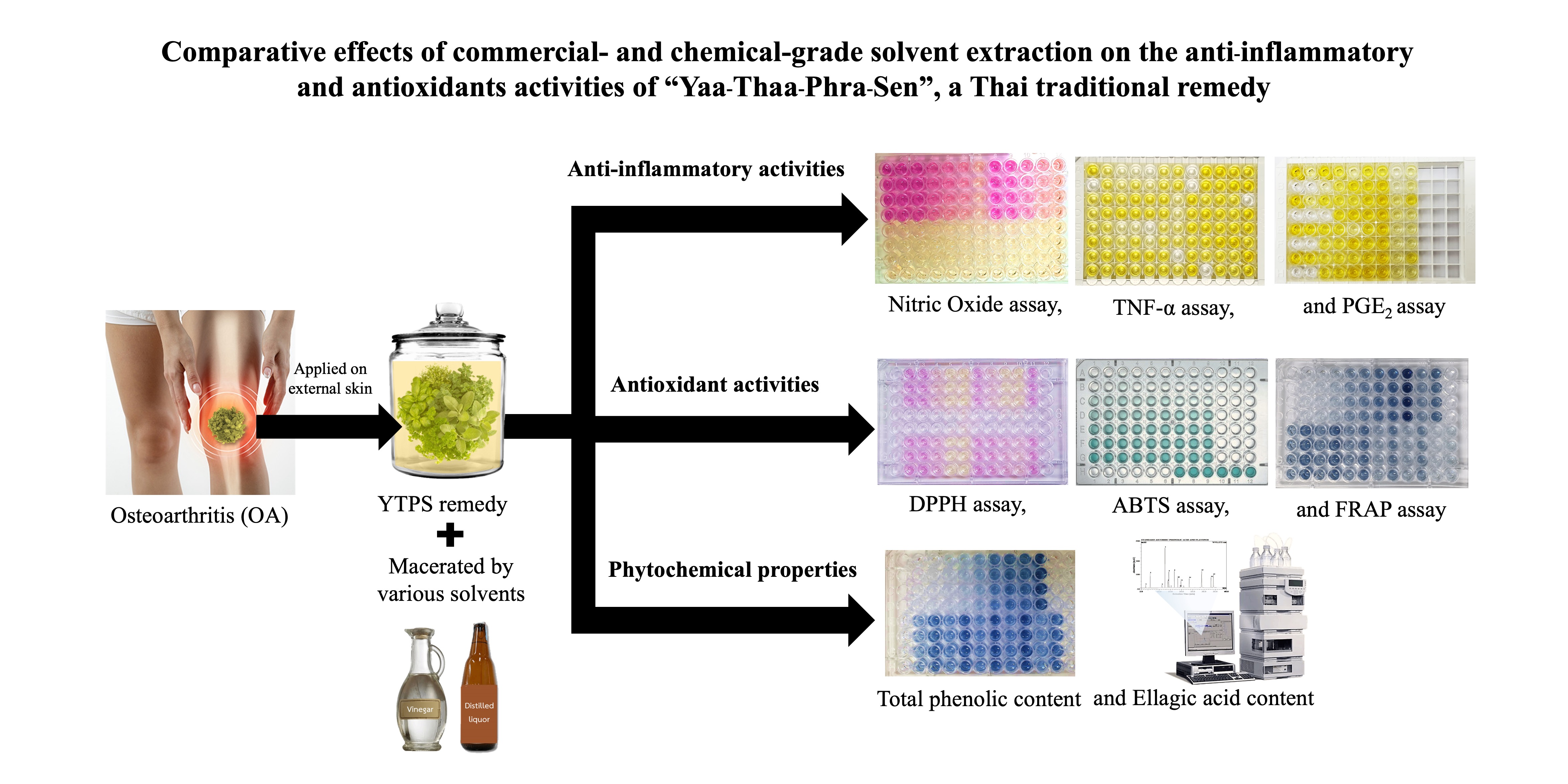
Downloads
References
AM Alshami. Knee osteoarthritis related pain: A narrative review of diagnosis and treatment. International Journal of Health Sciences 2014; 8(1), 85-104.
DJ Hunter, L March and M Chew. Osteoarthritis in 2020 and beyond: A Lancet Commission. The Lancet 2020; 396(10264), 1711-1712.
Thai Bureau of Non-Communicable Diseases, Department of Disease Control and Ministry of Public Health. Non-communicable disease and injury survey report: Annual report. WVO Thailand, Bangkok, 2018.
AM Briggs, MJ Cross, DG Hoy, L Sànchez-Riera, FM Blyth, AD Woolf and L March. Musculoskeletal health conditions represent a global threat to healthy aging: A report for the 2015 World Health Organization world report on ageing and health. Gerontologist 2016; 56(2), 245-255.
R Wittenauer, L Smith and K Aden. Priority medicines for Europe and the World 2013 update. Background Paper 6.12 Osteoarthritis. WHO Essential Medicines and Health Products Information Portal, Switzerland, 2013.
HG Schaible. Mechanisms of chronic pain in osteoarthritis. Current Rheumatology Reports 2012; 14, 549-556.
HG Schaible, F Richter, A Ebersberger, MK Boettger, H Vanegas, G Natura, E Vazquez and GSV Banchet. Joint pain. Experimental Brain Research 2009; 196(1), 153-162.
SL Kolasinski, T Neogi, MC Hochberg, C Oatis, G Guyatt, J Block, L Callahan, C Copenhaver, C Dodge, D Felson and K Gellar. 2019 American College of Rheumatology/Arthritis Foundation guideline for the management of osteoarthritis of the hand, hip, and knee. Arthritis & Rheumatology 2020; 72(2), 220-233.
JP Pelletier, J Martel-Pelletier, F Rannou and C Cooper. Efficacy and safety of oral NSAIDs and analgesics in the management of osteoarthritis: Evidence from real-life setting trials and surveys. Semin Arthritis Rheum 2016; 45(4), 22-27.
M Bardou and AN Barkun. Preventing the gastrointestinal adverse effects of nonsteroidal anti-inflammatory drugs: From risk factor identification to risk factor intervention. Joint Bone Spine 2010; 77(1), 6-12.
Ministry of Public Health. Notification of the Protection and Promotion of Thai Traditional Medicine Committee: The promulgation of national textbooks and national formulas of Thai traditional medicine (No. 1). 2016. Available at: https://www.ratchakitcha.soc.go.th/DATA/PDF/2559/E/007/21.PDF, accessed October 2023.
P Sengupta and J Mukherjee. Terpenoids and related compounds-XI: The structure of roxburgholone, a new triterpenoid constituent of Putranjiva roxburghi. Tetrahedron 1968; 24(20), 6259-6264.
AKA Kumar, SR Chowdhury, TCT Chakrabarti, HK Majumdar, TJT Jha and SMS Mukhopadhyay. A new ellagic acid glycoside and DNA topoisomerase IB inhibitory activity of saponins from Putranjiva roxburghii. Natural Product Communications 2014; 9(5), 675-677.
S Corbett, J Daniel, R Drayton, M Field, R Steinhardt and N Garrett. Evaluation of the anti-inflammatory effects of ellagic acid. Journal of PeriAnesthesia Nursing 2010; 25(4), 214-220.
S Mishra and M Vinayak. Ellagic acid inhibits PKC signaling by improving antioxidant defense system in murine T cell lymphoma. Molecular Biology Reports 2014; 41, 4187-4197.
Department of Thai Traditional and Alternative Medicine, Ministry of Public Health. Kum-Pre-Tat-Phra-Naa-rai. WVO Thailand, Bangkok, Thailand, 2012.
P Kanokkangsadal, M Waipradab, P Toonsakul, K Kanlamyai, R Khun-anake and A Itharat. Clinical efficacy and safety of Ya-Ta-Pra-Sen in treating primary osteoarthritis of knee compared with analgesic cream an open label randomized controlled trial. Thai Journal of Pharmacy Practice 2024; 12(3), 880-890.
S Tewtrakul, S Subhadhirasakul, C Karalai, C Ponglimanont and S Cheenpracha. Anti-inflammatory effects of compounds from Kaempferia parviflora and Boesenbergia Pandurata. Food Chemistry 2009; 115(2), 534-538.
W Pipatrattanaseree, A Itharat, N Mukkasombut and U Saesiw. Potential in vitro anti-allergic, anti-inflammatory and cytotoxic activities of ethanolic extract of Baliospermum montanum root, its major components and a validated HPLC method. BMC Complementary and Alternative Medicine 2019; 19(1), 45.
N Kakatum, N Jaiarree, S Makchuchit and A Itharat. Antioxidant and anti-inflammatory activities of Thai medicinal plants in Sahasthara remedy for muscle pain treatment. Journal of The Medical Association of Thailand 2012; 95, 120-126.
RS Bai and P Sarath. Screening and evaluation of bioactivity of methanolic extract of leaf of Putranjiva roxburghii Wall. (Putranjivaceae). International Journal of Pharmaceutical and Biological Science 2019; 9(1), 1148-1156.
SR Bijekar, M Gayatri and L Rajanna. Evaluation of anti-inflammatory activity of flavonoid fractions from Euphorbiaceae members on raw 264.7 cell lines. Journal of Cytology and Genetics 2015; 16(1), 39-46.
I Sakpakdeejaroen, S Makchuchit and A Itharat. Nitric oxide inhibitory activity of herbal extract formulae for anti-inflammation. Thammasat Medical Journal 2014; 14(1), 7-12.
X Ying, X Chen, S Cheng, Y Shen, L Peng and HZ Xu. Piperine inhibits IL-β induced expression of inflammatory mediators in human osteoarthritis chondrocyte. International Immunopharmacology 2013; 17(2), 293-299.
D Shahwar, MA Raza, A Saeed, M Riasat, FI Chattha, M Javaid and S Ullah. Antioxidant potential of the extracts of Putranjiva roxburghii, Conyza bonariensis, Woodfordia fruiticosa and Senecio chrysanthemoids. African Journal of Biotechnology 2012; 11(18), 4288-4295.
A Bucić-Kojić, M Planinić, S Tomas, L Jakobek and M Šeruga. Influence of solvent and temperature on extraction of phenolic compounds from grape seed, antioxidant activity and colour of extract. International Journal of Food Science & Technology 2009; 44(12), 2394-2401.
S Felhi, A Daoud, H Hajlaoui, K Mnafgui, N Gharsallah and A Kadri. Solvent extraction effects on phytochemical constituents profiles, antioxidant and antimicrobial activities and functional group analysis of Ecballium elaterium seeds and peels fruits. Journal of Food Science and Technology 2017; 37(3), 483-492.
G Ozcan-Sinir, A Ozkan-Karabacak, CE Tamer and OU Copur. The effect of hot air, vacuum and microwave drying on drying characteristic, rehydration capacity, color, total phenolic content and antioxidant capacity of Kumquat (Citrus japonica). Journal of Food Science and Technology 2018; 39, 475-484.
L Zou, F Lu, B Lin, Y Zhou, T Liu and Y Sun. Stability of alkaloids during drying process and their effect on anticoagulating activity of Uncariae Ramulus Cum Uncis. Journal of Analytical Methods in Chemistry 2019; 1, 789515.
S Tewtrakul and A Itharat. Nitric oxide inhibitory substances from the rhizomes of Dioscorea membranacea. Journal of Ethnopharmacology 2007; 109(3), 412-416.
S Makchuchit, R Rattarom and A Itharat. The anti-allergic and anti-inflammatory effects of Benjakul extract (A Thai traditional medicine), its constituent plants and its some pure constituents using in vitro experiments. Biomedicine & Pharmacotherapy 2017; 89, 1018-1026.
S Tewtrakul and S Subhadhirasakul. Effects of compounds from Kaempferia parviflora on nitric oxide, prostaglandin E2 and tumor necrosis factor-alpha productions in RAW264.7 macrophage cell. Journal of Ethnopharmacology 2008; 120(1), 81-84.
K Yamazaki, A Hashimoto, Y Kokusenya, T Miyamoto and T Sato. Electrochemical method for estimating the antioxidative effects of methanol extracts of crude drugs. The Chemical and Pharmaceutical Bulletin 1994; 42(8), 1663-1665.
R Re, N Pellegrini, A Proteggente, A Pannala, M Yang and C Rice-Evans. Antioxidant activity applying an improved ABTS radical cation decolorization assay. Free Radical Biology and Medicine 1999; 26(9-10), 1231-1237.
IF Benzie and JJ Strain. The ferric reducing ability of plasma (FRAP) as a measure of “antioxidant power”: The FRAP assay. Analytical Biochemistry 1996; 239(1), 70-76.
O Folin and V Ciocalteu. On tyrosine and tryptophane determinations in proteins. The Journal of Biological Chemistry 1927; 73, 627-650.
RP Rocha, EC Melo and LL Radünz. Influence of drying process on the quality of medicinal plants: A review. Journal of Medicinal Plants Research 2011; 5(33), 7076-7084.
UF Hutchinson, NP Jolly, BS Chidi, MM Ngongang and SK Ntwampe. Vinegar engineering: A bioprocess perspective. Food Engineering Reviews 2019; 11, 290-305.
L Shi, W Zhao, Z Yang, V Subbiah and HA Suleria. Extraction and characterization of phenolic compounds and their potential antioxidant activities. Environmental Science and Pollution Research 2022; 29(54), 81112-81129.
TL Brown, HE Lemay, BE Bursten, CJ Murphy and PM Woodward. Chemistry: The central science. 12th ed. Pearson Education, Illinois, 2012.
B Zhuang, G Ramanauskaite, ZY Koa and ZG Wang. Like dissolves like: A first-principles theory for predicting liquid miscibility and mixture dielectric constant. Science Advances 2021; 12(7), eabe7275.
MB Goldring and M Otero. Inflammation in osteoarthritis. Current Opinion in Rheumatology 2011; 23(5), 471-478.
N Harbourne, E Marete, JC Jacquier and D O’Riordan. Effect of drying methods on the phenolic constituents of meadowsweet (Filipendula ulmaria) and willow (Salix alba). LWT 2009; 42(9), 1468-1473.
R Lemus-Mondaca, A Vega-Gálvez, P Rojas, K Stucken, C Delporte, G Valenzuela-Barra, RJ Jagus, MV Agüero and A Pasten. Antioxidant, antimicrobial and anti-inflammatory potential of Stevia rebaudiana leaves: Effect of different drying methods. Journal of Applied Research on Medicinal and Aromatic 2018; 11, 37-46.
AL Rajahamsa, KS Deepak, TK Rao, AP Kumar, GS Reddy and MS Potbhare. Muti-model confirmatory evaluation of anti-inflammatory, analgesic and antioxidant activities of Putranjiva roxburghii Wall. International Journal of Advanced Biological and Biomedical Research 2013; 4(12), 921-932.
SR Bijekar, MC Gayatri and L Rajanna. Antimicrobial activity of isolated flavonoid fractions from Drypetes Roxburghii (Wall.) Huresawa and its phytochemical fingerprinting. The International Journal of Innovative Research in Science, Engineering and Technology 2015; 4(7), 6214-6224.
AN Naik, PN Pandya and AU Mankad. A comprehensive review on phytochemicals and medicinal properties of Putranjiva roxburghii Wall. International Association of Biologicals and Computational Digest 2023; 2(1), 234-240.
JE Hayes, P Allen, N Brunton, MN O’Grady and JP Kerry. Phenolic composition and in vitro antioxidant capacity of four commercial phytochemical products: Olive leaf extract (Olea europaea L.), lutein, sesamol and ellagic acid. Food Chemistry 2011; 126(3), 948-955.
K Khuntong, S Fakkham, Y Watcharadul, T Chinakarn and T Imsomboon. A comparison of efficacy of Ya-Tha-Pra-Sen between 40% ethyl alcohol solvent and vinegar solvent for pain reducing in Thai traditional diagnosis of Lom-Jub-Pong-Hang-Kao at Thai traditional and complimentary medicine hospital. Journal of Traditional Thai Medical Research 2022; 8(2), 13-28.
Z Lin, C Lin, C Fu, H Lu, H Jin, Q Chen and J Pan. The protective effect of Ellagic acid (EA) in osteoarthritis: An in vitro and in vivo study. Biomedicine & Pharmacotherapy 2020; 125, 109845.
H Rasouli, MH Farzaei and R Khodarahmi. Polyphenols and their benefits: A review. International Journal of Food Properties 2017; 65, 16-28.
S Wang, KA Meckling, MF Marcone, Y Kakuda and R Tsao. Synergistic, additive, and antagonistic effects of food mixtures on total antioxidant capacities. Journal of Agricultural and Food Chemistry 2011; 59(3), 960-968.
LM Babenko, OE Smirnov, KO Romanenko, OK Trunova and IV Kosakivska. Phenolic compounds in plants: Biogenesis and function. The Ukrainian Biochemical Journal 2019; 91(3), 5-18.
Published
How to Cite
Issue
Section
License
Copyright (c) 2026 Walailak University

This work is licensed under a Creative Commons Attribution-NonCommercial-NoDerivatives 4.0 International License.





