
Development of Microemulsions Containing Ruean-Mhoon-Nok Remedy Extract and Evaluation for Skin Irritation in Healthy Volunteers
DOI:
https://doi.org/10.48048/tis.2026.12681Keywords:
Ruean-Mhoon-Nok remedy, Thai traditional medicine, Dermatitis, Microemulsion, Skin irritation test, Ruean-Mhoon-Nok remedy, Thai traditional medicine, Dermatitis, Microemulsion, Skin irritation testAbstract
Ruean-Mhoon-Nok (RMN), a Thai traditional remedy, has been used topically to treat skin inflammatory disorders, including dermatitis and psoriasis. Previously, the ethanolic extract of RMN and its bioactive compound, hydroxychavicol, demonstrated promising in vitro anti-inflammatory activity by inhibiting NO and IL-6 production. Therefore, this study aimed to develop a stable microemulsion capable of enhancing skin penetration of the RMN extract and to evaluate its potential for skin irritation in healthy volunteers. Two RMN microemulsion formulations were prepared, consisting of an oil phase (Capryol® 90) combined with surfactants (Polyglyceryl-4 caprate or PEG-6 caprylic/capric glycerides) and a co-surfactant (Transcutol® P) at a weight ratio of 1:2. These microemulsions had mean droplet sizes of less than 100 nm and carried a negative surface charge. Furthermore, they remained stable after nine heating-cooling storage cycles. In vitro skin permeation studies showed that the RMN microemulsions were able to penetrate the skin and release hydroxychavicol, achieving a maximum cumulative permeation of 26% over 8 h. In healthy volunteers, the RMN microemulsions were well tolerated, showing no signs of irritation at the maximum dose of 3% RMN extract. In conclusion, the RMN microemulsions are highly promising formulations that warrant further investigation for their efficacy and safety in clinical applications.
HIGHLIGHTS
- Two RMN microemulsion formulations were successfully prepared, consisting of an oil phase (Capryol® 90) combined with surfactants (Polyglyceryl-4 caprate or PEG-6 caprylic/capric glycerides) and a co-surfactant (Transcutol® P) at a weight ratio of 1:2.
- The RMN microemulsions had mean droplet sizes of less than 100 nm and carried a negative surface charge.
- In vitro skin permeation studies showed that the RMN microemulsions were able to penetrate the skin and release hydroxychavicol, achieving a maximum cumulative permeation of 26% over 8 h.
- All microemulsion formulations containing 0.5%, 1%, and 3% of RMN extract were non-irritating and could be safely applied to human skin.
GRAPHICAL ABSTRACT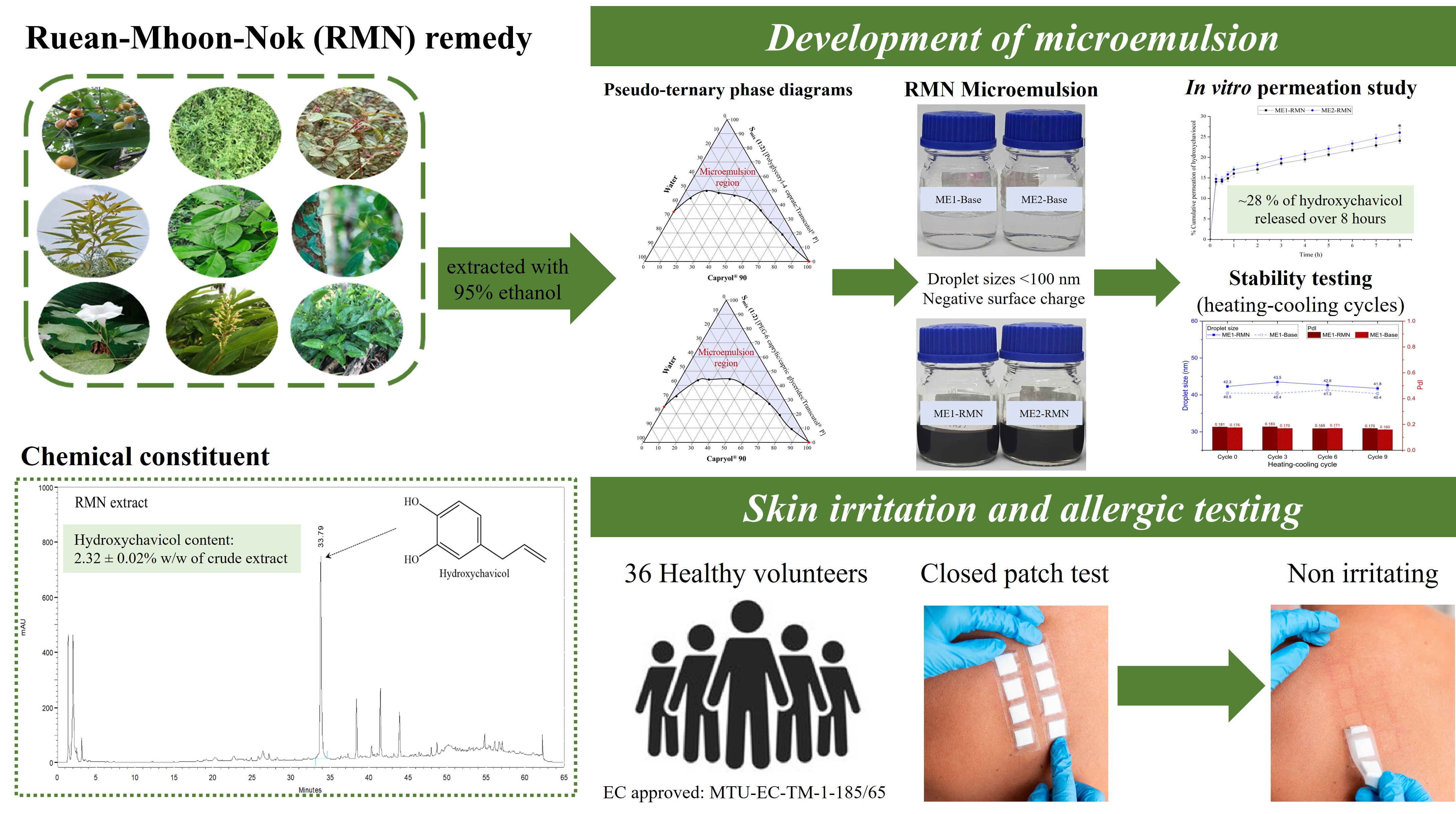
Downloads
References
CE Griffiths, P van de Kerkhof and M Czarnecka-Operacz. Psoriasis and atopic dermatitis. Dermatology and Therapy 2017; 7(S1), 31-41.
A Yakupu, R Aimaier, B Yuan, B Chen, J Cheng, Y Zhao, Y Peng, J Dong and S Lu. The burden of skin and subcutaneous diseases: Findings from the global burden of disease study 2019. Frontiers in Public Health 2023; 11, 1145513.
E Niculet, C Bobeica and AL Tatu. Glucocorticoid-induced skin atrophy: The old and the new. Clinical, Cosmetic and Investigational Dermatology 2020; 13, 1041-1050.
NV Limantara, R Sadono, S Widhiati and R Danarti. Asian herbal medicine for atopic dermatitis: A systematic review. Dermatology Reports 2023; 16(1), 9727.
Ministry of Public Health. National Thai traditional medicine formulary 2021 edition. Samcharoen Panich, Nonthaburi, Thailand, 2021.
H Matsuda, T Morikawa, H Managi and M Yoshikawa. Antiallergic principles from Alpinia galanga: Structural requirements of phenylpropanoids for inhibition of degranulation and release of TNF-alpha and IL-4 in RBL-2H3 cells. Bioorganic & Medicinal Chemistry Letters 2003; 13(19), 3197-3202.
MJ Hossen, SC Kim, YJ Son, KS Baek, E Kim, WS Yang, D Jeong, JG Park, HG Kim, WJ Chung, K Yoon, C Ryou, SY Lee, JH Kim and JY Cho. AP-1-Targeting anti-inflammatory activity of the methanolic extract of Persicaria chinensis. Evidence-Based Complementary and Alternative Medicine 2015; 2015, 608126.
BY Yang, YG Cheng, Y Liu, Y Liu, JY Tan, W Guan, S Gou and HX Kuang. Datura metel L. ameliorates imiquimod-induced psoriasis-like dermatitis and inhibits inflammatory cytokines production through TLR7/8-MyD88-NF-κB-NLRP3 inflammasome pathway. Molecules 2019; 24(11), 2157.
C Nongmai, K Kanokmedhakul, T Promgool, J Paluka, C Suwanphakdee and S Kanokmedhakul. Chemical constituents and antibacterial activity from the stems and leaves of Piper wallichii. Journal of Asian Natural Products Research 2022; 24(4), 344-352.
A Taingthum, I Sakpakdeejaroen, S Panthong and P Kanokkangsadal. Assessment of in vitro antioxidant activities and quantification of total phenolic and flavonoid contents in extracts from the Thai traditional remedy “Ruean-Khi-Nok” and its plant constituents. Asian Medical Journal and Alternative Medicine 2024; 24(1), 9-18.
EB Souto, A Cano, C Martins-Gomes, TE Coutinho, A Zielińska and AM Silva. Microemulsions and nanoemulsions in skin drug delivery. Bioengineering 2022; 9(4), 158
J Leanpolchareanchai and V Teeranachaideekul. Topical microemulsions: Skin irritation potential and anti-inflammatory effects of herbal substances. Pharmaceuticals 2023; 16(7), 999
YH Lin, MJ Tsai, YP Fang, YS Fu, YB Huang and PC Wu. Microemulsion formulation design and evaluation for hydrophobic compound: catechin topical application. Colloids and Surfaces B: Biointerfaces 2018; 161, 121-128.
ACN Brathwaite, T Alencar-Silva, LAC Carvalho, MSF Branquinho, R Ferreira-Nunes, M Cunha-Filho, GM Gelfuso, SS Maria-Engler, JL Carvalho, JKR Silva and T Gratieri. Pouteria macrophylla fruit extract microemulsion for cutaneous depigmentation: Evaluation using a 3D pigmented skin model. Molecules 2022; 27(18), 5982
S Jiamphun and W Chaiyana. Enhancing skin delivery and stability of vanillic and ferulic acids in aqueous enzymatically extracted glutinous rice husk by nanostructured lipid carriers. Pharmaceutics 2023; 15(7), 1961
N Magrode, W Poomanee, K Kiattisin and C Ampasavate. Microemulsions and nanoemulsions for topical delivery of tripeptide-3: from design of experiment to anti-sebum efficacy on facial skin. Pharmaceutics 2024; 16(4), 554.
K Phumlek, A Itharat, P Pongcharoen, P Chakkavittumrong, HY Lee, GS Moon, MH Han, Panthong S, W Ketjinda and NM Davies. Garcinia mangostana hydrogel patch: bactericidal activity and clinical safety for acne vulgaris treatment. Research in Pharmaceutical Sciences 2022; 17(5), 457-467.
SM An, H Ham, EJ Choi, MK Shin, SS An, HO Kim amd JS Koh. Primary irritation index and safety zone of cosmetics: retrospective analysis of skin patch tests in 7440 Korean women during 12 years. International Journal of Cosmetic Science 2014; 36(1), 62-67.
KG Patel, AT Patel, JR Christian, AS Patel, PA Shah and MC Gohel. D-optimal mixture design for optimization of self microemulsifying drug delivery system of simvastatin: Characterization and in vitro evaluation. Bulletin of Pharmaceutical Research 2018; 8(2), 156.
P Chouhan and T Saini. D-optimal design and development of microemulsion based transungual drug delivery formulation of ciclopirox olamine for treatment of onychomycosis. Indian Journal of Pharmaceutical Sciences 2016; 78(4), 498-511
A Eichner, S Stahlberg, S Sonnenberger, S Lange, B Dobner, A Ostermann, TE Schrader, T Hauß, A Schroeter, D Huster and RHH Neubert. Influence of the penetration enhancer isopropyl myristate on stratum corneum lipid model membranes revealed by neutron diffraction and 2H NMR experiments. Biochimica et Biophysica Acta 2017; 1859(5), 745-755.
T Shukla, N Upmanyu, M Agrawal, S Saraf, S Saraf and A Alexander. Biomedical applications of microemulsion through dermal and transdermal route. Biomedicine & Pharmacotherapy 2018; 108, 1477-1494.
K Singpanna, D Charnvanich and V Panapisal. Effect of the HLB values of non-ionic surfactants on size and size distribution and stability of oil/water soybean oil nanoemulsions. Thai Journal of Pharmaceutical Sciences 2021; 45(6), 487-491.
QL Vu, CW Fang, M Suhail and PC Wu. Enhancement of the topical bioavailability and skin whitening effect of genistein by using microemulsions as drug delivery carriers. Pharmaceuticals 2021; 14(12), 1233
L Pavoni, DR Perinelli, G Bonacucina, M Cespi and GF Palmieri. An overview of micro- and nanoemulsions as vehicles for essential oils: Formulation, preparation and stability. Nanomaterials 2020; 10(1), 135.
DW Osborne and J Musakhanian. Skin penetration and permeation properties of Transcutol®-neat or diluted mixtures. AAPS PharmSciTech 2018; 19(8), 3512-3533.
Z Ait-Touchente, N Zine, N Jaffrezic-Renault, A Errachid, N Lebaz, H Fessi and A Elaissari. Exploring the versatility of microemulsions in cutaneous drug delivery: opportunities and challenges. Nanomaterials 2023; 3(10), 1688
A Azeem, M Rizwan, FJ Ahmad, Z Iqbal, RK Khar, M Aqil and S Talegaonkar. Nanoemulsion components screening and selection: A technical note. AAPS PharmSciTech 2009; 10(1), 69-76.
AK Sharma, T Garg, AK Goyal and G Rath. Role of microemulsions in advanced drug delivery. Artificial Cells, Nanomedicine, and Biotechnology 2016; 44(4), 1177-85.
LN Shen, YT Zhang, Q Wang, L Xu and NP Feng. Preparation and evaluation of microemulsion-based transdermal delivery of total flavone of rhizoma arisaematis. International Journal of Nanomedicine 2014; 9, 3453-64.
O Sarheed, M Dibi and K Ramesh. Studies on the effect of oil and surfactant on the formation of alginate-based o/w lidocaine nanocarriers using nanoemulsion template. Pharmaceutics 2020; 12(12), 1223
M Lindner, M Bäumler and A Stäbler. Inter-correlation among the hydrophilic-lipophilic balance, surfactant system, viscosity, particle Size, and stability of candelilla wax-based dispersions. Coatings 2018; 8(12), 469.
MD Arpa, E Çağlar, D Güreşçi, H Sipahi and NÜ Okur. Novel microemulsion containing benzocaine and fusidic acid simultaneously: Formulation, characterization, and in vitro evaluation for wound healing. AAPS PharmSciTech 2024; 25(3), 53.
M Lukić, I Pantelić and SD Savić. Towards optimal pH of the skin and topical formulations: from the current state of the art to tailored products. Cosmetics 2021; 8(3), 69.
L Vlaia, I Olariu, AM Muţ, G Coneac, V Vlaia, DF Anghel, ME Maxim, G Stânga, A Dobrescu, M Suciu, Z Szabadai and D Lupuleasa. New, biocompatible, chitosan-gelled microemulsions based on essential oils and sucrose esters as nanocarriers for topical delivery of fluconazole. Pharmaceutics 2022; 14(1), 75.
Y Liu, S Chen, L Sheng, M Wang and He Liu. The phase behavior and solubilization ability of nonionic surfactant-distillate fraction of crude oil microemulsion system. Colloids and Surfaces A: Physicochemical and Engineering Aspects 2020; 603, 125181.
S Alharthi, ZM Ziora, G Mustafa, P Chaubey, AFE Kirdasy and G Alotaibi. β-caryophyllene-loaded microemulsion-based topical hydrogel: a promising carrier to enhance the analgesic and anti-inflammatory outcomes. Gels 2023; 9(8), 634
CS Chiu, PH Huang, YJ Chan, PH Li and WC Lu. D-limonene nanoemulsion as skin permeation enhancer for curcumin prepared by ultrasonic emulsification. Journal of Agriculture and Food Research 2024; 15, 100932.
G Novak-Bilić, M Vučić, I Japundžić, J Meštrović-Štefekov, S Stanić-Duktaj and L Lugović-Mihić. Irritation and allergic contact dermatitis-skin lesion characteristics. Acta Clinica Croatica 2018; 57(4), 713-720.
Published
How to Cite
Issue
Section
License
Copyright (c) 2025 Walailak University

This work is licensed under a Creative Commons Attribution-NonCommercial-NoDerivatives 4.0 International License.





