
Chemical Composition Analysis Using HPLC-UV and Inhibitory Activity of Thai Herbal Formulation on Proinflammatory Mediators
DOI:
https://doi.org/10.48048/tis.2025.10135Keywords:
Tri-Phon-That, Herb, Complementary medicine, Anti-inflammation, Alternative medicine, Plant extract, Zingiber montanum, Zingiber zerumbet, Cymbopogon nardus, Tri-Phon-That, Herb, Complementary medicine, Anti-inflammation, Alternative medicine, Plant extract, Zingiber montanum, Zingiber zerumbet, Cymbopogon nardusAbstract
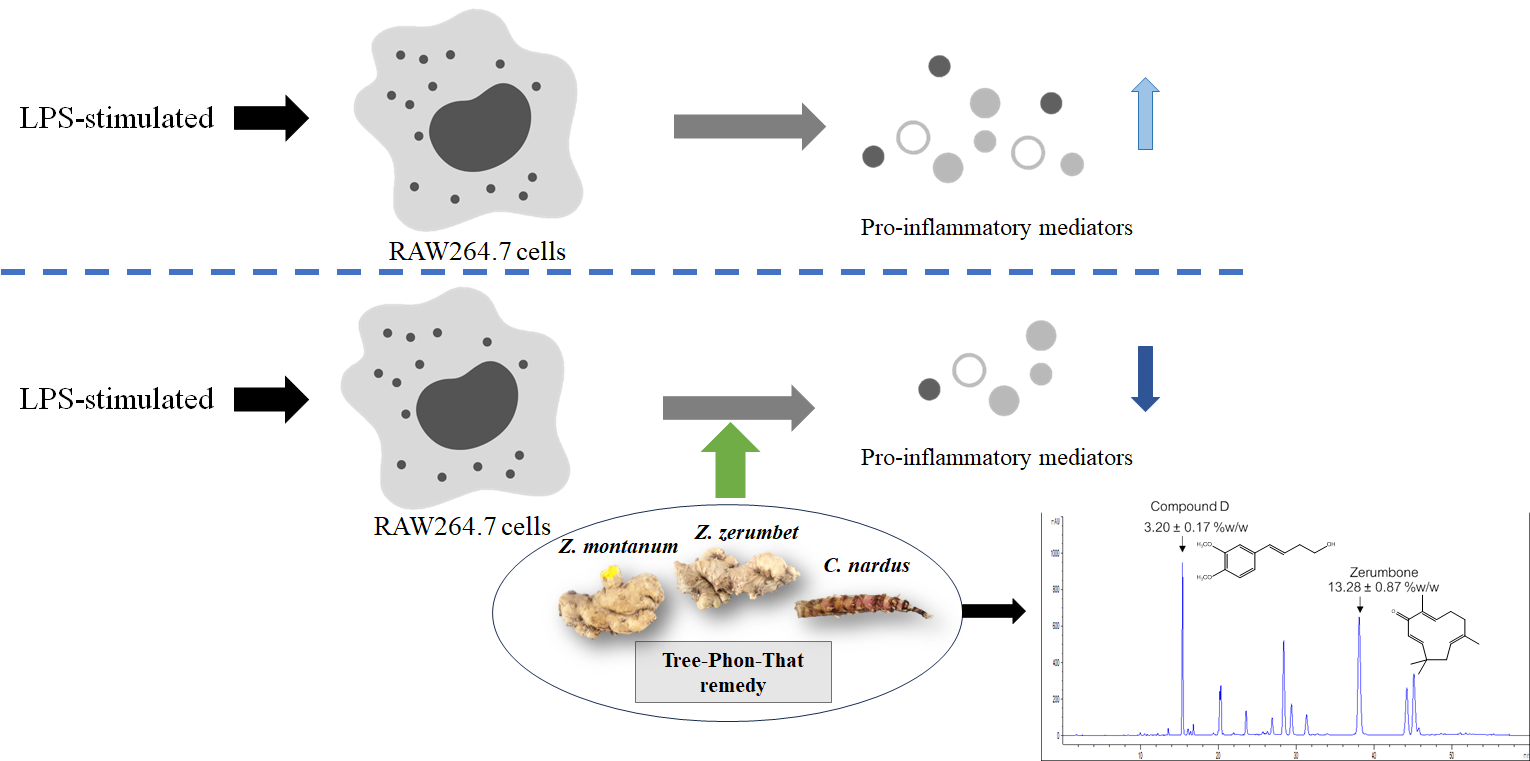
Herbal medicines are widely used to treat various physical disorders. One such remedy, Tri-Phon-That, is composed of rhizomes of three herbs: Zingiber zerumbet, Zingiber montanum, and Cymbopogon nardus. Traditionally, it is used to alleviate fever, swelling, bruising, and muscle pain-conditions associated with inflammation. This study aimed to evaluate the effects of Tri-Phon-That remedy and its individual ingredients on the production of nitric oxide (NO), interleukin-6(IL-6), and prostaglandin E2 (PGE-2). Additionally, the chemical compositions of the remedy and its plant extracts were analyzed. The results showed that the Tri-Phon-That extract strongly inhibited NO, IL-6, and PGE-2 production, with IC50 values of 5.35 ± 0.77, 7.48 ± 0.26, and 24.75 ± 0.33 μg/mL, respectively. Among the individual ingredients, Z. montanum exhibited the most potent anti-inflammatory activity, followed by Z. zerumbet, which effectively inhibited nitric oxide and IL-6 but had no effect on PGE-2. Chemical analysis using high-performance liquid chromatography revealed that the Tri-Phon-That extract contained zerumbone and compound D or (E)-4-(3’,4’-dimethoxyphenyl) but -3-en-1-ol at concentrations of 13.31 ± 0.87 and 3.16 ± 0.17 % w/w, respectively. These compounds were primarily found in Z. zerumbet and Z. montanum with concentrations of 36.05 ± 1.67 and 6.97 ± 0.28 % w/w, respectively. In contrast, no chemical constituents were found in C. nardus, which correlates with its weaker anti-inflammatory activity. In conclusion, Tri-Phon-That extract strongly inhibits pro-inflammatory cytokines, making it a promising treatment for acute inflammation.
HIGHLIGHTS
- The finding of this study showed that the Tri-Phon-That remedy, a Thai herbal preparation, suppressed pro-inflammatory mediators such as nitric oxide, IL-6, and PGE-2.
- The inhibitory effect of the Tri-Phon-That extract on inflammatory mediators was comparable to that of its individual plant constituents.
- The Tri-Phon-That extract, analyzed in this study using HPLC validation methods, contained D and zerumbone as its main components.
GRAPHICAL ABSTRACT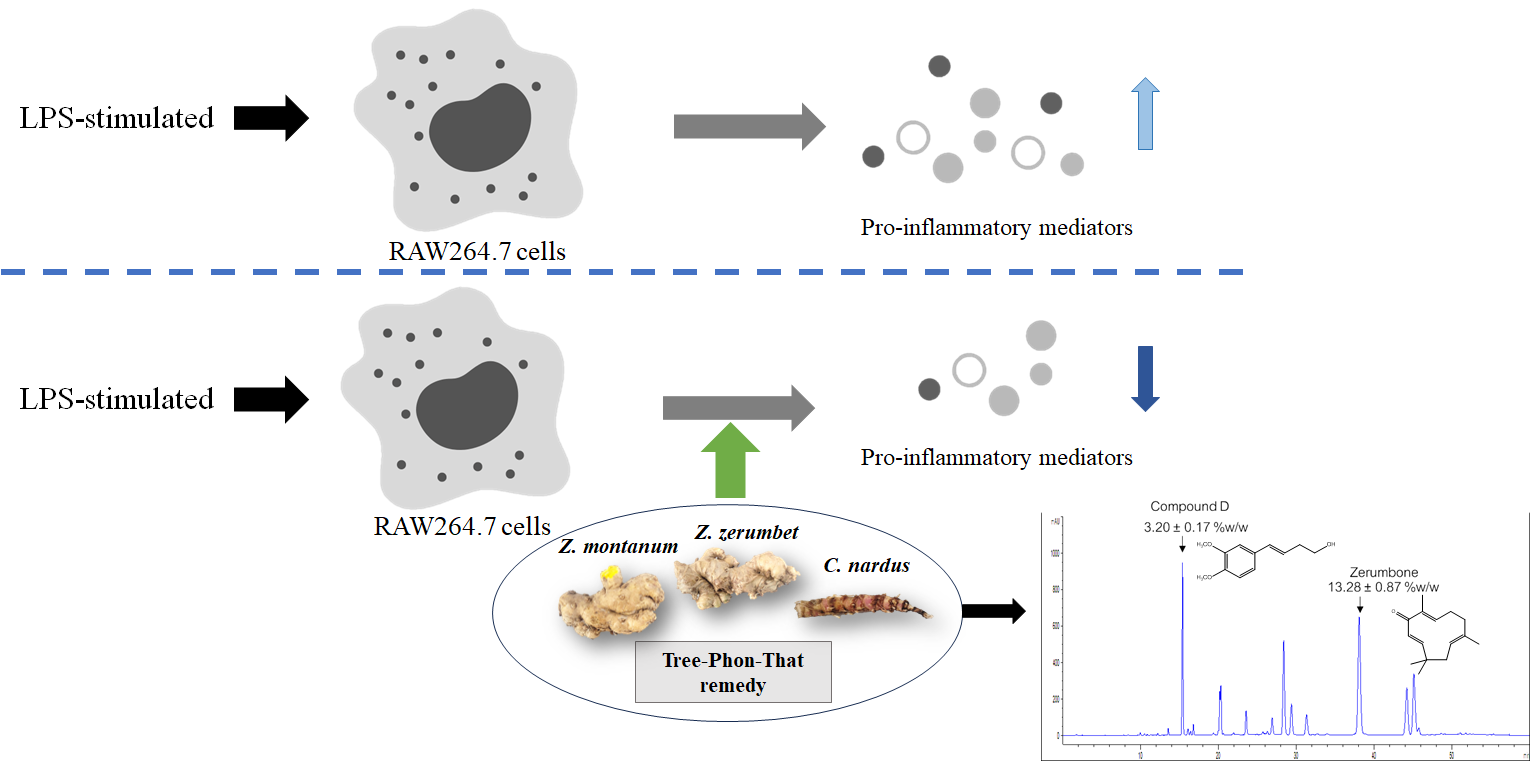
Downloads
References
L Chen, H Deng, H Cui, J Fang, Z Zuo, J Deng, Y Li, X Wang and L Zhao. Inflammatory responses and inflammation-associated diseases in organs. Oncotarget 2018; 9(6), 7204.
D Furman, J Campisi, E Verdin, P Carrera-Bastos, S Targ, C Franceschi, L Ferrucci, DW Gilroy, A Fasano, GW Miller, AH Miller, A Mantovani, CM Weyand, N Barzilai, JJ Goronzy, TA Rando, RB Effros, A Lucia, N Kleinstreuer and GM Slavich. Chronic inflammation in the etiology of disease across the life span. Nature Medicine 2019; 25(12), 1822-1832.
MI Yatoo, A Gopalakrishnan, A Saxena, OR Parray, NA Tufani, S Chakraborty, R Tiwari, K Dhama and HMN Iqbal. Anti-inflammatory drugs and herbs with special emphasis on herbal medicines for countering inflammatory diseases and disorders: A review. Recent Patents on Inflammation & Allergy Drug Discovery 2018; 12(1), 39-58.
E Prempeh, L Akwetey, S Ankamah, N Amofah-Serwaa and E Kisseih. A systematic review of the efficacy of herbal medicines in the treatment of acute diarrhea. Advances in Traditional Medicine 2024. https://doi.org/10.1007/s13596-024-00766-x
Foundation for the promotion Thai traditional medicine of Ayurved Schools (Chiwokkomaraphat). Tamra Phesatchakamthai (in Thailand). Vol 1. Pickanes Printing Centre, Bangkok, 2005, p. 108.
MA Haque, I Jantan, H Harikrishnan and S Ghazalee. Standardized extract of Zingiber zerumbet suppresses LPS-induced proinflammatory responses through NF-κB, MAPK and PI3K-Akt signaling pathways in U937 macrophages. Phytomedicine 2019; 54, 195-205.
N Jaiaree, A Itharat and S Ruangnoo. Cytotoxic and anti-inflammatory activities of medicinal plants and women’s health remedy found in “Mahachotarat Scripture” of Thai traditional medicine. Journal of the Medical Association of Thailand 2016; 99, S211-S221.
VL Truong, B Manochai, TT Pham and WS Jeong. Antioxidant and anti-inflammatory activities of Zingiber montanum Oil in HepG2 cells and lipopolysaccharide-stimulated raw 264.7 macrophages. Journal of Medicinal Food 2021; 24(6), 595-605.
ZA Zakaria, AS Mohamad, CT Chear, YY Wong, DA Israf and MR Sulaiman. Anti-inflammatory and antinociceptive activities of Zingiber zerumbet methanol extract in experimental model systems. Medical Principles and Practice 2010; 19(4), 287-294.
A Singharach, S Thongpraditchote, N Anantachoke and R Temsiririrkkul. Anti-inflammatory activity of Zingiber montanum (J. König) Link ex Dietr. extracts prepared by deep frying in coconut oil. Pharmaceutical Sciences Asia 2020; 47, 51-57.
B Bayala, AY Coulibaly, FW Djigma, BM Nagalo, S Baron, G Figueredo, JA Lobaccaro and J Simpore. Chemical composition, antioxidant, anti-inflammatory and antiproliferative activities of the essential oil of Cymbopogon nardus, a plant used in traditional medicine. Biomolecular Concepts 2020; 11(1), 86-96.
F Ocheng, F Bwanga, E Almer Boström, M Joloba, AK Borg-Karlson, T Yucel-Lindberg, C Obua and A Gustafsson. Essential oils from Ugandan medicinal plants: In vitro cytotoxicity and effects on IL‐1β‐induced proinflammatory mediators by human gingival fibroblasts. Evidence-Based Complementary and Alternative Medicine 2016; 2016, 357689.
S Deeoun, P Phuneerub, C Palanuvej, N Ruangrungsi and P Towiwat. Antinociceptive and anti-inflammatory activities of Tree-Phon-Thad remedy. The Thai Journal of Pharmaceutical Sciences 2014; 38(4), 188-194.
X Wu. Guidelines for anti-inflammatory assays in RAW264.7 cells. Food Safety and Health 2025; 3, 128-136.
P Kumar, A Nagarajan and PD Uchil. Analysis of Cell viability by the MTT assay. Cold Spring Harbor Protocols 2018. https://doi.org/10.1101/pdb.prot095505
International Organization for Standardization. Biological evaluation of medical devices - Part 5: Tests for in vitro cytotoxicity. 3rd eds. International Organization for Standardization, Geneva, Switzerland, 2009.
S Makchuchit, R Rattarom and A Itharat. The anti-allergic and anti-inflammatory effects of Benjakul extract (a Thai traditional medicine), its constituent plants and its some pure constituents using in vitro experiments. Biomedicine & Pharmacotherapy 2017; 89, 1018-1026.
S Panthong, A Itharat, S Naknarin, P Kuropakornpong, B Ooraikul and I Sakpakdeejaroen. Bactericidal effect and anti-inflammatory activity of Cassia garettiana heartwood extract. The Scientific World Journal 2020. https://doi.org/10.1155/2020/1653180
HP Devkota, KR Paudel, MM Hassan, AI Dirar, N Das, A Adhikari-Devkota, J Echeverría, R Logesh, NK Jha and SK Singh, PM Hansbro, Y Chan, DK Chellappan and K Dua. Bioactive compounds from Zingiber montanum and their pharmacological activities with focus on zerumbone. Applied Sciences 2021; 11(21), 10205.
S Kongkiatpaiboon, C Saereewat, N Tayana, N Duangdee and W Inthakusol. Isolation and ultra-high performance liquid chromatography analysis of zerumbone and zerumbone epoxide in Zingiber zerumbet rhizomes. Agriculture and Natural Resources 2023; 57(1), 99-106.
NA Saputra, HS Wibisono, S Darmawan, and G Pari. Chemical composition of Cymbopogon nardus essential oil and its broad spectrum benefit. IOP Conference Series: Earth and Environmental Science 2020; 415, 012017.
The International Council for Harmonisation. Validation of analytical procedures: Text and methodology. Q2(R1). The International Council for Harmonisation, Geneva, Switzerland, 2005.
CT Higuchi, CC Sales, N Andreo-Filho, TS Martins, HO Ferraz, YR Santos, PS Lopes, JE Grice, HAE Benson and VR Leite-Silva. Development of a nanotechnology matrix-based citronella oil insect repellent to obtain a prolonged effect and evaluation of the safety and efficacy. Life 2023; 13(1), 141.
R Chen, OJM Coppes and RD Urman. Receptor and molecular targets for the development of novel opioid and non-opioid analgesic therapies. Pain Physician 2021; 24(2), 153-163.
A Parveen, S Zahiruddin, N Agarwal, M Akhtar Siddiqui, S Husain Ansari and S Ahmad. Modulating effects of the synergistic combination of extracts of herbal drugs on cyclophosphamide-induced immunosuppressed mice. Saudi Journal of Biological Sciences 2021; 28(11), 6178-6190.
Q Zhao, X Luan, M Zheng, XH Tian, J Zhao, WD Zhang and BL Ma. Synergistic mechanisms of constituents in herbal extracts during intestinal absorption: Focus on natural occurring nanoparticles. Pharmaceutics 2020; 12(2), 128.
L Zhang, X Fang, J Sun, E Su, F Cao and L Zhao. Study on synergistic anti-inflammatory effect of typical functional components of extracts of Ginkgo Biloba leaves. Molecules 2023; 28(3), 1377.
TY Chien, SK Huang, CJ Lee, PW Tsai and CC Wang. Antinociceptive and anti-inflammatory effects of zerumbone against mono-iodoacetate-induced arthritis. International Journal of Molecular Sciences 2016; 17(2), 249.
A Rawat, S Kholiya, A Chauhan, D Kumar, KT Venkatesha, RK Upadhyay and RC Padalia. Chemical composition of the essential oil from different plant parts of Zingiber zerumbet Sm. grown in the foothills of Uttarakhand. Biochemical Systematics and Ecology 2023; 108, 104627.
AR Han, MS Kim, YH Jeong, SK Lee and EK Seo. Cyclooxygenase-2 inhibitory phenylbutenoids from the rhizomes of Zingiber cassumunar. Chemical and Pharmaceutical Bulletin 2005; 53(11), 1466-1468.
TY Chien, SK Huang, CJ Lee, PW Tsai and CC Wang. Anti-inflammatory constituents of Zingiber zerumbet. Food Chemistry 2008; 110(3), 584-589.
P Khemawoot, N Hunsakunachai, T Anukunwithaya, K Bangphumi, B Ongpipattanakul, Jiratchariyakul, R Soawakontha, T Inthachart, T Dechatiwongse Na Ayudhya, S Koontongkaew and O Poachanukoon. Pharmacokinetics of compound D, the major bioactive component of Zingiber cassumunar in Rats. Planta Medica 2016; 82(13), 1186-1191.
J Park, H Chung, SH Bang, AR Han, EK Seo, SE Chang, DH Kang and ES Oh. (E)-4-(3, 4-Dimethoxyphenyl) but-3-en-1-ol enhances melanogenesis through increasing upstream stimulating factor-1-mediated tyrosinase expression. PLoS ONE 2015; 10(11), e0141988.
A Kaewchoothong, S Tewtrakul and P Panichayupakaranant. Inhibitory effect of phenylbutanoid-rich Zingiber cassumunar extracts on nitric oxide production by murine macrophage-like RAW264.7 cells. Phytotherapy Research 2012; 26(12), 1789-1792.
H Kaur, U Bhardwaj and R Kaur. Cymbopogon nardus essential oil: A comprehensive review on its chemistry and bioactivity. Journal of Essential Oil Research 2021; 33(3), 205-220.
P Phuneerub. 2014, Quality safety and efficacy evaluation of Cha Tu Ka La Thad and Tree Phon Thad remedies. Ph. D. Dissertation. Chulalongkorn University, Bangkok, Thailand.
R Jayaganesh, P Pugalendhi and R Murali. Effect of citronellol on NF‐kB inflammatory signaling molecules in chemical carcinogen‐induced mammary cancer in the rat model. Journal of Biochemical and Molecular Toxicology 2020; 34(3), e22441.
Published
How to Cite
Issue
Section
License
Copyright (c) 2025 Walailak University

This work is licensed under a Creative Commons Attribution-NonCommercial-NoDerivatives 4.0 International License.





