
The Combination of Enzymatic and Acid Hydrolysis to Produce Nanocrystalline Cellulose from Oil Palm Empty Fruit Bunches
DOI:
https://doi.org/10.48048/tis.2026.12847Keywords:
Crystallinity, Enzyme, Hydrolysis, Isolation, Nanocrystalline cellulose, OPEFB, Particle sizeAbstract
Harsh acid hydrolysis is a conventional method for producing nanocrystalline cellulose (CNC), but a more environmentally friendly alternative should be developed. Therefore, this study aimed to investigate the performance of the combined hydrolysis method in the CNC isolation process to improve yield, crystallinity index, and particle size. The conditions of the combined hydrolysis process were examined, specifically the concentration of endoglucanase enzyme (Endo-1,4-β-glucanase (EC. 3.2.1.4)) and the duration of enzymatic hydrolysis. Endoglucanase enzyme concentration was 20 - 100 µL, and hydrolysis time was 12 - 60 h. The results showed that the combined hydrolysis method using enzyme and acid significantly affected the increase in crystalline yield, crystallinity index, and reduced the average crystal size. This process started with cellulose hydrolysis using endoglucanase enzyme with a concentration of 40 µL for 24 h, followed by sulfuric-acid hydrolysis at a concentration of 20% at 40 °C for 30 min. The method produced the highest crystalline yield of 99.10%, crystallinity index 78.13%, average crystal size 20.94 nm, and average particle size of 64.01 nm. FTIR analysis showed that the combined hydrolysis process does not affect the crystalline structure of cellulose, while SEM studies showed a more open and fibrillated appearance because of efficient removal of amorphous areas. Overall, combined enzymatic-chemical hydrolysis produced CNC with high crystallinity, high yield, and smaller particle size, indicating its potential as a biopolymer for food packaging applications.
HIGHLIGHTS
- The combined hydrolysis method improves the crystalline yield (99.10%) and crystallinity index (78.13%) of CNC.
- The combined hydrolysis method can reduce the use of sulfuric acid.
- The combined hydrolysis method produces CNC with good characteristics, namely a smaller average crystal size (64.01 nm) and a higher WI value (72.67%).
- The zeta potential of CNC has a value of –20.39, showing good dispersion in water.
GRAPHICAL ABSTRACT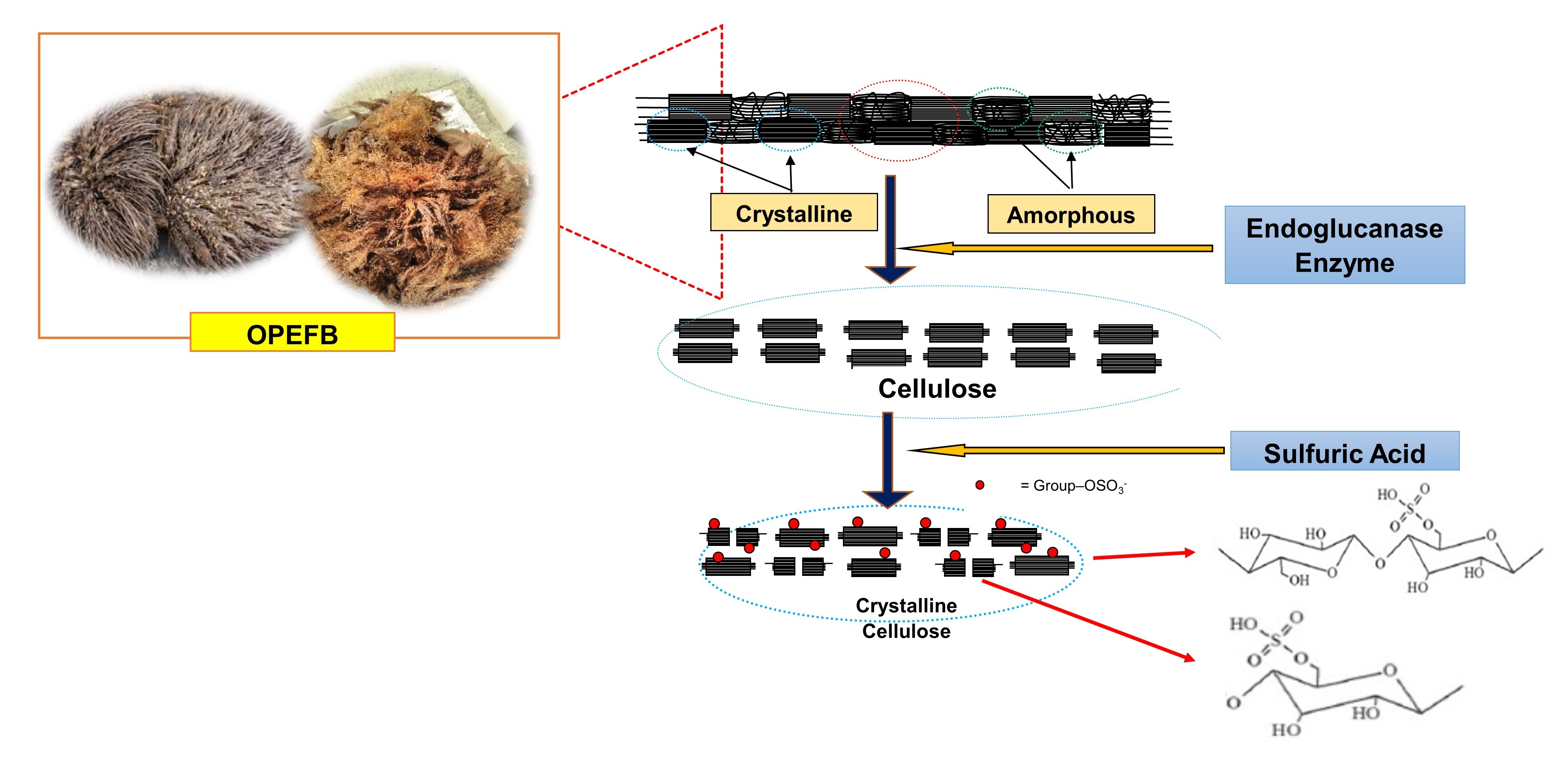
Downloads
References
NW Asmoro, C Hidayat, T Ariyanto and R Millati. Cellulose isolation from oil palm empty fruit bunch using different pretreatment processes. Journal of Applied Science and Engineering 2022; 26(11), 1513-1520.
SH Pranolo, J Waluyo, R Ikbar, RA Damayanthy, S Lestary and ML Qadarusman. Application of nanocrystal cellulose based on empty palm oil fruit bunch as glucose biosensing. ASEAN Journal of Chemical Engineering 2023; 23(3), 360-369.
PG Marakana, A Dey and B Saini. Isolation of nanocellulose from lignocellulosic biomass: Synthesis, characterization, modification, and potential applications. Journal of Environmental Chemical Engineering 2021; 9(6), 106606.
QJ Chen, LL Zhou, JQ Zou and X Gao. The preparation and characterization of nanocomposite film reinforced by modified cellulose nanocrystals. International Journal of Biological Macromolecules 2019; 132, 1155-1162.
P Kumari, R Seth, A Meena and D Sharma. Enzymatic synthesis of cellulose nanocrystals from lemongrass and its application in improving anti-cancer drug release, uptake and efficacy. Industrial Crops and Products 2023; 192, 115933.
J Shojaeiarani, D Bajwa and A Shirzadifar. A review on cellulose nanocrystals as promising biocompounds for the synthesis of nanocomposite hydrogels. Carbohydrate Polymers 2019; 216, 247-259.
B Zakani and D Grecov. Effect of ultrasonic treatment on yield stress of highly concentrated cellulose nano-crystalline (CNC) aqueous suspensions. Carbohydrate Polymers 2022; 291, 119651.
J Lamaming, R Hashim, CP Leh and O Sulaiman. Properties of cellulose nanocrystals from oil palm trunk isolated by total chlorine free method. Carbohydrate Polymers 2017; 156, 409-416.
J Marett, A Aning and EJ Foster. The isolation of cellulose nanocrystals from pistachio shells via acid hydrolysis. Industrial Crops and Products 2017; 109, 869-874.
A Kumar, YS Negi, V Choudhary and NK Bhardwaj. Characterization of cellulose nanocrystals produced by Acid-hydrolysis from sugarcane bagasse as Agro-waste. Journal of Materials Physics and Chemistry 2014; 2(1), 1-8.
FT Seta, X An, L Liu, H Zhang, J Yang, W Zhang, S Nie, S Yao, H Cao, Q Xu, Y Bu and H Liu. Preparation and characterization of high yield cellulose nanocrystals (CNC) derived from ball mill pretreatment and maleic acid hydrolysis. Carbohydrate Polymers 2020; 234, 115942.
PB Filson, BE Dawson-Andoh and D Schwegler-Berry. Enzymatic-mediated production of cellulose nanocrystals from recycled pulp. Green Chemistry 2009; 11(11), 1808-1814.
SR Anderson, D Esposito, W Gillette, JY Zhu, U Baxa and SE McNeil. Enzymatic preparation of nanocrystalline and microcrystalline cellulose. TAPPI Journal, 13(5), 35-42.
T Yang, Y Guo, N Gao, X Li and J Zhao. Modification of a cellulase system by engineering Penicillium oxalicum to produce cellulose nanocrystal. Carbohydrate Polymers 2020; 234, 115862.
H Zhang, Y Chen, S Wang a , L Ma, Y Yu, H Dai and Y Zhang. Extraction and comparison of cellulose nanocrystals from lemon (Citrus limon) seeds using sulfuric acid hydrolysis and oxidation methods. Carbohydrate Polymers 2020; 238(2), 116180.
NS Prasanna and J Mitra. Isolation and characterization of cellulose nanocrystals from Cucumis sativus peels. Carbohydrate Polymers 2020; 247, 116706.
AY Melikoğlu, SE Bilek and S Cesur. Optimum alkaline treatment parameters for the extraction of cellulose and production of cellulose nanocrystals from apple pomace. Carbohydrate Polymers 2019; 215, 330-337.
N Johar, I Ahmad and A Dufresne. Extraction, preparation and characterization of cellulose fibres and nanocrystals from rice husk. Industrial Crops and Products 2012; 37(1), 93-99.
Y Habibi, LA Lucia and OJ Rojas. Cellulose nanocrystals: Chemistry, self-assembly, and applications. Chemical Reviews 2010; 110(6), 3479-3500.
C Liu, B Li, H Du, D Lv, Y Zhang, G Yu, X Mu and H Peng. Properties of nanocellulose isolated from corncob residue using sulfuric acid, formic acid, oxidative and mechanical methods. Carbohydrate Polymers 2016; 151, 716-724.
Z Karim, S Afrin, Q Husain and R Danish. Necessity of enzymatic hydrolysis for production and functionalization of nanocelluloses. Critical Reviews in Biotechnology 2017; 37(3), 355-370.
R Sposina, S Teixeira, A Sant and J Jang. Combining biomass wet disk milling and endoglucanase / β -glucosidase hydrolysis for the production of cellulose nanocrystals Combining biomass wet disk milling and endoglucanase /  -glucosidase hydrolysis for the production of cellulose nanocrystals. Carbohydrate Polymers 2015; 89(1), 80-88.
P Squinca, S Bilatto, AC Badino and CS Farinas. Nanocellulose production in future biorefineries: An integrated approach using tailor-made enzymes. ACS Sustainable Chemistry & Engineering 2020; 8(5), 2277-2286.
BD Argo, AK Wardani, E Zubaidah and S Winarsih. Endoglucanase, exo-glucanase and ‚-glucosidase activity thecombination of crude enzyme from Trichoderma reesei and Aspergillus niger at different temperatures and pH. Biosciences 2014; 9(2), 46-48.
B Pereira and V Arantes. Production of cellulose nanocrystals integrated into a biochemical sugar platform process via enzymatic hydrolysis at high solid loading. Industrial Crops and Products 2020; 152, 112377.
NW Asmoro, R Millati, C Hidayat and T Ariyanto. Kombinasi Proses Hidrolisis Enzimatis dan Kimiawi pada Pembuatan Nanokristalin Selulosa dari Tandan Kosong Kelapa Sawit. Universitas Gadjah Mada, Yogyakarta, Indonesia, 2025.
T Niamsap, NT Lam and P Sukyai. Production of hydroxyapatite-bacterial nanocellulose scaffold with assist of cellulose nanocrystals. Carbohydrate Polymers 2019; 205, 159-166.
L Amoroso, G Muratore, MA Ortenzi, S Gazzotti, S Limbo and L Piergiovanni. Fast Production of Cellulose Nanocrystals by Hydrolytic-Oxidative Microwave-Assisted Treatment. Polymer 2020; 12(1), 68.
R Arun, R Shruthy, R Preetha and V Sreejit. Biodegradable nano composite reinforced with cellulose nano fiber from coconut industry waste for replacing synthetic plastic food packaging. Chemosphere 2022; 291(P1), 132786.
Z Zulnazri, R Dewi, S Sulhatun and N Nasrun. Kinetics study the decomposition of the cellulose into cellulose nanocrystals by hydrothermal with hydrochloric acid catalyst. International Journal of Plant Biology 2019; 10(1), 7440.
M Thakur, A Sharma, V Ahlawat, M Bhattacharya and S Goswami. Process optimization for the production of cellulose nanocrystals from rice straw derived α-cellulose. Materials Science for Energy Technologies 2020; 3, 328-334.
F Beltramino, BM Roncero, T Vidal, AL Torres and C Valls. Increasing yield of nanocrystalline cellulose preparation process by a cellulase pretreatment. Bioresource Technology 2015; 192, 574-581.
X Wang, J Zeng, W Gao, K Chen, B Wang and J Xu. Endoglucanase recycling for disintegrating cellulosic fibers to fibrils. Carbohydrate Polymers 2019; 223, 115052.
E Quintana, C Valls, T Vidal and MB Roncero. Comparative evaluation of the action of two different endoglucanases. Part I: On a fully bleached, commercial acid sulfite dissolving pulp. Cellulose 2015; 22(3), 2067-2079.
ADAD Santos, MJF Silva, MV Scatolino, AFS Durães, MC Dias, RAP Damásio and GHD Tonoli. Comparison of pre-treatments mediated by endoglucanase and TEMPO oxidation for eco-friendly low-cost energy production of cellulose nanofibrils. Environmental Science and Pollution Research 2022; 30(2), 4934-4948.
JJ Kaschuk, TM Lacerda and E Frollini. International journal of biological macromolecules investigating effects of high cellulase concentration on the enzymatic hydrolysis of the sisal cellulosic pulp. International Journal of Biological Macromolecules 2019; 138, 919-926.
K Song, X Zhu, W Zhu and X Li. Preparation and characterization of cellulose nanocrystal extracted from Calotropis procera biomass. Bioresources and Bioprocessing 2019; 6(1), 45.
Y Tang, X Shen, J Zhang and D Guo. Extraction of cellulose nano-crystals from old corrugated container fiber using phosphoric acid and enzymatic hydrolysis followed by sonication. Carbohydrate Polymers 2015; 125, 360-366.
WT Wulandari, A Rochliadi and IM Arcana. Nanocellulose prepared by acid hydrolysis of isolated cellulose from sugarcane bagasse. IOP Conference Series: Materials Science and Engineering 2016; 107(1), 012045.
JD Aguiar, TJ Bondancia, PIC Claro, HC Mattoso, CS Farinas and JM Marconcini. Enzymatic deconstruction of sugarcane bagasse and straw to obtain cellulose nanomaterials. ACS Sustainable Chemistry & Engineering 2020; 8(5), 2287-2299.
B Frka-Petesic, TG Parton, C Honorato-Rios, A Narkevicius, K Ballu, Q Shen, Z Lu, Yu Ogawa, JS Haataja, BE Droguet, RM Parker and S Vignolini. Structural color from cellulose nanocrystals or chitin nanocrystals: Self-Assembly, Optics, and Applications. Chemical Reviews 2023; 123(23), 12595-12756.
JA Sirvio, K Rekinen and A Ammala. High-yield nanocellulose from supramolecular chemistry-driven delignified softwood. Carbohydrate Polymers Journal 2025; 366, 123873.
J Nithikarnjanatharn and N Samsalee. Effect of cassava pulp on Physical, Mechanical, and Biodegradable properties of Poly(Butylene-Succinate)-Based biocomposites. Alexandria Engineering Journal 2022; 61(12), 10171-10181.
Published
How to Cite
Issue
Section
License
Copyright (c) 2026 Walailak University

This work is licensed under a Creative Commons Attribution-NonCommercial-NoDerivatives 4.0 International License.





