
Cinnamaldehyde-Chitosan Nanoparticles Protect Fibroblasts from High-Glucose-Induced Apoptosis via PI3K/AKT Pathway Activation
DOI:
https://doi.org/10.48048/tis.2026.12663Keywords:
Apoptosis, Cinnamaldehyde, Fibroblast, High glucose, Chitosan nanoparticle, PI3K, AKTAbstract
Hyperglycemia disrupts wound healing in diabetes partly by promoting fibroblast apoptosis. This study aimed to evaluate whether cinnamaldehyde-chitosan nanoparticles (CCNPs) can inhibit high-glucose-induced fibroblasts apoptosis, and to determine whether this effect involves modulation of the PI3K/AKT pathway. CCNPs were synthesized using a modified ionic-gelation method and characterized by Dynamic Light Scattering (DLS) and Transmission Electron Microscopy (TEM). Murine embryonic fibroblasts cell line (NIH-3T3) were allocated to 6 groups: 2 control groups - normal glucose (NG, 5.5 mM glucose) and high glucose (HG, 30 mM glucose) - and 4 treatment groups that were pretreated with metformin (50 µM) or CCNPs (12.5, 25 and 50 µM) prior to 24 h of HG exposure. After 24 h of treatment, PI3K and phosphorylated-AKT levels in the cell lysates were quantified using ELISA, and fibroblasts apoptosis was assessed and quantified by Annexin V-PI flow cytometry. Synthesized CCNPs exhibited spherical morphology with an average diameter of 214.8 ± 54.0 nm, a polydispersity index (PDI) of 0.419, and a ζ-potential of +66.2 mV. High glucose exposure significantly increased the proportion of late apoptotic cells and reduced PI3K and p-AKT expression, compared with NG group (p < 0.05). Meanwhile, CCNPs at all tested concentrations significantly reduced late apoptotic cell percentages in a concentration-dependent manner, whereas only CCNPs at 50 µM significantly restored both PI3K and p-AKT levels. These findings suggest that CCNPs mitigate high-glucose-induced fibroblast apoptosis and is likely associated with the activation of PI3K/AKT pathway. This study provides preliminary in vitro evidence supporting a potential fibroblast-protective role of CCNPs under hyperglycemic conditions. Limitations of this study include the short-term in-vitro design and the absence of a direct comparison between CCNPs versus cinnamaldehyde only. Future studies should incorporate longer exposure durations, pathway-specific inhibitor, and in-vivo validation.
HIGHLIGHTS
- Cinnamaldehyde-chitosan nanoparticles (CCNPs) with average particel size of 214.8 ± 54.0 nm and a polydispersity index (PDI) of 0.419 were succesfully synthesized by ionic gelation method to improve the stability of cinnamaldehyde.
- CCNPs significantly protected NIH-3T3 fibroblasts from high-glucose-induced apoptosis and
- CCNPs upregulated the PI3K/AKT signaling pathway, contributing to the reduction of apoptosis.
- This study provides novel evidence supporting the therapeutic potential of CCNPs for preventing fibroblast dysfunction in the context of diabetes mellitus.
GRAPHICAL ABSTRACT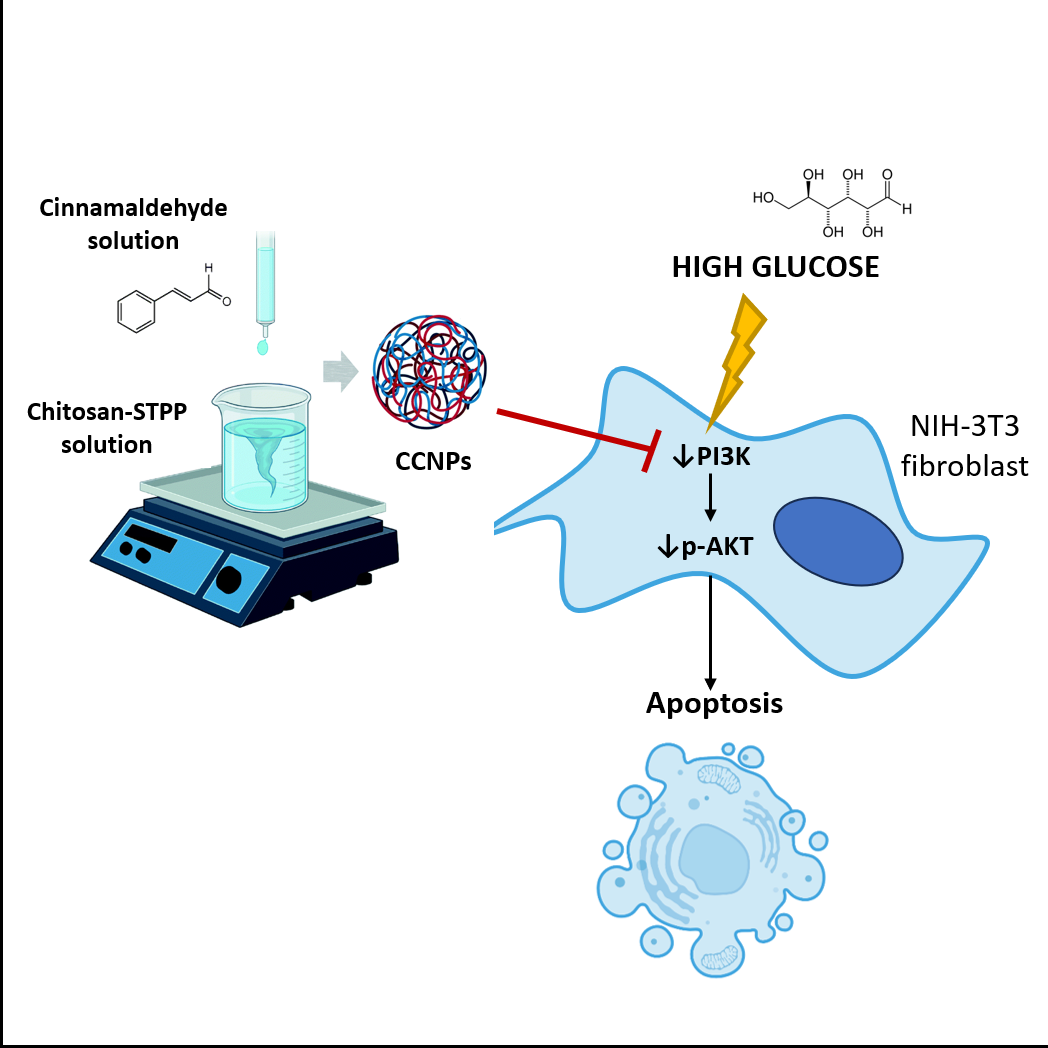
Downloads
References
International Diabetes Federation. IDF diabetes atlas, Available at: https://diabetesatlas.org/atlas/tenth-edition/, accessed October 2025.
CMO Volpe, PH Villar-Delfino, PMF dos Anjos and JA Nogueira-Machado. Cellular death, reactive oxygen species (ROS) and diabetic complications. Cell Death & Disease 2018; 9(2), 119.
SP Levick and A Widiapradja. The diabetic cardiac fibroblast: mechanisms underlying phenotype and function. International Journal of Molecular Sciences 2020; 21(3), 970.
P Buranasin, K Mizutani, K Iwasaki, CPN Mahasarakham, D Kido, K Takeda and Y Izumi. High glucose-induced oxidative stress impairs proliferation and migration of human gingival fibroblasts. PLoS One 2018; 13(8), e0201855.
A Perez-Favila, ML Martinez-Fierro, JG Rodriguez-Lazalde, MA Cid-Baez, M de J Zamudio-Osuna, Ma del R Martinez-Blanco, FE Mollinedo-Montaño, IP Rodriguez-Sanchez, R Castañeda-Miranda and I Garza-Veloz. Current therapeutic strategies in diabetic foot ulcers. Medicina 2019; 55(11), 714.
Y Liu, Y Liu, J Deng, W Li and X Nie. Fibroblast growth factor in diabetic foot ulcer: Progress and therapeutic prospects. Frontiers in Endocrinology 2021; 12, 744868.
Z Ma, Y Ding, X Ding, H Mou, R Mo and Q Tan. PDK4 rescues high-glucose-induced senescent fibroblasts and promotes diabetic wound healing through enhancing glycolysis and regulating YAP and JNK pathway. Cell Death Discovery 2023; 9(1), 424.
X Chen, N Xie, L Feng, Y Huang, Y Wu, H Zhu, J Tang and Y Zhang. Oxidative stress in diabetes mellitus and its complications: From pathophysiology to therapeutic strategies. Chinese Medical Journal 2025; 138(1), 15.
CY Huang, MY Ng, T Lin, YW Liao, WS Huang, CW Hsieh, CC Yu and CJ Chen. Quercetin ameliorates advanced glycation end product-induced wound healing impairment and inflammaging in human gingival fibroblasts. Journal of Dental Sciences 2024; 19(1), 268-275.
S Bathina, NKV Gundala, P Rhenghachar, S Polavarapu, AD Hari, M Sadananda and UN Das. Resolvin D1 ameliorates nicotinamide-streptozotocin-induced type 2 diabetes mellitus by its anti-inflammatory action and modulating PI3K/Akt/mTOR pathway in the brain. Archives of Medical Research 2020; 51(6), 492-503.
Y Dong, Y Xing, J Sun, W Sun, Y Xu and C Quan. Baicalein Alleviates Liver Oxidative Stress and Apoptosis Induced by High-Level Glucose through the Activation of the PERK/Nrf2 Signaling Pathway. Molecules 2020; 25(3), 599.
T Soydaş, EY Saraç, S Çınar, G Yenmiş, S Doğan, S Solakoğlu, M Tunçdemir and GK Sultuybek. Effects of short-term high glucose on NIH/3T3 fibroblast proliferation, apoptosis, and collagen type I production. Tıp Fakültesi Klinikleri Dergisi 2019; 2(3), 91-95.
W Xie, P Zhou, M Qu, Z Dai, X Zhang, C Zhang, X Dong, G Sun and X Sun. Ginsenoside re attenuates high glucose-induced RF/6A injury via regulating PI3K/AKT inhibited HIF-1α/VEGF signaling pathway. Frontiers in Pharmacology 2020; 11, 695.
AA Doyle and JC Stephens. A review of cinnamaldehyde and its derivatives as antibacterial agents. Fitoterapia 2019; 139, 104405.
K Yang, A Liu, A Hu, J Li, Z Zen, Y Liu, S Tang and C Li. Preparation and characterization of cinnamon essential oil nanocapsules and comparison of volatile components and antibacterial ability of cinnamon essential oil before and after encapsulation. Food Control 2021; 123, 107783.
R Karimirad, BS Inbaraj and BH Chen. Recent Advances on the analysis and biological functions of cinnamaldehyde and its derivatives. Antioxidants 2025; 14(7), 765.
X Qi, R Zhou, Y Liu, J Wang, WN Zhang, HR Tan, Y Niu, T Sun, YX Li and JQ Yu. Trans-cinnamaldehyde protected PC12 cells against oxygen and glucose deprivation/reperfusion (OGD/R)-induced injury via anti-apoptosis and anti-oxidative stress. Molecular and Cellular Biochemistry 2016; 421(1), 67-74.
B Zheng, J Qi, Y Yang, L Li, Y Liu, X Han, W Qu and L Chu. Mechanisms of cinnamic aldehyde against myocardial ischemia/hypoxia injury in vivo and in vitro: Involvement of regulating PI3K/AKT signaling pathway. Biomedicine & Pharmacotherapy 2022; 147, 112674.
CM Sena, A Pereira and RM Seiça. Cinnamaldehyde supplementation reverts endothelial dysfunction in rat models of diet-induced obesity: Role of NF-E2-related factor-2. Antioxidants 2023; 12(1), 82.
ME Abdelmageed, GS Shehatou, RA Abdelsalam, GM Suddek and HA Salem. Cinnamaldehyde ameliorates STZ-induced rat diabetes through modulation of IRS1/PI3K/AKT2 pathway and AGEs/RAGE interaction. Naunyn-Schmiedeberg’s Arch Pharmacol 2019; 392(2), 243-258.
YF Chen, KJ Wu, CC Kuo and HY Tsai. Protection of Gueichih-Fuling-Wan on cerebral ischemia-induced brain injury in rodents is mediated by trans-cinnamaldehyde via inhibition of neuroinflammation and apoptosis. Biomedicine 2024; 14(2), 38-48.
E Fukata, A Aulanni’am, MS Rohman, S Fakurazi, NANN Malek, Y Kawamoto and AT Endharti. In silico prediction of cinnamaldehyde on the PI3K/AKT pathway activator of anti-apoptotic potential. Journal of Pharmacy & Pharmacognosy Research 2025; 13(2), 565-577.
DRA Muhammad, A Sedaghat Doost, V Gupta, MD bin Sintang, D Van de Walle, P Van der Meeren and K Dewettinck. Stability and functionality of xanthan gum-shellac nanoparticles for the encapsulation of cinnamon bark extract. Food Hydrocolloids 2020; 100, 105377.
L Wu, Y Meng, Y Xu and X Chu. Improved uptake and bioavailability of cinnamaldehyde via solid lipid nanoparticles for oral delivery. Pharmaceutical Development and Technology 2022; 27(10), 1038-1048.
Q Liu, H Cui, B Muhoza, E Duhoranimana, S Xia, K Hayat, S Hussain, MU Tahir and X Zhang. Fabrication of low environment-sensitive nanoparticles for cinnamaldehyde encapsulation by heat-induced gelation method. Food Hydrocolloids 2020; 105, 105789.
B Muhoza, B Qi, JD Harindintwali, MYF Koko, S Zhang and Y Li. Encapsulation of cinnamaldehyde: an insight on delivery systems and food applications. Critical Reviews in Food Science and Nutrition 2023; 63(15), 2521-2543.
SF Hosseini, J Ghaderi and MC Gómez-Guillén. Tailoring physico-mechanical and antimicrobi¬al/antioxidant properties of biopolymeric films by cinnamaldehyde-loaded chitosan nanoparticles and their application in packaging of fresh rain¬bow trout fillets. Food Hydrocolloids 2022; 124, 107249.
P Subhaswaraj, S Barik, C Macha, PV Chiranjee¬vi and B Siddhardha. Anti quorum sensing and anti-biofilm efficacy of cinnamaldehyde encapsulated chitosan nanoparticles against Pseudomonas aeruginosa PAO1. LWT 2018; 97, 752-759.
J Xu, Q Lin, M Sheng, T Ding, B Li, Y Gao and Y Tan. Antibiofilm effect of cinnamaldehyde-chitosan nanoparticles against the biofilm of Staphylococcus aureus. Antibiotics 2022; 11(10), 1403.
R Mu, H Zhang, Z Zhang, X Li, J Ji, X Wang, Y Gu and X Qin. Trans-cinnamaldehyde loaded chitosan based nanocapsules display antibacterial and antibiofilm effects against cavity-causing Streptococcus mutans. Journal of Oral Microbiology 2023; 15(1), 2243067.
R Awaluddin, DA Nugrahaningsih and EN Solikhah. The concentration-dependent pro-fibrotic effect of metformin on LPS and high glucose induced fibroblast NIH 3T3 and macrophage RAW 264.7 cell co-culture. The Medical Journal of Malaysia 2020; 75(S1), 10-13.
LK Chao, WT Chang, W Shih and JS Huang. Cinnamaldehyde impairs high glucose-induced hypertrophy in renal interstitial fibroblasts. Toxicology and Applied Pharmacology 2010; 244(2), 174-180.
DV SepAlveda. Trichrome stain for diagnosis of amoebae in parasitology laboratory. Global Journal of Medical Research 2013; 13(K7), 7-12.
V Sandhiya and U Ubaidulla. A review on herbal drug loaded into pharmaceutical carrier techniques and its evaluation process. Future Journal of Pharmaceutical Sciences 2020; 6(1), 51.
J Hu, Y Zhang, Z Xiao and X Wang. Preparation and properties of cinnamon-thyme-ginger composite essential oil nanocapsules. Industrial Crops and Products 2018; 122, 85-92.
M Ji, X Sun, X Guo, W Zhu, J Wu, L Chen, J Wang, M Chen, C Cheng and Q Zhang. Green synthesis, characterization and in vitro release of cinnamaldehyde/sodium alginate/chitosan nanoparticles. Food Hydrocolloids 2019; 90, 515-522.
A Loquercio, E Castell-Perez, C Gomes and RG Moreira. Preparation of chitosan-alginate nanoparticles for trans-cinnamaldehyde entrapment. Journal of Food Science 2015; 80(10), N2305-N2315.
LE Low, SP Siva, YK Ho, ES Chan and BT Tey. Recent advances of characterization techniques for the formation, physical properties and stability of Pickering emulsion. Advances in Colloid and Interface Science 2020; 277, 102117.
M Danaei, M Dehghankhold, S Ataei, F Hasanzadeh Davarani, R Javanmard, A Dokhani, S Khorasani and MR Mozafari. Impact of particle size and polydispersity index on the clinical applications of lipidic nanocarrier systems. Pharmaceutics 2018; 10(2), 57.
Z Németh, I Csóka, R Semnani Jazani, B Sipos, H Haspel, G Kozma, Z Kónya and DG Dobó. Quality by design-driven zeta potential optimisation study of liposomes with charge imparting membrane additives. Pharmaceutics 2022; 14(9), 1798.
NH Hoang, T Le Thanh, R Sangpueak, J Treekoon, C Saengchan, W Thepbandit, NK Papathoti, A Kamkaew and N Buensanteai. Chitosan nanoparticles-based ionic gelation method: A promising candidate for plant disease management. Polymers 2022; 14(4), 662.
L Wu and R Derynck. Essential role of TGF-β signaling in glucose-induced cell hypertrophy. Developmental Cell 2009; 17(1), 35-48.
FJ López-Hernández. Cell surface area to volume relationship during apoptosis and apoptotic body formation. Cellular Physiology and Biochemistry 2021; 55(S1), 161-170.
ZE Sadeq, IJ Lafta and SA Lamburne. Interference with quorum sensing of Klebsiella pneumoniae by some plant extracts can affect the biofilm formation and antibiotic resistance. Baghdad Science Journal 2025; 22(4), 1234-1245.
R Wang, S Li, H Jia, X Si, Y Lei, J Lyu, Z Dai and Z Wu. Protective effects of cinnamaldehyde on the inflammatory response, oxidative stress, and apoptosis in liver of Salmonella typhimurium-challenged mice. Molecules 2021; 26(8), 2309.
R Zhu, H Liu, C Liu, L Wang, R Ma, B Chen, L Li, J Niu, M Fu, D Zhang and S Gao. Cinnamaldehyde in diabetes: A review of pharmacology, pharmacokinetics and safety. Pharmacological Research 2017; 122, 78-89.
HB Kumar, S Manandhar, E Rathi, SP Kabekkodu, CH Mehta, UY Nayak, SG Kini and KSR Pai. Identification of potential Akt activators: A ligand and structure-based computational approach. Mol Divers 2024; 28(3), 1485-1503.
NF Sangweni, RA Mosa, PV Dludla, AP Kappo, AR Opoku, CJF Muller and R Johnson. The triterpene, methyl-3β-hydroxylanosta-9,24-dien-21-oate (RA3), attenuates high glucose-induced oxidative damage and apoptosis by improving energy metabolism. Phytomedicine 2021; 85, 153546.
J Wang, H Yang, C Wang and C Kan. Cyp2e1 knockdown attenuates high glucose-induced apoptosis and oxidative stress of cardiomyocytes by activating PI3K/Akt signaling. Acta Diabetologica 2023; 60(9), 1219-1229.
T Pungsrinont, J Kallenbach and A Baniahmad. Role of PI3K-AKT-mTOR pathway as a pro-survival signaling and resistance-mediating mechanism to therapy of prostate cancer. International Journal of Molecular Sciences2021; 22(20), 11088.
BD Manning and A Toker. AKT/PKB signaling: Navigating the network. Cell 2017; 169(3), 381-405.
H Lan, Q Zheng, K Wang, C Li, T Xiong, J Shi and N Dong. Cinnamaldehyde protects donor heart from cold ischemia - reperfusion injury via the Pi3k/Akt/Mtor pathway. Biomedicine & Pharmacotherapy 2023; 165, 114867.
M Davaatseren, YJ Jo, GP Hong, HJ Hur, S Park and MJ Choi. Studies on the anti-oxidative function of trans-cinnamaldehyde-included β-cyclodextrin complex. Molecules 2017; 22(12), 1868.
CL Barrera-Martínez, F Padilla-Vaca, I Liakos, HI Meléndez-Ortiz, GY Cortez-Mazatan and RD Peralta-Rodríguez. Chitosan microparticles as entrapment system for trans- cinnamaldehyde: Synthesis, drug loading, and in vitro cytotoxicity evaluation. International Journal of Biological Macromolecules 2021; 166, 322-332.
PR Sarjono, N Ngadiwiyana, E Fachriyah, I Ismiyarto, NBA Prasetya and K Khikmah. Encapsulation of cinnamaldehyde using chitosan: Stability, mucoadhesive and cinnamaldehyde release. Jurnal Kimia Sains dan Aplikasi 2018; 21(4), 175-181.
N Aibani, R Rai, P Patel, G Cuddihy and EK Wasan. Chitosan nanoparticles at the biological interface: Implications for drug delivery. Pharmaceutics 2021; 13(10), 1686.
ES Kim, Y Baek, HJ Yoo, JS Lee and HG Lee. Chitosan-tripolyphosphate nanoparticles prepared by ionic gelation improve the antioxidant activities of astaxanthin in the in vitro and in vivo model. Antioxidants 2022; 11(3), 479.
Published
How to Cite
Issue
Section
License
Copyright (c) 2025 Walailak University

This work is licensed under a Creative Commons Attribution-NonCommercial-NoDerivatives 4.0 International License.





