
Physiological Activity Among Cocoa Plants Derived from Orthotropic and Plagiotropic Cuttings, Top Grafting, and Hybrid Seed in Drought
DOI:
https://doi.org/10.48048/tis.2026.11535Keywords:
Adaptation, Drought, Orthotropic cuttings, Plagiotropic cuttings, RewateringAbstract
Drought is one of the major limiting factors for the growth and development of cocoa. This research aimed to investigate the physiological responses of cocoa plants through novel vegetative propagation methods, namely orthotropic cuttings (OC) and plagiotropic cuttings (PC) under drought stress conditions. These were compared to established propagation methods, including orthotropic grafting (OG), plagiotropic grafting (PG), and hybrid seeds (HS). A complete randomized block design with 2 factors was used in this study, soil water status consisting of well watered (WW) and drought stress (DS), and the propagation method (OC, PC, OG, PG and HS). DS was applied using the fraction of transpirable soil water method. Relative water content, photosynthetic activity, reactive oxygen species, and antioxidant activity were evaluated. The results showed that cocoa plants derived from different propagation methods had varying drought responses. The OC exhibited moderate tolerance to drought, comparable to PG and OG, whereas PC showed the lowest tolerance. Moreover, HS exhibited high tolerance to drought. The OC showed better drought adaptation capability compared to PC, as evidenced by its ability to maintain relative water content, chlorophyll, stomatal conductance and transpiration rate under drought. The OC also exhibited a lower risk of cell damage than others due to a smaller increase in superoxide free radicals and a significant increase in antioxidant activity under drought. These findings indicate that, given its moderate drought tolerance, OC can be recommended as suitable planting material for cacao cultivation in distinctly dry climate regions.
HIGHLIGHTS
- The propagation of cocoa through cuttings offers a promising alternative approach to vegetative reproduction.
- Evaluation of the physiological activity of cutting-origin cocoa plants under drought and post-drought, especially those derived from orthotropic and plagiotropic shoots, is needed.
- The physiological adaptation strategies of orthotropic cuttings under drought and post-drought were found to be similar to those of plagiotropic grafted plants, a standard method of vegetative propagation, according to cluster analysis.
- Plagiotropic cuttings demonstrated distinct physiological adaptation strategies under drought conditions compared to orthotropic cuttings.
GRAPHICAL ABSTRACT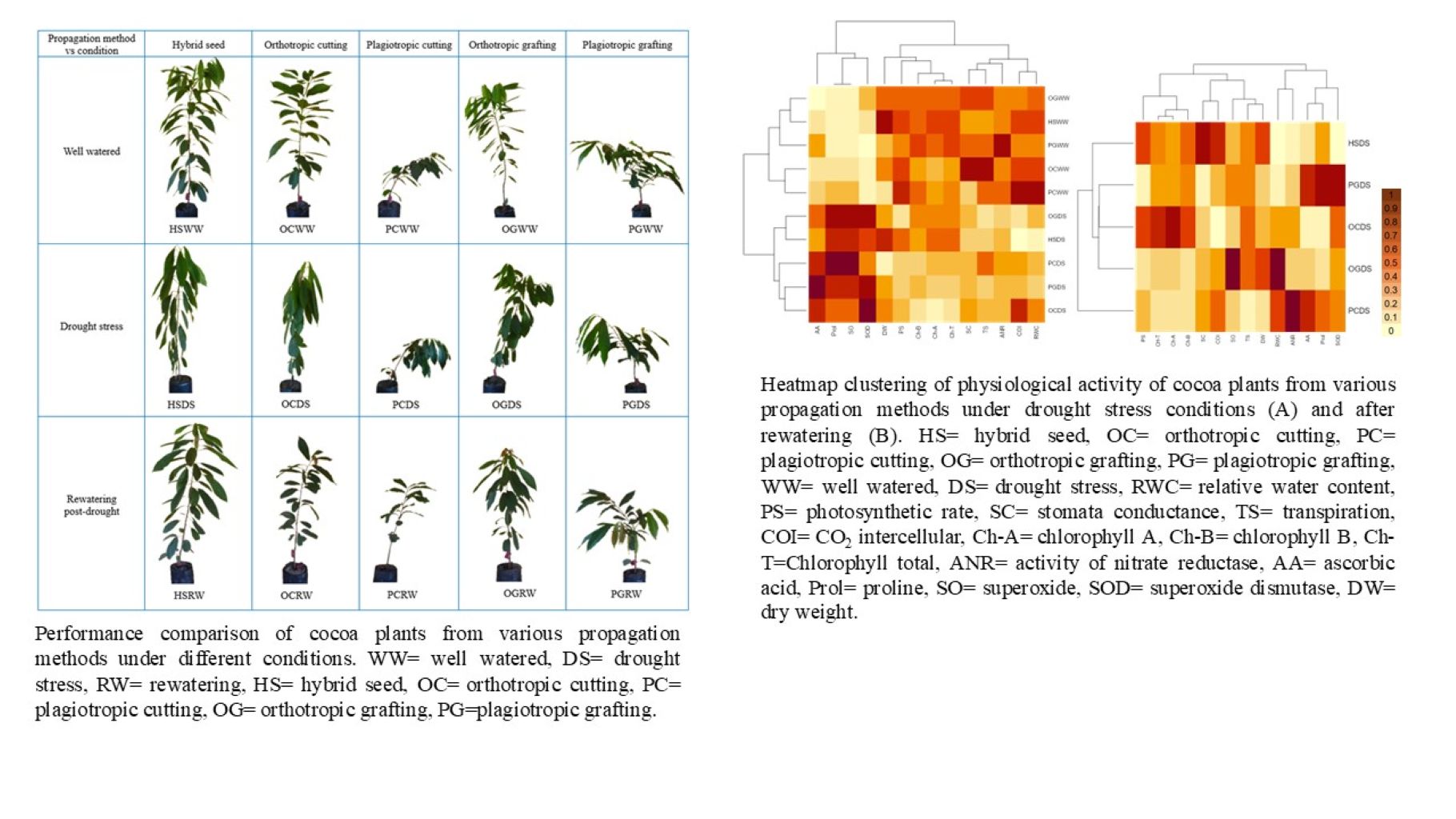
Downloads
References
F Lahive, P Hadley and AJ Daymond. The physiological responses of cacao to the environment and the implications for climate change resilience. A review. Agronomy for Sustainable Development 2019; 39(1), 5.
EA Santos, AAF Almeida, MCS Branco, IC Santos, D Ahnert, VC Baligar and RR Valle. Path analysis of phenotypic traits in young cacao plants under drought conditions. PLoS One 2018; 13(2), e0191847.
L Adet, DMA Rozendaal, A Tapi, PA Zuidema, P Vaast and NPR Anten. Negative effects of water deficit on cocoa tree yield are partially mitigated by irrigation and potassium application. Agricultural Water Management 2024; 296, 108789.
L Gateau-Rey, EVJ Tanner, B Rapidel, JP Marelli and S Royaert. Climate change could threaten cocoa production: Effects of 2015-2016 el Niño-related drought on cocoa agroforests in Bahia, Brazil. PLoS One 2018; 13(7), e0200454.
ARS Gomes, GA Sodre, M Guiltinan, R Lockwood and S Maximova. Supplying new cocoa planting material to farmers: A review of propagation methodologies. Bioversity International, Rome, Italy, 2015.
MAO Zambrano, DA Castillo, LR Perez and W Teran. Cacao (Theobroma cacao L.) response to water stress: Physiological characterization and antioxidant gene expression profiling in commercial clones. Frontiers in Plant Science 2021; 12, 700855.
F Zakariyya and D Indradewa. Drought stress affecting growth and some physiological characters of 3 cocoa clones at seedling phase. Pelita Perkebunan 2018; 34(3), 156-165.
AJ Daymond, A Prawoto, S Abdoellah, AW Susilo, NC Cryer, F Lahive and P Hadley. Variation in Indonesian cocoa farm productivity in relation to management, environmental and edaphic factors. Experimental Agriculture 2020; 56(5), 738-751.
JE Schmidt, AD Val, A Puig, A Tempeleu and T Crow. Interactive and dynamic effects of rootstock and rhizobiome on scion nutrition in cacao seedlings. Frontiers in Agronomy 2021; 3, 754646.
GA Sodré and ARS Gomes. Cocoa propagation, technologies for production of seedlings. Revista Brasileira de Fruticultura 2019; 41(2), e-782.
JC N’zi, I Koné, KAA M’bo, S Koné and C Kouamé. Successful grafting elite cocoa clones (Theobroma cacao L.) as a function of the age of rootstock. Heliyon 2023; 9(8), e18732.
PB Adhikari, Q Xu and M Notaguchi. Compatible graft establishment in fruit trees and its potential markers. Agronomy 2022; 1, 1981.
TI Santoso, E Sulistyaningsih, ETS Putra and AW Susilo. Typology of cocoa seedlings derived from orthotropic and plagiotropic cuttings compared with grafting and hybrid seeds. Caraka Tani: Journal of Sustainable Agriculture. 2025; 40(2), 266.
TI Santoso and F Zakariyya. Field performance of plagiotropic cocoa in 2 clonally propagation methods: vegetative and early production phase. AIP Conference Proceedings 2022; 2563(1), 020002.
T Wahyudi, Pujiyanto and Misnawi. Kakao: Sejarah, botani, proses produksi, pengolahan dan perdagangan (in Indonesian). Gadjah Mada Univesity Press, Yogyakarta, Indonesia, 2015.
E Dzandu, L Enu-Kwesi, CM Markwei and KO Ayeh. Screening for drought tolerance potential of nine cocoa (Theobroma cacao L.) genotypes from Ghana. Heliyon 2021; 7(11), e08389.
M Zasari, A Wachjar AW Susilo and Sudarsono. Prope legitimate rootstocks determine the selection criteria for drought-tolerant cocoa. Biodiversitas 2020; 21(9), 4067-4075.
E Nurwahyuni and ETS Putra. The effect of calcium on photosynthetic rate due to aba and proline behaviour of oil palm (Elaeis guineensis Jacq.) seedlings under drought conditions. Caraka Tani: Journal of Sustainable Agriculture 2019; 34(1), 31-42.
AW Susilo, I Anita-Sari and B Setyawan. Yield performance of promising cocoa clones (Theobroma cacao L.) in dry climatic conditions. Pelita Perkebunan 2020; 36(1), 24-31.
A Asman, T Iwanami and A Rosmana. Effect of drought stress on dieback disease development under Lasiodiplodia theobromae infection in cocoa clone MCC 02. Beverage Plant Research 2024; 4(1), e034.
K Lamba, M Kumar, V Singh, L Chaudhary, R Sharma, S Yashveer and MS Dalal. Heat stress tolerance indices for identification of the heat tolerant wheat genotypes. Scientific Reports 2023; 13(1), 10842.
M Suchithra, B Suma, JS Minimol, D Mathew and AVS Kumar. Biochemical response of cocoa (Theobroma cacao L.) genotypes to water deficit stress condition. Environment and Ecology 2023; 41(2), 824-830.
A Malecka, A Kutrowska, A Piechalak and B Tomaszewska. High peroxide level may be a characteristic trait of a hyperaccumulator. Water, Air, & Soil Pollution 2015; 226(4), 84.
AN Cahyo, RH Murti, ETS. Putra, F Oktavia, S Ismawanto and P Montoro. Rubber genotypes with contrasting drought factor index revealed different mechanisms for drought resistance in Hevea brasiliensis. Plants 2022; 11(24), 3563.
R Jaimez, R Loor, F Arteaga, V Márquez and W Tezara. Differential response of photosynthetic activity, leaf nutrient content and yield to long-term drought in cacao clones. Acta Agronómica 2021; 70(3), 274-284.
Z Song, L Wang, M Lee and GH Yue. The evolution and expression of stomatal regulators in C3 and C4 crops: Implications on the divergent drought tolerance. Frontiers in Plant Science 2023; 14, 1100838.
IC Santos, AAF Almeida, D Anhert, AS Conceição, CP Pirovani, JL Pires, RR Valle and VC Baligar. Molecular, physiological and biochemical responses of Theobroma cacao L. genotypes to soil water deficit. PLoS One 2014; 9(12), e115746.
NA Akram, F Shafiq and M Ashraf. Ascorbic acid-a potential oxidant scavenger and its role in plant development and abiotic stress tolerance. Frontiers in Plant Science 2017; 8, 613.
Q Yang, W Cheng, Z Hao, Q Zhang, D Yang, D Teng, Y Zhang, X Wang, H Shen and S Lei. Study on the fractal characteristics of the plant root system and its relationship with soil strength in tailing ponds. Wireless Communications and Mobile Computing 2022; 2022(1), 9499465.
HC Chun, S Lee, YD Choi, DH Gong and KY Jung. Effects of drought stress on root morphology and spatial distribution of soybean and adzuki bean. Journal of Integrative Agriculture 2021; 20(10), 2639-2651.
J Syamsiyah, S Minardi, G Herdiansyah, O Cahyono and FC Mentari. Physical properties of alfisols, growth and products of hybrid corn affected by organic and inorganic fertilizer. Caraka Tani: Journal of Sustainable Agriculture 2023; 38(1), 99-112.
E Arévalo-Gardini, A Farfán, F Barraza, CO Arévalo-Hernández, LB Zúñiga-Cernades, J Alegre and VC Baligar. Growth, physiological, nutrient-uptake-efficiency and shade-tolerance responses of cacao genotypes under different shades. Agronomy 2021; 11(8), 1536.
CN Maghfiroh and ETS Putra. Morphological characters of root and yield of 3 cocoa (Theobroma cacao L.) clones in the field with dead-end trench. Ilmu Pertanian 2020; 5(2), 58.
JD Vries, JB Evers, TW Kuyper, JV Ruijven and L Mommer. Mycorrhizal associations change root functionality: A 3D modelling study on competitive interactions between plants for light and nutrients. New Phytologist 2021; 231(3), 1171-1182.
Published
How to Cite
Issue
Section
License
Copyright (c) 2025 Walailak University

This work is licensed under a Creative Commons Attribution-NonCommercial-NoDerivatives 4.0 International License.





