
Unraveling the Tolerance of Rice Varieties to Single and Dual Salinity and Waterlogging Stresses: Impacts on Agronomic Traits and Yield Performance
DOI:
https://doi.org/10.48048/tis.2026.11928Keywords:
Agronomic responses, Dual stress, Rice variety, Salinity, Susceptible, Tolerant, Yield stability index, Agronomic responses, Dual stress, Rice variety, Salinity, Susceptible, Tolerant, Yield stability indexAbstract
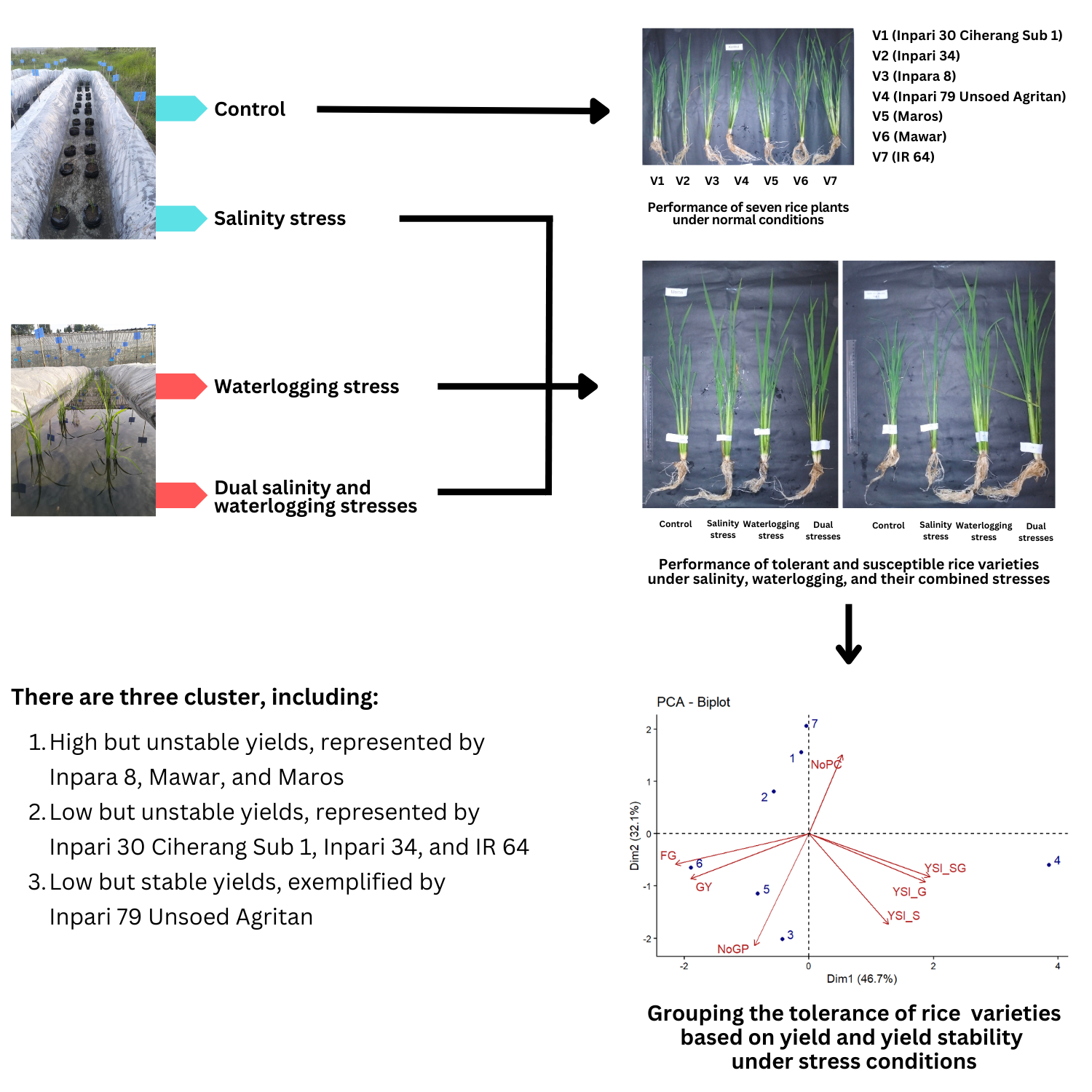
Dual salinity and waterlogging alter metabolisms activity in rice, leading to reduced growth and yield. The use of tolerant varieties offers a promising strategy to enhance plant resistance, improving agronomic traits and yield performance. The main objective of this study is to reveal and evaluate rice tolerance to single and dual salinity and waterlogging stress and to assess their effects on agronomic traits and yield performance. A split-plot design was used with stress conditions as the main factor, consisting of control (no salinity or waterlogging), salinity stress, waterlogging stress, and dual salinity and waterlogging stress. Seven rice varieties were tested as subplots, including Inpari 30 Ciherang Sub 1, Inpari 34, Inpara 8, Inpari 79 Unsoed Agritan, Maros, Mawar, and IR 64. All stress conditions significantly reduced leaf area. Salinity and dual salinity-waterlogging stresses induced Na+ accumulation in the leaves and reduced K+ concentrations, whereas waterlogging and dual salinity-waterlogging stresses accelerated flowering age. Under dual salinity and waterlogging, rice varieties such as Inpari 30 Ciherang Sub 1, Inpari 34, Inpara 8, and IR 64 exhibited higher proline content than other varieties. All 3 stress treatments resulted in a reduced percentage of filled grain and lower grain yield in Inpari 30 Ciherang Sub 1, Inpari 34, and IR 64, whereas Inpari 79 Unsoed Agritan showed more stable performance across stress conditions, despite producing the lowest grain yield among the varieties tested. Based on the YSI and PCA analysis, Inpari 79 Unsoed Agritan was identified as the most stable variety under stress conditions, although its yield remained low. In contrast, Inpara 8, Maros, Mawar, and IR 64 recorded higher yields than the other varieties.
HIGHLIGHTS
- Evaluation of rice varieties responses to single and dual salinity and waterlogging stress
- Dual stress conditions exacerbate negative impacts compared to single salinity or waterlogging
- Inpari 79 Unsoed Agritan showed yield stability under stress conditions, but relatively low grain yield
- Inpara 8, Mawar, Maros, and IR 64 exhibited higher yields, but less stability across stress conditions
GRAPHICAL ABSTRACT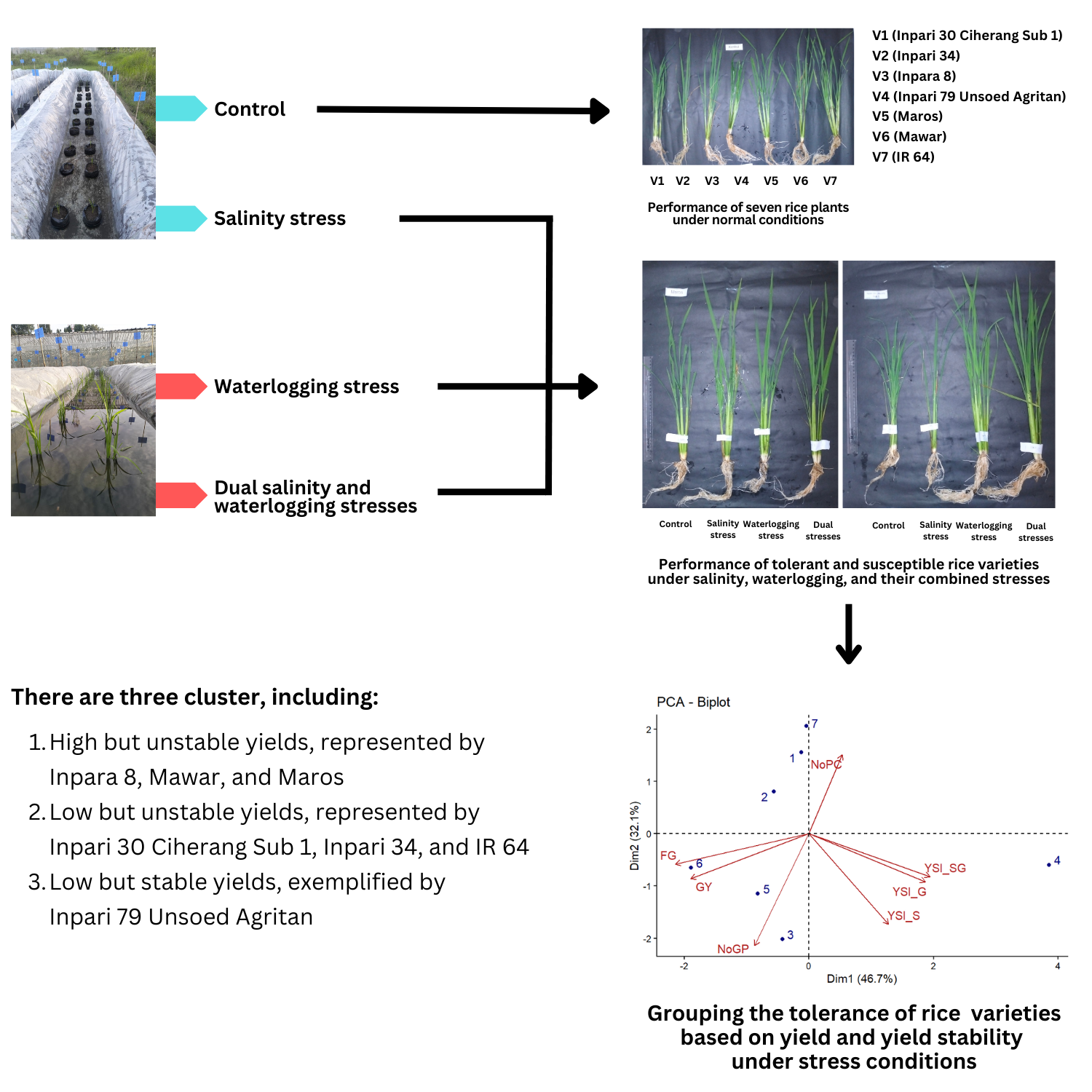
Downloads
References
MI Bhuyan, I Supit, U Kumar, S Mia and F Ludwig. The significance of farmers’ climate change and salinity perceptions for on-farm adaptation strategies in the south-central coast of Bangladesh. Journal of Agriculture and Food Research 2024; 16, 101097.
T Gopalakrishna, MK Hasan, ATMS Haque, SL Jayasinghe and L Kumar. Sustainability of coastal agriculture under climate change. Sustainability 2019; 11(24), 7200.
R Vargas, EI Pankova, SA Balyuk, PV Krasilnikov and GM Khasankhanova. Handbook for saline soil management. Food and Agricultural Organization the United Nations and Lomonosov Moscow State University, Rome, Italy, 2018.
K Liu, K Zhang, Y Zhang, J Cui, Z Li, J Huang, S Li, J Zhang, S Deng, Y Zhang, J Huang, L Ren, Y Chu, H Zhao and H Chen. Optimizing the total spikelets increased grain yield in rice. Agronomy 2024; 14(1), 152.
KT Win, AZ Oo and T Yokoyama. Plant growth and yield response to salinitystress of rice grown under the application of different nitrogen levels and Bacillus pumilus Strain TUAT-1. Crops 2022, 2(4), 435-444.
X Liu, C Xu, P Ji, Q Li, M Zhu, Z Zhang, F Ling and H Wang. Lower nitrogen levels improve growth and some physiological traits of rice (Oryza sativa) under salt stress during reproductive period. International Journal of Agriculture & Biology 2020; 24, 769-776.
PLC Paul, A Jahan, PK Kundu, D Roy, RW Bell, MB Hossain, R Shultana, MRBH Pranto, T Islam, SE Benes and MR Islam. Rice growth and yield responses to saline water irrigation are related to N+/K+ ratio in plants. PLoS One 2024; 19(11), e0312372.
W Taratima, S Chaisuwan, K Plaikhuntod, P Maneerattanarungroj, N Kunpratum and A Trunjaruen. Salinity tolerance evaluation of rice (Oryza sativa L.) “Tubtim Chumphae” seedling and early vegetative stage. Asian Journal of Plant Science 2023; 22(2), 250-259.
SF Hadi and MMA Abdul-Razak. Comparison of the role of growth regulators and its impact on yield and yield components of rice under saline stress. Plant Achieves 2020; 20(2), 2728-2732.
JA Majeed, A Mahmood, S Bibi, A Jabeen, MM Javaid, HB Ahmad and J Nargis. Waterlogging and crop productivity. In: M Hasanuzzaman (Ed.). Climate-resilient agriculture. Springer, Cham, Switzerland, 2023.
Y Chen, J Song, C Yan and X Hong. Effects of submergence stress at the vegetative growth stage on hybrid rice growth and grain yield in China. Chilean Journal of Agricultural Research 2021; 81(2), 191-201.
Y Yu, Y Meng, P Chen and K Cao. Submergence stress reduces the ability of rice to regulate recovery after disaster. Agronomy 2024; 14, 319.
LT Bu, ES Ella, ML Dionisio-Sese and AM Ismail. Morpho-physiological changes in roots of rice seedling upon submergence. Rice Science 2019; 26(3), 167-177.
Y Nugraha, N Hidayatun, T Trisnaningsih, D Yuliani, S Ardiyanti and TS Kadir. Phenotypic performance of Ciherang Sub1 near isogenic line as an adaptive variety for flooding conditions. Indonesian Journal of Agricultural Science 2017; 18(1), 7-16.
BB Saidi, J Hendri, S Suharyon and H Purnama. Adaptation of new rice high yielding varieties on new constructed by sea water intrusion in West Tanjung Jabung District, Jambi. Journal of Tropical Soils 2020; 25(3), 119-126.
P Gautam, B Lal, R Tripathi, M Shahida, MJ Baig, R Raja, S Maharana and AK Nayak. Role of silica and nitrogen interaction in submergence rolerance of rice. Environmental and Experimental Botany 2016; 125, 98-109.
ZM Zulkarnaini, SZ Sakimin, MTM Mohamed and HZE Jaafar. Changes in leaf area, leaf mass ratio, net assimilation rate, relative growth rate and specific lead area 2 cultivars of fig (Ficus carica L.) treated under different concentrations of Brassinolide. AGRIVITA Journal of Agricultural Sciences 2019; 41(1), 158-165.
K Trivedi, D Kubavat, KK Ghara, R Kumar, H Trivedi, KGV Anand, P Maiti and A Ghosh. Evaluation of fertilizer potential of different K compounds prepared utilizing sea bittern as feed stock. Frontiers in Plant Science 2017; 8, 01541.
LS Bates, R Waldren and ID Teare. Rapid determination of free proline for water-stress studies. Plant and Soil 1973; 39, 205-207.
W Skrzypkowski, R Galek, A Adamu and Kiełkowska. Pollen development and sustainability in Vicia faba L. and Lupinus angustifolius L. Agriculture 2023; 13(11), 2065.
GA Gitore, B Danga, S Henga and F Gurmu. Evaluating drought tolerance indices for selection of drought tolerant orange fleshed sweet potato (OFSP) genotypes in Ethiopia. International Journal of Agricultural Science and Food Technology 2021; 7(2), 249-254.
SR Sruthi, NL Kumar, D Kishore, JS Ivin and Y Anbuselvam. Principal component analysis in rice (Oryza sativa L.) varieties for 3 seasons in Annamalai Negar, an east coast region of Tamil Nadu. Plant Science Today, 2024; 11(4), 634-639.
H Lu, K Li, JN Nkoh, X He, R Xu, W Qian, R Shi and Z Hong. Effects of pH variations caused by redox reactions and pH buffering capacity on Cd(II) speciation in paddy soils during submerging/draining alternation. Ecotoxicology and Environmental Safety 2022; 234, 113409.
M Bruneau, J Brendlé, S Pluchon and M Arkoun. Plants and redox potential: iron-rich clay minerals as redox active compounds in soils. Soil Research 2022; 61(3), 241-254.
E Tokarz and D Urban. Soil redox potential and its impact on microorganisms and plants of wetlands. Journal of Ecological Engineering 2015; 16(3), 20-30.
M Akter, H Deroo, AM Kamal, MA Kader, E Verhoeven, C Decock, P Boeckx and S Sleutel. Impact of irrigation management on paddy soil N supply and depth distribution of abiotic drivers. Agriculture, Ecosystems and Environment 2018; 261, 12-24.
K Tiwari, S Tiwari, N Kumar, S Sinha, SL Krishnamurthy, R Singh, S Kalia, NK Singh and V Rai. QTLs and genes for salt stress tolerance: A journey from seed to seed continued. Plants 2024; 13(8), 1099.
T Chen, Y Niu, C Yang, Y Liang and J Xu. Screening of rice (Oryza sativa L.) genotypes for salinity tolerance and dissecting determinants of tolerance mechanism. Plants 2024; 13(4), 1036.
RK Sarkar, K Chakraborty, K Chattopadhyay, S Ray, D Panda and AM Ismail. Responses of rice to individual and combined stresses of flooding and salinity. In: M Hasanuzzaman, M Fujita, K Nahar and JK Biswas (Eds.). Advances in rice research for abiotic stress tolerance. Woodhead Publishing, Cambridge, United Kingdom, 2019, p. 281-297.
S Klinsawang, T Sumraniwanich, A Wannaro and P Saengwilai. Effects of root hair length on potassium acquisition in rice (Oryza sativa L.). Applied Ecology and Environmental Research 2018; 16(2), 1609-1620.
KS Ponce, L Guo, Y Leng, L Men and G Ye. Advances in sensing, response and regulation mechanism of salt tolerance in rice. International Journal of Molecular Science 2021; 22, 2254.
S Garcia-Daga, SJ Roy and M Gilliham. Redefining the role of sodium exclusion within salt tolerance. Trends in Plant Scence 2025; 30(2), 137-146.
C Theerawitaya, T Samphumphuang, R Tisarum, M Siangliw, S Cha-um, T Takabe and T Toojinda. Expression level of Na+ homeostasis-related genes and salt-tolerant abilities in backcross introgression lines of rice crop under salt stress at reproductive stage. Protoplasma 2020; 257, 1595-1606.
M Guo, X Zhang, J Liu, L Hou, H Liu and X Zhao. OsProDH negatively regulates thermotolerance in rice by modulating proline metabolism and reactive oxygen species scavenging. Rice 2020; 13, 61.
YCF Salsinha, RP Puspitawati, YA Purwestri, D Rachmawati, D Indradewa, A Bashri, SD Prastyaningtyas and N Kumalasari. Exogenous-osmoprotectant of Casuarina equisetifolia leaf extract enhancing the root anatomical adaptations of Indonesian local rice under drought. Journal of Crop Science and Biotechnology 2024; 27, 535- 547.
LIR Coca, MTG González, ZG Unday, JJ Hernández, MMR Jáuregui and YF Cancio. Effects of sodium salinity on rice (Oryza sativa L.) cultivation: A review. Sustainability 2023; 15(3), 1804.
Z Lv, W Zhao, S Kong, L Li and S Lin. Overview of molecular mechanisms of plant leaf development: A systematic review. Frontiers in Plant Science 2023; 14, 1293424.
P Gautam, B Lal, A Nayak, R Raja, B Tripathi, M Shahid, U Kumar, M Baig, D Chatterjee and C Swain. Inter-relationship between intercepted radiation and rice yield influenced by transplanting time, method, and variety. International Journal of Biometeorology 2019; 63(3), 337-349.
S Saha, S Puryastha, K Nimitha, S Ganguly, S Das, S Ganguly, NS Mahapatra, K Bhattacarya, D Das, AK Saha, T Biswas, PK Bhattacharyya and S Bhattacharyya. Rice (Oryza sativa) alleviates photosynthesis and yield loss by limiting specific leaf weight under low light intensity. Functional Plant Biology 2023; 50(4), 267-276.
SD Lim, JH Kim, J Lee, SG Hwang, SH Shim, JS Jeon and CS Jang. Role of OsCZMT1 in Na+ and Mg2+ transport and salinity insensitivity. Environmental and Experimental Botany 2022; 194, 104754.
HY Chi, SL Ou, MC Wang and CY Yang. Physiological responses and Ethylene-Response AP2/ERF Factor expression in Indica rice seedlings subjected to submergence and osmotic stress. BMC Plant Biology 2023; 23, 372.
S Kumar, S Basu, AK Choudhary, S Shekhar, JS Mishra, S Kumar, K Shubha, R Dubey, S Mondal, SK Dwivedi, N Bhakta, R Kumar, S Sarkar, S Dhamudia, S Kumari and A Das. Sequential submergence and drought induce yield loss in rice by affecting redox homeostasis and source-to-sink sugar transport. Field Crops Research 2024; 310, 109362.
CQ Duong, AL Bui, TH Le, TT Tran and NN Trinh. Differential biochemical and metabolic responses of contrast rice cultivars (Oryza sativa L.) under salt stress. Acta Agrobotanica 2023; 76, 172513.
NL Ma, WAC Lah, NA Kadir, M Mustaqim, Z Rahmat, A Ahmad, SD Lam and MR Ismail. Susceptibility and tolerance of rice crop to salt threat: Physiological and metabolic inspections. PLoS One 2018; 13(2), e0192732.
C Zheng, C Liu, L Liu, Y Tan, X Sheng, D Yu, Z Sun, X Sun, J Chen, D Yuan and M Duan. Effect of salinity stress on rice yield and grain quality: A meta-analysis. European Journal of Agronomy 2023; 144, 126765.
C Zheng, G Zhou, Z Zhang, W Li, Y Peng and X Xie. Moderate salinity stress reduces rice grain yield by influencing expression of grain number-and grain filling-associated gened. Journal of Plant Growth Regulator 2021; 40, 1111-1120.
Y Zheng, M Li, P Sun, G Gao, Q Zhang, Y Li, G Lou, B Wu and Y He. QTL detection for grain shape and fine mapping of 2 novel locus qGL4 and qGL6 in rice. Molecular Breeding 2024; 44(9), 62.
J Li, F Feng, X Wang, G Xu, Z Luo, J Peng, Q Luo, W Lu and Z Han. High nitrogen input increases the total spikelets but decreases the high-density grain content in hybrid indica rice. Field Crops Research 2022; 288, 108679.
GJD Kirk, A Boghi, MC Affholder, SD Keyes, J Heppel and T Roose. Soil carbon dioxide venting through rice roots. Plant, Cell & Environment 2019; 42(12), 3197-3207.
O Pedersen and M Herzog. The importance of leaf gas films for gas exchange during submergence. In: JI Sakagami and M Nakazono (Eds.). Responses of plants to soil flooding. Springer, Singapore, 2024. p. 89-101.
A Das, S Pal, N Chakraborty, M Hasanuzzaman and MK Adak. Regulation of reactive oxygen species metabolism and oxidative stress signaling by abscisic acid pretreatment in rice (Oryza sativa L.) seedlings through sub1A QTL under salinity. Plant Stress 2024; 11, 100422.
Q Li, P Zhu, X Yu, J Xu and G Liu. Physiological and molecular mechanisms of rice tolerance to salt and drought stress: advances and future directions. International Journal of Molecular Sciences 2024; 25(17), 9404.
S Basu, M Monika, S Kumari and G Kumar. Sub1 QTL confers submergence tolerance in rice through nitro- oxidative regulation and phytohormonal signaling. Plant Physiological and Biochemistry 2024; 211, 108682.
A Fukushima, T Kuroha, K Nagai, Y Hattori, M Kobayashi, T Nishizawa, M Kojima, Y Utsumi, A Oikawa, M Seki, H Sakakibara, K Saito, M Ashikari and M Kusano. Metabolite and phytohormone profilling illustrates metabolic reprogramming as an escape strategy of depewater rice during partially submerged stress. Metabolites 2020; 10(2), 68.
Y Li, W Tu, C Liu, W Liu, G Hu, X Liu, Z Chen and C Yang. Light convertion film promotes CO2 assimilation by increasing cylic electron flow around Photosystem I in Arabidopsis thaliana. International Journal of Hydrogen Energy 2017; 42(12), 8545-8553.
S Liang, W Xiong, C Yin, X Xie, Y Jin, S Zhang, B Yang, G Ye, S Chen and W Luan. Overexpression of OsARD1 improves submergence, drought, and salt tolerances of seedling through the enhancement of ethylene synthesis in rice. Frontiers in Plant Science 2019; 10, 01088.
MEB Gerona, MP Deocampo, JA Egdane, AM Ismail and ML Dionisio-Sese. Physiological responses of contrasting rice genotypes to salt stress at reproductive stage. Rice Science 2019; 26(4), 207-219.
MS Khan and S Hemalatha. Biochemical and molecular changes induced by salinity stress in Oryza sativa L. Acta Physiologiae Plantarum 2016; 38, 167.
T Khare, CS Seth and V Kumar. Sodium stress-induced oxidative damage and antioxidant responses during grain filling in Indica rice. Plant Cell Reports 2024; 43(10), 239.
H Itoh, KC Wada, H Sakai, K Shibasaki, S Fukuoka, J Wu, JI Yonemaru, M Yano and T Izawa. Genomic adaptation of flowering-time genes during the expansion of rice cultivation area. The Plant Journal 2018; 94(5), 895-909.
K Chakraborty, K Chattaopadhyay, L Nayak, S Ray, L Yeasmin, P Jena, S Gupta, SK Mohanty, P Swain and RK Sarkar. Ionic selectivity and coordinated transport of Na+ and K+ in flag leaves render differential salt tolerance in rice at the reproductive stage. Planta 2019; 250, 1637-1653.
Z Jiang, H Yang, M Zhu, L Wu, F Yan, H Qian, W He, D Liu, H Chen, L Chen, Y Ding, S Sakr and G Li. The inferior grain filling initiation promotes the source strength of rice leaves. Rice 2023; 16, 41.
C Wu, K Cui, S Tang, G Li, S Wang, S Fahad, L Nie, J Huang, S Peng and Y Ding. Intensified pollination and fertilization ameliorate heat injury in rice (Oryza sativa L.) during the flowering stage. Field Crops Research 2020; 252, 107795.
M Okamura, Y Arai-Sanoh, H Yoshida, T Mukouyama, S Adachi, S Yabe, H Nakagawa, K Tsutsumi, Y Taniguchi, N Kobayashi and N Kondo. Characterization of high-yielding rice cultivars with different grain-filling properties to clarify limiting factors for improving grain yield. Field Crops Research 2018; 219, 139-147.
J Yang and J Zhang. Simultaneously improving grain yield and water and nutrient use efficiencies by enhancing the harvest index in rice. Crop and Environment 2023; 2(3), 157-164.
N Nasrudin and B Kurniasih. The agro-physiological characteristics of 3 rice varieties affected by water depth in the coastal agricultural land of Yogyakarta, Indonesia. BIODIVERSITAS Journal of Biological Diversity 2021; 22(9), 3656-3662.
Q Zhao, L Zhou, J Liu, X Du, MAU Asad, F Huang, G Pan and F Cheng. Relationship of ROS accumulation and superoxide dismutase isozymes in developing anther with floret fertility of rice under heat stress. Plant Physiology and Biochemistry 2018; 122, 90-101.
L Nayyeripasand, GA Garosi and Ahmadikhah. Selection for salinity tolerance in an international rice collection at vegetative stage. Australian Journal of Crop Science 2019; 13(06), 837-846.
Published
How to Cite
Issue
Section
License
Copyright (c) 2025 Walailak University

This work is licensed under a Creative Commons Attribution-NonCommercial-NoDerivatives 4.0 International License.





