
Morpho-Physiology and Yield Alterations in the Four Chili Varieties (Capsicum annuum L.) in Various Soil Depth Media in Tropical Lowland
DOI:
https://doi.org/10.48048/tis.2025.10372Keywords:
Chili yield, Root morphology, Soil depth, Shoot morphologyAbstract
Chilies (Capsicum annuum L.) cultivated in lowland areas of Indonesia typically exhibit lower yields compared to those grown in highland regions. Chili growth and yield can be optimized by modifying the growing medium. This research aimed to determine the changing morpho-physiology and yield of four chili varieties in various soil depth media planted in tropical lowlands. The factorial treatments were arranged in a completely randomized design with 240 chili plants for 8 combination treatments. The first factor was the chili variety: Kencana, Lembang-1, Tanjung-2, and Ungara. The second factor was the soil depth media, consisting of 25- and 30-cm soil depth media. Data in morpho-physiology and yield were analyzed using factorial analysis of variance (ANOVA) based on a completely randomized design (CRD), followed by an Honestly Significant Difference (HSD) test at a 95% confidence interval. The results showed that the fruit yield in Lembang-1, Tanjung-2, and Ungara responded positively by 15.20%, 7.80%, and 8.11%, respectively, under 30 cm compared to the 25 cm soil depth media. However, the yield in Kencana responded negatively by 8.29%, due to new vegetative growth. In the responsive varieties, enhanced chili yield was related to the improvement of morpho-physiology through increased root length, root surface area, and root:shoot ratio, as well as shoot dry weight and leaf area, total chlorophyll content, net assimilation rate, and relative growth rate of the plant. It was concluded that soil media up to a 30 cm depth is recommended to improve yield in Lembang-1, Tanjung-2, and Ungara, in tropical lowland.
HIGHLIGHTS
Chili plants have a taproot system and grow in tropical lowland, with root lengths ranging from 4,177 to 7,642 cm, depending on the varieties. Therefore, it is important to evaluate the increment of soil depth for chili plant cultivation up to 30 cm to facilitate root development of chili for enhancing chili yield. This research provides information on chili yield and morpho-physiological responses of different soil depth conditions in tropical lowland areas. Results showed that fruit yields of Lembang-1, Tanjung-2, and Ungara increased by 15.20%, 7.80%, and 8.11%, respectively, under 30 cm soil depth compared to 25 cm, unlike in Kencana. The varieties in which the yield improved in response to 30 cm soil depth were related to enhanced root architecture (total root length and root surface area), increased shoot dry weight, leaf area, total chlorophyll content, net assimilation rate, and relative growth rate. Therefore, a soil depth of 30 cm is recommended to improve yield in Lembang-1, Tanjung-2, and Ungara, in tropical lowland areas.
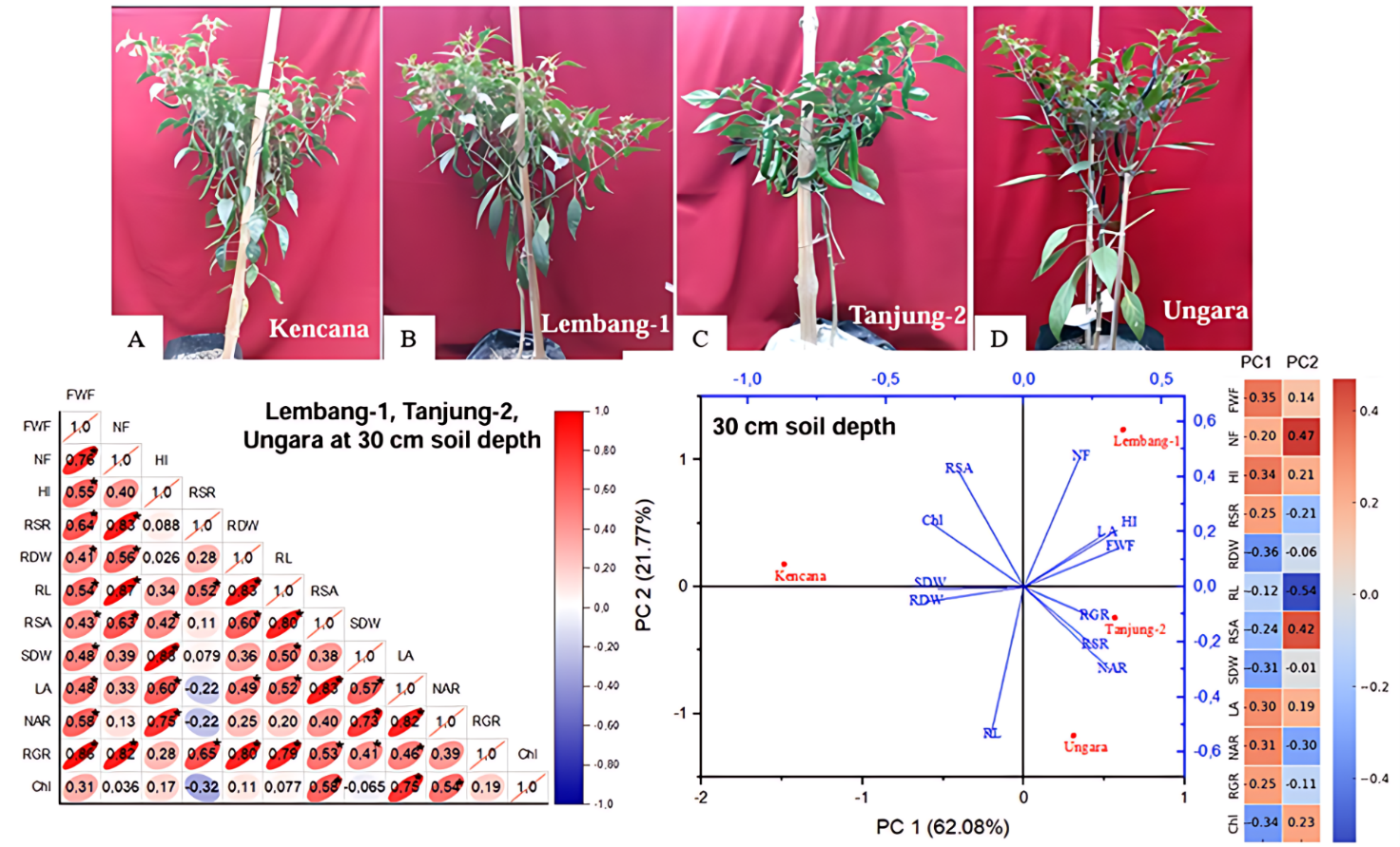
GRAPHICAL ABSTRACT
Downloads
References
AD Irjayanti, AS Wibowo, H Stiyaningsih, IM Putri, OP Gitaningtyas, SK Areka, W Suprapti and Z Nurfalah. Statistics of Horticulture 2022. BPS Statistics Indonesia, Jakarta, Indonesia, 2023.
S Kusumaningrum, E Sulistyaningsih, R Harimurti and K Dewi. Identification of chili varieties (Capsicum annum) tolerance to root cutting based on stress selection indices and morphological traits planted in lowland area. Biodiversitas 2024; 25(5), 2063-2073.
X Zhang, Y Kong, Y Lv, F Yao, Y Cao, X Shao, Y Geng, L Wang and Y Wang. Increased topsoil depth required to support increased grain yield production in high density maize. Field Crops Research 2024; 308(4), 109282.
RFD Silva, EC Severiano, GCD Oliveira, SM Barbosa, DS Peixoto, D Tassinari, BM Silva, SHG Silva, MS Júnior and TAFR Figueiredo. Changes in soil profile hydraulic properties and porosity as affected by deep tillage soil preparation and Brachiaria grass intercropping in a recent coffee plantation on a naturally dense Inceptisol. Soil Tillage Research 2021; 213, 105127.
JL Yost and AE Hartemink. How deep is the soil studied - an analysis of four soil. Plant Soil 2020; 452, 5-18.
RP Azevedo, LM Corinto, DS Peixoto, T De Figueiredo, GCD. Silveira, PM Peche, PS Pio, PH Pagliari, N Curi and BM Silva. Deep tillage strategies in perennial crop installation: Structural changes in contrasting soil classes. Plants 2022; 11(17), 2255.
R Grasso, MT Peña-Fleitas, M Gallardo, RB Thompson and FM Padilla. Tillage effects on soil properties, crop responses and root density of sweet pepper (Capsicum annuum). Spanish Journal of Agricultural Research 2021; 19(2), e0902.
M Yoshimura, K Maezuka and Y Toma. Using surface soil layer depth for determining soil quality index for evaluating productivity of potato (Solanum tuberosum L.) in Hokkaido, Japan. Soil Science Plant Nutrition 2023; 69(1), 1-12.
J Hirzel and I Matus. Effect of soil depth and increasing fertilization rate on yield and its components of two durum wheat varieties. Chillean Journal Agriculture Research 2013; 73(1), 55-59.
X Zhang, Y Kong, YF Yao, Y Cao, X Shao, Y Geng, L Wang and Y Wang. Increased topsoil depth required to support increased grain yield production in high density maize. Field Crops Research 2024; 308(4), 109282.
X Bai, SJ Smidt, Y Fan, T Brophy, YG Her, N Manirakiza, Y Li and JH Bhadha. Farming shallow soils: impacts of soil depth on crop growth in the everglades agricultural area of Florida, USA. Field Crops Research 2024; 316(1), 109523.
CA Spadotto and R Mingoti. Climates, soils, and agriculture in the tropical region. Meio ambiente: Agricultura, desenvolvimento e sustentabilidade 2023. https://doi.org/10.22533/at.ed.3912322062
IS Banuwa, KF Hidayat, I Zulkarnain, P Sanjaya, Afandi and A Rahmat. Soil loss and cassava yield under ridge tillage in humid tropical climate of Sumatra, Indonesia. International Journal of GEOMATE 2020; 18(67), 1-7.
Indonesian Vegetable Research Institute. Standard operational procedure for chili cultivation. Ministry of Agriculture Indonesia, Indonesia, 2014.
N Iftikhar, S Perveen, B Ali, MH Saleem and MK Al-Sadoon. Physiological and biochemical responses of maize (Zea mays L.) cultivars under salinity stress. Turkish Journal of Agriculture and Forestry 2024; 48(3), 1-13.
DL Arnon. Copper enzymes in isolated chloroplasts polyphenoloxidase in Beta vulgaris. Plant Physiology 1949; 24(1), 1-15.
FC Wulansari, E Purwanto, M Rahayu and AT Sakya. The rate of net assimilation and the rate of relative growth of amaranth (Amaranthus tricolor L.) varieties on urea fertilizer application. IOP Conference Series: Earth and Environmental Science 2024; 1362, 012056.
RA Fischer and R Maurerac. Drought resistance in spring wheat cultivars grain yield responses. Australia Journal Agriculture Research 1978; 29(5), 897-912.
AT Sakya, E Sulistyaningsih, BH Purwanto and D Indradewa. Evaluation of zinc efficiency and some of nutritional and physiological responses of tomatoes cultivars. Journal of Plant Nutrition 2023; 46(18), 4420-4437.
HM Schneider, CF Strock, MT Hanlon, DJ Vanhees, AC Perkins, IB Ajmera, JS Sidhu, SJ Mooney, KM Brown and JP Lynch. Multiseriate cortical sclerenchyma enhance root penetration in compacted soils. Proceedings of the National Academy of Sciences of the United States of America 2021; 118(6), e2012087118.
DW Jing, FC Liu, MY Wang, HL Ma, ZY Du, BY Ma and YF Dong. Effects of root pruning on the physicochemical properties and microbial activities of poplar rhizosphere soil. Plos One 2017; 12(11), e0187685.
HW Jeong, HR Lee, JY Kim, GG Kim, CI Na and SJ Hwang. Assessment of growing media and fertigation for production of root pruning splice-grafted cucumber seedlings. Korean Journal of Horticultural Science and Technology 2021; 39(3), 294-304.
M Rieger and P Litvin. Root system hydraulic conductivity in species with contrasting root anatomy. Journal Experiment Botany 1999; 50(331), 201-209.
OA Valdés-Rodríguez and A Pérez-Vázquez. Seedling characteristics of three oily species before and after root pruning and transplant. Plants 2019; 8(8), 258.
RA Sheridan and AS Davis. Characterizing the utility of the root-to-shoot ratio in douglas-fir seedling production. Forests 2021; 12(12), 1745.
M Kulkarni and S Phalke. Evaluating variability of root size system and its constitutive traits in hot pepper (Capsicum annuum L.) under water stress. Scientia Horticulturae 2009; 120(2), 159-166.
T Mašková and T Herben. Root: shoot ratio in developing seedlings: how seedlings change their allocation in response to seed mass and ambient nutrient supply. Ecology and Evolution 2018; 8(14), 7143-7150.
E Sathiyavani, NK Prabaharan and KK Surendar. Role of mineral nutrition on root growth of crop plants - a review. International Journal of Current Microbiology and Applied Sciences 2017; 6(4), 2810-2837.
M Kamran, S Wennan, I Ahmad, M Xiangping, C Wenwen, Z Xudong, M Siwei, A Khan, H Qingfang and L Tiening. Application of paclobutrazol affect maize grain yield by regulating root morphological and physiological characteristics under a semi-arid region. Scientific Reports 2018; 8(1), 4818.
C Wu, Y Bi, W Zhu, C Xue and P Christie. Optimizing water use strategies in arid coal mining areas: the synergistic effects of layered soil profiles and arbuscular mycorrhizal fungi on plant growth and water use efficiency. Environment Experimental Botany 2024; 221, 105722
L Chen, Y Luo, J Tang, X Zhang, H Liu, J Cui, J Zheng and X Dong. Determination of optimum solum thickness of sloping cropland for maize plantation in an entisol based on water use strategy and plant traits. Agriculture Water Management 2024; 299(8), 108867.
HY Dasgan and K Abak. Effects of plant density and number of shoots on yield and fruit characteristics of peppers grown in glasshouses. Turkish Journal of Agriculture and Forestry 2003; 27(1), 29-35.
N Witariadi and K NNC. Productivity of Asystasia gangetica (L) subsp. Micrantha planted in different soil types and levels of shade. International Journal of Fauna and Biological Studies 2024; 11(3), 04-07.
U Musa, U Tanko and H Taiwo. Leaf area determination for maize (Zea mays L), okra (Abelmoschus esculentus L) and cowpea (Vigna unguiculata L) crops using linear measurements. Journal of Biology, Agriculture and Healthcare 2016; 6(4), 103-111.
IZ Kiri, FBJ Sawa, SD Abdul and AM Gani. Effects of phosphorus and zinc on net assimilation rate of cowpea (Vigna unguiculata (L.) Walp) varieties grown in Bauchi, Nigeria. Dutse Journal of Pure and Applied Sciences 2023; 9(2), 209-222.
HB Jumin, M Muslim, I Vebionita and Jekinda. Net assimilation rate and mean relative growth rate of horticulture plants on swamp land under control of organic compounds. Current Journal of Applied Science and Technology 2025; 25(4), e0259673.
B Shipley. Net assimilation rate, specific leaf area and leaf mass ratio: which is most closely correlated with relative growth rate? A meta-analysis. Functional Ecology 2006; 20(4), 565-574.
PS Bindraban, JJ Stoorvogel, DM Jansen, J Vlaming and JJR Groot. Land quality indicators for sustainable land management: Proposed method for yield gap and soil nutrient balance. Agriculture, Ecosystems & Environment 2000; 81(2), 103-112.
J Li, Z Guo and Y Xu. Soil structure and stability features under rotation tillage. IOP Conference Series Earth and Environmental Science 2019; 384(1), 012213.
Y Huang, P Ciais, M Santoro, D Makowski, J Chave, D Schepaschenko, RZ Abramoff, DS Goll, H Yang, Y Chen, W Wei and S Piao. A global map of root biomass across the world’s forests. Earth System Science Data 2021; 13(9), 4263-4274.
M Umar, S Ahmad, ST Haider and S Naz. Effect of pruning to improve yield and fruit quality of ‘Kinnow’ Mandarin plants under high density plantation. Journal of Horticultural Science & Technology 2019; 2(3), 85-89.
I Mado. Analysis of productivity of sloping land with solum shallow for maize plant development. International Journal Current Research Bioscience Plant Biology 2019; 6(1), 29-36.
AC Kusumasari, S Sutoyo, S Jauhari, W Hariyanto, S Sarjana, D Sihombing, W Handayati and B Winarto. Growth-yield performances of two chilli varieties under different agronomical components applied and their partial economic analysis. Agronomy Research 2022; 20(S1), 999-1013.
C Azmi, A Sembiring and H Kurniawan. Yield components and seed attribute of nine varieties of open-pollinated chili. Jurnal Agro 2024; 11(1), 1-15.
Q Sidra, P Chandra, V Aparna and C Rashav. Chapter-15 transport and partitioning of photosynthates. In: Priyanka, SB Naik, CS Choudhary and D Katiyar (Eds.). Text book of agriculture & agroforestry. AkiNik Publications, New Delhi, India, 2023, p. 163-171.
M Uzair, R Kalsoom, KA Attia, I Ali, T Hussain, AM Abushady, H Ali, S Fiaz, S Jameel, MU Hameed, R Iqbal and MR Khan. Understanding the role of thermal stress in modulating growth, yield, and quality attributes of tomato at two locations. Turkish Journal of Agriculture and Forestry 2025; 49(1), 153-168.
S Aryal, P Thapa, S Panth, A Bhatt, B Thapa and B Khanal. Effect of pinching on the growth and yield of chili (Capsicum annuum). Turkish Journal of Food and Agriculture Sciences 2023; 5(2), 106-112.
Published
How to Cite
Issue
Section
License
Copyright (c) 2025 Walailak University

This work is licensed under a Creative Commons Attribution-NonCommercial-NoDerivatives 4.0 International License.





