
Antioxidant Activity of Cocoa Flavored Sterilized Milk Fortified with Whey Protein Hydrolysate Derived from Gastrointestinal Proteinases Digestion
DOI:
https://doi.org/10.48048/tis.2022.5762Keywords:
Flavored milk, Whey protein hydrolysate, Antioxidant activity, Spray dryer, Molecular weight distributionAbstract
The objectives of this work were to study the change in α-amino content and antioxidant activity of whey protein hydrolysate (WPH) using gastrointestinal proteinases (pepsin and pancreatin). In addition, whey protein hydrolysate powder (WPHP) with high antioxidant activity were produced by simulated GI digestion using an in vitro pepsin - pancreatin hydrolysis for supplementation in flavored milk. Whey protein was hydrolyzed with pepsin for 2 h followed by pancreatin for 3 h. WPH was collected to determine the α-amino content and antioxidant activity. The results showed that digested WPH contained higher α-amino content and antioxidant activity than undigested whey. To study optimum temperature, WPH was dried using Spray Dryer at 130, 140, and 150 °C. Results showed that WPHP at 150 °C exhibited the highest antioxidant activity with a major area peak of molecular weight around >12,000 - 990 Da (43.4 %) and 990 - 336 Da (23.7 %). WPHP at 150 °C was selected to supplement in Cocoa flavored sterilized milk (CFSM_WPHP). α-Amino content, antioxidant activity, and microbiological of CFSM_WPHP were investigated. CFSM_WPHP contained higher α-amino content and antioxidant activity than Control (without addition of WPHP). Total plate count, fecal coliform, and E. coli of CFSM_WPHP were under Notification of the Ministry of Public Health of Flavored milk. These results suggested that WPHP has the potential as nutritive and antioxidative supplementation for Cocoa flavored sterilized milk.
HIGHLIGHTS
- Whey protein hydrolysate prepared by pepsin-pancreatin had antioxidant activity
- At 150 ºC was the optimum drying temperature to produce WPH powder
- WPH exhibited the molecular weight around >12,000-990 Da and 990 - 336 Da
- Addition of WPH improved antioxidant activity of Cocoa flavored sterilized milk
- WPH powder exhibited the potential of being used as a functional peptide
GRAPHICAL ABSTRACT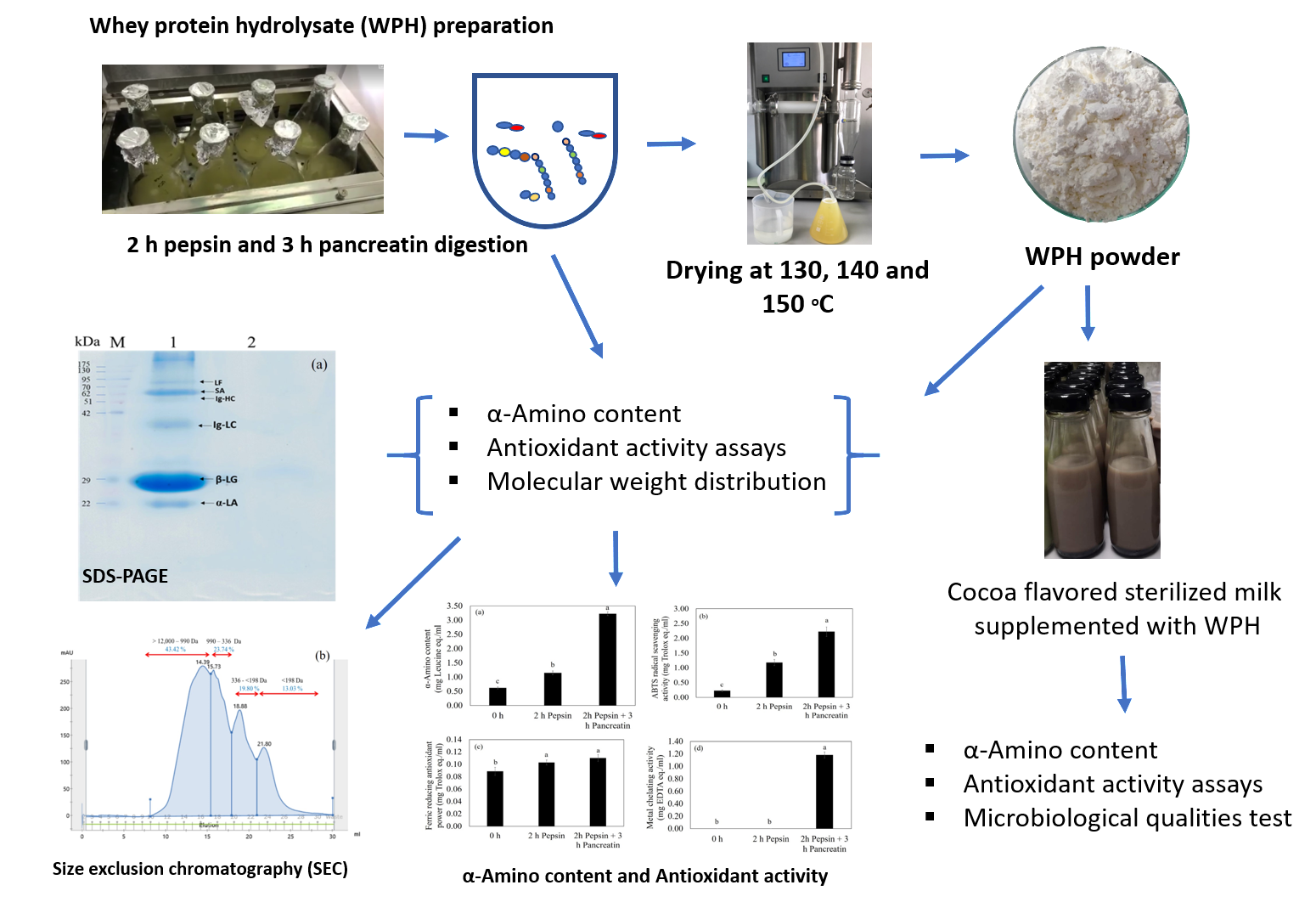
Downloads
References
J Manners and H Craven. MILK | Processing of liquid milk. In: B Caballero, L Trugo, and PM Finglas (Eds.). Encyclopedia of food sciences and nutrition. 2nd eds. Academic Press, San Diego, CA, 2003, p. 3951-57.
RK Sharma. Effect of heat treatment on the nutritive value of milk. Indian Dairyman 1980; 32, 6l9-21.
B Mann, A Kumari, R Kumar, R Sharma, K Prajapati, S Mahboob and S Athira. Antioxidant activity of whey protein hydrolysates in milk beverage system. J. Food Sci. Technol. 2014; 52, 3235-41.
R Sinha, C Radha, J Prakash and P Kaul. Whey protein hydrolysate: Functional properties, nutritional quality, and utilization in beverage formulation. Food Chem. 2007; 101, 1484-91.
A Drya´kova´, A Pihlanto, P Marnila, L Čurda and HJT Korhonen. Antioxidant properties of whey protein hydrolysates as measured by three methods. Eur. Food Res. Technol. 2010; 230, 865-74.
S Embiriekah, M Bulatović, M Borić, D Zarić and M Rakin. Antioxidant activity, functional properties and bioaccessibility of whey protein hydrolysates. Int. J. Dairy Technol. 2017; 71, 243-52.
C Wiriyaphan, H Xiao, EA Decker and J Yongsawatdigul. Chemical and cellular antioxidative properties of threadfin bream (Nemipterus spp.) surimi byproduct hydrolysates fractionated by ultrafiltration. Food Chem. 2015; 167, 7-15.
L You, M Zhao, JM Regenstein and J Ren. Changes in the antioxidant activity of loach (Misgurnus anguillicaudatus) protein hydrolysates during a simulated gastrointestinal digestion. Food Chem. 2010; 120, 810-16.
D Young, F Nau, M Pasco and Y Mine. Identification of hen egg yolk derived phosvitin phosphopeptides and their effects on gene expression profiling against oxidative stress-induced Caco-2 Cells. J. Agric. Food Chem. 2011; 59, 9207-18.
J Adler-Nissen. Determination of the degree of hydrolysis of food protein hydrolyzates by trinitrobenzenesulfonic acid. J. Agric. Food Chem. 1979; 27, 1256-62.
C Wiriyaphan, B Chitsomboon and J Yongsawadigul. Antioxidant activity of protein hydrolysates derived from threadfin bream surimi byproducts. Food Chem. 2012; 132, 104-11.
EA Decker and B Welch. Role of ferritin as a lipid oxidation catalyst in muscle food. J. Agric. Food Chem. 1990; 38, 674-77.
AOAC. Official methods of analysis. 17th eds. Association of Official Chemists, Gaithersberg, Maryland, 2000.
UK Laemmli. Cleavage of structural proteins during the assembly of head of bacteriophage T4. Nature 1970; 227, 680-85.
C Khongla, S Musika and P Sangsawad. Changes in antioxidant activity of fermented fish sauce (Nam Pla-ra) from Osteochilus Hasseltii during fermentation. Suranaree J. Sci. Technol. 2020; 27; 1-8.
L Maturin and JT Peeler. BAM: Aerobic plate count, Available at: https://www.fda.gov/Food/FoodScienceResearch/LaboratoryMethods/ucm063346.htm, accessed August 2020.
P Feng, SD Weagant, MA Grant, W Burkhardt, M Shellfish and B Water. BAM: Enumeration of escherichia coli and the coliform bacteria, Available at: http://www.fda.gov/Food/FoodScience Research/LaboratoryMethods/ucm064948.htm, accessed August 2020.
RJS Castro and H Sato. Comparison and synergistic effects of intact proteins and their hydrolysates on the functional properties and antioxidant activities in a simultaneous process of enzymatic hydrolysis. Food Bioprod. Process. 2014; 92, 80-8.
P Phanturat, S Benjakul, W Visessanguan and S Roytrakul. Use of pyloric caeca extract from bigeye snapper (Priacanthus macracanthus) for the production of gelatin hydrolysate with antioxidative activity. LWT - Food Sci. Technol. 2010; 43, 86-97.
S Raghavan, HG Kristinsson and C Leeuwenburgh. Radical scavenging and reducing ability of tilapia (Oreochromis niloticus) protein hydrolysates. J. Agric. Food Chem. 2008; 56, 10359-67.
BK Simpson. Digestive proteinases from marine animals. In: NM Haard and BK Simpson (Eds.). Seafood enzymes: Utilization and influence on postharvest seafood quality, Marcel Dekker, New York, 2000, p. 531-40.
B Hernández-Ledesma, A Davalos, B Bartolome and L Amigo. Preparation of antioxidant enzymatic hydrolysates from α-lactalbumin and β-lactoglobulin. Identification of active peptides by HPLC-MS/MS. J. Agric. Food Chem. 2005; 53, 588-93.
L Wattanasiritham, C Theerakulkait, S Wickramasekara, CS Maier and JF Stevens. Isolation and identification of antioxidant peptides from enzymatically hydrolyzed rice bran protein. Food Chem. 2016; 192, 156-62.
T Sirisamut. Whey protein: Nutritional and medical benefits. Thai Pharm. Health Sci. J. 2015; 10, 75-80.
C Wiriyaphan, B Chitsomboon, S Roytrakul and J Yongsawadigul. Isolation and identification of antioxidative peptides from hydrolysate of threadfin bream surimi processing byproduct. J. Funct. Foods. 2013; 5, 1654-64.
L Sadat, C Cakir-Kiefer, MA N’Negue, JL Gaillard, JM Girardet and L Miclo. Isolation and identification of antioxidative peptides from bovine α-lactalbumin. Int. Dairy J. 2011; 21, 214-21.
EA Decker, AD Crum and JT Calvert. Differences in the antioxidant mechanism of carnosine in the presence of copper and iron. J. Agric. Food Chem. 1992; 40, 756-59.
JH Zhang, H Zhang, L Wang, XN Guo, XG Wang and HY Yao. Isolation and identification of antioxidative peptides from rice endosperm protein enzymatic hydrolysate by consecutive chromatography and MALDI-TOF/TOF MS/MS. Food Chem. 2010; 119, 226-34.
V Conway, SF Gauthier and Y Pouliot. Antioxidant activities of buttermilk proteins, whey proteins, and their enzymatic hydrolysates. J. Agric. Food Chem. 2013; 61, 364-72.
SV Silva and FX Malcata. Caseins as source of bioactive peptides. Int. Dairy J. 2005; 15, 1-15.
SS Nielsen. Determination of moisture content. In: SS Nielsen (Ed.). Food science texts series: Food analysis laboratory manual. Springer, Boston, Massachusetts, 2010, p. 17-27.
Lesson 22. Manufacture of dried whey, Available at: http://ecoursesonline.iasri. res.in/mod/page/view.php?id=5507, accessed March 2020.
Q Rao, AK Kamdar and TP Labuza. Storage stability of food protein hydrolysates-a review. Crit. Rev. Food Sci. Nutr. 2013; 56, 1169-92.
L Li-jun, Z Chuan-he and Z Zheng. Analyzing molecular weight distribution of whey protein hydrolysates. Food Bioprod. Process. 2008; 86, 1-6.
HL Jang, AM Liceaga and KY Yoon. Purification, characterisation and stability of an antioxidant peptide derived from sandfish (Arctoscopus japonicus) protein hydrolysates. J. Funct. Foods., 2016; 20, 433-42.
H Yuan, H Wang, L Wang, L Chai and C Tian. Nutritional evaluation and functional properties of the antioxidant polypeptide from Zanthoxylum bungeanum Maxim seeds kernel protein hydrolysate. CyTA J. Food 2017; 15, 425-32.
Notification of the Ministry of Public Health (No.351). Flavored milk, Available at: food.fda.moph.go.th/law/data/announ_ moph/V.English/P351_E.pdf, accessed August 2020.
Downloads
Published
How to Cite
Issue
Section
License

This work is licensed under a Creative Commons Attribution-NonCommercial-NoDerivatives 4.0 International License.





