
Restoration of Brain Insulin Signaling by Tinospora crispa Extract via PI3K/AKT Pathway Modulation in HFHF-Fed Rats
DOI:
https://doi.org/10.48048/tis.2026.11597Keywords:
Insulin resistance, Tinospora crispa, PI3K, AKT, HFHF, Insulin resistance, Tinospora crispa, PI3K, AKT, HFHFAbstract
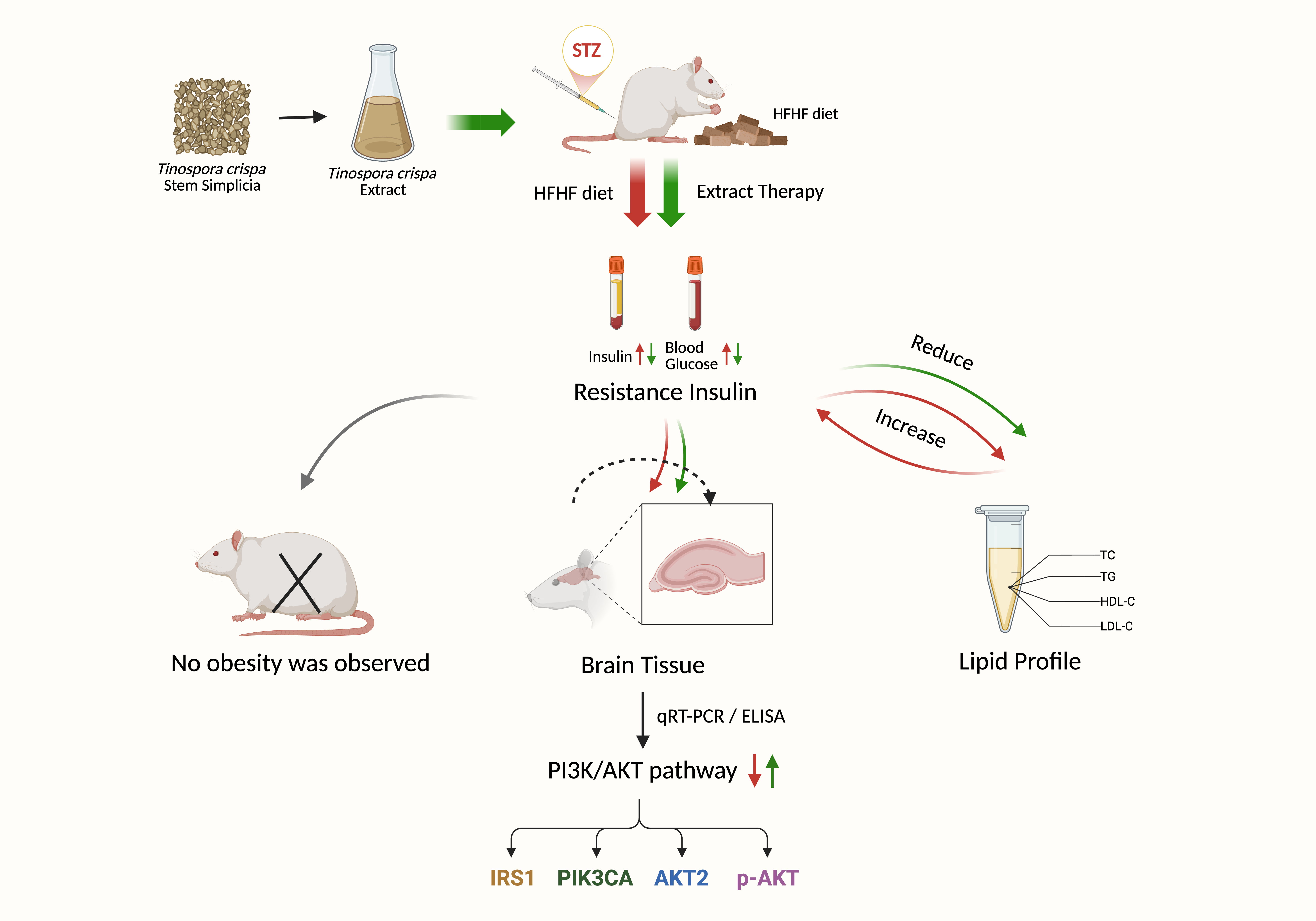
Insulin resistance in the brain contributes to metabolic and neurodegenerative disorders. Existing ones have a limited efficacy and a long-term safety profile for traditional therapy, mainly represented by metformin. Hence, there is an urgent necessity for a safe alternative using plant-based medications. One such candidate, Tinospora crispa (T. crispa), has shown antidiabetic properties, but there is no scientific study focusing on its effectiveness in alleviating brain insulin resistance. This study aims to evaluate the potential of T. crispa for brain insulin resistance via modulation of the PI3K/Akt pathway. Six-week-old Wistar rats were randomly assigned to seven different groups for the study. These included a normal control group (N), a high-fat high-fructose group (HFHF), a group treated with metformin (MET), groups receiving T. crispa extract at doses of 200 mg/kgBW (TC200) and 400 mg/kgBW (TC400) combinations of T. crispa with metformin (TC200MET, TC400MET). The rats were fed a high-fat, high-fructose (HFHF) diet for 16 weeks, with treatments beginning at week 8 after confirming insulin resistance. Body weight, glucose and insulin levels were measured at week 0, 8 and 16. Lipid profiles were assessed using colorimetry, whilebrain PI3K/Akt expressions were measured using qRT-PCR. Both were conducted at the end of the study. Results shows that A 16-week HFHF diet did not affect body weight or induce obesity in mice but led to insulin resistance, elevated fasting blood glucose and altered lipid profiles. Treatment with T. crispa extract or its combination with metformin improved insulin resistance, glucose homeostasis and lipid levels. Notably, increased expression of IRS, PI3K and AKT was observed only in the TC400 and TC400MET groups. These findings suggest that T. crispa extract exhibits neuroprotective effects as an insulin sensitizer via the PI3K/Akt pathway, both as a monotherapy and in combination with metformin.
HIGHLIGHTS
- The high consumption of fast food and high-sugar beverages, which disrupts sugar homeostasis, can also cause brain damage.
- Metformin, a blood sugar-lowering drug recently studied for its beneficial effects on brain function due to insulin resistance, can cause numerous side effects.
- Alternative plant-based drugs are needed as a substitute or adjuvant for metformin that can improve blood sugar levels, insulin resistance and mainly, the brain, which is still rarely studied.
- Unlike previous studies that primarily investigated Tinospora crispa in the context of peripheral glucose regulation, this work is the first to demonstrate its potential in reversing brain insulin resistance through restoration of PI3K/Akt signaling.
GRAPHICAL ABSTRACT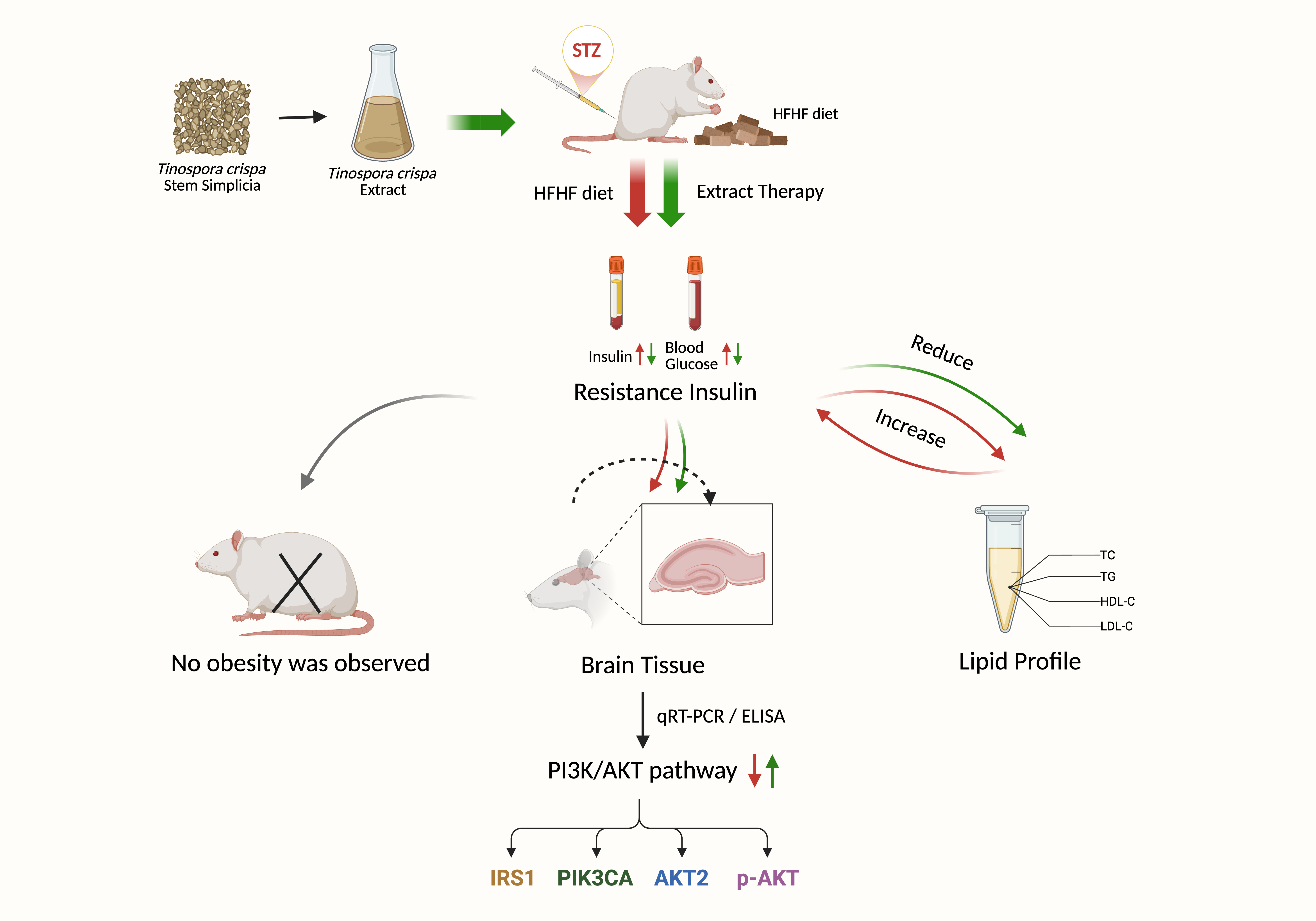
Downloads
References
YK Chen, TT Liu, FKF Teia and MZ Xie. Exploring the underlying mechanisms of obesity and diabetes and the potential of traditional chinese medicine: An overview of the literature. Frontiers in Endocrinology 2023; 14, 1218880.
SK Ahmed and RA Mohammed. Obesity: Prevalence, causes, consequences, management, preventive strategies and future research directions. Metabolism Open 2025; 27, 100375.
MS Ellulu and H Samouda. Clinical and biological risk factors associated with inflammation in patients with type 2 diabetes mellitus. BMC Endocrine Disorders 2022; 22(1), 16.
P Arya. Risk factors of diabetes. Journal of Diabetes Medication & Care 2023; 6(3), 61-66.
R Hegazi, M El-Gamal, N Abdel-Hady and O Hamdy. Epidemiology of and risk factors for type 2 diabetes in egypt. Annals of Global Health 2015; 81(6), 814-820.
CJ Bailey. Metformin: Therapeutic profile in the treatment of type 2 diabetes. Diabetes, Obesity & Metabolism 2024; 26(S3), 3-19.
CT Roberts, N Raabe, L Wiegand, AK Shahib and M Rastegar. Diverse applications of the anti-diabetic drug metformin in treating human disease. Pharmaceuticals 2024; 17(12), 1601.
M Zheng and P Wang. Role of insulin receptor substance-1 modulating PI3K/Akt insulin signaling pathway in alzheimer’s disease. 3 Biotech 2021; 11(4), 179.
H Takemori, A Hamamoto, K Isogawa, M Ito, M Takagi, H Morino, T Miura, K Oshida and T Shibata. Mouse model of metformin-induced diarrhea. BMJ Open Diabetes Research & Care 2020; 8(1), e000898.
K Subramaniam, MP Joseph and LA Babu. A Common drug causing a common side effect at an uncommon time: Metformin-induced chronic diarrhea and weight loss after years of treatment. Clinical Diabetes : a Publication of the American Diabetes Association 2021; 39(2), 237-240.
T Congiu, M Alghrably, AH Emwas, L Jaremko, JI Lachowicz, M Piludu, M Piras, G Faa, G Pichiri, M Jaremko and P Coni. Undercover toxic ménage à trois of amylin, copper (II) and metformin in human embryonic kidney cells. Pharmaceutics 2021; 13(6), 830.
L Sun, Y Wu, J Chen, J Zhong, F Zeng and S Wu. A turn-on optoacoustic probe for imaging metformin-induced upregulation of hepatic hydrogen sulfide and subsequent liver injury. Theranostics 2019; 9(1), 77-89.
I Szymczak-Pajor, J Drzewoski, S Wenclewska and A Śliwińska. Metformin-Associated gastrointestinal adverse events are reduced by probiotics: A meta-analysis. Pharmaceuticals 2024; 17(7), 898.
K Nabrdalik, M Hendel, K Irlik, H Kwiendacz1, I Łoniewski, T Bucci, U Alam, GYH Lip, J Gumprecht and K Skonieczna‑Żydecka. Gastrointestinal adverse events of metformin treatment in patients with type 2 diabetes mellitus: A systematic review and meta-analysis with meta-regression of observational studies. BMC Endocrine Disorders 2024; 24(1), 206.
UM Zuhri, ND Yuliana, F Fadilah, L Erlina, EH Purwaningsih and A Khatib. Exploration of the main active metabolites from Tinospora crispa (L.) Hook. f. & Thomson stem as insulin sensitizer in L6.C11 skeletal muscle cell by integrating in vitro, metabolomics, and molecular docking. Journal of Ethnopharmacology 2024; 319(P3), 117296.
FH Arifah, AE Nugroho, A Rohman and W Sujarwo. A bibliometric analysis to preclinical studies of Tinospora Crispa (L.) Hook. F. & Thomson as an antidiabetic. Indonesian Journal of Pharmacy. 2023; 34(1), 24-35.
Y Xu, , Y Niu, Y Gao, F Wang, W Qin, Y Lu, J Hu, L Peng, J Liu and W Xiong. Borapetoside E, a clerodane diterpenoid extracted from tinospora crispa, improves hyperglycemia and hyperlipidemia in high-fat-diet-induced type 2 diabetes mice. Journal of Natural Products 2017; 80(8), 2319-2327.
UM Zuhri, EH Purwaningsih, F Fadilah and ND Yuliana. Network pharmacology integrated molecular dynamics reveals the bioactive compounds and potential targets of Tinospora crispa Linn. as insulin sensitizer. PLoS One 2022; 17(6), e0251837.
DGB Krisnamurti, FAG Sinuraya, TE Firsty, RW Hakim and EH Purwaningsih. Uric acid and glucose level in high fructose high cholesterol induced sprague-dawley rats after therapy with acalypha indica linn. ethanol extract. AIP Conference Proceedings 2019; 2193, 030014.
S Gunawan, E Munika, ET Wulandari, F Ferdinal, EH Purwaningsih, PE Wuyun, M Louisa and V Soetikno. 6-Gingerol ameliorates weight gain and insulin resistance in metabolic syndrome rats by regulating adipocytokines. Saudi Pharmaceutical Journal 2023; 31(3), 351-358.
BK Koo. Metformin preserves peripheral nerve damage with comparable effects to alpha lipoic acid in streptozotocin/high-fat diet induced diabetic rats. Diabetes & Metabolism Journal 2021; 45(1), 125-126.
MA Mobasher, HG El-Tantawi and KS El-Said. Metformin ameliorates oxidative stress induced by diabetes mellitus and hepatocellular carcinoma in rats. Reports of Biochemistry & Molecular Biology 2020; 9(1), 115-128.
HMF Mohammad, SG Gouda, MA Eladl, AY Elkazaz, KS Elbayoumi, NE Farag, A Elshormilisy, BB Al-Ammash, A Hegazym, SM Abdelkhalig, AS Mohamed, M El-Dosoky and SA Zaitone. Metformin suppresses LRG1 and TGFβ1/ALK1-induced angiogenesis and protects against ultrastructural changes in rat diabetic nephropathy. Biomedicine & Pharmacotherapy 2023; 158, 114128.
S Firdausa, MM Cho, KM Maung, N Aung, N Kuzaifah S Suryawati. The blood glucose lowering effect of malaysian Tinospora crispa in rats. Jurnal Natural 2020; 20(1), 20-23.
W Ahmad, I Jantan, E Kumolosasi and SNA Bukhari. Immunostimulatory effects of the standardized extract of Tinospora crispa on innate immune responses in wistar kyoto rats. Drug Design, Development and Therapy 2015; 9, 296-2973.
S Akieda-Asai, H Ma, W Han, J Nagata, F Yamaguchi and Y Date. Mechanism of muscle atrophy in a normal-weight rat model of type 2 diabetes established by using a soft-pellet diet. Scientific Reports 2024; 14(1), 7670.
F Yamaguchi, S Akieda-Asai, E Nakamura, H Uchida, A Yamashita and Y Date. Continuous exposure of nonobese adult male rats to a soft-textured, readily absorbable diet induces insulin resistance and derangements in hepatic glucose and lipid metabolism. The Journal of Nutrition 2025; 155(5), 1387-1397.
S Swaminathan, Elanthendral, TKD Edward and MJ Abirami. Diagnostic Usefulness of HOMA-β and HOMA-IR in Diabetes Mellitus - A Review. International Journal of Pharmaceutical Research & Allied Sciences 2019; 8(1), 17-24.
LC Antunes, JL Elkfury, MN Jornada, KC Foletto and MC Bertoluci. Validation of HOMA-IR in a model of insulin-resistance induced by a high-fat diet in Wistar rats. Archives of Endocrinology and Metabolism 2016; 60(2), 138-142.
CPD Kottaisamy, DS Raj, VP Kumar and U Sankaran. Experimental animal models for diabetes and its related complications: A review. Laboratory Animal Research 2021; 37(1), 23.
R Singh, M Gholipourmalekabadi and SH Shafikhani. Animal models for type 1 and type 2 diabetes: Advantages and limitations. Frontiers in Endocrinology 2024; 15, 1359685.
T Chukir, L Mandel, BG Tchangc, NA Al-Mullad, LI Igelc, RB Kumarc, J Waitmanc, LJ Aronne and AP Shukla. Metformin-induced weight loss in patients with or without type 2 diabetes/prediabetes: A retrospective cohort study. Obesity Research & Clinical Practice 2021; 15(1), 64-68.
NT Shurrab and ESA Arafa. Metformin: A review of its therapeutic efficacy and adverse effects. Obesity Medicine 2020; 17, 100186.
R Ray, AU Haq, R Chaudhry, S Burra, A Batool, MD Masmoum and I Ullah. Efficacy of metformin in weight management and glycemic control in type 2 diabetes: An updated systematic review and meta-analysis. Journal of Advances in Medicine and Medical Research 2024; 36(9), 225-239.
CT Ruan, SH Lam, TC Chi, SS Lee and MJ Su. Borapetoside C from Tinospora crispa improves insulin sensitivity in diabetic mice. Phytomedicine 2012; 19(8-9), 719-724.
E Haque, MS Bari, L Khandokar, J Anjum, I Jantan, V Seide and MA Haque. An updated and comprehensive review on the ethnomedicinal uses, phytochemistry, pharmacological activity and toxicological profile of Tinospora crispa (L.) Hook. f. & Thomson. Phytochemistry reviews : Proceedings of the Phytochemical Society of Europe 2023; 22(1), 211-273.
ZM Shah, MKN Hasan, SM Arshad, KKA Kadir, IS Kamarazaman, Z Amom, RM Ali and DJ Arapoc. Effects of Tinospora crispa aqueous extract in regulating cholesterol metabolism in human hepatoma cancer cell line (Hep G2). Journal of Medicinal Plants Research 2017; 11(43), 673-682.
V Kothari, Y Luo, T Tornabene, AM O’Neill, MW Greene, T Geetha and JR Babu. High fat diet induces brain insulin resistance and cognitive impairment in mice. Biochim. Biochimica et Biophysica Acta (BBA) - Molecular Basis of Disease 2017; 1863(2), 499-508.
RR Castillejo, LA Ticona, A Macho-González, A Bocanegra, A Garcimartín, M Hernández-Martín, A Parfenova, S Bastida, L García-García, ME López-Oliva, FJ Sánchez-Muniz and J Benedí. Silicon-enriched meat consumption mitigates brain cortex damage associated with diabetic dyslipidemia in a late-stage type 2 diabetes mellitus rat model. Redox Biology 2025; 85, 103697.
J Sripetchwandee, N Chattipakorn and SC Chattipakorn. Links between obesity-induced brain insulin resistance, brain mitochondrial dysfunction and dementia. Frontiers in Endocrinology 2018; 9, 496.
Published
How to Cite
Issue
Section
License
Copyright (c) 2025 Walailak University

This work is licensed under a Creative Commons Attribution-NonCommercial-NoDerivatives 4.0 International License.





