
Effects of Phycocyanin on Oxidative Stress in The Brain of Prolonged Strenuous Exercise Rats
DOI:
https://doi.org/10.48048/tis.2025.9967Keywords:
Phycocyanin, Oxidative stress, Antioxidant, Overexercise, Hippocampus, Amygdala, Prefrontal cortexAbstract
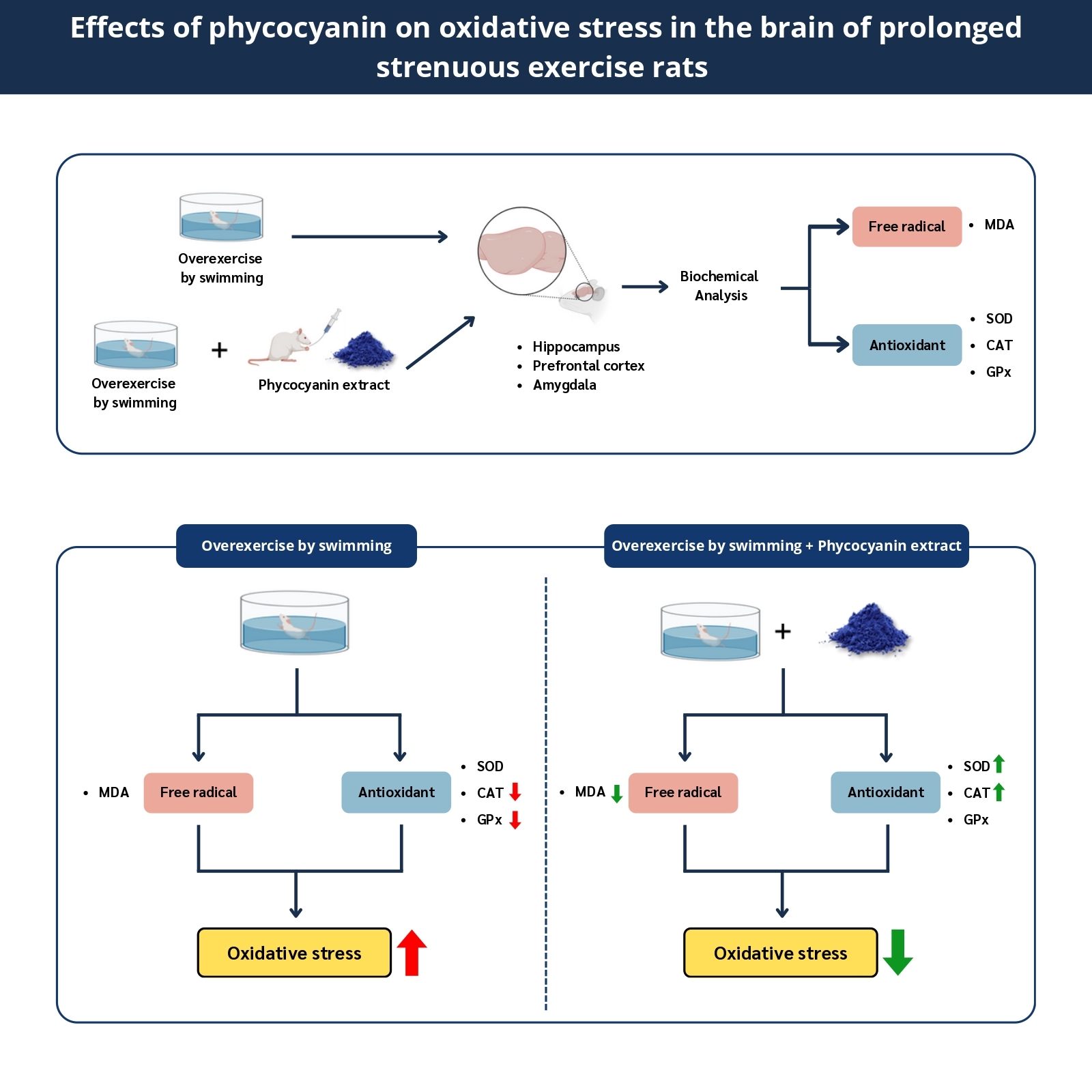
Excessive exercise can lead to oxidative stress which can negatively affect the nervous system. Phycocyanin, a pigment in blue-green algae like spirulina, has potent antioxidant properties that help neutralize free radicals and reduce oxidative stress. This study examined the effects of phycocyanin on oxidative stress in the rat brain induced by prolonged strenuous exercise. The male Sprague-Dawley rats were divided into 5 groups: Control group, exercise group, exercise with low (100 mg/kg BW) or high (200 mg/kg BW) doses of phycocyanin or vitamin C (200 mg/kg BW). After the 8th week of experiment, brain tissue was collected to analyze malondialdehyde levels (MDA) and antioxidant activity in the prefrontal cortex, hippocampus, and amygdala. The results show that excessive exercise tends to increase MDA levels and decrease superoxide dismutase (SOD) levels, although these changes are not statistically significant. However, excessive exercise significantly reduces the antioxidant enzymes catalase (CAT) and glutathione peroxidase (GPx), which may contribute to oxidative stress. Phycocyanin, on the other hand, enhances the antioxidant activity of SOD and CAT, both of which play a critical role in mitigating oxidative damage. Interestingly, phycocyanin does not appear to significantly affect GPx levels. This suggests that phycocyanin may selectively target specific antioxidant pathways while leaving others unaffected.
HIGHLIGHTS
- Prolonged strenuous exercise exhibited a significant decrease in CAT and GPx activity in the prefrontal cortex, hippocampus, and amygdala.
- Phycocyanin decrease free radical levels and may help mitigate lipid peroxidation in the rat brain.
- Phycocyanin enhance antioxidant activity.
- Phycocyanin attenuated oxidative stress in the brain of prolonged strenuous exercise.
GRAPHICAL ABSTRACT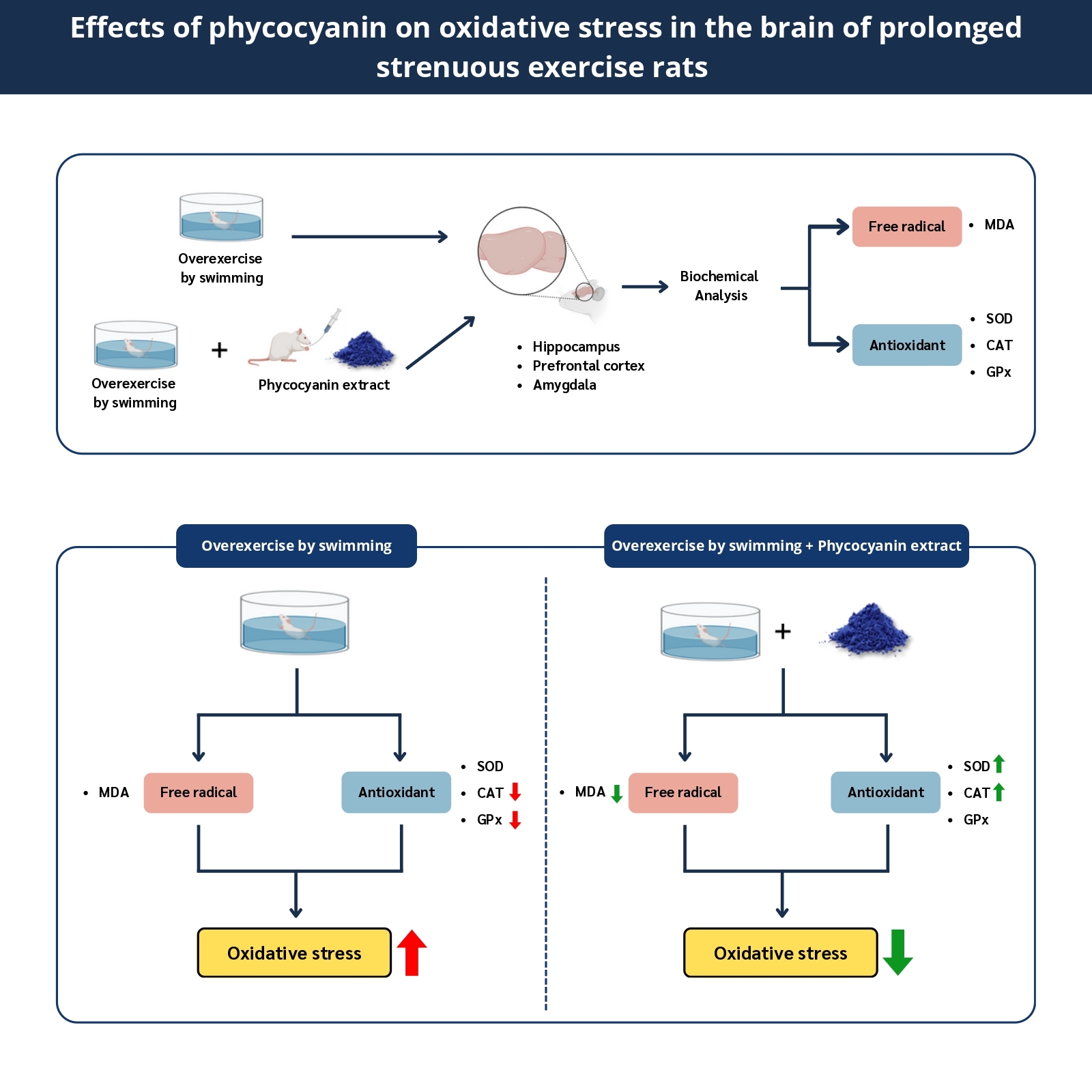
Downloads
References
AM Newsome, R Reed, J Sansone, A Batrakoulis, C Mcavoy and MW Parrott. 2024 ACSM worldwide fitness trends: Future directions of the health and fitness industry. ACSM’s Health & Fitness Journal 2024; 28(1), 14-26.
TMD Santos, J Kolling, C Siebert, H Biasibetti, CG Berto, LK Grun, C Dalmaz, FM Barbe-Tuana and ATS Wyse. Effects of previous physical exercise to chronic stress on long-term aversive memory and oxidative stress in amygdala and hippocampus of rats. International Journal of Developmental Neuroscience 2017; 56, 58-67.
N Moradi-Kor, M Dadkhah, A Ghanbari, H Rashidipour, AR Bandegi, M Barati, P Kokhaei and A Rashidy-Pour. Protective effects of Spirulina platensis, voluntary exercise and environmental interventions against adolescent stress-induced anxiety and depressive-like symptoms, oxidative stress and alterations of BDNF and 5HT-3 receptors of the prefrontal cortex in female rats. Neuropsychiatric Disease and Treatment 2020; 16, 1777-1794.
SM Somani, R Ravi and LP Rybak. Effect of exercise training on antioxidant system in brain regions of rat. Pharmacology Biochemistry and Behavior 1995; 50(4), 635-639.
Z Jahangiri, Z Gholamnezhad, MM Hosseini, F Beheshti and F Beheshti. The effects of moderate exercise and overtraining on learning and memory, hippocampal inflammatory cytokine levels, and brain oxidative stress markers in rats. The Journal of Physiological Sciences 2019; 69(6), 993-1004.
C Simioni, G Zauli, AM Martelli, M Vitale, G Sacchetti, A Gonelli and LM Neri. Oxidative stress: Role of physical exercise and antioxidant nutraceuticals in adulthood and aging. Oncotarget 2018; 9(24), 17181-17198.
S Mitra, WA Siddiqui and S Khandelwal. C-Phycocyanin protects against acute tributyltin chloride neurotoxicity by modulating glial cell activity along with its anti-oxidant and anti-inflammatory property: A comparative efficacy evaluation with N-acetyl cysteine in adult rat brain. Chemico-Biological Interactions 2015; 238, 138-150.
A Patel, S Mishra and PK Ghosh. Antioxidant potential of C-phycocyanin isolated from cyanobacterial species Lyngbya, Phormidium and Spirulina spp. Indian Journal of Biochemistry and Biophysics 2006; 43(1), 25-31.
G Penton-Rol, JM Prida, GL Pardo-Andreu, G Martinez-Sanchez, EF Acosta-Medina, A Valdivia-Acosta, N Lagumersindez, ER Jimenez, A Llopiz-Arzuaga, PA Lopez-Saura, G Guillen and E Penton-Arias. C-Phycocyanin is neuroprotective against global cerebral ischemia/reperfusion injury in gerbils. Brain Research Bulletin 2011; 86(1-2), 42-52.
A Bennett and L Bogorad. Complementary chromatic adaptation in a filamentous blue-green alga. Journal of Cell Biology 1973; 58(2), 419-435.
S Puengpan, A Phetrungnapha, S Sattayakawee and S Tunsophon. Phycocyanin attenuates skeletal muscle damage and fatigue via modulation of Nrf2 and IRS-1/AKT/mTOR pathway in exercise-induced oxidative stress in rats. PLoS One 2024; 19(9), 0310138.
DK Kwon, KH Hwang, YK Kim, KH Lee and YJ Song. Effects of swimming exercise and soybean supplementation on the immune functions of rats fed a high-fat diet. Clinical and Experimental Pharmacology and Physiology 2008; 35(5-6), 638-642.
Q Li, X Tuo, B Li, Z Deng, Y Qiu and H Xie Semaglutide attenuates excessive exercise-induced myocardial injury through inhibiting oxidative stress and inflammation in rats. Life Sciences 2020; 250, 117531.
FD Lima, DN Stamm, ID Della-Pace, F Dobrachinski, NRD Carvalho, LFF Royes, FA Soares, JB Rocha, J Gonzalez-Gallego and G Bresciani. Swimming training induces liver mitochondrial adaptations to oxidative stress in rats submitted to repeated exhaustive swimming bouts. PLoS One 2013; 8(2), 55668.
H Ogonovszky, M Sasvari, A Dosek, I Berkes, T Kaneko, S Tahara, H Nakamoto, S Goto and Z Radak. The effects of moderate, strenuous, and overtraining on oxidative stress markers and DNA repair in rat liver. Canadian Journal of Applied Physiology 2005; 30(2), 186-195.
T Phothi, S Tunsophon, W Tiyaboonchai and O Khongsombat. Effects of curcumin and γ-oryzanol solid dispersion on the brain of middle-aged rats. Biomedical Reports 2022; 17(1), 59.
PK Smith, RI Krohn, GT Hermanson, AK Mallia, FH Gartner, MD Provenzano, EK Fujimoto, NM Goeke, BJ Olson and DC Klenk. Measurement of protein using bicinchoninic acid. Analytical Biochemistry 1985; 150(1), 76-85.
] Z Radak, AW Taylor, H Ohno and S Goto. Adaptation to exercise-induced oxidative stress: From muscle to brain. Exercise Immunology Review 2001; 7, 90-107.
J Liu, HC Yeo, E Overvik-Douki, T Hagen, SJ Doniger, DW Chu, GA Brooks and BN Ames. Chronically and acutely exercised rats: Biomarkers of oxidative stress and endogenous antioxidants. Journal of Applied Physiology 2000; 89(1), 21-28.
SM Somani, R Ravi and LP Rybak. Effect of exercise training on antioxidant system in brain regions of rat. Pharmacology Biochemistry and Behavior 1995; 50(4), 635-639.
I Aksu, A Topcu, UM Camsari and O Acikgoz. Effect of acute and chronic exercise on oxidant-antioxidant equilibrium in rat hippocampus, prefrontal cortex and striatum. Neuroscience Letters 2009; 452(3), 281-285.
K Husain and SM Somani. Influence of exercise and ethanol on cholinesterase activity and lipid peroxidation in blood and brain regions of rat. Progress in Neuro-Psychopharmacology and Biological Psychiatry 1997; 21(4), 659-670.
Y Ye, H Lin, M Wan, P Qiu, R Xia, J He, J Tao, L Chen and G Zheng. The effects of aerobic exercise on oxidative stress in older adults: A systematic review and meta-analysis. Frontiers in Physiology 2021; 12, 701151.
RH Lambertucci, AC Levada-Pires, LV Rossoni, R Curi and TC Pithon-Curi. Effects of aerobic exercise training on antioxidant enzyme activities and mRNA levels in soleus muscle from young and aged rats. Mechanisms of Ageing and Development 2007; 128(3), 267-275.
M Wiecek, J Szymura, M Maciejczyk, M Kantorowicz and Z Szygula. Anaerobic exercise-induced activation of antioxidant enzymes in the blood of women and men. Frontiers in Physiology 2018; 9, 1006.
H Shirvani, J Aslani, ZF Mohammadi and E Arabzadeh. Short-term effect of low-, moderate-, and high-intensity exercise training on cerebral dopamine neurotrophic factor (CDNF) and oxidative stress biomarkers in brain male Wistar rats. Comparative Clinical Pathology 2019; 28(2), 369-376.
S Wang, Y Zhou, Y Wu, Y Lang, Y Mao, G Pan and Z Gao. Long-term aerobic exercise improves learning memory capacity and effects on oxidative stress levels and Keap1/Nrf2/GPX4 pathway in the hippocampus of APP/PS1 mice. Frontiers in Neuroscience 2024; 18, 1505650.
R Liu, S Qin and W Li. Phycocyanin: Anti-inflammatory effect and mechanism. Biomedicine & Pharmacotherapy 2022; 153, 113362.
S Hao, F Li, Q Li, Q Yang and W Zhang. Phycocyanin protects against high glucose high fat diet induced diabetes in mice and participates in AKT and AMPK signaling. Foods 2022; 11(20), 3183.
M Agrawal, S Bansal and K Chopra. Evaluation of the in vitro and in vivo antioxidant potentials of food grade phycocyanin. Journal of Food Science and Technology 2021; 58(11), 4382-4390.
G Yun-liang, D Xiao-jie, S Feng and W Chao. Neuroprotective effects and mechanism of phycocyanin in cerebral ischemia reperfusion injury in rats. Chinese Journal of Marine Drugs 2000; 6, 20-25.
R Fernandes, J Campos, M Serra, J Fidalgo, H Almeida, A Casas, D Toubarro and AIRNA Barros. Exploring the benefits of phycocyanin: From spirulina cultivation to its widespread applications. Pharmaceuticals (Basel) 2023; 16(4), 592.
B Fernandez-Rojas, J Hernandez-Juarez and J Pedraza-Chaverri. Nutraceutical properties of phycocyanin. Journal of Functional Foods 2014; 11(5), 375-392.
T Trotta, C Porro, A Cianciulli and MA Panaro. Beneficial effects of spirulina consumption on brain health. Nutrients 2022; 14(3), 676.
J Riss, K Decorde, T Sutra, M Delage, JC Baccou, N Jouy, JP Brune, H Oreal, JP Cristol and JM Rouanet. Phycobiliprotein C-phycocyanin from spirulina platensis is powerfully responsible for reducing oxidative stress and nadph oxidase expression induced by an atherogenic diet in hamsters. Journal of Agricultural and Food Chemistry 2007; 55(19), 7962-7967.
Published
How to Cite
Issue
Section
License
Copyright (c) 2025 Walailak University

This work is licensed under a Creative Commons Attribution-NonCommercial-NoDerivatives 4.0 International License.





