
Hypolipidemic Potential of Roselle Calyces (Hibiscus sabdariffa) Extracts and Passion Fruit (Passiflora edulis) Juice with Pulp Concentrate Formulations in High Fat Diet-Fed Rats
DOI:
https://doi.org/10.48048/tis.2025.10773Keywords:
Hypolipidemia, Roselle calyces extract, Passion fruit, ObesityAbstract
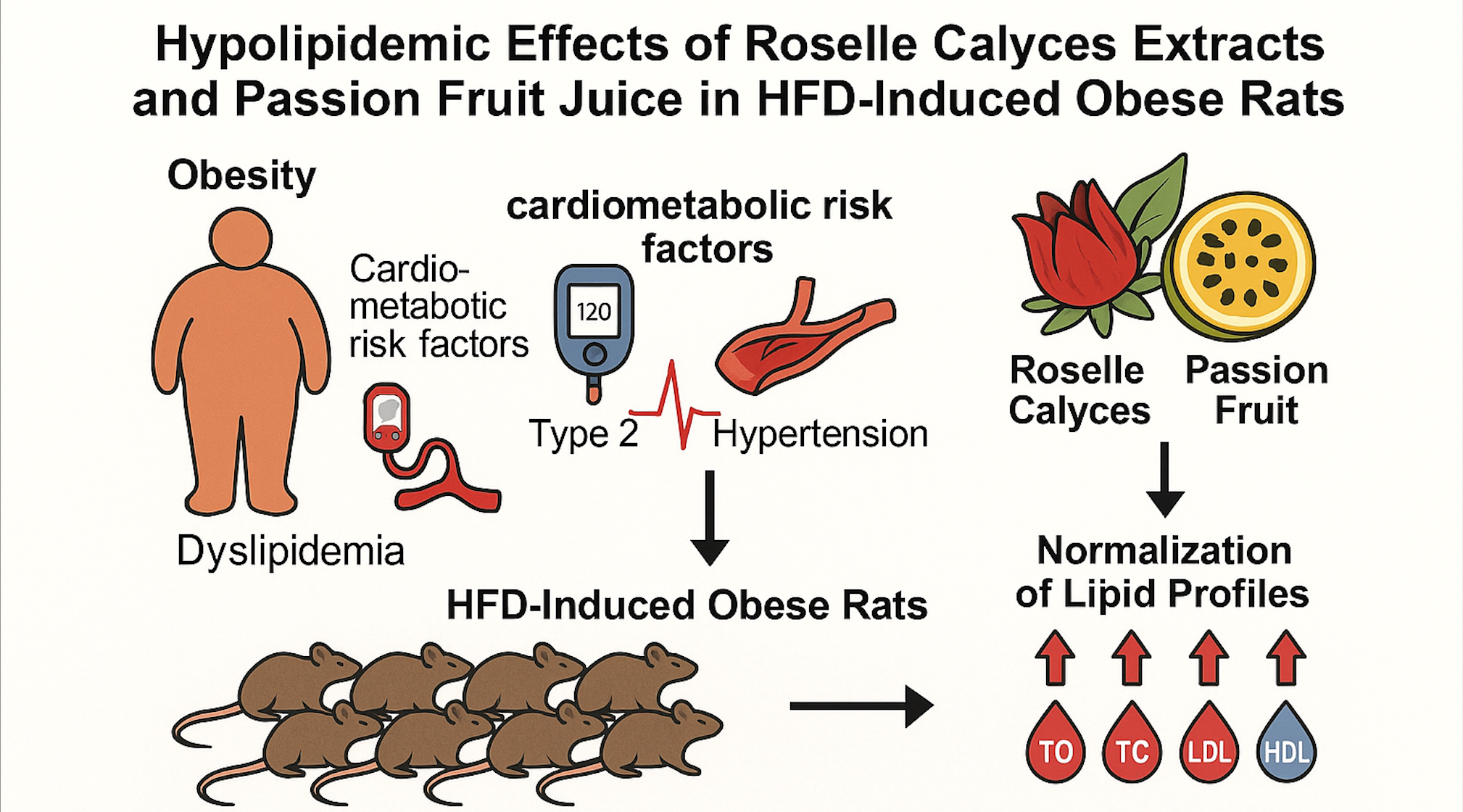
Obesity contributes to cardiometabolic risk factors, including type 2 diabetes mellitus, hypertension, and dyslipidemia. In this study, we aimed to investigate the hypolipidemic potential of various formulations of Roselle Calyces (Hibiscus sabdariffa) extracts and Passion Fruit (Passiflora edulis) juice with pulp concentrate on high-fat diet (HFD) induced obese rats. Male Sprague Dawley rats were divided into seven groups: (1) control group, (2) HFD group, (3) HFD treated with passion fruit juice with pulp concentrate group, (4) HFD treated with roselle calyces extract group, (5) HFD treated with mix roselle calyces extract plus passion fruit juice with pulp concentrate in powdered form group, (6) HFD treated with a jelly drink containing polyphenol-rich roselle calyces extract and passion fruit juice with pulp concentrate group, and (7) HFD treated with simvastatin group. The results revealed that HFD-fed rats exhibited an increase in body weight, atherogenic and adiposity indices, serum triglyceride (TG), total cholesterol (TC), low-density lipoproteins (LDL), and decreased high-density lipoproteins (HDL) levels compared to control rats. Interestingly, all of these formulas namely the roselle calyces extract, the passion fruit juice with pulp concentrate, the combination of roselle calyces extract plus passion fruit juice with pulp concentrate (RP powder), and the jelly drink containing polyphenol-rich roselle calyces extract and passion fruit juice with pulp concentrate could normalize lipid profiles levels including TG, TC, LDL and increased HDL in HFD-fed rats. Our findings provide significant information for the commercial development of functional ingredients or foods with hypolipidemic properties.
HIGHLIGHTS
- High-fat diet (HFD) fed-rats presented increases in body weight, atherogenic and adiposity indices compared to control diet (CD) fed-rats.
- HFD fed-rats exhibited increasing serum triglyceride (TG), total cholesterol (TC), low-density lipoproteins (LDL), and decreasing high-density lipoproteins (HDL) levels compared to CD fed-rats.
- Formulations of Roselle Calyces (Hibiscus sabdariffa) extracts and Passion Fruit (Passiflora edulis) juice with pulp concentrate alleviated metabolic alterations in HFD fed-rats.
GRAPHICAL ABSTRACT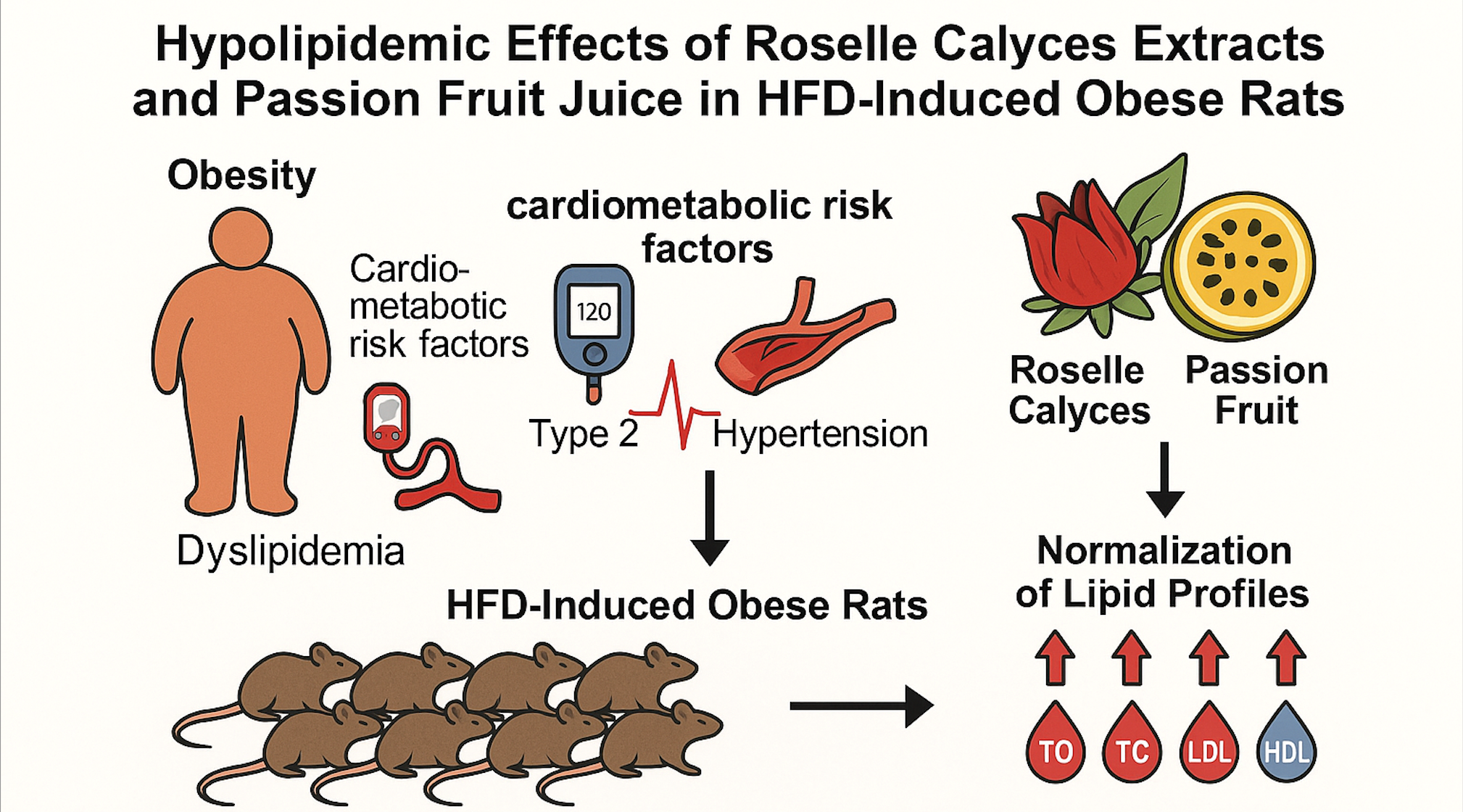
Downloads
References
P Poirier, TD Giles, GA Bray, Y Hong, JS Stern, FX Pi-Sunyer and RH Eckel Obesity and cardiovascular disease: A scientific statement from the american heart association. Circulation 2006; 113(6), 898-918.
AM Heck, JA Yanovski and KA Calis. Orlistat, a new lipase inhibitor for the management of obesity. Pharmacotherapy 2000; 20(3), 270-279.
CE Leite, CA Mocelin, GO Petersen, MB Leal and FV Thiesen. Rimonabant: An antagonist drug of the endocannabinoid system for the treatment of obesity. Pharmacological Reports 2009; 61(2), 217-224.
M Ahmadian, JM Suh, N Hah, C Liddle, AR Atkins, M Downes and RM Evans. PPARγ signaling and metabolism: The good, the bad and the future. Nature Medicine 2013; 19(5), 557-566.
S Singh, NA Osna and KK Kharbanda. Treatment options for alcoholic and non-alcoholic fatty liver disease: A review. World Journal of Gastroenterology 2017; 23(36), 6549-6570.
PW Wilson, RB D’agostino, D Levy, AM Belanger, H Silbershatz and WB Kannel. Prediction of coronary heart disease using risk factor categories. Circulation 1998; 97(18), 1837-1847.
PP Toth, D Potter and EE Ming. Prevalence of lipid abnormalities in the United States: The national health and nutrition examination survey 2003-2006. Journal of Clinical Lipidology 2012; 6(4), 325-330.
N Bergeron, BaP Phan, Y Ding, A Fong and RM Krauss. Proprotein convertase subtilisin/kexin type 9 inhibition: A new therapeutic mechanism for reducing cardiovascular disease risk. Circulation 2015; 132(17), 1648-1666.
Q Zhou and JK Liao. Statins and cardiovascular diseases: From cholesterol lowering to pleiotropy. Current Pharmaceutical Design 2009; 15(5), 467-478.
BA Golomb and MA Evans. Statin adverse effects. American Journal of Cardiovascular Drugs 2008; 8(6), 373-418.
E Montalvo-Gonzalez, Z Villagran, S Gonzalez-Torres, LE Iniguez-Munoz, MA Isiordia-Espinoza, JM Ruvalcaba-Gomez, RI Arteaga-Garibay, JL Acosta, N Gonzalez-Silva and LM Anaya-Esparza. Physiological effects and human health benefits of Hibiscus sabdariffa: A review of clinical trials. Pharmaceuticals 2022; 15(4), 464.
JA Izquierdo-Vega, DA Arteaga-Badillo, M Sanchez-Gutierrez, JA Morales-Gonzalez, N Vargas-Mendoza, CA Gomez-Aldapa, J Castro-Rosas, L Delgado-Olivares, E Madrigal-Bujaidar and E Madrigal-Santillan. Organic acids from Roselle (Hibiscus sabdariffa L.) - A brief review of its pharmacological effects. Biomedicines 2020; 8(5), 100.
ES Kao, MY Yang, CH Hung, CN Huang and CJ Wang. Polyphenolic extract from Hibiscus sabdariffa reduces body fat by inhibiting hepatic lipogenesis and preadipocyte adipogenesis. Food & Function 2016; 7(1), 171-182.
J Prasomthong, N Limpeanchob, S Daodee, P Chonpathompikunlert and S Tunsophon. Hibiscus sabdariffa extract improves hepatic steatosis, partially through IRS-1/Akt and Nrf2 signaling pathways in rats fed a high fat diet. Scientific Reports 2022; 12(1), 7022.
HC Chang, CH Peng, DM Yeh, ES Kao and CJ Wang. Hibiscus sabdariffa extract inhibits obesity and fat accumulation, and improves liver steatosis in humans. Food & Function 2014; 5(4), 734-739.
X He, F Luan, Y Yang, Z Wang, Z Zhao, J Fang, M Wang, M Zuo and Y Li. Passiflora edulis: An insight into current researches on phytochemistry and pharmacology. Frontiers in Pharmacology 2020; 11, 617.
M He, J Zeng, L Zhai, Y Liu, H Wu, R Zhang, Z Li and E Xia. Effect of in vitro simulated gastrointestinal digestion on polyphenol and polysaccharide content and their biological activities among 22 fruit juices. Food Research International 2017; 102, 156-162.
M Goss, M Nunes, I Machado, L Merlin, N Macedo, A Silva, T Bresolin and J Santin. Peel flour of Passiflora edulis Var. Flavicarpa supplementation prevents the insulin resistance and hepatic steatosis induced by low-fructose-diet in young rats. Biomedicine & Pharmacotherapy 2018; 102, 848-854.
NS Mota, MR Kviecinski, RC Zeferino, DA De Oliveira, LC Bretanha, SR Ferreira, GA Micke, D Wilhelm Filho, RC Pedrosa and F Ourique. In vivo antitumor activity of by-products of Passiflora edulis f. flavicarpa Deg. Rich in medium and long chain fatty acids evaluated through oxidative stress markers, cell cycle arrest and apoptosis induction. Food and Chemical Toxicology 2018; 118, 557-565.
MF Panelli, DT Pierine, SLB de Souza, AJT Ferron, J L Garcia, KCD Santos, MAF Belin, GPP Lima, MG Borguini, IO Minatel, AC Cicogna, FV Francisqueti and CR Correa. Bark of Passiflora edulis treatment stimulates antioxidant capacity, and reduces dyslipidemia and body fat in db/db mice. Antioxidants 2018; 7(9), 120.
J Khongrum, P Yingthongchai, K Boonyapranai, W Wongtanasarasin, N Donrung, W Sukketsiri, A Prachansuwan and P Chonpathompikunlert. Antidyslipidemic, Antioxidant, and Anti‐inflammatory Effects of Jelly Drink Containing Polyphenol‐Rich Roselle Calyces Extract and Passion Fruit Juice with Pulp in Adults with Dyslipidemia: A Randomized, Double‐Blind, Placebo‐Controlled Trial. Oxidative Medicine and Cellular Longevity 2022; 2022(1), 4631983.
M Fritz and G Rinaldi. Blood pressure measurement with the tail-cuff method in Wistar and spontaneously hypertensive rats: Influence of adrenergic-and nitric oxide-mediated vasomotion. Journal of Pharmacological and Toxicological Methods 2008; 58(3), 215-221.
SM Lim, YM Goh, N Mohtarrudin and SP Loh. Germinated brown rice ameliorates obesity in high-fat diet induced obese rats. BMC Complementary and Alternative Medicine 2016; 16, 140.
P Od‑Ek, W Deenin, W Malakul, I Phoungpetchara and S Tunsophon. Anti‑obesity effect of Carica papaya in high‑fat diet fed rats. Biomedical Reports 2020; 13(4), 30.
S Fernandez-Arroyo, IC Rodriguez-Medina, R Beltran-Debon, F Pasini, J Joven, Micol, A Segura-Carretero and A Fernandez-Gutierrez. Quantification of the polyphenolic fraction and in vitro antioxidant and in vivo anti-hyperlipemic activities of Hibiscus sabdariffa aqueous extract. Food Research International 2011; 44(5), 1490-1495.
M Herranz-Lopez, M Olivares-Vicente, JA Encinar, E Barrajon-Catalan, A Segura-Carretero, J Joven and V Micol. Multi-targeted molecular effects of Hibiscus sabdariffa polyphenols: An opportunity for a global approach to obesity. Nutrients 2017; 9(8), 907.
CY Kuo, ES Kao, KC Chan, HJ Lee, TF Huang and CJ Wang. Hibiscus sabdariffa L. extracts reduce serum uric acid levels in oxonate-induced rats. Journal of Functional Foods 2012; 4(1), 375-381.
E Avalos-Martínez, JA Pino, S Sayago-Ayerdi, O Sosa-Moguel and L Cuevas-Glory. Assessment of volatile compounds and sensory characteristics of Mexican hibiscus (Hibiscus sabdariffa L.) calyces hot beverages. Journal of Food Science and Technology 2019; 56(1), 360-366.
MY Yang, CH Peng, KC Chan, YS Yang, CN Huang and CJ Wang. The hypolipidemic effect of Hibiscus sabdariffa polyphenols via inhibiting lipogenesis and promoting hepatic lipid clearance. Journal of Agricultural and Food Chemistry 2010; 58(2), 850-859.
CH Peng, CC Chyau, KC Chan, TH Chan, CJ Wang and CN Huang. Hibiscus sabdariffa polyphenolic extract inhibits hyperglycemia, hyperlipidemia, and glycation-oxidative stress while improving insulin resistance. Journal of Agricultural and Food Chemistry 2011; 59(18), 9901-9909.
CM Gurrola-Diaz, PM Garcia-Lopez, S Sanchez-Enriquez, R Troyo-Sanroman, I Andrade-Gonzalez and J Gomez-Leyva. Effects of Hibiscus sabdariffa extract powder and preventive treatment (diet) on the lipid profiles of patients with metabolic syndrome (MeSy). Phytomedicine 2010; 17(7), 500-505.
TL Lin, HH Lin, CC Chen, MC Lin, MC Chou and CJ Wang. Hibiscus sabdariffa extract reduces serum cholesterol in men and women. Nutrition Research 2007; 27(3), 140-145.
AB Montanher, SM Zucolotto, EP Schenkel and TS Frode. Evidence of anti-inflammatory effects of Passiflora edulis in an inflammation model. Journal of Ethnopharmacology 2007; 109(2), 281-288.
CBB Cazarin, JK da Silva, TC Colomeu, AG Batista, LMM Meletti, JAR Paschoal, SB Junior, PA de Campos Braga, FGR Reyes, F Augusto, LR de Meirelles, R de Lima Zollner, MRM Júnior. Intake of Passiflora edulis leaf extract improves antioxidant and anti-inflammatory status in rats with 2, 4, 6-trinitrobenzenesulphonic acid induced colitis. Journal of Functional Foods 2015; 17, 575-586.
BCC Salles, KC Leme, MA Da Silva, CQ Da Rocha, MM Tangerina, W Vilegas, SA Figueiredo, SMDS Duarte, MR Rodrigues and FB De Araujo Paula. Protective effect of flavonoids from Passiflora edulis Sims on diabetic complications in rats. Journal of Pharmacy and Pharmacology 2021; 73(10), 1361-1368.
T Yuan, C Kao, W Li, H Li and C Chen. Chemical constituents of leaves of Passiflora edulis. Chemistry of Natural Compounds 2017; 53(6), 1165-1166.
ML Zeraik and JH Yariwake. Quantification of isoorientin and total flavonoids in Passiflora edulis fruit pulp by HPLC-UV/DAD. Microchemical Journal 2010; 96(1), 86-91.
FQ Xu, N Wang, WW Fan, CT Zi, HS Zhao, JM Hu and J Zhou. Protective effects of cycloartane triterpenoides from Passiflora edulis Sims against glutamate-induced neurotoxicity in PC12 cell. Fitoterapia 2016; 115, 122-127.
C Wang, FQ Xu, JH Shang, H Xiao, WW Fan, FW Dong, JM Hu and J Zhou. Cycloartane triterpenoid saponins from water soluble of Passiflora edulis Sims and their antidepressant-like effects. Journal of Ethnopharmacology 2013; 148(3), 812-817.
MK Kim, K Han, HS Kim, YM Park, HS Kwon, KH Yoon and SH Lee. Cholesterol variability and the risk of mortality, myocardial infarction, and stroke: A nationwide population-based study. European Heart Journal 2017; 38(48), 3560-3566.
A Alloubani, R Nimer and R Samara. Relationship between hyperlipidemia, cardiovascular disease and stroke: A systematic review. Current Cardiology Reviews 2021; 17(6), 051121189015.
N Thongtang, R Sukmawan, EJB Llanes and Z-V Lee. Dyslipidemia management for primary prevention of cardiovascular events: Best in-clinic practices. Preventive Medicine Reports 2022; 27, 101819.
B Hamzeh, Y Pasdar, N Mirzaei, RS Faramani, F Najafi, E Shakiba and M Darbandi. Visceral adiposity index and atherogenic index of plasma as useful predictors of risk of cardiovascular diseases: Evidence from a cohort study in Iran. Lipids in Health and Disease 2021; 20, 82.
B Lioy, RJ Webb and F Amirabdollahian. The association between the atherogenic index of plasma and cardiometabolic risk factors: A review. Healthcare (Basel) 2023; 11(7), 966.
I Ahmed, M Lakhani, M Gillett, A John and H Raza. Hypotriglyceridemic and hypocholester-olemic effects of anti-diabetic Momordica char-antia (karela) fruit extract in streptozotocin-in-duced diabetic rats. Diabetes Research and Clini¬cal Practice 2001; 51(3), 155-161.
H Francis and R Stevenson. The longer-term impacts of Western diet on human cognition and the brain. Appetite 2013; 63, 119-128.
Y Janthakhin, S Kingtong and S Juntapremjit. In-hibition of glucocorticoid synthesis alleviates cog-nitive impairment in high-fat diet-induced obese mice. Comprehensive Psychoneuroendocrinology 2022; 10, 100130.
S Juntapremjit and Y Janthakhin. Effects of indian gooseberry fruit on anxiety-related behaviors and memory performance in high-fat diet-induced obese mice. Chiang Mai University Journal of Natural Sciences 2021; 20(4), 2021094.
DG Hardie and DA Pan. Regulation of fatty acid synthesis and oxidation by the AMP-activated protein kinase. Biochemical Society Transactions 2002; 30(6), 1064-1070.
Y Li, S Xu, MM Mihaylova, B Zheng, X Hou, B Jiang, O Park, Z Luo, E Lefai, JYJ Shyy, B Gao, M Wierzbicki, TJ Verbeuren, RJ Shaw, RA Cohen and M Zang. AMPK phosphorylates and inhibits SREBP activity to attenuate hepatic steatosis and atherosclerosis in diet-induced insulin-resistant mice. Cell Metabolism 2011; 13(4), 376-388.
D Carling, PR Clarke, VA Zammit, and DG Hardie. Purification and characterization of the AMP‐activated protein kinase: Copurification of acetyl‐CoA carboxylase kinase and 3‐hydroxy‐3‐methylglutaryl‐CoA reductase kinase activities. European Journal of Biochemistry 1989; 186(1‐2), 129-136.
MS Brown and JL Goldstein. A receptor-mediated pathway for cholesterol homeostasis. Science 1986; 232(4746), 34-47.
Published
How to Cite
Issue
Section
License
Copyright (c) 2025 Walailak University

This work is licensed under a Creative Commons Attribution-NonCommercial-NoDerivatives 4.0 International License.





