
Sustainable Red Mud Conversion to ZSM-5
DOI:
https://doi.org/10.48048/tis.2025.9834Keywords:
Red mud, ZSM-5 zeolite, Dual-hydrothermal synthesis, Mesoporous materials, Waste valorization, Adsorbent characterization, Sustainable material developmentAbstract
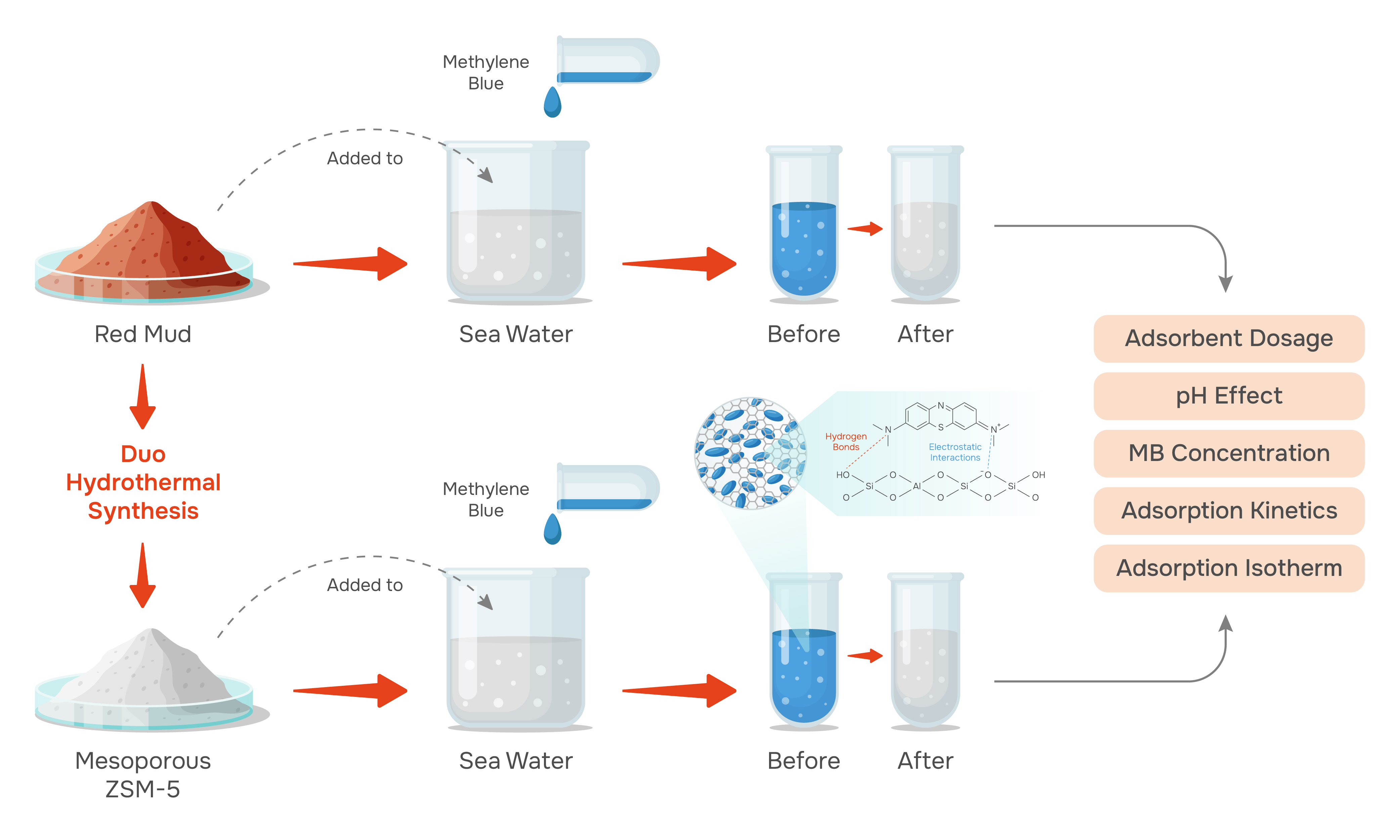
Red mud (RM), a highly alkaline industrial byproduct of alumina production, poses significant environmental challenges due to its massive accumulation and hazardous composition. This study addresses these issues by developing a sustainable method to convert RM into high-performance mesoporous ZSM-5 zeolite. A dual-hydrothermal synthesis approach was employed, combining alkali fusion and hydrothermal treatment with cetyltrimethylammonium bromide (CTAB) as a structure-directing agent to enhance mesoporosity. Comprehensive characterization was performed to confirm the structural and textural properties of the synthesized ZSM-5. X-ray diffraction (XRD) analysis confirmed the successful formation of the highly crystalline MFI zeolite framework, while Fourier-transform infrared spectroscopy (FTIR) validated the incorporation of aluminosilicate species. Nitrogen adsorption-desorption analysis revealed a significant enhancement in surface area (734 m²/g) and dual porosity, with micropores (1.18 nm) and mesopores (2.79 nm) present. Scanning electron microscopy (SEM) highlighted the morphological transformation from aggregated particles in RM to well-defined cubic structures characteristic of ZSM-5. The synthesized material exhibited promising properties for adsorption applications, particularly in addressing environmental challenges such as wastewater treatment. This study demonstrates a scalable and eco-friendly approach to valorizing industrial waste, contributing to sustainable material development and the circular economy.
HIGHLIGHTS
- A sustainable dual-hydrothermal synthesis method was employed to transform red mud (RM) into mesoporous ZSM-5.
- The synthesis significantly enhanced the material's structural and textural properties, achieving a BET surface area of 734 m²/g.
- XRD analysis confirmed the successful formation of the highly crystalline MFI zeolite framework.
- FTIR spectroscopy validated the incorporation of silica and alumina into the ZSM-5 structure, with characteristic T-O-T vibration.
GRAPHICAL ABSTRACT
Downloads
References
E Mukiza, LL Zhang, X Liu and N Zhang. Utilization of red mud in road base and subgrade materials: A review. Resources, Conservation and Recycling 2019; 141, 187-199.
CNG Silveira, MLF Martins, ACS Bezzera and FGS Araujo. Red mud from the aluminium industry: Production, characteristics, and alternative applications in construction materials: A review. Sustainability 2021; 13(22), 12741.
Y Haoxuan, I Zahidi, MF Chow, D Liang and DO Madsen. Reimagining resources policy: Synergizing mining waste utilization for sustainable construction practices. Journal of Cleaner Production 2024; 464, 42795.
A Mlonka-Medrala. Recent findings on fly ash-derived zeolites synthesis and utilization according to the circular economy concept. Energies 2023; 16(18), 6593.
V Sharma, B Javed, H Byrne, J Curtin and F Tian. Zeolites as carriers of nano-fertilizers: From structures and
principles to prospects and challenges. Applied Nano 2022; 3(3), 163-186
F Mo, H Ullah, N Zada and A Shahab. A review on catalytic co-pyrolysis of biomass and plastics waste as a thermochemical conversion to produce valuable products. Energies 2023; 16(14), 5403.
B Sekizkardeş, S Soyer-Uzun, A Uzun, S Kuhn, K Kaya-Ozkiper and SF Kurtoğlu-Oztulum. A comprehensive review on red mud-based catalysts: Modification methods and applications in thermal- and photocatalysis. The European Society Journal for Catalysis 2024; 17(5), e202401678.
O Riski, D Prasetyoko, DK Febrianti, YL Nikmah, VN Iftitahiyah, H Hartati, I Qoniah and E Santoso. The effect of time and H2O/CTAB ratio in synthesis of mesoporous alumina from bauxite residue. Malaysian Journal of Fundamental and Applied Sciences 2019; 15(1), 93-98.
R Subagyo, H Tehubijuluw, WP Utomo, HD Rizqi, Y Kusumawati, H Bahruji and D Prasetyoko. Converting red mud wastes into mesoporous ZSM-5 decorated with TiO2 as an eco-friendly and efficient adsorbent-photocatalyst for dyes removal. Arabian Journal of Chemistry 2022; 15(5), 103754.
H Tehubijuluw, R Subagyo, MF Yulita, RE Nugraha, Y Kusumawati, H Bahruji, AA Jalil, H Hartati and D Prasetyoko. Utilization of red mud waste into mesoporous ZSM-5 for methylene blue adsorption-desorption studies. Environmental Science and Pollution Research 2021; 28, 37354-37370.
Y Cheng, L Xu and C Liu. NaP1 zeolite synthesized via effective extraction of Si and Al from red mud for methylene blue adsorption. Advanced Powder Technology 2021; 32(10), 3904-3914.
T Taher, A Yoshida, A Lesbani, I Kurnia, G Guan, A Abudula and W Ueda. Adsorptive removal and photocatalytic decomposition of cationic dyes on niobium oxide with deformed orthorhombic structure. Journal of Hazardous Materials 2021; 415, 125635.
Published
How to Cite
Issue
Section
License
Copyright (c) 2025 Walailak University

This work is licensed under a Creative Commons Attribution-NonCommercial-NoDerivatives 4.0 International License.





