
Ethanolic Extract of Curcuma domestica Val. and Curcuma xanthorrhiza Roxb.: A Comparative Study In Vitro and In Silico Antibacterial Effect against Methicillin-Resistant Staphylococcus aureus
DOI:
https://doi.org/10.48048/tis.2025.9458Keywords:
Antimicrobial resistance, Staphylococcus, Antibiotics, Bioactive molecules, BiofilmsAbstract
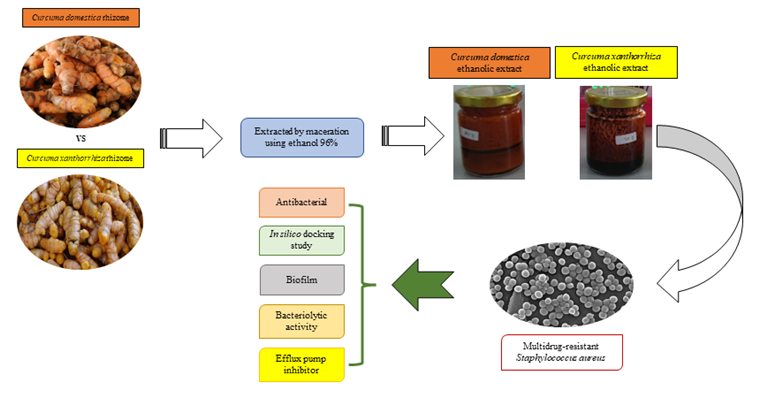
Methicillin-resistant Staphylococcus aureus (MRSA) is a priority pathogen due to its multidrug-resistant characteristics. This study compared the antibacterial, antibiofilm, bacteriolytic, and efflux pump inhibitory effects of Curcuma domestica and Curcuma xanthorrhiza rhizome extracts, both individually and in combination with tetracycline, against MRSA. Antibacterial activity and the combinatory effect with tetracycline were assessed using the microdilution method. Additionally, antibiofilm, bacteriolytic, and efflux pump inhibitory were investigated. Extracts from C. domestica and C. xanthorrhiza exhibited antibacterial effects against MRSA, with Minimum Inhibitory Concentration (MIC) values of 125 and 250 µg/mL, respectively. The combination of C. domestica and tetracycline demonstrated a synergistic interaction, with a Fractional Inhibitory Concentration Index (FICI) of 0.5. In contrast, the combination C. xanthorrhiza and tetracycline showed only an additive effect, with an FICI of 0.6. Computer simulations indicated that bisdemethoxycurcumin exhibited the strongest binding affinity to the protein inhibiting topoisomerase ATPase. Furthermore, when combined with tetracycline, each extract was effective in inhibiting biofilm formation and efflux pump activity in MRSA. This combination also induced cell death by altering membrane permeability. The combination of Curcuma extracts with tetracycline demonstrated enhanced antibacterial activity against MRSA compared to the extracts used alone.
HIGHLIGHTS
- Bisdemethoxycurcumin has the strongest binding affinity to the protein that inhibits topoisomerase ATPase with computer simulations
- The ethanolic extract of Curcuma xanthorrhiza has additive interaction with tetracycline against MRSA and revealed higher antibacterial activity, antibiofilm, bacteriolytic activity, and inhibit the efflux pump as compared to the extract alone.
- The combination of domestica extract and tetracycline produced a synergistic effect and reduced the MIC value of tetracycline against MRSA up to 1/32 MIC.
GRAPHICAL ABSTRACT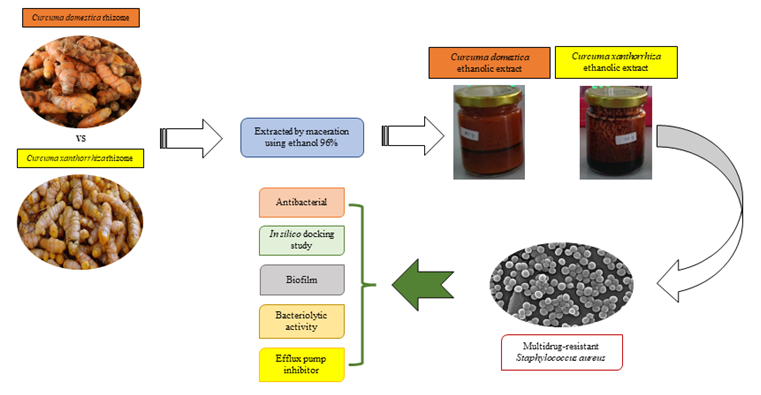
Downloads
References
BM Aiesh, MA Nazzal, AI Abdelhaq, SA Abutaha, SH Zyoud and A Sabateen. Impact of an antibiotic stewardship program on antibiotic utilization, bacterial susceptibilities, and cost of antibiotics. Scientific Reports 2023; 13(1), 5040.
MA Abushaheen, AJ Fatani, M Alosaimi, W Mansy, M George, S Acharya, S Rathod, DD Divakar, C Jhugroo, S Vellappally, AA Khan, J Shaik and P Jhugroo. Antimicrobial resistance, mechanisms, and its clinical significance. Diseasea-Month 2020; 66(6), 100971.
KMG O’Connell, JT Hodgkinson, HF Sore, M Welch, GPC Salmond and DR Spring. Combating multidrug-resistant bacteria: Current strategies for the discovery of novel antibacterials. Angewandte Chemie International Edition 2013; 52(41), 10706-10733.
MS Meah, M Lertcanawanichakul, P Pedpradab, W Lin, K Zhu, G Li and P Panichayupakaranant. Synergistic effect on anti-methicillin-resistant Staphylococcus aureus among combinations of α-mangostin-rich extract, lawsone methyl ether and ampicillin. Letters in Applied Microbiology 2020; 71(5), 510-519.
AW Septama and P Panichayupakaranant. Synergistic effect of artocarpin on antibacterial activity of some antibiotics against methicillin-resistant Staphylococcus aureus, Pseudomonas aeruginosa, and Escherichia coli. Pharmaceutical Biology 2016; 54(4), 686-691.
N Vaou, E Stavropoulou, C Voidarou, C Tsigalou and E Bezirtzoglou. Towards advances in medicinal plant antimicrobial activity: A review study on challenges and future perspectives. Microorganisms 2021; 9(10), 2041.
H Itokawa, Q Shi, T Akiyama, SL Morris-Natschke and KH Lee. Recent advances in the investigation of curcuminoids. Chinese Medicine 2008; 3, 11.
S Hadi, AN Artanti, Y Rinanto and DSC Wahyuni. Curcuminoid content of Curcuma longa L. and Curcuma xanthorrhiza rhizome based on drying method with NMR and HPLC-UVD. IOP Conference Series: Materials Science and Engineering 2018; 349(1), 012058.
SY Teow, K Liew, SA Ali, ASB Khoo and SC Peh. Antibacterial action of curcumin against Staphylococcus aureus: A brief review. Journal of Tropical Medicine 2016; 2016(1), 2853045.
Yuandani, I Jantan, AS Rohani and IB Sumantri. Immunomodulatory effects and mechanisms of Curcuma species and their bioactive compounds: A review. Frontiers in Pharmacology 2021; 12, 643119.
P Panichayupakaranant, AW Septama and A Sinviratpong. Synergistic activity of lawsone methyl ether in combination with some antibiotics and artocarpin against methicillin-resistant Staphylococcus aureus, Candida albicans, and Trychophyton rubrum. Chinese Herbal Medicines 2019; 11, 321-325.
P Wayne. Performance standards for antimicrobial susceptibility testing. 28th ed. Clinical and Laboratory Standards Institute, Pennsylvania, United States, 2018.
G Aktas. In vitro synergistic effect of vancomycin combined with daptomycin against vancomycin-resistant enterococci. Microbial Drug Resistance 2019; 25(10), 1484-1489.
KEN Milne and IM Gould. Combination antimicrobial susceptibility testing of multidrug-resistant Stenotrophomonas maltophilia from cystic fibrosis patients. Antimicrobial Agents and Chemotherapy 2012; 56(8), 4071-4077.
J Eberhardt, D Santos-Martins, AF Tillack and S Forli. AutoDock Vina 1.2.0: New docking methods, expanded force field, and python bindings. Journal of Chemical Information and Modeling 2021; 61(8), 3891-3898.
F Stanzione, I Giangreco and JC Cole. Use of molecular docking computational tools in drug discovery. Progress in Medicinal Chemistry 2021; 60, 273-343.
FA Ikwu, Y Isyaku, BS Obadawo, HA Lawal and SA Ajibowu. In silico design and molecular docking study of CDK2 inhibitors with potent cytotoxic activity against HCT116 colorectal cancer cell line. Journal of Genetic Engineering and Biotechnology 2020; 18(1), 51.
S Dallakyan and AJ Olson. Small-molecule library screening by docking with PyRx. Chemical Biology: Methods and Protocols 2015; 1263, 243-250.
AW Septama, AN Tasfiyati, R Kristiana and A Jaisi. Chemical profiles of essential oil from Javanese turmeric (Curcuma xanthorrhiza Roxb.), evaluation of its antibacterial and antibiofilm activities against selected clinical isolates. South African Journal of Botany 2022; 146, 728-734.
AW Septama, J Xiao and P Panichayupakaranant. A synergistic effect of artocarpanone from Artocarpus heterophyllus L. (moraceae) on the antibacterial activity of selected antibiotics and cell membrane permeability. Journal of Intercultural Ethnopharmacology 2017; 6(2), 186-191.
L Paixão, L Rodrigues, I Couto, M Martins, P Fernandes, CCCR de Carvalho, GA Monteiro, F Sansonetty, L Amaral and M Viveiros. Fluorometric determination of ethidium bromide efflux kinetics in Escherichia coli. Journal of Biological Engineering 2009; 3, 18.
DF Pancu, A Scurtu, IG Macasoi, D Marti, M Mioc, C Soica, D Coricovac, D Horhat, M Poenaru and C Dehelean. Antibiotics: Conventional therapy and natural compounds with antibacterial activity a pharmaco-toxicological screening. Antibiotics 2021; 10(4), 401.
PS Negi, GK Jayaprakasha, L Jagan Mohan Rao and KK Sakariah. Antibacterial activity of turmeric oil a byproduct from curcumin manufacture. Journal of Agricultural and Food Chemistry 1999; 47(10), 4297-4300.
JO Momoh, AA Manuwa and YO Bankole. Phytochemical screening, atomic absorption spectroscopy, GC-MS and antibacterial activities of turmeric (Curcuma longa L.) rhizome extracts. Journal of Advances in Microbiology 2022; 22(9), 116-131.
E Rahmat, J Lee and Y Kang. Javanese turmeric (Curcuma xanthorrhiza Roxb.): Ethnobotany, phytochemistry, biotechnology, and pharmacological activities. Evidence‐Based Complementary and Alternative Medicine 2021; 2021(1), 9960813.
I Górniak, R Bartoszewski and J Króliczewski. Comprehensive review of antimicrobial activities of plant flavonoids. Phytochemistry Rreviews 2019; 18(1), 241-272.
Y Yang, Z Zhang, S Li, X Ye, X Li and K He. Synergy effects of herb extracts: Pharmacokinetics and pharmacodynamic basis. Fitoterapia 2014; 92, 133-147.
I Jantan, FC Saputri, MN Qaisar and F Buang. Correlation between chemical composition of Curcuma domestica and Curcuma xanthorrhiza and their antioxidant effect on human low-density lipoprotein oxidation. Evidence-Based Complementary and Alternative Medicine 2012; 2012, 438356.
SS Grant and DT Hung. Persistent bacterial infections, antibiotic tolerance, and the oxidative stress response. Virulence 2013; 4(4), 273-283.
TB Rasmussen and M Givskov. Quorum-sensing inhibitors as anti-pathogenic drugs. International Journal of Medical Microbiology 2006; 296(2-3),149-161.
MN Alekshun and SB Levy. Molecular mechanisms of antibacterial multidrug resistance. Cell 2007; 128(6), 1037-1050.
A Vikram, GK Jayaprakasha, PR Jesudhasan, SD Pillai and BS Patil. Suppression of bacterial cell-cell signaling, biofilm formation and type III secretion system by citrus flavonoids. Journal of Applied Microbiology 2010; 109(2), 515-527.
L Lu, W Hu, Z Tian, D Yuan, G Yi, Y Zhou, Q Cheng, J Zhu and M Li. Developing natural products as potential anti-biofilm agents. Chinese Medicine 2019; 14(1), 11.
D Wang, W Zhang, T Wang, N Li, H Mu, J Zhang and J Duan. Unveiling the mode of action of 2 antibacterial tanshinone derivatives. International Journal of Molecular Sciences 2015; 16(8), 17668-17681.
MS Moghadam, S Maleki, E Darabpour, H Motamedi and SMS Nejad. Antibacterial activity of eight Iranian plant extracts against methicillin and cefixime resistant Staphylococcus aureus strains. Asian Pacific Journal of Tropical Medicine 2010; 3(4), 262-265.
A Lamut, L Peterlin Mašič, D Kikelj and T Tomašič. Efflux pump inhibitors of clinically relevant multidrug resistant bacteria. Medicinal Research Reviews 2019; 39(6), 2460-2504.
M Lekshmi, P Ammini, J Adjei, LM Sanford, U Shrestha, S Kumar and MF Varela. Modulation of antimicrobial efflux pumps of the major facilitator superfamily in Staphylococcus aureus. AIMS Microbiology 2018; 4(1), 1-18.
NY Saad, CD Muller and A Lobstein. Major bioactivities and mechanism of action of essential oils and their components. Flavour and Fragrance Journal 2013; 28(5), 269-279.
NA Mahizan, SK Yang, CL Moo, AAL Song, CM Chong, CW Chong, A Abushelaibi, SHE Lim and KS Lai. Terpene derivatives as a potential agent against antimicrobial resistance (AMR) pathogens. Molecules 2019; 24(14), 2631.
V Lorenzi, A Muselli, AF Bernardini, L Berti, JM Pages, L Amaral and JM Bolla. Geraniol restores antibiotic activities against multidrug-resistant isolates from gram-negative species. Antimicrobial Agents and Chemotherapy 2009; 53(5), 2209-2211.
G Kumar and AK Tudu. Tackling multidrug-resistant Staphylococcus aureus by natural products and their analogues acting as NorA efflux pump inhibitors. Bioorganic & Medicinal Chemistry 2023; 80(1), 117187.
Published
How to Cite
Issue
Section
License
Copyright (c) 2025 Walailak University

This work is licensed under a Creative Commons Attribution-NonCommercial-NoDerivatives 4.0 International License.





