
Antibacterial and Wound Healing Activities of Oral Suspension and Cream of Ethanol Extract of Lemon Peel (Citrus limon (L.)) Burm.f.
DOI:
https://doi.org/10.48048/tis.2025.10453Keywords:
Citrus limon, Antibacterial effect, Excision Wound, Wound Healing effect, Lemon peel, Cream, Excision wound, Wound healingAbstract
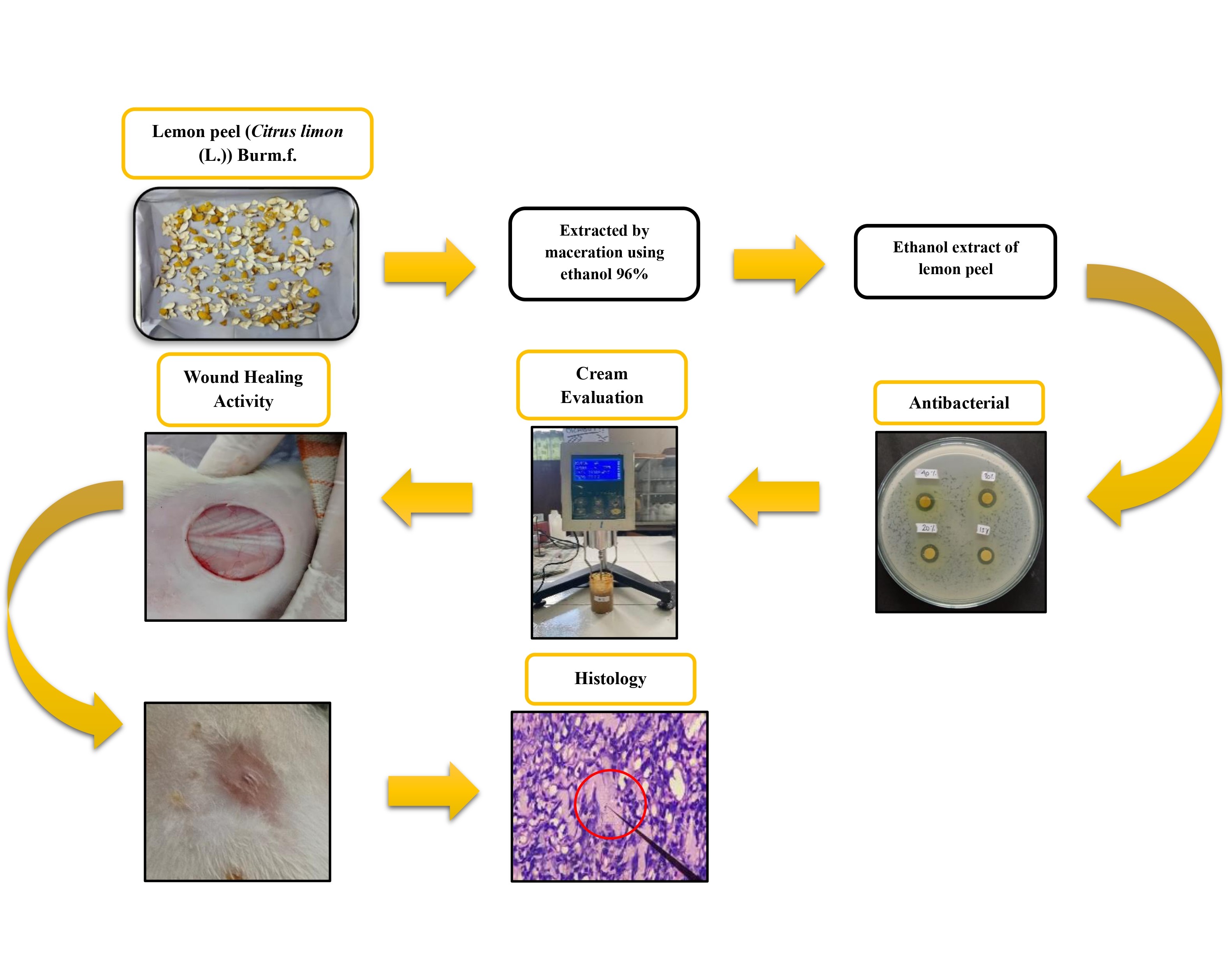
The purpose of this study was to determine the antibacterial activity of ethanol extract of lemon peel against Escherichia coli, Staphylococcus aureus, and Pseudomonas aeruginosa bacteria as well as Healing of excision wounds from suspension and cream preparations of lemon peel ethanol extract. The antibacterial activity of lemon peel ethanol extract was evaluated against Escherichia coli, Staphylococcus aureus, and Pseudomonas aeruginosa bacteria using the disc diffusion method. The lemon peel ethanol extract with the best antibacterial activity was formulated into a cream dosage form with variations in concentrations of F1 (10%), F2 (20%), and F3 (40%). Then, the excision wound healing activity was tested using the oral, topical, and combined routes (suspension and cream of lemon peel ethanol extract). The treatment of excision wound healing activity was carried out for 16 days with observations of the reduction in wound diameter on days 0, 3, 7, 12, and 16. Ethanol extract of lemon peel has antibacterial activity against Escherichia coli, Staphylococcus aureus, and Pseudomonas aeruginosa bacteria with an inhibition zone diameter of 9.4 mm for Escherichia coli bacteria. Staphylococcus aureus (11.0), and Pseudomonas aeruginosa (11.2 mm) with a concentration of 40%. Lemon peel ethanol extract cream was stable during 12 weeks of storage. Treatment with a combined oral and topical route (suspension and cream of lemon peel ethanol extract) had better wound healing activity for excision compared to oral and topical routes. The results showed that the suspension and cream of lemon peel ethanol extract have the potential to heal excision wounds.
HIGHLIGHTS
- The antibacterial activity of lemon peel ethanol extract cream on Pseudomonas aeruginosa bacteria has the largest inhibition zone diameter compared to the inhibition zone diameters on Escherichia coli and Staphylococcus aureus bacteria
- Lemon peel ethanol extract cream has storage stability for 12 weeks at low temperature, room temperature, and high temperature
- Treatment with a combined oral and topical route (suspension and cream of lemon peel ethanol extract) had better wound healing activity for excision compared to oral and topical routes.
GRAPHICAL ABSTRACT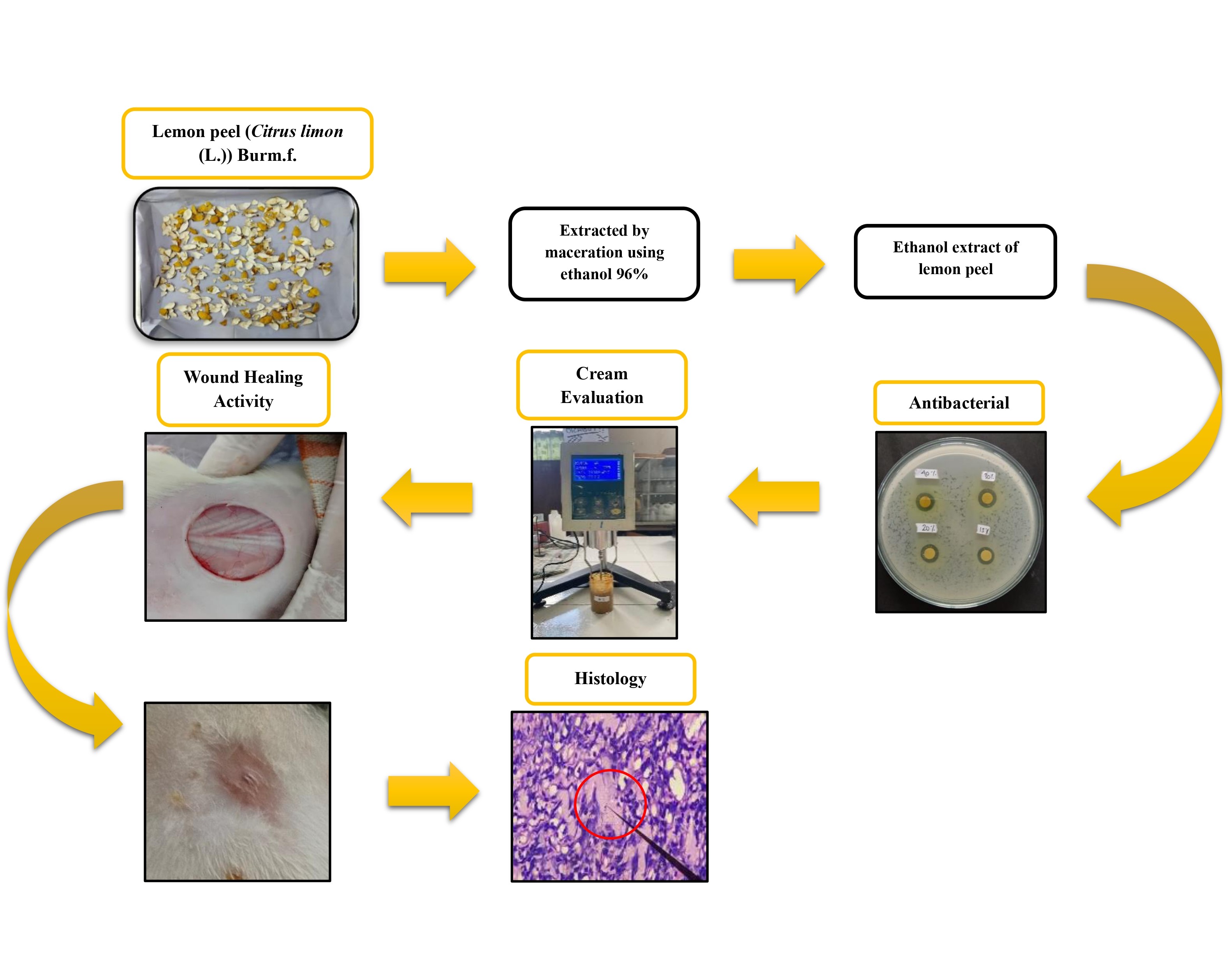
Downloads
References
LF Ang, Y Darwis, RY Koh, KV Gah Leong, MY Yew, LY Por and MF Yam. Wound healing property of curcuminoids as a microcapsule-incorporated cream. Pharmaceutics 2019; 11(5), 205.
M Ahmad, MN Ansari, A Alam, and TH Khan. Oral dose of citrus peel extracts promotes wound repair in diabetic rats. Pakistan Journal of Biological Sciences 2013; 16(20), 1086-1094.
H Ansel. Introduction to Pharmaceutical Dosage Forms. University of Indonesia Press, Jakarta, Indonesia, 2008.
LV Allen, NG Popovich, and HC Ansel. Ansel’s pharmaceutical dosage forms and drug delivery systems. 9th ed. Lippincott Williams & Wilkins, Hong Kong, China, 2011.
J Aponno, VY Paulina, Yamlean, and S. Hamidah. 2014, Effectiveness test of gel preparation containing ethanolic extract of guava leaves (Psidium guajava Linn) on wound healing infected by Staphylococcus aureus in rabbits (Oryctolagus cuniculus). Undergraduate Thesis. Sam Ratulangi University, Manado, Indonesia.
D Ariando. Health analyst pocket book. 6th ed. Analis Muslim Publish, Bekasi, Indonesia, 2017.
P Bainbridge. Wound healing and the role of fibroblasts. Journal of Wound Care 2013; 22(8), 407-412.
TF Belachew, S Asrade, M Geta and E Fentahun. In vivo evaluation of wound healing and anti-inflammatory activity of 80% methanol crude flower extract of Hagenia abyssinica (Bruce) J.F. Gmel in mice. Evidence Based Complementary and Alternative Medicine 2020; 2020(1), 9645792.
IH Caesar and BA Dhiani.Formulation and antibacterial activity of fennel fruit (Foeniculum vulgare Mill) essential oil lotion. Media Farmasi 2014; 11(1), 41-54.
MTB Carvalho, HG Araújo-Filho, AS Barreto, LJ Quintans-Júnior, JSS Quintans and RSS Barreto. Wound healing properties of flavonoids: A systematic review highlighting the mechanisms of action. Phytomedicine 2021; 90, 153636.
C Dev and RNS Rishi. Basketful benefit of citrus limon. International Journal of Pharmaceutics 2016; 7(6), 1-6.
R Elcistia and AK Zulkarnain. Optimization of O/W cream formulation combining oxybenzone and titanium dioxide and in vivo testing of its sunscreen activity. Majalah Farmasetik 2018; 14(2), 67.
U Fauziah, M Arsyi, Rizki, and YD Safrida. Formulation study and physical stability test of ointment and cream preparations containing ethanol extract of robusta coffee fruit flesh (Coffea canephora). Darussalam Journal of Science and Health 2022; 2(1), 1-9.
A Garg, D Aggarwal, S Garg, and AK Singla. Spreading of semisolid formulations: An update. Pharmaceutical Technology 2002; 2002, 84-102.
H Fitri, A Apriliana, and H Natalia. Characterization and phytochemical screening of Selutui Puka Leaf Simplisia (Tabernaemontana macracarpa Jack). Ibnu Sina Scientific Journal 2009; 4(1), 49-58.
L Hakkinnen, H Larjava and L Koivisto. Granulation tissue formation and remodelling. In: H Larjava (Ed.). Oral wound healing cell biology and clinical management. 1st ed. SPi Publisher Services, Pondicherry, Indonesia, 2012, p. 135-139.
P Husni, AN Pratiwi, and A Baitariza. Formulation of a cream containing ethanol extract of moringa leaves (Moringa oleifera Lamk). Jurnal Ilmiah Farmasi Farmasyifa 2019; 2(2), 101-110.
RM Jacob, P Amruth, P Akshay, KVS Rose, R Anandan, and S Mathew. In vivo assessment of wound closure and biocompatibility of nanochitosan-polyvinylalcohol-glycerol films in experimental animal model. International Journal of Zoology and Applied Biosciences 2023; 8(6), 77-83.
T Kurahashi and J Fujii. Roles of antioxidative enzymes in wound healing. Journal of Developmental Biology 2025; 3(2), 57-70.
K Li, Y Diao, H Zhang, S Wang, Z Zhang, B Yu, S Huang, and H Yang. Tannin extracts from immature fruits of Terminalia chebula Fructus Retz. promote cutaneous wound healing in rats. BMC Complementary and Alternative Medicine 2011; 11, 86.
E Lukitaningsih, AH Saputro, M Widiasri, N Khairunnisa, N Prabaswari and R Kuswahyuningsih. In vitro anti-aging analysis of a topical pharmaceutical preparation containing a mixture of strawberry fruit, pomelo peel, and langsat fruit extracts. Indonesian Journal of Chemometrics and Pharmaceutical Analysis 2020; 1(1), 52-60.
N Lumentut, HJ Edi and EM Rumondor. Formulation and physical stability testing of a cream preparation containing 12.5% ethanol extract of Goroho banana peel (Musa acuminata L.) as a sunscreen. Jurnal MIPA 2020; 9(2), 42.
D MacKay and AL Miller. Nutritional support for wound healing. Alternative Medicine Review 2003; 8(4), 369-370.
NS Majid, VYY Paulina, and C Gayatri. Formulation and antibacterial effectiveness test of jackfruit leaf (Artocarpus heterophyllus Lam.) extract cream against Staphylococcus aureus. Pharmacon 2019; 8(1), 225-233.
A Martin and J Swarbick. Physical pharmacy. 3rd ed. Lee & Febiger, New York, 1969.
E Middleton, C Kandaswami, and TC Theoharides. The effects of plant flavonoids on mammalian cells: Implications for inflammation, heart disease, and cancer. Pharmacological Reviews 2000; 52(4), 673-751.
EG Molina. Natural bioactive compounds of citrus limon for food and health. Journal of Pharmaceutical and Biomedical Analysis 2010; 51(2), 327-345.
S Nealma and Nurkholis. Formulation and physical evaluation of cosmetic cream with variations of Sappan wood extract (Caesalpinia sappan) and Sumbawa Beeswax. Tambora Journal 2020; 4(2), 8-15.
EF Palumpun, AAGP Wiraguna, and W Pangkahila. Topical administration of betel leaf extract (Piper betle) increases epidermal thickness, fibroblast count, and collagen count in the wound healing process in male Wistar rats (Rattus norvegicus). e-Biomedic Journal 2017; 5(1), 1-7.
A Paramita. 2016, The effect of Binahong leaf extract ointment (Anredera cordifolia (ten) steenis) on collagen density in white rats (Rattus norvegicus) with burn wounds. Undergraduate Thesis. Airlangga University, Surabaya, Indonesia.
ACO Silva, EF Santana, AM Saraiva, FN Coutinho, RHA Castro, MNC Pisciottano, ELC Amorim, and UP Albuquerque. Which approach is more effective in the selection of plants with antimicrobial activity? Evidence-Based Complementary and Alternative Medicine 2013; 2013(1), 308980.
NIMDS Suena, NIPU Antari, and E Cahyaningsih. Physical quality evaluation of body butter formulation from ethanol extract of mangosteen (Garcinia mangostana L.) rind. Indonesian Journal of Pharmaceutical Sciences 2017; 15(1), 63-69.
RE Sucita and IS Hamid. Topical ethanol extract of Sappan wood (Caesalpinia sappan L.) is effective on collagen density during the healing phase of incision wounds in white rats. Journal of Veterinary Medicine 2019; 2(2), 119-126.
IS Suharto and AN Etika. Ginger extract (Zingiber officinale Roscoe) affects the collagen fiber density of incision wounds. Scientific Journal of Health Sciences 2019; 7(1), 27-34.
T Sentat and Permatasari. Activity test of ethanolic extract of avocado leaves (Persea americana Mill.) on burn wounds on the backs of male white mice (Mus musculus). Jurnal Ilmiah Manuntung 2015; 1(2), 100-106.
WH Schmitt. Skin care products. In: DF Williams and WH Schmitt (Eds.). Cosmetics and toiletries industry. 2nd ed. Blackie Academy and Professional, London, 1996.
R Tuloli, HJ Edi, and I Jayanto. Formulation of a cream preparation combining celery leaf extract (Apium graveolens L.) and teak leaf extract (Tectona grandis Linn. f) as an antibacterial agent against Staphylococcus aureus. Pharmacon 2020; 9(2), 259.
M Toyoda, H Takayama, N Horiguchi, T Otsuka, T Fukusato, G Merlino, H Takagi, and M Mori. Overexpression of hepatocyte growth factor/scatter factor promotes vascularization and granulation tissue formation in vitro. FEBS Letters 2001; 509(1), 95-100.
W Wahyuni, H Wahid and R Febriana. Formulation of an ethanol extract cream from taro (Colocasia esculenta L.) leaf stalks for incised wounds in white rats (Rattus norvegicus) of the Wistar strain. Jurnal Ilmiah Farmasi 2022; 3(3), 338-347.
Published
How to Cite
Issue
Section
License
Copyright (c) 2025 Walailak University

This work is licensed under a Creative Commons Attribution-NonCommercial-NoDerivatives 4.0 International License.





