
Enhancing Photostability of Chemically Modified Poly(Vinyl Chloride) through the Incorporation of Organotin Moieties on the Polymeric Chains
DOI:
https://doi.org/10.48048/tis.2025.9413Keywords:
Poly(vinyl chloride), Photodegradation, Surface morphology, Organotin compounds, Polymeric fragmentsAbstract
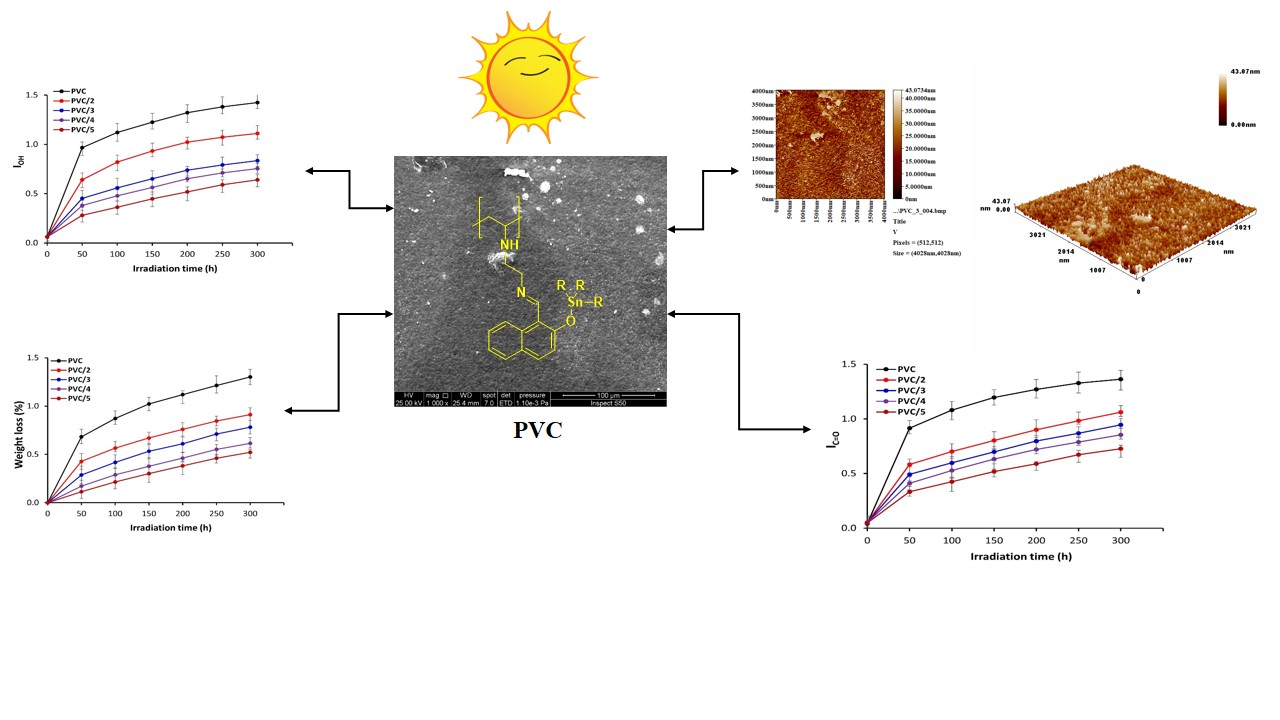
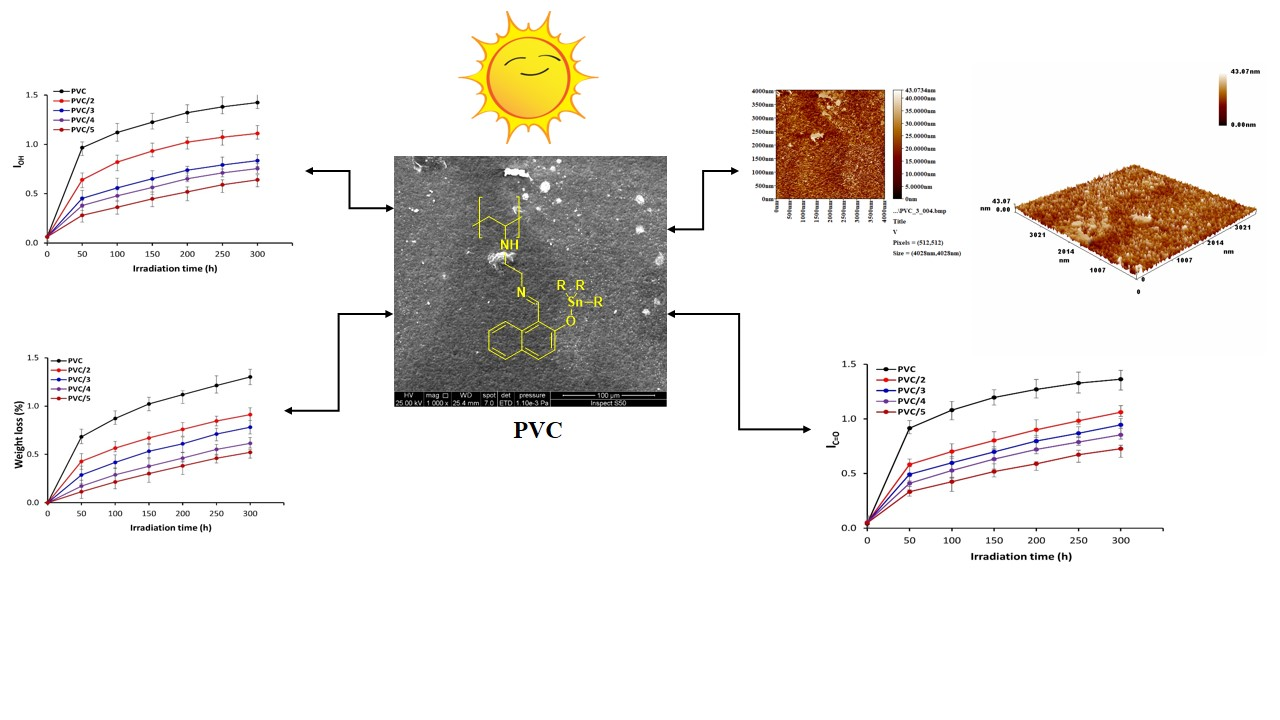
The surface functionalization through the incorporation of an organometallic moiety on the backbone of poly(vinyl chloride) (PVC) was successful. The reaction of ethylenediamine and PVC tetrahydrofuran produces an amino residue that reacts with 2-hydroxynaphthaldehyde to form the corresponding Schiff base. The addition of triorganotin compounds leads to the attachment of organometallic residues to the polymeric chains. The synthetic approach circumvents the need for separate steps for chemical synthesis, separation and purification of additives. Thin films of the modified PVC were made and irradiated with UV light to test the effect of modification on their photostability using different methods, including infrared spectroscopy, weight loss, and surface morphology analysis. Infrared spectroscopy monitored changes in the polymer’s chemical structure, while weight loss measurements quantified degradation. Surface morphology, likely analyzed by Scanning Electron Microscopy (SEM), revealed the extent of surface damage before and after UV irradiation. The results indicated that the organometallic modification, particularly with aromatic groups, significantly improved the photostability of PVC. The modified PVC film containing the triphenyl tin-Schiff base exhibited the least destructive damage due to photoirradiation. The aromatic substituent stabilized PVC better than the aliphatic ones. The findings pave the way for alternative ways of PVC modification to improve photostability. The results confirmed that the organometallic modification, especially with aromatic groups, significantly enhanced the photostability of PVC, offering a promising alternative method for PVC modification to improve its durability under UV irradiation. These findings pave the way for future advancements in PVC stabilization and related polymer modifications for improved environmental resistance.
HIGHLIGHTS
- This article focused on Photostabilization on new modify polymers
- Polymers react with tin compounds to increase the efficiency of photochemical process
- Many techniques were used in this study, such as: AFM, SEMand FTIR
GRAPHICAL ABSTRACT
Downloads
References
X Wu, W Fu and H Chen. Conductive polymers for flexible and stretchable organic optoelectronic applications. ACS Applied Polymer Materials 2022; 4(7), 4609-4623.
Sonika, SK Verma, S Samanta, AK Srivastava, S Biswas, RM Alsharabi and S Rajput. Conducting polymer nanocomposite for energy storage and energy harvesting systems. Advances in Materials Science and Engineering 2022; 2022(1), 2266899.
J Sternberg, O Sequerth and S Pilla. Green chemistry design in polymers derived from lignin: Review and perspective. Progress in Polymer Science 2021; 113, 101344.
GA El-Hiti, DS Ahmed, E Yousif, OSA Al-Khazrajy, M Abdallh and SA Alanazi. Modifications of polymers through the addition of ultraviolet absorbers to reduce the aging effect of accelerated and natural irradiation. Polymers 2022; 14(1), 20.
MM Kareem, NA Alrazzak, SA Aowda, AJA Lafta, FH Mohammed and MS Jabir. Synthesis and characterization of new modified poly(vinyl chloride) polymers and study of their photodegradation under irradiation with ultra-violet radiation. Brazilian Archives of Biology and Technology 2023; 66, e23210443.
P Purohit, A Bhatt, RK Mittal, MH Abdellattif and TA Farghaly. Polymer grafting and its chemical reactions. Frontiers in Bioengineering and Biotechnology 2022; 10, 1044927.
JE Kilduff, S Mattaraj, JP Pieracci and G Belfort. Photochemical modification of poly(ether sulfone) and sulfonated poly(sulfone) nanofiltration membranes for control of fouling by natural organic matter. Desalination 2000; 132(1-3), 133-142.
A Higuchi, M Tamai, Y Tagawa, Y Chang and QD Ling. Surface modification of polymeric membranes for low protein binding. Membrane and Water Treatment 2010; 1(2), 103-120.
SX Liu, JT Kim and S Kim. Effect of polymer surface modification on polymer-protein interaction via hydrophilic polymer grafting. Journal of Food Science 2008; 73(3), E143-E150.
Z Yi, Y Xu, L Zhu, H Dong and B Zhu. Hydrophilic modification of PPESK porous membranes via aqueous surface-initiated atom transfer radical polymerization. Chinese Journal of Polymer Science 2009; 27(05), 695-702.
M Yu, BW Zhang, B Deng, LF Li, LD Xie, XF Lu, KL Sheng and JY Li. Introducing reactive groups into polymer chains by radiation induced grafting technique. Plastics, Rubber and Composites 2010; 39(2), 79-82.
RO Ebewele. Polymer Science and Technology. CRC Press, New York, 2000.
SD Lee, GH Hsiue and CY Kao. Preparation and characterization of a homobifunctional silicone rubber membrane crafted with acrylic acid via plasma-induced craft copolymerization. Journal of Polymer Science Part A: Polymer Chemistry 1996; 34(1), 141-148.
HA Ibraheem, GA El-Hiti, E Yousif, DS Ahmed, H Hashim and BM Kariuki. Investigation of the impact of chemical modifications on the photostability of polymethyl methacrylate. International Journal of Polymer Science 2024; 2024(1), 3354280.
MW Allsopp and G Vianello. Poly(vinyl chloride). In: C Ley and B Elvers (Eds.). Ullmann’s encyclopedia of industrial chemistry. Wiley-VCH, Weinheim, Germany, 2012.
WV Titow. PVC technology. Elsevier, London, 1984.
R Díaz and C Gallegos. Sustainable materials for polymer stabilization: Schiff base metal complexes in modern polymer chemistry. Journal of Materials Science 2019; 54, 8950-8967.
R Thomson. Recent developments in PVC stabilizers: Organotin and alternatives. Plastics, Additives and Compounding 2018; 20, 42-47.
HH Mujbil, LA Al Jebur, E Yousif, M Kadhom, A Mohammed, DS Ahmed, M Ali and H Hashim. Utilization of metal oxides nanoparticles in modulating polyvinyl chloride films to resist ultraviolet light. Metals 2022; 12(9), 1413.
S Pramanik and S Saha. Schiff base-organotin complexes: Catalytic applications and effects on polymer stabilization. Catalysis Reviews 2022; 64, 278-292.
F Ali and MA Khan. The role of organotin and Schiff base complexes in reducing environmental hazards: A review of their use in polymer stabilization. Environmental Science and Pollution Research 2020; 27, 37981-37998.
P Nguyen-Tri, P Ghassemi, P Carriere, S Nanda, AA Assadi and DD Nguyen. Recent applications of advanced atomic force microscopy in polymer science: A review. Polymers 2020; 12(5), 1142.
J Rydz, A Šišková and AA Eckstein. Scanning electron microscopy and atomic force microscopy: Topographic and dynamical surface studies of blends, composites, and hybrid functional materials for sustainable future. Advances in Materials Science and Engineering 2019; 2019(1), 6871785.
AE Minuti, L Labusca, DD Herea, G Stoian, H Chiriac and N Lupu. A simple protocol for sample preparation for scanning electron microscopic imaging allows quick screening of nanomaterials adhering to cell surface. International Journal of Molecular Sciences 2023; 24(1), 430.
T Karayıldırım, J Yanık, M Yüksel, M Sağlam and M Haussmann. Degradation of PVC containing mixtures in the presence of HCl fixators. Journal of Polymers and the Environment 2005; 13, 365-379.
OA Nief. Photostabilization of polyvinyl chloride by some new thiadiazole derivatives. European Journal of Chemistry 2015; 6, 242-247.
JL Gardette, S Gaumet and J Lemaire. Photooxidation of poly (viny1 chloride). 1. A reexamination of the mechanism. Macromolecules 1989; 22, 2576-2581.
S Gaumet and JL Gardette. Photo-oxidation of poly(vinyl chloride): Part 2 - A comparative study of the carbonylated products in photo-chemical and thermal oxidations. Polymer Degradation and Stability 1991; 33(1), 17-34.
K Chaochanchaikul, V Rosarpitak and N Sombatsompop. Photodegradation profiles of PVC compound and wood/PVC composites under UV weathering. Express Polymer Letters 2013; 7, 146-160.
MW Sabaa, EH Oraby, ASA Naby and RR Mohamed. N-Phenyl-3-substituted-5-pyrazolone derivatives as organic stabilizer for rigid PVC against photodegradation. Journal of Applied Polymer Science 2005; 101, 1543-1555.
MTH Tarafder, KB Chew, KA Crouse, AM Ali, BM Yamin and HK Fun. Synthesis and characterization of Cu(II), Ni(II) and Zn(II) metal complexes of bidentate NS isomeric Schiff bases derived from S-methyldithiocarbazate (SMDTC): Bioactivity of the bidentate NS isomeric Schiff bases, some of their Cu(II), Ni(II) and Zn(II) complexes and the X-ray structure of the bis[S-methyl-β-N-(2-furyl-methyl)methylenedithiocarbazato]zinc(II) complex. Polyhedron 2002; 21(27-28), 2683-2690.
ME Sánchez-Vergara, L Hamui, E Gómez, GM Chans and JM Galván-Hidalgo. Design of promising heptacoordinated or-ganotin(IV) complexes-PEDOT: PSS-based composite for new-generation optoelectronic devices applications. Polymers 2021; 13(7), 1023.
RK Dubey and S Pathak. Some new organotin(IV) complexes: Synthesis and characterization by means of IR, 1H, 13C-NMR and FAB-mass spectral studies. Main Group Metal Chemistry 2008; 31(1-2), 29-38.
OS Morozov, NN Vyshinskii and NK Rudnevskii. Investigation of some organotin compounds and their complexes by IR spectroscopy. Journal of Applied Spectroscopy 1981; 35(3), 1019-1023.
AJ Jafari and JD Donaldson. Determination of HCl and VOC emission from thermal degradation of PVC in the absence and presence of copper, copper(II) oxide and copper(II) chloride. Journal of Chemistry 2009; 6(3), 685-692.
J Yu, L Sun, C Ma, Y Qiao and H Yao. Thermal degradation of PVC: A review. Waste Management 2016; 48, 300-314.
MH Kudzin, D Piwowarska, N Festinger and JJ Chruściel. Risks associated with the presence of polyvinyl chloride in the environment and methods for its disposal and utilization. Materials 2024; 17(1), 173.
AJ Jafari and JD Donaldson. Determination of HCl and VOC emission from thermal degradation of PVC in the absence and presence of copper, copper(II) oxide and copper(II) chloride. Journal of Chemistry 2009; 6(3), 685-692.
A Venkateshaiah, VVT Padil, M Nagalakshmaiah, S Waclawek, M Černík and RS Varma. Microscopic techniques for the analysis of micro and nanostructures of biopolymers and their derivatives. Polymers 2020; 12(3), 512.
S Nikafshar, O Zabihi, M Ahmadi, A Mirmohseni, M Taseidifar and M Naebe. The effects of UV light on the chemical and mechanical properties of a transparent epoxy-diamine system in the presence of an organic UV absorber. Materials 2017; 10(2), 180.
N Mehmood, E Andreasson and S Kao-Walter. SEM observations of a metal foil laminated with a polymer film. Procedia Materials Science 2014; 3, 1435-1440.
F Kara, EA Aksoy, Z Yuksekdag, N Hasirci and S Aksoy. Synthesis and surface modification of polyurethanes with chitosan for antibacterial properties. Carbohydrate Polymers 2014; 112, 39-47.
W Shi, J Zhang, XM Shi and GD Jiang. Different photo-degradation processes of PVC with different average degrees of polymerization. Journal of Applied Polymer Science 2008; 107(1), 528-540.
CH See and J O’Haver. Atomic force microscopy characterization of ultrathin polystyrene films formed by admicellar polymerization on silica disks. Journal of Applied Polymer Science 2003; 89, 36-46.
EK Kosareva, AN Pivkina and NV Muravyev. Atomic force microscopy in energetic materials research: A review. Energetic Materials Frontiers 2022; 3, 290-302.
M Fadhil, E Yousif, DS Ahmed, A Mohammed, H Hashim, A Ahmed, BM Kariuki and GA El-Hiti. Synthesis of new norfloxacin-tin complexes to mitigate the effect of ultraviolet-visible irradiation in polyvinyl chloride films. Polymers 2022; 14, 2812.
M Fadhil, E Yousif, DS Ahmed, BM Kariuki and GA El-Hiti. Synthesis and application of levofloxacin-tin complexes as new photostabilizers for polyvinyl chloride. Polymers 2022; 14(18), 3720.
OG Mousa, GA El‐Hiti, MA Baashen, M Bufaroosha, A Ahmed, AA Ahmed, DS Ahmed and E Yousif. Synthesis of carvedilol-organotin complexes and their effects on reducing photodegradation of poly(vinyl chloride). Polymers 2021; 13(4), 500.
AA Yaseen, E Yousif, ETB Al-Tikrity, GA El-Hiti, BM Kariuki, DS Ahmed and M Bufaroosha. FTIR, weight, and surface morphology of poly(vinyl chloride) doped with tin complexes containing aromatic and heterocyclic moieties. Polymers 2021; 13(19), 3264.
A Mohammed, GA El-Hiti, E Yousif, AA Ahmed, DS Ahmed and MH Alotaibi. Protection of poly(vinyl chloride) films against photodegradation using various valsartan tin complexes. Polymers 2020; 12(4), 969.
AG Hadi, E Yousif, GA El-Hiti, DS Ahmed, K Jawad, MH Alotaibi and H Hashim. Long-term effect of ultraviolet irradiation on poly(vinyl chloride) films containing naproxen diorganotin(IV) complexes. Molecules 2019; 24(13), 2396.
AG Hadi, K Jawad, GA El-Hiti, MH Alotaibi, AA Ahmed, DS Ahmed and E Yousif. Photostabilization of poly(vinyl chloride) by organotin(IV) compounds against photodegradation. Molecules 2019; 24(19), 3557.
MM Ali, GA El-Hiti and E Yousif. Photostabilizing efficiency of poly(vinyl chloride) in the presence of organotin(IV) complexes as photostabilizers. Molecules 2016; 21(9), 1151.
LK Krehula, A Papić, S Krehula, V Gilja, L Foglar and Z Hrnjak-Murgić. Properties of UV protective films of poly(vinylchloride)/TiO2 nanocomposites for food packaging. Polymer Bulletin 2017; 74, 1387-1404.
Y Li, J Feng, S Wu, A Chen, D Kuang, T Bai, Y Gao, J Zhang, L Li, L Wan, Q Liu, Z Chen and D Gu. Review of ultraviolet ageing mechanisms and anti-ageing methods for asphalt binders. Journal of Road Engineering 2022; 2(2), 137-155.
E Yousif, A Hasan and GA El-Hiti. Spectroscopic, physical and topography of photochemical process of PVC films in the presence of Schiff base metal complexes. Polymers 2016; 8(6), 204.
DS Ahmed, GA El-Hiti, AS Hameed, E Yousif and A Ahmed. New tetra-Schiff bases as efficient photostabilizers for poly(vinyl chloride). Molecules 2017; 22(9), 1506.
H Xu, R Chen, Q Sun, W Lai, Q Su, W Huang and X Liu. Recent progress in metal-organic complexes for optoelectronic applications. Chemical Society Reviews 2014; 43(10), 3259-3302.
Downloads
Published
How to Cite
Issue
Section
License
Copyright (c) 2024 Walailak University

This work is licensed under a Creative Commons Attribution-NonCommercial-NoDerivatives 4.0 International License.





