
A Chronological Record of Contamination: Coral Skeletons Reveal Increasing Microplastic Diversity in Central Tapanuli, Indonesia
DOI:
https://doi.org/10.48048/tis.2026.12323Keywords:
Coral reefs, Microplastics, Anthropogenic causes, Natural causes, Central Tapanuli, Coral reefs, Microplastics, Anthropogenic causes, Natural causes, Ungge Island, Karang Island, Central TapanuliAbstract
Microplastic pollution has increasingly been recognized as a critical environmental threat to coral reef ecosystems, known to disrupt feeding behavior, hinder skeletal deposition, and induce bleaching events. Despite growing awareness, little is known about how such stressors are chronologically archived within coral growth bands, particularly in regions exposed to simultaneous anthropogenic and natural pressures. This study investigates the relationship between coral growth dynamics and microplastic contamination in the coastal waters of Central Tapanuli, Indonesia an area characterized by dense human settlements (population 250,017 - 394,910), active shipping routes, and industrial growth (1,802 - 2,568 units). The research was conducted at 2 reef sites representing gradients of human influence, Karang Island and Ungge Island; coral cores were sectioned, X-rayed to visualize annual growth bands, and analyzed for embedded microplastics using stereo microscopy and Fourier Transform Infrared Spectroscopy (FTIR). Growth rates at Karang Island (2015 - 2024) ranged from 11 - 26 mm yr⁻¹, while rates at Ungge Island (2019 - 2024) were 8 - 20 mm yr⁻¹; microplastic concentrations were 3 - 20 particles g⁻¹ (Karang, 2015 - 2024) and 3 - 16 particles g⁻¹ (Ungge, 2019 - 2024). Fibers (58% - 63%) were the dominant morphology, with particle sizes ranging from 25 - 873 µm. FTIR analysis (peaks: 555 - 3,409 cm⁻¹) identified a complex polymer mixture dominated by Polystyrene (19.9%), Polypropylene (16.2%), and Polyvinyl Chloride (13.4%). Crucially, chronological analysis revealed a significant temporal trend: polymer diversity increased from 11 unique types in 2015 to 15 unique types in 2024, including new engineered plastics. The dominance of packaging-derived polymers reflects strong anthropogenic input, and this study provides the first evidence of microplastic incorporation within coral growth bands in Central Tapanuli, demonstrating that coral skeletons not only archive contamination but also record its increasing compositional complexity over time. These findings emphasize the urgent need for integrated coastal management and stricter plastic-waste regulation in Indonesia’s reef ecosystems.
HIGHLIGHTS
- Coral bleaching on coral reef growth is influenced by anthrophogenic cause and natural cause factor.
- Recent research indicates that microplastics have a significant impact on coral bleaching.
- Microplastic particle abundance was found to be 3 - 20 particles/g on Karang Island and 3 - 16 particles/g on Ungge Island.
- Polystyrene (PS, 19.9%), Polypropylene (PP, 16.2%), and Polyvinyl Chloride (PVC, 13.4%) polymers who consistently become the main source of microplastics.
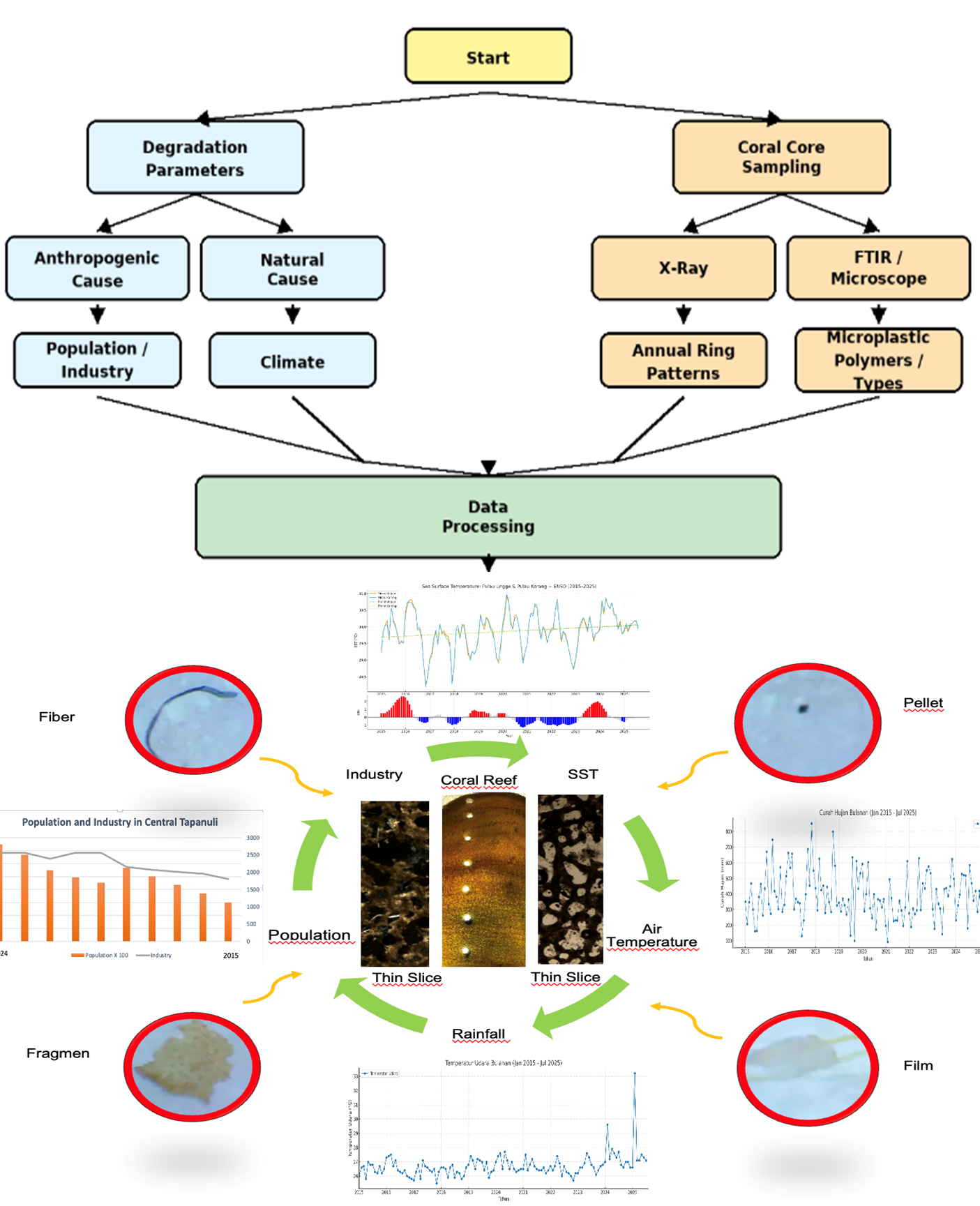
GRAPHICAL ABSTRACT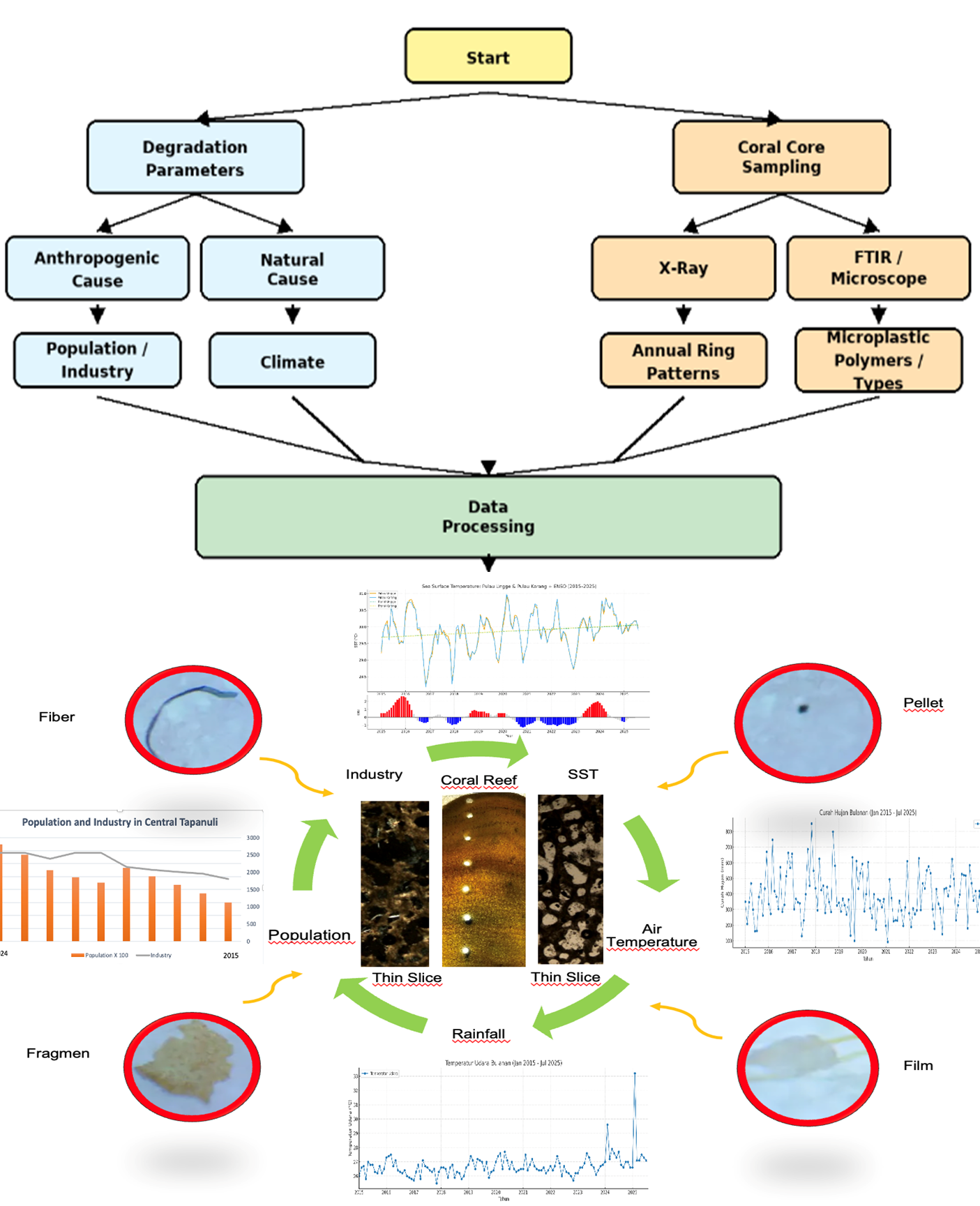
Downloads
References
WWF Internasional, Available at: https://wwf.panda.org/discover/knowledge_hub/where_we_work/coraltriangle/coraltrianglefacts, accessed January 2025.
H Ritchie, V Samborska and M Roser. Plastic pollution, Available at: https://ourworldindata.org/plastic-pollution, accessed January 2025.
Kementerian Lingkungan Hidup dan Kehutanan. Sistem Informasi Pengelolaan Sampah Nasional (SIPSN), Available at: https://sipsn.menlhk.go.id/, accessed January 2025.
K Zhang, AH Hamidian, A Tubić, Y Zhang, JKH Fang, C Wu and PKS Lam. Understanding plastic degradation and microplastic formation in the environment: A review. Environmental Pollution 2021; 274, 116554.
B Rani-Borges, E Gomes, G Maricato, LHF de Carvalho Lins, BR de Moraes, V Lima, LGF Côrtes, M Tavares, PHC Pereira, RA Ando and LG Queiroz. Unveiling the hidden threat of microplastics to coral reefs in remote South Atlantic islands. Science of The Total Environment 2023; 897, 165401.
SS Singh, R Chanda, NS Singh, Ramtharmawi, NR Devi, KV Devi, KK Upadhyay and SK Tripathi. Microplastic pollution: Exploring trophic transfer pathways and ecological impacts. Discover Environment 2024; 2(1), 103.
W Li, X Li, J Tong, W Xiong, Z Zhu, X Gao, S Li, M Jia, Z Yang and J Liang. Effects of environmental and anthropogenic factors on the distribution and abundance of microplastics in freshwater ecosystems. Science of The Total Environment 2023; 856(2), 159030.
R Rahmatsyah, R Juliani, S Syarifuddin, K Andini and RY Purba. Growth pattern and microplastic accumulation of Anadara spp. harvested from the eastern waters of North Sumatra Province, Indonesia. AACL Bioflux 2024; 17(5), 2139-2147.
R Rahmatsyah, S Syarifuddin, R Juliani, A F Azzahra, S Rahmeida and A S Batubara. Microplastic contamination of four important commercial fish in east coast of North Sumatera Province, Indonesia. The Philippine Journal of Fisheries 2024; 31(2), 321-330.
N Rafa, B Ahmed, F Zohora, J Bakya, S Ahmed, SF Ahmed, M Mofijur, AA Chowdhury and F Almomani. Microplastics as carriers of toxic pollutants: Source, transport, and toxicological effects. Environmental Pollution 2024; 343, 123190.
T Biswas, SC Pal, A Saha, D Ruidas, M Shit, ARMT Islam and G Malafaia. Microplastics in the coral ecosystems: A threat which needs more global attention. Ocean & Coastal Management 2024; 249, 107012.
S Jandang, MB Alfonso, H Nakano, N Phinchan, U Darumas, V Viyakarn, S Chavanich and A Isobe. Possible sink of missing ocean plastic: Accumulation patterns in reef-building corals in the Gulf of Thailand. Science of The Total Environment 2024; 954, 176210.
L Reuning, L Hildebrandt, DK Kersting and D Pröfrock. High levels of microplastics and microrubber pollution in a remote, protected Mediterranean Cladocora caespitosa coral bed. Marine Pollution Bulletin 2025; 217, 118070.
MO Soares, L Rizzo, ARX Neto, Y Barros, JE Filho, T Giarrizzo and EF Rabelo. Do coral reefs act as sinks for microplastics? Environmental Pollution 2023; 337, 122509.
V Tirpitz, M Hutter, H Hutter, J Prume, M Koch, T Wilke and J Reichert. Increasing microplastic concentrations have nonlinear impacts on the physiology of reef-building corals. Science of The Total Environment 2025; 960, 178318.
S Jandang, MB Alfonso, H Nakano, N Phinchan, U Darumas, V Viyakarn, S Chavanich and A Isobe. Possible sink of missing ocean plastic: Accumulation patterns in reef-building corals in the Gulf of Thailand. Science of The Total Environment 2024; 954, 176210.
L Reuning, L Hildebrandt, DK Kersting and D Pröfrock. High levels of microplastics and microrubber pollution in a remote, protected Mediterranean Cladocora caespitosa coral bed. Marine Pollution Bulletin 2025; 217, 118070.
KW Wilkins and RH Richmond. Unseen threats: Negative effects of microplastic leachate on coral planulae settlement. Frontiers in Marine Science 2025; 12, 1596594.
S Krishnakumar, S Anbalagan, SM Hussain, R Bharani, PS Godson and S Srinivasalu. Coral annual growth band impregnated microplastics (Porites sp.): A first investigation report. Wetlands Ecology and Management 2021; 29, 677-687.
Central Bureau of Statistics. Statistics Indonesia (BPD) publication portal, Available at: https://www.bps.go.id/publication/2025/, accessed January 2025.
BMKG. Pinang Sori Meteorological Station weather data report, Available at: https://www.bmkg.go.id/, accessed January 2025.
NP Jones and DS Gilliam. Temperature and local anthropogenic pressures limit stony coral assemblage viability in southeast Florida. Marine Pollution Bulletin 2024; 200, 116098.
MK Donovan, DE Burkepile, C Kratochwill, T Shlesinger, S Sully, TA Oliver, G Hodgson, J Freiwald and R van Woesik. Local conditions magnify coral loss after marine heatwaves. Science 2021; 372, 977-980.
J Cavailles, C Kuzmics and M Grube. Symbiont dynamics and coral regulation under changing temperatures. Coral Reefs 2025; 44, 1107-1126.
National Oceanic and Atmospheric Administration. NOAA Optimum Interpolation Sea Surface Temperature (OISST) version 2.1 daily data, Available at: https://psl.noaa.gov/data/gridded/data.noaa.oisst.v2.html, accessed January 2025.
CF Chen, YR Ju, MH Wang, YC Lim, CW Chen, YR Cheng and CD Dong. Microplastic pollution in stony coral skeletons and tissues: A case study of accumulation and interrelationship in South Penghu Marine National Park, Taiwan Strait. Journal of Hazardous Materials 2025; 484, 136761.
AS Wong, S Vrontos and ML Taylor. An assessment of people living by coral reefs over space and time. Global Change Biology 2022; 28, 7136-7153.
M Andrello, ES Darling, A Wenger, AF Suárez-Castro, S Gelfand and GN Ahmadia. A global map of human pressures on tropical coral reefs. Conservation Letters 2022; 15, 12858.
F Haque and C Fan. Fate of microplastics under the influence of climate change. iScience 2023; 26(9), 107649.
W Bian, Y Zeng, Y Li, G Na, J Mu, S Lv and M Liu. Microplastic pollution in tropical coral reef ecosystems from the coastal South China Sea and their impacts on corals in situ. Journal of Hazardous Materials 2024; 480, 135898.
C Hankins, D Lasseigne, SM Davis, K Edwards and JS Paul. Coral reef attributes associated with microplastic exposure. Coral Reefs 2025; 44, 193-207.
KMSN Abeysinghe, KPGKP Guruge, T Bandara and PBTP Kumara. Microplastic pollution status in the coral reef ecosystems on the Southern and Western coasts of Sri Lanka during the Southwest monsoon. Marine Pollution Bulletin 2024; 206, 116713.
Y Barros, MO Soares, AP Ayala, VS Neto, T Giarrizzo and RM Cavalcante. First evidence of microplastic contamination in the tissue and skeletons of the keystone reef-building coral Siderastrea stellata in coastal reefs. Discover Oceans 2025; 2, 20.
K Hansani, E Thilakarathne, JB Koongolla, W Gunathilaka, B Perera, W Weerasingha and K Egodauyana. Contamination of microplastics in tropical coral reef ecosystems of Sri Lanka. Marine Pollution Bulletin 2023; 194(A), 115299.
O Pantos. Microplastics: Impacts on corals and other reef organisms.Emerging Topics in Life Sciences 2022; 6(1), 81-93.
Z Zhou, L Wan, W Cai, J Tang, Z Wu and K Zhang. Species-specific microplastic enrichment characteristics of scleractinian corals from reef environment: Insights from an in-situ study at the Xisha Islands. Science of The Total Environment 2022; 815, 152845.
M Sutthacheep, C Chamchoy, W Suebpala, A Wongnutpranont, L Jungrak, W Aunkhongthong, S Pengsakun, W Klinthong, M Jowantha, L Sangsawang and T Yeemin. Assessment of microplastic pollution in corals, seawater, and marine sediments in the Gulf of Thailand. Frontiers in Marine Science 2025; 12, 1669901.
JB Axworthy, KS Lasdin and JL Padilla-Gamiño. Low incidence of microplastics in coral reefs of Kāne’ohe Bay, Hawai’i, USA. Marine Pollution Bulletin 2024; 208, 116996.
LP Yen, CLX Yong and PA Todd. The effect of coral colony morphology, coral surface condition, particle size, and seeding point on the trapping and deposition of microplastics. Science of The Total Environment 2024; 921, 171077.
KT Tahsin, N Sangmanee, C Chamchoy, S Phoaduang, T Yeemin and E Winijkul. Coral feeding behavior on microplastics. In: Microplastic occurrence, fate, impact, and remediation. Environmental Chemistry for a Sustainable World 2023; 73, 65-86.
V Isa, F Saliu, A Becchi, G Spadaccino, M Quinto, M Veronelli, M Lasagni, P Galli and S Lavorano. Impacts of microplastics on reef-building corals: Disentangling the contribution of the chain scission products released by weathering. Science of The Total Environment 2025; 975, 179239.
Y Aminot, C Lanctôt, V Bednarz, W J Robson, A Taylor, C Ferrier-Pagès, M Metian and I Tolosa. Leaching of flame-retardants from polystyrene debris: Bioaccumulation and potential effects on coral. Marine Pollution Bulletin 2020; 151, 110862.
S Veerasingam, M Ranjani, R Venkatachalapathy, A Bagaev, V Mukhanov and D Litvinyuk. Contributions of Fourier transform infrared spectroscopy in microplastic pollution research: A review. Environmental Science and Pollution Research 2021; 51(22), 2681-2743.
Y Chen, D Wen, J Pei, Y Fei, D Ouyang, H Zhang and Y Luo. Identification and quantification of microplastics using Fourier-transform infrared spectroscopy: Current status and future prospects. Current Opinion in Environmental Science & Health 2020; 18, 14-19.
J John, A R Nandhini, P V Chellam and M Sillanpää. Microplastics in mangroves and coral reef ecosystems: A review. Environmental Chemistry Letters 2022; 20, 397-416.
B Rani-Borges, E Gomes, G Maricato, LHF de Carvalho Lins, BR de Moraes, GV Lima, LGF Côrtes, M Tavares, PHC Pereira, RA Ando and LG Queiroz. Unveiling the hidden threat of microplastics to coral reefs in remote South Atlantic islands. Science of The Total Environment 2023; 891, 165401.
F Hierl, H C Wu and H Westphal. Scleractinian corals incorporate microplastic particles: Identification from a laboratory study. Environmental Science and Pollution Research 2021; 28, 37882-37893.
MN Rahman, SH Shozib, MY Akter, ARMT Islam, MS Islam, S Sohel, C Kamaraj, MRJ Rakib, AM Idris, A Sarker and G Malafaia. Microplastic as an invisible threat to the coral reefs: Sources, toxicity mechanisms, policy intervention, and the way forward. Journal of Hazardous Materials 2023; 454, 131522.
C Hankins, E Moso and D Lasseigne. Microplastics impair growth in two Atlantic scleractinian coral species, Pseudodiploria clivosa and Acropora cervicornis. Environmental Pollution 2021; 275, 116649.
M Rades, P Schubert, T Wilke and J Reichert. Reef-building corals do not develop adaptive mechanisms to better cope with microplastics. Frontiers in Marine Science 2022; 9, 863187.
E Corona, C Martin, R Marasco and CM Duarte. Passive and active removal of marine microplastics by a mushroom coral (Danafungia scruposa). Frontiers in Marine Science 2020; 7, 128.
J Patterson, KI Jeyasanta, RL Laju, AM Booth, N Sathish and JKP Edward. Microplastic in the coral reef environments of the Gulf of Mannar, India: Characteristics, distributions, sources and ecological risks. Environmental Pollution 2022; 298, 118848.
H Zhang, Y Nie, S Zhao, L Wu, X Xi, L Xu, Y Fang, X Long and X Liu. Distribution characteristics and transport pathways of soil microplastics in coral reef islands with different developmental stages and human activities. Marine Pollution Bulletin 2025; 215, 117848.
CKH Cheung and C Not. Impacts of extreme weather events on microplastic distribution in coastal environments. Science of The Total Environment 2023; 904, 166723.
MP Belioka and DS Achilias. The effect of weathering conditions in combination with natural phenomena/disasters on microplastics’ transport from aquatic environments to agricultural soils. Microplastics 2024; 3(3), 518-538.
C Li, X Wang, L Zhu, K Liu, C Zong, N Wei and D Li. Enhanced impacts evaluation of Typhoon Sinlaku (2020) on atmospheric microplastics in South China Sea during the East Asian summer monsoon. Science of The Total Environment 2022; 806(4), 150767.
L Piazzi, E Cecchi, MF Cinti and G Ceccherelli. Extreme events and conservation of subtidal habitats: Effects of a rainfall flood on coralligenous reefs. Marine Pollution Bulletin 2021; 165, 112106.
Y Yao and C Wang. Marine heatwaves and cold-spells in global coral reef zones. Progress in Oceanography 2022; 209, 102920.
Published
How to Cite
Issue
Section
License
Copyright (c) 2025 Walailak University

This work is licensed under a Creative Commons Attribution-NonCommercial-NoDerivatives 4.0 International License.





