
Sequential Solvent Extraction of Caesalpinia pulcherrima Yellow Flowers Reveals Potent Antioxidant, Antimicrobial, and Anticancer Activities Against Various Human Cancer Cell Lines
DOI:
https://doi.org/10.48048/tis.2025.9368Keywords:
Caesalpinia pulcherrima, Antimicrobial resistance, Anticancer, Antioxidant activity, Phytochemical propertiesAbstract
While the pursuit and development of novel drugs to combat emerging diseases is ongoing, many newly characterized compounds have been discovered in different parts of traditional medicinal plants. Numerous investigations have scrutinized the phytochemical properties of the leaf, flower, seed, and bark of Caesalpinia pulcherrima, revealing its noteworthy attributes as an herbal remedy employed in the treatment of diverse ailments. Our research aims to re-evaluate this medicinal plant, with a focus on the yellow flower, employing a sequential solvent extraction technique. Our findings revealed that a methanolic extract exhibited the highest antioxidant capacity in 3 colorimetric antioxidant assays: DPPH, ABTS, and FRAP. Extracts from the yellow flower of C. pulcherrima exhibited antimicrobial resistance against a wide range of both pathogenic Gram-positive and Acinetobacter baumannii isolates. Additionally, these extracts manifested anticancer properties against various cancer cell lines. Our investigation marks the first inhibition of cell proliferation of the bile duct cancer cell line (KKU-213A) by this crude extract. This study contributes valuable insights to the ongoing research of potential phytochemical properties from the yellow flower of C. pulcherrima, providing additional information for further research on the separation and purification of crude extracts from the yellow flower of C. pulcherrima. Ultimately, our study presents a promising approach to specifically screening phytochemicals from C. pulcherrima flowers that could be developed into new antibiotic drugs or anticancer agents.
HIGHLIGHTS
- Methanol was identified as the most effective solvent for extracting antioxidant compounds from Caesalpinia pulcherrima yellow flowers.
- Extracts obtained using hexane, ethyl acetate, and aqueous solutions exhibited antimicrobial activity against all tested gram-positive bacteria and some gram-negative strains.
- For the 1st time, this study demonstrated that ethyl acetate and methanol extracts showed significant cytotoxicity against the bile duct cancer cell line KKU-213A, indicating their potential for anticancer drug development.
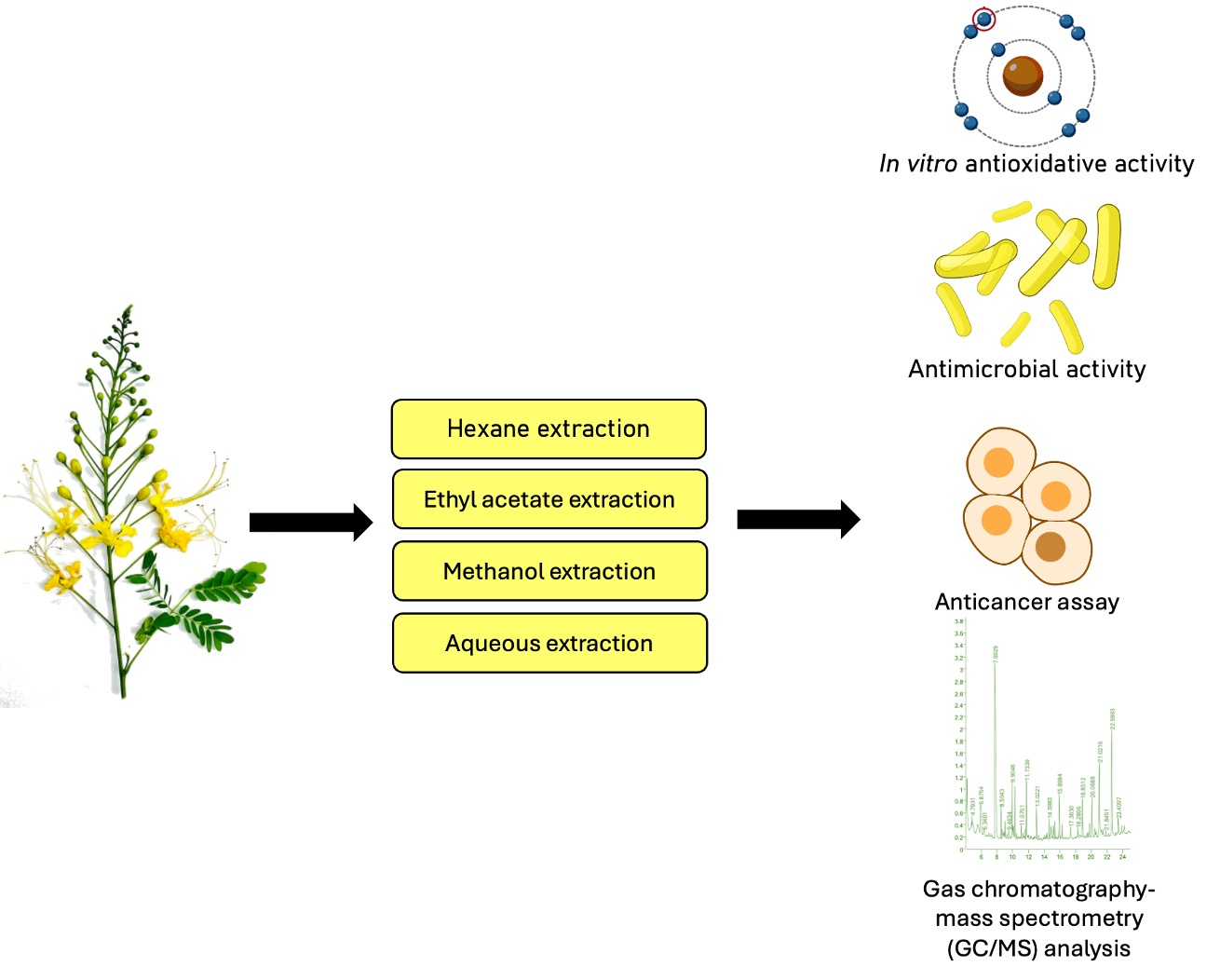
GRAPHICAL ABSTRACT

Downloads
References
Z Popović, R Matić, S Bojović, M Stefanović and V Vidaković. Ethnobotany and herbal medicine in modern complementary and alternative medicine: An overview of publications in the field of I&C medicine 2001 - 2013. Journal of Ethnopharmacology 2016; 181, 182-192.
H Yuan, Q Ma, L Ye and G Piao. The traditional medicine and modern medicine from natural products. Molecules 2016; 21(5), 559.
DS Fabricant and NR Farnsworth. The value of plants used in traditional medicine for drug discovery. Environmental Health Perspectives 2001; 109(S1), 69-75.
RR Mendonça‐Filho. Bioactive phytocompounds: New approaches in the phytosciences. In: I Ahmad, F Aqil and M Owais (Eds.). Modern phytomedicine: Turning medicinal plants into drugs. John Wiley & Sons, New Jersey, 2006.
TCSP Pires, L Barros, C Santos-Buelga and ICFR Ferreira. Edible flowers: Emerging components in the diet. Trends in Food Science & Technology 2019; 93, 244-258.
M Teixeira, W Tao, A Fernandes, A Faria, IMPLVO Ferreira, J He, VD Freitas, N Mateus and H Oliveira. Anthocyanin-rich edible flowers, current understanding of a potential new trend in dietary patterns. Trends in Food Science & Technology 2023; 138, 708-725.
M Skrajda-Brdak, G Dąbrowski and I Konopka. Edible flowers, a source of valuable phytonutrients and their pro-healthy effects - A review. Trends in Food Science & Technology 2020; 103, 179-199.
P Kumari, Ujala and B Bhargava. Phytochemicals from edible flowers: Opening a new arena for healthy lifestyle. Journal of Functional Foods 2021; 78, 104375.
TK Lim. Caesalpinia pulcherrima. In: Edible medicinal and non-medicinal plants. Springer Dordrecht, Netherlands, 2013, p. 766-772.
ARS Ribeiro, PBF Diniz, CS Estevam, MS Pinheiro, RLC Albuquerque-Júnior and SM Thomazzi. Gastroprotective activity of the ethanol extract from the inner bark of Caesalpinia pyramidalis in rats. Journal of Ethnopharmacology 2013; 147(2), 383-388.
JF Morton. Caribbean and Latin American folk medicine and its influence in the United States. Quarterly Journal of Crude Drug Research 1980; 18(2), 57-75.
H Takawale, V Mute, D Awari, VI Hukkeri, P Mehta and P Vawhal. Screening of antiulcer activity of Caesalpinia pulcherrima L. bark. against aspirin induced ulcer in rats. World Journal of Medical Sciences 2011; 6(4), 168-172.
SMU Gilani, S Ahmed, SG Baig and MM Hasan. Ethnopharmacognosy, phytochemistry and pharmacology of genus Caesalpinia: A review. Journal of Pharmacognosy and Phytochemistry 2019; 8(4), 2222-2229.
SS Phuse and ZH Khan. Influence of extraction methods using different solvents on Caesalpinia pulcherrima leavaes. International Journal of Pharma and Bio Sciences 2017; 8(2), 829-837.
C Rajaram, K Reddy and K Sekhar. Evaluation of anti-arthritic activity of Caesalpinia pulcherrima in freund’s complete adjuvant induced arthritic rat model. Journal of Young Pharmacists 2015; 7(2), 128-132.
A Raj, A Sharma, N Singh, P Kumar, A Singh, V Bhatia and SK Sharma. Studies on anti-fertility activity of peacock flower (Caaesalpinia pulcherrima) on uterine morphology of rat (Rattus rattus). In: Proceedings of the Reviewed Proceeding National Seminar on Internet: Applications in Research, Haryana, India. 2011, p. 7-15.
S Kumar, J Singh, A Baghotia, V Mehta, V Thakur, M Choudhary, S Verma and D Kumar. Antifertility potential of the ethanolic extract of Caesalpinia pulcherrima Linn. leaves. Asian Pacific Journal of Reproduction 2013; 2(2), 90-92.
GS Chakraborthy and RS Badujar. Antioxidant activity of the successive extracts of Caesalpinia pulcherrima leaves. International Journal of Pharmaceutical and Clinical Research 2009; 1(2), 75-76.
F Hussain, SMR Dewan, MM Hassan, S Akter and M Meshkat. In vitro antimicrobial and antioxidant activities evaluation of methanolic extract of Caesalpinia pulcherrima flowers. International Research Journal of Pharmacy 2013; 4, 30-32.
S Pulipati, G Pallavi, B Sujan, KA Babu and PS Babu. Evaluation of antibacterial activity of fresh and dry flower extracts of Caesalpinia pulcherrima L. International Journal of Biological Pharmaceutical Research 2012; 3(3), 360-365.
XM Chen, W Lu, ZH Zhang, JY Zhang, TML Tuong, LL Liu, YH Kim, CH Li and JM Gao. Cassane diterpenoids from the aerial parts of Caesalpinia pulcherrima and their antibacterial and anti-glioblastoma activity. Phytochemistry 2022; 196, 113082.
O Erharuyi, A Adhikari, A Falodun, A Jabeen, R Imad, M Ammad, MI Choudhary and N Gören. Cytotoxic, anti-inflammatory, and leishmanicidal activities of diterpenes isolated from the roots of Caesalpinia pulcherrima. Planta Medica 2017; 83(1-2), 104-110.
N Promsawan, P Kittakoop, S Boonphong and P Nongkunsarn. Antitubercular cassane furanoditerpenoids from the roots of Caesalpinia pulcherrima. Planta Medica 2003; 69(8), 776-777.
BAD Carvalho, OS Domingos, M Massoni, MHD Santos, M Ionta, JHG Lago, CR Figueiredo, AL Matsuo and MG Soares. Essential oil from Caesalpinia peltophoroides flowers-chemical composition and in vitro cytotoxic evaluation. Natural Product Communications 2013; 8(5), 679-682.
G Zengin, MF Mahomoodally, MCN Picot-Allain, KI Sinan, G Ak, OK Etienne, E Sieniawska, M Maciejewska-Turska, Ł Świątek, B Rajtar and M Polz-Dacewicz. Chemical composition, biological properties and bioinformatics analysis of two Caesalpina species: A new light in the road from nature to pharmacy shelf. Journal of Pharmaceutical and Biomedical Analysis 2021; 198, 114018.
K Larsen, SS Larsen and JE Vidal. Flora of Thailand: Leguminosae - caesalpinioideae. Forest Herbarium, Royal Forest Department, Bangkok, Thailand, 1984.
EA Ainsworth and KM Gillespie. Estimation of total phenolic content and other oxidation substrates in plant tissues using Folin-Ciocalteu reagent. Nature Protocols 2007; 2(4), 875-877.
TJ Herald, P Gadgil and M Tilley. High‐throughput micro plate assays for screening flavonoid content and DPPH‐scavenging activity in sorghum bran and flour. Journal of the Science of Food and Agriculture 2012; 92(11), 2326-2331.
A Nowak, A Klimowicz, W Duchnik, Ł Kucharski, K Florkowska, A Muzykiewicz, D Wira, J Zielonkabrzezicka, A Siedłowska and K Nadarzewska. Application of green-extraction technique to evaluate of antioxidative capacity of wild population of fireweed. Herba Polonica 2019; 65(4), 18-30.
K Thaipong, U Boonprakob, K Crosby, L Cisneros-Zevallos and DH Byrne. Comparison of ABTS, DPPH, FRAP, and ORAC assays for estimating antioxidant activity from guava fruit extracts. Journal of Food Composition and Analysis 2006; 19(6-7), 669-675.
W Sirisarn, A Mordmuang, K Kerdkumthong and S Saeheng. Exploring Bougainvillea glabra flowers: A promising source of natural antimicrobial and anticancer agents. Journal of Applied Biology & Biotechnology 2024; 12(6), 174-184.
GLTD Torre, EC Arollado, AA Atienza and RAM Manalo. Evaluation of antioxidant capacity and identification of bioactive compounds of crude methanol extracts of Caesalpinia pulcherrima (L.) swartz. Indian Journal of Pharmaceutical Sciences 2017; 79(1), 113-123.
MN Vivek, HCS Swamy, M Manasa, S Pallavi, Y Kambar, MM Asha, M Chaithra, TRP Kekuda, N Mallikarjun and R Onkarappa. Antimicrobial and antioxidant activity of leaf and flower extract of Caesalpinia pulcherrima, Delonix regia and Peltaphorum ferrugineum. Journal of Applied Pharmaceutical Science 2013; 3(8), 64-71.
GS Chakraborthy. Antioxidant activity of the successive extracts of Caesalpinia pulcherrima flowers. Pharmacologyonline 2009; 1, 362-365.
N Chaves, A Santiago and JC Alías. Quantification of the antioxidant activity of plant extracts: Analysis of sensitivity and hierarchization based on the method used. Antioxidants 2020; 9(1), 76.
A Farooqui, A Khan, I Borghetto, SU Kazmi, S Rubino and B Paglietti. Synergistic antimicrobial activity of Camellia sinensis and Juglans regia against multidrug-resistant bacteria. PloS One 2015; 10(2), e0118431.
LA Refahy, TA Farghaly, MS Abdel-Aziz and TS Mohamed. Antimicrobial, antioxidant and cytotoxic potential of Caesalpinia pulcherrima flower. Medicine, Environmental Science, Biology 2015; 9(2), 150-158.
HCS Swamy, MM Asha, M Chaithra, MN Vivek, Y Kambar and TRP Kekuda. Antibacterial activity of flower extract of Caesalpinia pulcherrima, Delonix regia and Peltaphorum ferrugineum against urinary tract pathogens. International Research Journal of Biological Sciences 2014; 3(4), 80-83.
OT Osuntokun, J Ju and T Oa. Bioprospective screening of antibacterial and phytochemical activity of Caesalpinia pulcherrima (pride of Barbados) on selected clinical isolate. Bioequivalence & Bioavailability International Journal 2017; 1(3), 118.
NS Sakle, D Lokwani and SN Mokale. Caesalpinia pulcherrima arrests cell cycle and triggers reactive oxygen species-induced mitochondrial-mediated apoptosis and necroptosis via modulating estrogen and estrogen receptors. Pharmacognosy Magazine 2019; 15(S2), S288-S297.
B Das, Y Srinivas, C Sudhakar, I Mahender, K Laxminarayana, PR Reddy, TV Raju, NM Jakka and JV Rao. New diterpenoids from Caesalpinia species and their cytotoxic activity. Bioorganic & Medicinal Chemistry Letters 2010; 20(9), 2847-2850.
S Mallapur, PR Biradar, SA Kavatagimath, P Patil, V Patil and N Kudatarkar. Pharmacological evaluation of Caesalpinia pulcherrima leaf extract for anticancer activity against Ehrlich Ascites Carcinoma bearing mice. Indian Journal of Pharmaceutical Education and Research 2021; 55(1), 164-173.
EC Kim, YS Hwang, HJ Lee, SK Lee, MH Park, BH Jeon, CD Jeon, SK Lee, HH Yu and YO You. Caesalpinia sappan induces cell death by increasing the expression of p53 and p21WAF1/CIP1 in head and neck cancer cells. The American Journal of Chinese Medicine 2005; 33(3), 405-414.
AD Patil, AJ Freyer, RL Webb, G Zuber, R Reichwein, MF Bean, L Faucette and RK Johnson. Pulcherrimins A - D, novel diterpene dibenzoates from Caesalpinia pulcherrima with selective activity against DNA repair-deficient yeast mutants. Tetrahedron 1997; 53(5), 1583-1592.
AO Ogunbinu, S Okeniyi, G Flamini, PL Cioni and IA Ogunwande. Monoterpenoid constituents of the volatile oils of Cynometra megalophylla harms., Caesalpinia pulcherrima L. swartz and Pachylobus edulis G. Don., growing in Nigeria. Journal of Essential Oil Research 2010; 22(6), 536-539.
K Jaikumar, MSN Mohamed, WJ Wyson, M Deventhiran, D Anand and P Saravanan. Phytochemical analysis of Caesalpinia pulcherrima (L.) Sw. leaf extract using GC-MS analysis. International Journal of Pharmaceutical Sciences and Drug Research 2017; 9(2), 90-93.
Downloads
Published
How to Cite
Issue
Section
License
Copyright (c) 2024 Walailak University

This work is licensed under a Creative Commons Attribution-NonCommercial-NoDerivatives 4.0 International License.





