
Teratogen and Hematology Effects of Ethanol Extract from Unripe Pisang Kayu (Musa paradisiaca L. var. Kayu) on Mice (Mus musculus)
DOI:
https://doi.org/10.48048/tis.2025.9332Keywords:
Anti-diarrheal, Differential leukocytes, Hematology, Malformation, Pisang Kayu, TeratogenAbstract
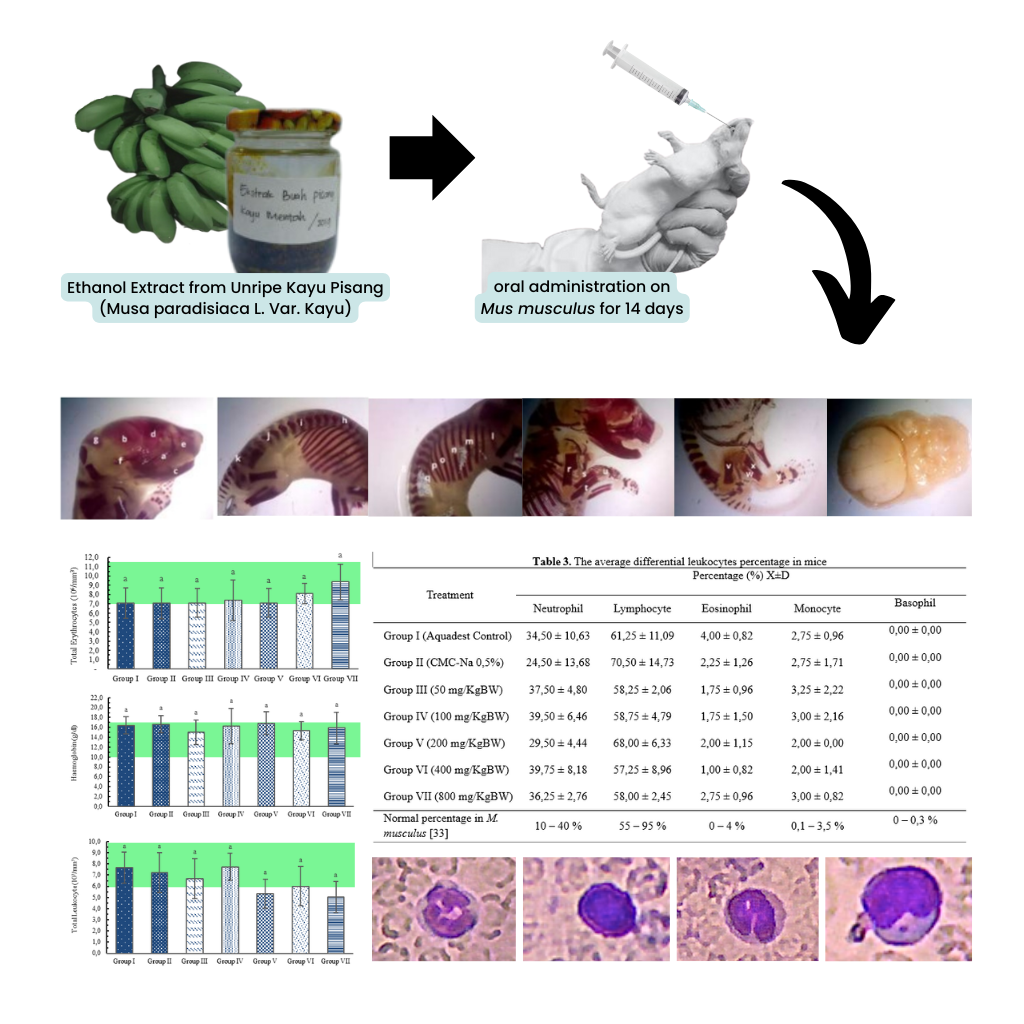
Unripe Pisang Kayu (Musa paradisiaca L. var. Kayu) has been traditionally used in Senduro Village, Lumajang, East Java, as a remedy for diarrhea, with the unripe fruit typically prepared by roasting, steaming or boiling. This traditional use highlights the need to develop it into standardized herbal medicine for broader healthcare applications, necessitating rigorous safety and efficacy evaluations, including preclinical studies. This study aimed to assess the teratogenic and hematological effects of its ethanol extract on female mice (Mus musculus) as part of these evaluations. Mice were administered varying doses (50 - 800 mg/kg BW) of the extract for 14 days, with hematological parameters, including erythrocyte and leukocyte counts, hemoglobin levels and differential leukocyte profiles, measured alongside teratogenicity assessments of fetal length, weight, skeletal structure and organ formation. Observations revealed no significant differences in blood parameters or fetal development between treated and control groups, with no malformations or abnormalities detected. These results suggest that the ethanol extract of unripe Pisang Kayu is non-toxic at tested doses and safe for use, supporting its potential as a standardized herbal antidiarrheal remedy. Further studies, including chronic toxicity and clinical trials, are recommended to ensure its safety and efficacy for human application.
HIGHLIGHTS
- The study found no significant differences in fetal length, weight or organ development between the dose groups (50, 100, 200, 400 and 800 mg/kg BW) and control groups, with 1-way ANOVA analysis (p > 0.05) showing no effect from the extract.
- Hematological analysis demonstrated no significant impact on erythrocyte, hemoglobin or leukocyte counts on female mice, confirming the extract’s safety for maternal health.
- This study validates the safety of Pisang Kayu (Musa paradisiaca var. Kayu) extract, demonstrating that it does not cause significant adverse effects on fetal development or maternal health, thereby supporting its potential as a standardized herbal treatment for diarrhea.
GRAPHICAL ABSTRACT
Downloads
References
DJ Newman and GM Cragg. Natural products as sources of new drugs over the nearly four decades from 01/1981 to 09/2019. Journal of Natural Products 2020; 83(3), 770-803.
ICS Klau, AW Ningsih and WFI Putra. Profil rendemen ekstrak dan fraksi kulit buah, daging buah dan buah pisang mentah (Musa paradisiaca L.) (in Indonesian). Journal of Pharmacy Science and Technology 2022; 3(1), 181-190.
AW Ningsih. 2010, Uji efek antidiare ekstrak buah pisang (Musa paradisiaca) pada mencit (Mus Muculus) jantan galur Balb-C (in Indonesian). Bachelor’s Thesis. Universitas Jember, Jember, Indonesia.
AW Ningsih, M Rochmanti and A Basori. Effectiveness of antidiarrheal unripe wooden banana (Musa paradisiaca L.) in male Balb-C/mice induced with Escherichia coli. Folia Medica Indonesiana 2021; 56(3), 208-215.
TL Zafirah. 2023, Uji toksistas subkronis ekstrak etanol buah mentah pisang kayu (Musa paradisiaca L. var. Kayu) terhadap histopatologi lambung mencit (in Indonesian). Ph. D. Dissertation. Universitas Anwar Medika, Jawa Timur, Indonesia.
C Clinton. Plant tannins: A novel approach to the treatment of ulcerative colitis. Natural Medicine Journal 2015; 2, 1-4.
E Aas. Traditional tannin-treatment against intestinal parasites in sheep and cattle. Ethnobotany Research and Applications 2008; 1, 31-38.
SK Bardal, JE Waechter and DS Martin. Applied pharmacology. Elsevier Health Sciences, Amsterdam, Netherlands, 2011.
KI Astuti, LD Wulandari and EF Susiani. Antidiarrheal activity of ethanolic extract of Vernonia amygdalina Del leaves against male mice induced by oleum ricini. Borneo Journal of Pharmacy 2019; 2(1), 10-14.
AW Ningsih, A Syahrani, AW Septama and Sukardiman. Predicting toxicity and conducting molecular docking analysis of compounds from unripe kayu banana fruit (Musa paradisiaca L. var. Kayu) against 3mzd and 2q85 proteins in Escherichia coli for antibacterial activity (in Indonesian). Pharmacy Education 2024; 24(3), 329-335.
ER Yuslianti, BM Bachtiar, DF Suniarti and AB Sudjiatmo. Standardisasi farmasetikal bahan alam menuju fitofarmaka untuk pengembangan obat tradisional Indonesia (in Indonesian). Dentika Dental Journal 2016; 19(2), 179-185.
JG Fox, SW Barthold, MT Davisson, CE Newcomer, FW Quimby and AL Smith. The mouse in biomedical research. Elsevier, Amsterdam, Netherlands, 2007.
SF Gilbert and MJ Barresi. Developmental biology. Sinauer Associates, Sunderland, England, 2016.
LJ Pillitteri, X Guo and J Dong. Asymmetric cell division in plants: Mechanisms of symmetry breaking and cell fate determination. Cellular and Molecular Life Sciences 2016; 73(22), 4213-4229.
K Enjelika, PD Pratiwi, Yuliawati and MR Efendi. Uji efek teratogenik ekstrak etanol daun andong merah (Cordyline fruticosa L) pada fetus mencit putih (Mus musculus. L) (in Indonesian). Indonesian Journal of Pharma Science 2022; 4(2), 132-142.
AP Bolliger and N Everds. Haematology of the mouse. In: MA Suckow, S Hashway and KR Pritchett-Corning (Eds.). The laboratory mouse. Academic Press, Cambridge, 2012, p. 133-170.
P Wexler. Encyclopedia of toxicology. Academic Press, Cambridge, 2014.
IM Washington and GV Hoosier. Clinical biochemistry and hematology. In: MA Suckow, KA Stevens and RP Wilson (Eds.). The laboratory rabbit, guinea pig, hamster, and other rodents. Academic Press, Cambridge, 2012, p. 57-116.
JG Wilson and J Warkany. Teratology: Principles and techniques. University of Chicago Press, Chicago, 1993.
L Muna, OP Astirin and Sugiyarto. Teratogenic test of Pandanus conoideus var. yellow fruit extract to development of rat embryo (Rattus norvegicus). Nusantara Bioscience 2010; 2(3), 126-134.
HB Santoso. Kelainan struktur anatomi skeleton fetus mencit akibat kafein (in Indonesian). Bioscientiae 2004; 1(2), 23-30.
Badan Pengawas Obat dan Makanan RI. Peraturan badan pengawas obat dan makanan nomor 24 Tahun 2017 tentang kriteria dan tata laksana registrasi obat. Badan Pengawas Obat dan Makanan RI, Jakarta, Indonesia, 2017.
HE White, A Goswami and AS Tucker. The intertwined evolution and development of sutures and cranial morphology. Frontiers in Cell and Developmental Biology 2021; 9, 653579.
T Iwaki. A color atlas of sectional anatomy of the mouse. Braintree Scientific, Massachusetts, 2001.
OE Nelsen. Comparative embryology of the vertebrates. Literary Licensing, Montana, 2012.
MIH Mondal and MS Yeasmin. Toxicity study of food-grade carboxymethyl cellulose synthesized from maize husk in Swiss albino mice. International Journal of Biological Macromolecules 2016; 92, 965-971.
K Naka, T Muraguchi, T Hoshii and A Hirao. Regulation of reactive oxygen species and genomic stability in hematopoietic stem cells. Antioxidants & Redox Signaling 2008; 10(11), 1883-1894
B Little, N Sud, Z Nobile and D Bhattacharya. Teratogenic effects of maternal drug abuse on developing brain and underlying neurotransmitter mechanisms. Neurotoxicology 2021; 86, 172-179.
Y Fratiwi. The potential of guava leaf (Psidium guajava L.) for diarrhea. Eureka Herba Indonesia 2022; 3(1), 131-135.
S Rahimah, M Salampe and N Rahmania. Uji toksisitas teratogenik ekstrak etanol daun asam jawa (Tamarindus indica Linn) terhadap tikus (Rattus norvegicus) (in Indonesian). Jurnal Ilmiah As-Syifaa 2020; 12(1), 29-35.
JE Harkness, PV Turner, SV Woude and CL Wheler. Harkness and Wagner’s biology and medicine of rabbits and rodents. 5th ed. John Wiley & Sons, New Jersey, 2010.
F Lang and M Föller. Erythrocytes: Physiology and pathophysiology. Imperial College Press, London, 2012.
NN Etim, ME Williams, U Akpabio and EEA Offiong. Haematological parameters and factors affecting their values agricultural science haematological parameters and factors affecting their values. Agricultural Science 2014; 2(1), 37-47.
PP Chmielewski and B Strzelec. Elevated leukocyte count as a harbinger of systemic inflammation, disease progression, and poor prognosis: A review. Folia Morphologica 2018; 77(2), 171-178.
NE Everds. Hematology of the laboratory mouse. In: JG Fox, MT Davisson, FW Quimby, SW Barthold, CE Newcomer and AL Smith (Eds.). The mouse in biomedical research: History, wild mice, and genetics. 2nd ed. Academic Press, Cambridge, 2007.
MH Pan, CS Lai and CT Ho. Anti-inflammatory activity of natural dietary flavonoids. Food & Function 2010; 1(1), 15-31.
K Tietze. Clinical skills for pharmacists. Elsevier, Amsterdam, Netherlands, 2012.
RD Septianto, IBK Ardana, IW Sudira and OAAG Dharmayudha. Profil hematologi mencit pasca pemberian jamu temulawak secara oral (in Indonesian). Buletin Veteriner Udayana 2015; 7(1), 34-40.
F Ummah, M Belladonna and R Retnaningsih. Rasio neutrofil limfosit darah tepi sebagai indikator outcome pada stroke iskemik akut (in Indonesian). Diponegoro Medical Journal 2016; 5(4), 827-841.
AW Ningsih, A Syahrani, AW Septama and Sukardiman. Metabolit profilling and antibacterial activity of ethanol extract of the unripe fruit peel of Kayu banana (Musa paradisiaca L. var. Kayu). Trends in Sciences 2024; 21(2), 7154.
A Sundaryono. Uji aktivitas senyawa flavonoid total dari gynura segetum (Lour) terhadap peningkatan eritrosit dan penurunan leukosit pada mencit (Mus musculus) (in Indonesian). Jurnal Exacta 2011; 9(2), 8-16.
K Afsana, K Shiga, S Ishizuka and H Hara. Reducing effect of ingesting tannic acid on the absorption of iron, but not of zinc, copper and manganese by rats. Bioscience, Biotechnology, and Biochemistry 2004; 68(3), 584-592.
Asnilawati, E Restia, N Tadulako and D Miranda. Pengaruh ekstrak daun sungkai (Peronema canescens Jack) terhadap kadar leukosit, LED dan hematokrit pada mencit jantan (Mus musculus L.) yang terpapar Staphylococcus aureus (in Indonesian). Jurnal Aisyiyah Medika 2024; 9(1), 338-359.

Published
How to Cite
Issue
Section
License
Copyright (c) 2024 Walailak University

This work is licensed under a Creative Commons Attribution-NonCommercial-NoDerivatives 4.0 International License.





