
Optimization of Media, Expression Conditions and Extraction of SrUGT76G1 Glucosyltransferase and Sucrose Synthase for Glycoside Production
DOI:
https://doi.org/10.48048/tis.2025.9272Keywords:
Sucrose synthase, SrUGT76G, Glycosyltransferase, Box-Behnken design, Recombinant protein expression, MicrofluidizationAbstract
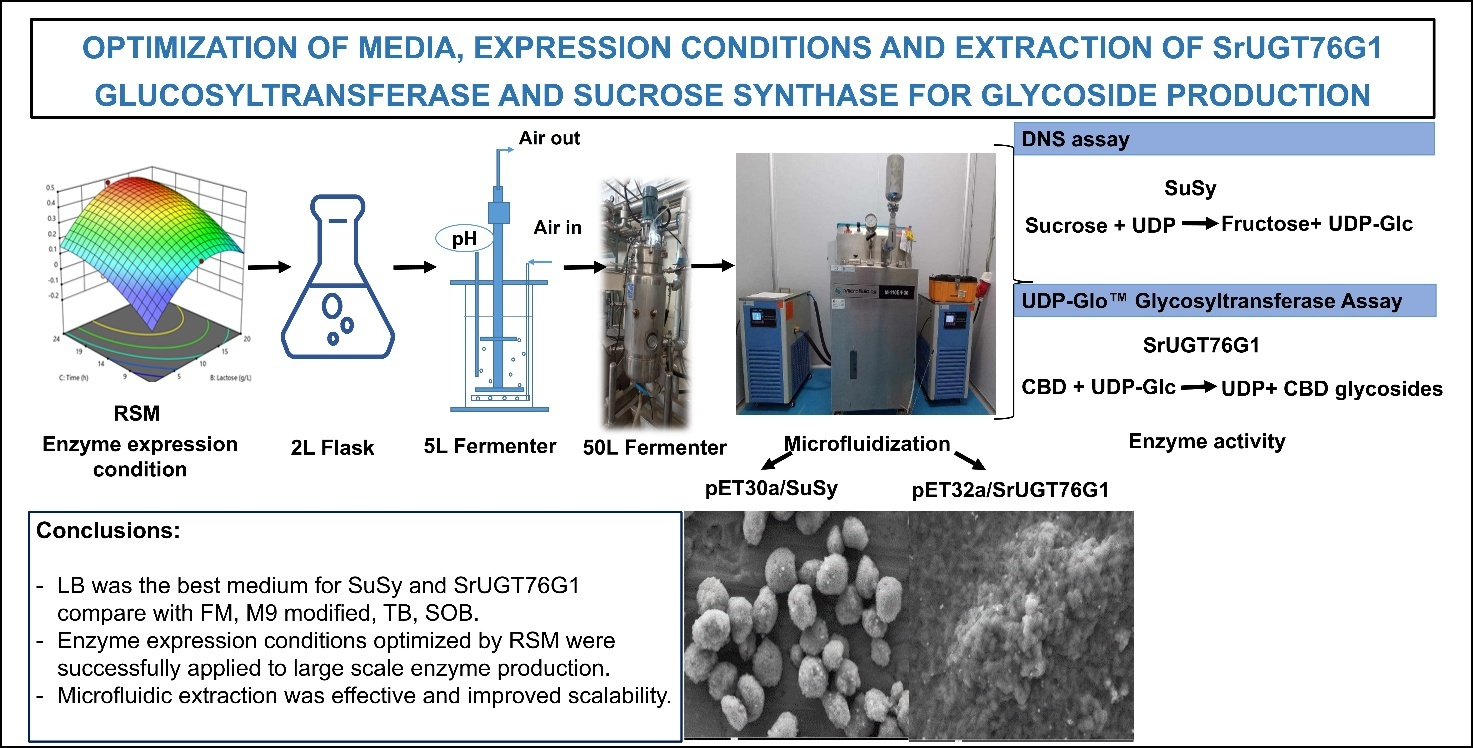
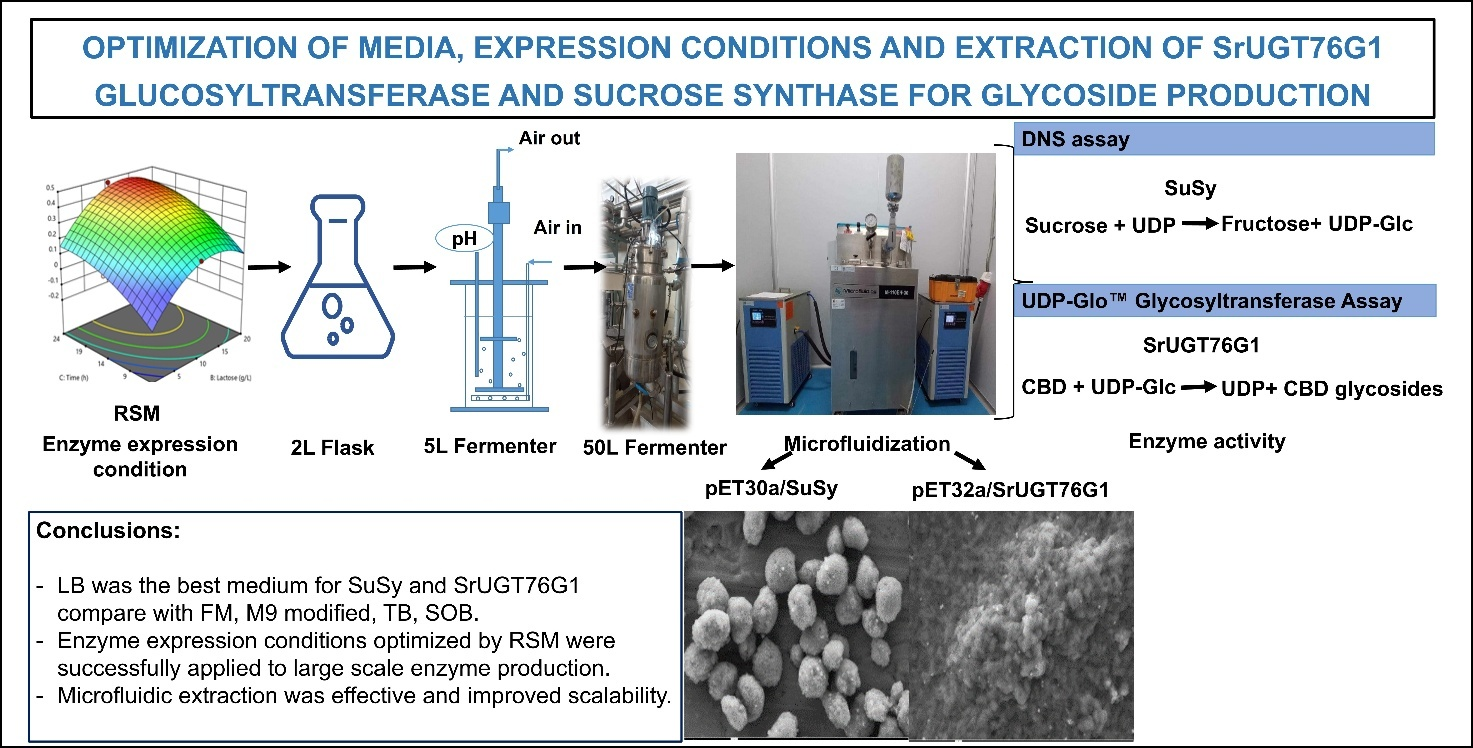
The objective of this work was to produce the soybean sucrose synthase and SrUGT76G1 glucosyltransferase for glycoside production. Media, expression conditions, fermentation, and extraction were screened to gain high amounts of soluble enzymes from E. coli BL21(DE3). Lysogeny broth (LB) was identified as the best of 5 media tested. Then, Box-Behnken design was used to determine the suitable expression conditions, including temperature, lactose concentration, and time. Application of the expression conditions identified in flask cultures to the fermenter successfully increased the soluble enzymes from 7.3 to 14.1 mg/L for sucrose synthase, and from 14 to 17.7 mg/L for SrUGT76G1. To improve scalability, microfluidization was used for extraction and the condition of 25 g/L cell concentration and 69 MPa pressure gave 86 % disruption efficiency in a single pass, after which cell fragmentation was observed by scanning electron microscopy. The yields of sucrose synthase and SrUGT76G1 were 12.7 ± 1.2 and 18.4 ± 1.2 mg/L, respectively. This work demonstrates the benefit of surface response methodology in optimizing enzyme production for glycosylation reactions.
HIGHLIGHTS
- Optimal conditions for SuSy and SrUGT76G1 were identified by Box-Behnken design.
- The optimal conditions could be scaled up to 5-L and 50-L fermenters with higher yields.
- Microfluidization provided efficient enzyme extraction for economical scalability.
GRAPHICAL ABSTRACT
Downloads
References
H Idrees, SZJ Zaidi, A Sabir, RU Khan, X Zhang and SU Hassan. A review of biodegradable natural polymer-based nanoparticles for drug delivery applications. Nanomaterials 2020; 10(10), 1970.
RB Gurung, SY Gong, D Dhakal, TT Le, NR Jung, HJ Jung, TJ Oh and JK Sohng. Synthesis of curcumin glycosides with enhanced anticancer properties using one-pot multienzyme glycosylation technique. Journal of Microbiology Biotechnology 2017; 27(9), 1639-1648.
S Zhang, Q Liu, C Lyu, J Chen, R Xiao, J Chen, Y Yang, H Zhang, K Hou and W Wu. Characterizing glycosyltransferases by a combination of sequencing platforms applied to the leaf tissues of Stevia rebaudiana. BMC Genomics 2020; 21(1), 794.
JM Hardman, RT Brooke and BJ Zipp. Cannabinoid glycosides: In vitro production of a new class of cannabinoids with improved physicochemical properties. bioRxiv 2017. https://doi.org/10.1101/104349.
W Shu, H Zheng, X Fu, J Zhen, M Tan, J Xu, X Zhao, S Yang, H Song and Y Ma. Enhanced heterologous production of glycosyltransferase UGT76G1 by co-expression of endogenous prpD and malK in Escherichia coli and its transglycosylation application in production of rebaudioside. International Journal of Molecular Science 2020; 21(16), 5752.
CE Okonkwo, AA Adeyanju, H Onyeaka, CO Nwonuma, AF Olaniran, OO Alejolowo, AA Inyinbor, AP Oluyori and C Zhou. A review on rebaudioside M: The next generation steviol glycoside and noncaloric sweetener. Journal of Food Science 2024; 89(11), 6946-6965.
L Chen, R Cai, J Weng, Y Li, H Jia, K Chen, M Yan and P Ouyang. Production of rebaudioside D from stevioside using a UGTSL2 Asn358Phe mutant in a multi-enzyme system. Microbial Biotechnology 2020; 13(4), 974-983.
O Stein and D Granot. An overview of sucrose synthases in plants. Frontiers in Plant Science 2019; 10, 95.
L Bungaruang, A Gutmann and B Nidetzky. Leloir glycosyltransferases and natural product glycosylation: Biocatalytic synthesis of the c-glucoside nothofagin, a major antioxidant of redbush herbal tea. Advanced Synthesis and Catalysis 2013; 355(14-15), 2757-2763.
Y Hu, J Min, Y Qu, X Zhang, J Zhang, X Yu and L Dai. Biocatalytic synthesis of calycosin-7-o-β-d-glucoside with uridine diphosphate-glucose regeneration system. Catalysts 2020; 10(2), 258.
A Gutmann, A Lepak, M Diricks, T Desmet and B Nidetzky. Glycosyltransferase cascades for natural product glycosylation: Use of plant instead of bacterial sucrose synthases improves the UDP-glucose recycling from sucrose and UDP. Biotechnology Journal 2017; 12(7), 1600557.
ZX Zhang, FT Nong, YZ Wang, CX Yan, Y Gu, P Song and XM Sun. Strategies for efficient production of recombinant proteins in Escherichia coli: Alleviating the host burden and enhancing protein activity. Microbial Cell Factories 2022; 21, 191.
PP Navarro, A Vettiger, VY Ananda, PM Llopis, C Allolio, TG Bernhardt and LH Chao. Cell wall synthesis and remodelling dynamics determine division site architecture and cell shape in Escherichia coli. Nature Microbiology 2022; 7(10), 1621-1634.
SH Meglič, N Janež, M Peterka, K Flisar, T Kotnik and D Miklavčič. Evaluation and optimization of protein extraction from E. coli by electroporation. Frontiers in Bioengineering and Biotechnology 2020; 8, 548187.
ZE Duman-Özdamar, A Ünlü, H Ünal, JM Woodley and BB Nay. High-yield production of active recombinant S. simulans lysostaphin expressed in E. coli in a laboratory bioreactor. Protein Expression and Purification 2021; 177, 105753.
YC Cheng, DL Jin, WT Yu, BY Tan, JJ Fu and YW Chen. Impact of thermal ultrasound on enzyme inactivation and flavor improvement of sea cucumber hydrolysates. Food Chemistry 2024; 449, 139302.
APJ Middelberg. 2 Microbial cell disruption by high-pressure homogenization. In: MA Desai (Ed.). Downstream processing of proteins: Methods in biotechnology. Humana Press, Totowa, New Jersey, 2000, p. 11-21.
TMM Bernaerts, L Gheysen, I Foubert, ME Hendrickx and AMV Loey. Evaluating microalgal cell disruption upon ultra high pressure homogenization. Algal Research 2019; 42, 101616.
A Purohit, L Pawar and SK Yadav. Fermenter scale production of recombinant beta-mannanase by E. coli BL21 cells under microaerobic environment. Carbohydrate Research 2024; 541, 109150.
A Fazaeli, A Golestani, M Lakzaei, SSR Varaei and M Aminian. Expression optimization, purification, and functional characterization of cholesterol oxidase from Chromobacterium sp. DS1. PLoS One 2019; 14(2), e0212217.
A Soares, LC Gomes, GA Monteiro and FJ Mergulhão. The influence of nutrient medium composition on Escherichia coli biofilm development and heterologous protein expression. Applied Sciences 2021; 11(18), 8667.
JD Rosa, AJC Viana, FRA Ferreira, A Koltun, LM Mertz-Henning, SRR Marin, EL Rech and AL Nepomuceno. Optimizing dsRNA engineering strategies and production in E. coli HT115 (DE3). Journal of Industrial Microbiology and Biotechnology 2024; 51, kuae028.
ST Kulmer, A Gutmann, M Lemmerer and B Nidetzky. Biocatalytic cascade of polyphosphate kinase and sucrose synthase for synthesis of nucleotide-activated derivatives of glucose. Advanced Synthesis and Catalysis 2017; 359(2), 292-301.
L Dai, C Liu, J Li, C Dong, J Yang, Z Dai, X Zhang and Y Sun. One-pot synthesis of ginsenoside Rh2 and bioactive unnatural ginsenoside by coupling promiscuous glycosyltransferase from Bacillus subtilis 168 to sucrose synthase. Journal of Agricultural and Food Chemistry 2018; 66(11), 2830-2837.
K Schmölzer, A Gutmann, M Diricks, T Desmet and B Nidetzky. Sucrose synthase: A unique glycosyltransferase for biocatalytic glycosylation process development. Biotechnology Advances 2016; 34(2), 88-111.
J Yu, Y Tao, H Pan, L Lin, J Sun, R Ma, Y Li and H Jia. Mutation of Stevia glycosyltransferase UGT76G1 for efficient biotransformation of rebaudioside E into rebaudioside M. Journal of Functional Foods 2022; 92, 105033.
L Chen, P Sun, Y Li, M Yan, L Xu, K Chen and P Ouyang. A fusion protein strategy for soluble expression of Stevia glycosyltransferase UGT76G1 in Escherichia coli. 3 Biotech 2017; 7(6), 356.
L Rezaei, SA Shojaosadati, L Farahmand and S Moradi-Kalbolandi. Enhancement of extracellular bispecific anti-MUC1 nanobody expression in E. coli BL21 (DE3) by optimization of temperature and carbon sources through an autoinduction condition. Engineering in Life Sciences 2020; 20(8), 338-349.
J Hausjell, R Kutscha, JD Gesson, D Reinisch and O Spadiut. The effects of lactose induction on a plasmid-free E. Coli T7 expression system. Bioengineering 2020; 7(1), 8.
N Nawaz, S Wen, F Wang, S Nawaz, J Raza, M Iftikhar and M Usman. Lysozyme and its application as antibacterial agent in food industry. Molecules 2022; 27(19), 6305.
EH Labossiere, S Gonzalez-Diaz, S Enns, P Lopez, X Yang, B Kidane, G Vazquez-Grande, AB Siddik, SKP Kung, P Sandstrom, A Ravandi, TB Ball and RS Su. Detectability of cytokine and chemokine using ELISA, following sample-inactivation using Triton X-100 or heat. Scientific Reports 2024; 14(1), 26777.
Downloads
Published
How to Cite
Issue
Section
License
Copyright (c) 2024 Walailak University

This work is licensed under a Creative Commons Attribution-NonCommercial-NoDerivatives 4.0 International License.





