
The Effectiveness of Herbal Medicine Mangosteen Peel Extract (Garcinia mangostana) to Prevent Free Radicals Occurrence and Decrease in Hemoglobin Levels in the Blood Caused by Diabetes Mellitus
DOI:
https://doi.org/10.48048/tis.2025.9250Keywords:
Diabetes mellitus, Free radicals, Garcinia mangostana, Hemoglobin, StreptozotocinAbstract
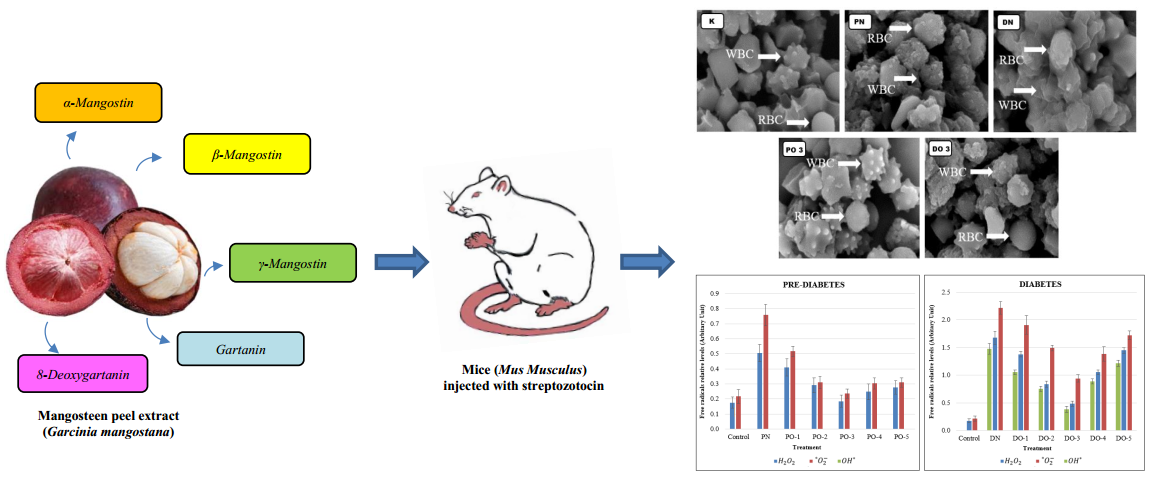
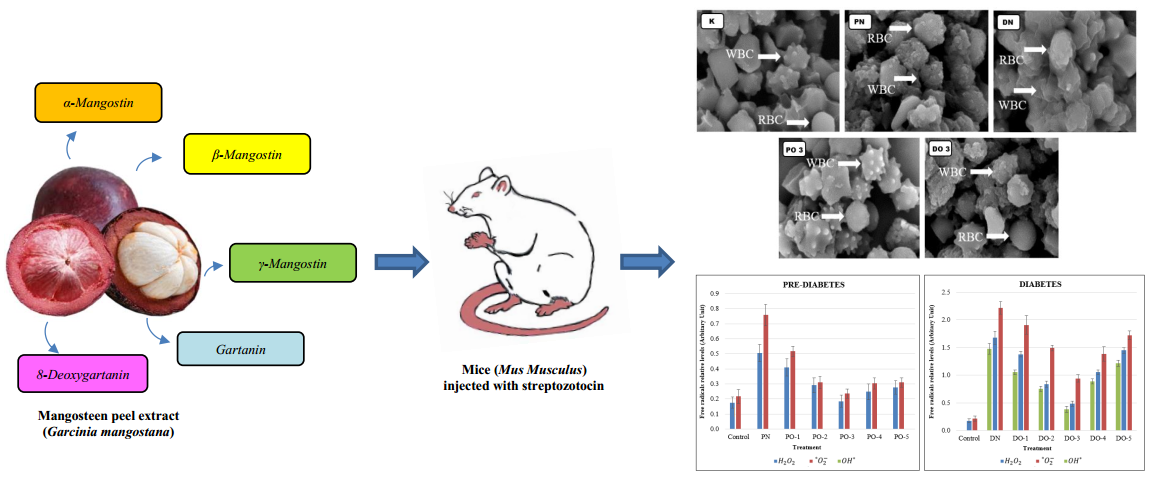
Diabetes mellitus is associated with a decrease in hemoglobin levels. The relationship between the 2 is inversely proportional. When blood sugar levels increase, it triggers glycation, enhancing xanthine oxidase activity and free radical formation. This phenomenon causes reactive oxygen species (ROS) to emerge and reduces oxygen in the blood, decreasing hemoglobin levels. This study aims to analyze the effectiveness of mangosteen peel extract (Garcinia mangostana) in preventing the formation of free radicals and reducing hemoglobin levels in the blood due to diabetes mellitus. This study was conducted using 195 experimental mice (Mus musculus). Diabetes mellitus was induced in the mice by injecting streptozotocin (dissolved in 0.1 M citrate buffer, pH 4.5) for 7 days. The dose of streptozotocin administered to create a pre-diabetes group was 10 mg/kg BW (PN and PO) and 30 mg/kg BW to create a diabetes group (DN and DO). The injection route used for streptozotocin was the intraperitoneal (IP) method. Mangosteen peel extract (Garcinia mangostana) was administered orally at doses of 0.86, 1.86, 2.86, 3.86 and 4.86 mg/mL. The mangosteen peel extract treatment was carried out for 14 days. Measurements in the mice included tests for hemoglobin levels, types of free radicals, relative levels of free radicals, and histopathological observations using Scanning Electron Microscopy (SEM). The free radicals were superoxide anion (* ) and hydroxyl radical ( *). The results showed that mangosteen peel extract (Garcinia mangostana) effectively prevented the decrease in hemoglobin levels and broke the chain of free radical formation. Hemoglobin levels in the diabetes group increased by 61.5 %, while the pre-diabetes group increased by 24 %, approaching the hemoglobin level of the control group at 19 ± 1.2 g/dL. The most effective dose of mangosteen peel extract (Garcinia mangostana) was 2.86 mg/mL. Mangosteen peel contains xanthone, which can counteract free radicals through single electron transfer (SET) and hydrogen atom transfer (HAT).
HIGHLIGHTS
- Mangosteen peel extract (Garcinia mangostana) effectively prevents a decrease in hemoglobin levels and interrupts the chain of free radical formation.
- Mangosteen peel extract (Garcinia mangostana) contains xanthones that can break the chain reaction process of superoxide anions (* ) into hydroxyl radicals ( *).
- Xanthones react with free radicals through 2 mechanisms, namely single electron transfer (SET) and hydrogen atom transfer (HAT).
GRAPHICAL ABSTRACT
Downloads
References
MA Darenskaya, LI Kolesnikova and SI Kolesnikov. Oxidative stress: Pathogenetic role in diabetes mellitus and its complications and therapeutic approaches to correction. Bulletin of Experimental Biology and Medicine 2021; 171(2), 179-189.
K Jakubczyk, K Dec, J Kałduńska, D Kawczuga, J Kochman and K Janda. Reactive oxygen species-sources, functions, oxidative damage. Polski merkuriusz lekarski: Organ Polskiego Towarzystwa Lekarskiego 2020; 48(284), 124-127.
S Perrone, E Laschi and G Buonocore. Biomarkers of oxidative stress in the fetus and in the newborn. Free Radical Biology and Medicine 2019; 142, 23-31.
BT Bekele, TG Demie and F Worku. Health-related quality-of-Life and associated factors among children and adolescents with type 1 diabetes mellitus: A cross-sectional study. Pediatric Health, Medicine and Therapeutics 2022; 13, 243-256.
H Yaribeygi, SL Atkin and A Sahebkar. A review of the molecular mechanisms of hyperglycemia‐induced free radical generation leading to oxidative stress. Journal of Cellular Physiology 2019; 234(2), 1300-1312.
WN Mratbaevna and S Farrux. The structure of the heart and its physiology in regular athletes. ACADEMICIA: An International Multidisciplinary Research Journal 2022; 13(8), 41-46.
R Kohan, A Collin, S Guizzardi, N Tolosa de Talamoni and G Picotto. Reactive oxygen species in cancer: A paradox between pro-and anti-tumour activities. Cancer Chemotherapy and Pharmacology 2020; 86(1), 1-13.
P González, P Lozano, G Ros and F Solano. Hyperglycemia and oxidative stress: An integral, updated and critical overview of their metabolic interconnections. International Journal of Molecular Sciences 2023; 24(11), 9352.
J Liang, Y Gao, Z Feng, B Zhang, Z Na and D Li. Reactive oxygen species and ovarian diseases: Antioxidant strategies. Redox Biology 2023; 62, 102659.
A Dobi, S Rosanaly, A Devin, P Baret, O Meilhac, GJ Harry, CL D’Hellencourt and P Rondeau. Advanced glycation end-products disrupt brain microvascular endothelial cell barrier: The role of mitochondria and oxidative stress. Microvascular Research 2021; 133, 104098.
M Faghir-Ganji, N Abdolmohammadi, M Nikbina, A Amanollahi, A Ansari-Moghaddam, R Khezri and H Baradaran. Prevalence of anemia in patients with diabetes mellitus: A systematic review and meta-analysis. Biomedical and Environmental Sciences 2024; 37(1), 96-107.
AS Kumar, AG Maiya, BA Shastry, K Vaishali, N Ravishankar, A Hazari, S Gundmi and R Jadhav. Exercise and insulin resistance in type 2 diabetes mellitus: A systematic review and meta-analysis. Annals of Physical and Rehabilitation Medicine 2019; 62, 98-103.
C Mathieu, PJ Martens and R Vangoitsenhoven. One hundred years of insulin therapy. Nature Reviews Endocrinology 2021; 17(12), 15-25.
MC Nauman and JJ Johnson. The purple mangosteen (Garcinia mangostana): Defining the anticancer potential of selected xanthones. Pharmacological Research 2022; 175, 106032.
A Nasrullah, B Saad, AH Bhat, AS Khan, M Danish, MH Isa and A Naeem. Mangosteen peel waste as a sustainable precursor for high surface area mesoporous activated carbon: Characterization and application for methylene blue removal. Journal of Cleaner Production 2019; 211, 1190-1200.
WM Aizat, FH Ahmad-Hashim and SNS Jaafar. Valorization of mangosteen, “The Queen of Fruits,” and new advances in postharvest and in food and engineering applications: A review. Journal of Advanced Research 2019; 20, 61-70.
RRNS Pushpa, KS Babulal, R Kumaran, G Shoba and MD Balakumaran. In silico molecular interaction analysis and pharmacokinetic profiling of flavonoids from Catharanthus roseus (flower) against TXNIP protein. Trends in Sciences 2023; 20(1), 6394.
LS Kalick, HA Khan, E Maung, Y Baez, AN Atkinson, CE Wallace, F Day, BE Delgadillo, A Mondal, R Watanapokasin, SM Barbalho and A Bishayee. Mangosteen for malignancy prevention and intervention: Current evidence, molecular mechanisms, and future perspectives. Pharmacological Research 2023; 188, 106-630.
M Masullo, A Cerulli, C Cannavacciuolo, H Kılınç, C Pizza and S Piacente. Garcinia mangostana L. fruits and derived food supplements: Identification and quantitative determination of bioactive xanthones by NMR analysis. Journal of Pharmaceutical and Biomedical Analysis 2022; 218, 114-335.
M Patrick, WNWM Zohdi, S Abd Muid and E Omar. Alpha (α)-mangostin (Xanthone of Garcinia mangostana L.): Augmenting macrophages activity for an effective diabetic wound healing. Trends in Sciences 2024; 21(10), 8254.
KN Lesa, N Ahmad, Y Mayangsari, MN Cahyanto and WD Saputra. Anti-diabetic effect of okara noodles on streptozotocin-nicotinamide induced diabetic rats. Trends in Sciences 2024; 21(5), 7428.
R Cecchini and AL Cecchini. SARS-CoV-2 infection pathogenesis is related to oxidative stress as a response to aggression. Medical Hypotheses 2020; 143, 101102.
JH Kim, YB Yu and JH Choi. Toxic effects on bioaccumulation, hematological parameters, oxidative stress, immune responses and neurotoxicity in fish exposed to microplastics: A review. Journal of Hazardous Materials 2021; 413, 125423.
S Sakuljaitrong, N Buddhakala, M Buddhakala, S Asawawibul, S Buatone, Y Tongaram and C Talubmook. Phytochemicals, cytotoxicity, inhibitory effect on nitric oxide production and alpha-glucosidase activity, and DPPH scavenging activity of leaf extract from Gymnema inodorum (Lour.) Decne. Trends in Sciences 2023; 20, 6548.
Z Chen, R Tian, Z She, J Cai and H Li. Role of oxidative stress in the pathogenesis of nonalcoholic fatty liver disease. Free Radical Biology and Medicine 2020; 152, 116-141.
J Yang, D Zeng, M Hassan, Z Ma, L Dong, Y Xie and Y He. Efficient degradation of Bisphenol A by dielectric barrier discharge non-thermal plasma: Performance, degradation pathways and mechanistic consideration. Chemosphere 2022; 286, 131627.
TJ Costa, PR Barros, C Arce, JD Santos, JD Silva-Neto, G Egea, AP Dantas, RC Tostes and F Jiménez-Altayó. The homeostatic role of hydrogen peroxide, superoxide anion and nitric oxide in the vasculature. Free Radical Biology and Medicine 2021; 162, 615-635.
Y Ahmed, J Zhong, Z Yuan and J Guo. Roles of reactive oxygen species in antibiotic resistant bacteria inactivation and micropollutant degradation in Fenton and photo-Fenton processes. Journal of Hazardous Materials 2022; 430, 128408.
N Maheshwari, N Qasim, R Anjum and R Mahmood. Fluoride enhances generation of reactive oxygen and nitrogen species, oxidizes hemoglobin, lowers antioxidant power and inhibits transmembrane electron transport in isolated human red blood cells. Ecotoxicology and Environmental Safety 2021; 208, 111611.
JW Weisel and RI Litvinov. Red blood cells: The forgotten player in hemostasis and thrombosis. Journal of Thrombosis and Haemostasis 2019; 17(2), 271-282.
SH Son, JM Oh, P Gangadaran, HD Ji, HW Lee, RL Rajendran, SH Baek, A Gopal, S Kalimuthu, SY Jeong, SW Lee, J Lee and BC Ahn. White blood cell labeling with Technetium-99m (99mTc) using red blood cell extracellular vesicles-mimetics. Blood Cells, Molecules, and Diseases 2020; 80, 102375.
T Pesen, M Haydaroglu, S Capar, U Parlatan and MB Unlu. Comparison of the human’s and camel’s red blood cell deformability by optical tweezers and Raman spectroscopy. Biochemistry and Biophysics Reports 2023; 35, 101490.
S Lin, Y Shen, X Huang, S Lin and X Shi. Schefflera arboricola tablets relieve diabetic neuropathic pain: Involvement of oxidative stress and inflammation. Pharmacognosy Magazine 2023; 19(4), 906-916.
K Zhao, E Seeliger, T Niendorf and Z Liu. Noninvasive assessment of diabetic kidney disease with MRI: Hype or hope? Journal of Magnetic Resonance Imaging 2024; 59(5), 1494-1513.
SH Azeez, SN Jafar, Z Aziziaram, L Fang, AH Mawlood and MF Ercisli. Insulin-producing cells from bone marrow stem cells versus injectable insulin for the treatment of rats with type I diabetes. Cellular, Molecular and Biomedical Reports 2021; 1(1), 42-51.
R Amelia, FM Said, F Yasmin and H Harun. The potential of West Sumatran Dadiah as the novel to alleviate hyperglycemia, hypercholesterolemia, and reducing NF-kB expression in nephropathy diabetes rat model. Trends in Sciences 2023; 20(11), 6812.
SJ Sharkey, PA Harnedy‐Rothwell, PJ Allsopp, LE Hollywood, RJ FitzGerald and FPM O’Harte. A narrative review of the anti‐hyperglycemic and satiating effects of fish protein hydrolysates and their bioactive peptides. Molecular Nutrition & Food Research 2020; 64(21), 2000403.
H Ki, H Jang, J Oh, GR Han, H Lee, S Kim and MG Kim. Simultaneous detection of serum glucose and glycated albumin on a paper-based sensor for acute hyperglycemia and diabetes mellitus. Analytical Chemistry 2020; 92(17), 11530-11534.
F Akhter, D Chen, A Akhter, SF Yan and SSD Yan. Age-dependent accumulation of dicarbonyls and advanced glycation endproducts (AGEs) associates with mitochondrial stress. Free Radical Biology and Medicine 2021; 164, 429-438.
SM Graves, Z Xie, KA Stout, E Zampese, LF Burbulla, JC Shih, J Kondapalli, T Patriarchi, LTian, L Brichta, P Greengard, D Krainc, PT Schumacker and DJ Surmeier. Dopamine metabolism by a monoamine oxidase mitochondrial shuttle activates the electron transport chain. Nature Neuroscience 2020; 23, 15-20.
H Park, JY Lee, W Lim and G Song. Assessment of the in vivo genotoxicity of pendimethalin via mitochondrial bioenergetics and transcriptional profiles during embryogenesis in zebrafish: Implication of electron transport chain activity and developmental defects. Journal of Hazardous Materials 2021; 411, 125153.
N Zeng, G Zhang, X Hu, J Pan and D Gong. Mechanism of fisetin suppressing superoxide anion and xanthine oxidase activity. Journal of Functional Foods 2019; 58, 1-10.
C Liu, W Fan, WX Cheng, Y Gu, Y Chen, W Zhou, XF Yu, M Chen, M Zhu, K Fan and QY Luo. Red emissive carbon dot superoxide dismutase nanozyme for bioimaging and ameliorating acute lung injury. Advanced Functional Materials 2023; 33(19), 2213856.
Y Liu, Y Zhao and J Wang. Fenton/Fenton-like processes with in-situ production of hydrogen peroxide/hydroxyl radical for degradation of emerging contaminants: Advances and prospects. Journal of Hazardous Materials 2021; 404, 124191.
H Zeng, G Zhang, Q Ji, H Liu, X Hua, H Xia, M Sillanpää and J Qu. pH-independent production of hydroxyl radical from atomic H*-mediated electrocatalytic H2O2 reduction: A green Fenton process without byproducts. Environmental Science & Technology 2020; 54(22), 14725-14731.
A Lin, Y Gorbanev, JD Backer, JV Loenhout, WV Boxem, F Lemière, P Cos, S Dewilde, E Smits and A Bogaerts. Non‐thermal plasma as a unique delivery system of short‐lived reactive oxygen and nitrogen species for immunogenic cell death in melanoma cells. Advanced Science 2019; 6(6), 1802062.
VG Sprygin, NF Kushnerova and SE Fomenko. Effect of a lipid complex from the Marine Red Alga Ahnfeltia tobuchiensis on the metabolic responses of the liver under conditions of experimental toxic hepatitis. Biology Bulletin 2021; 48(S3), S10-S18.
LFT Novaes, JSK Ho, K Mao, K Liu, M Tanwar, M Neurock, E Villemure, JA Terrett and S Lin. Exploring electrochemical C(sp3) - H oxidation for the late-stage methylation of complex molecules. Journal of the American Chemical Society 2022; 144(3), 1187-1197.
M Faisal, UP Juswono and DR Santoso. The effect of extract guava, bitter melon, broccoli, and shallots on liver damage due to indoor pollutant exposure. Journal of Physics: Conference Series 2021; 1825, 012097.
Z Salman, J Yu-Qing, L Bin, P Cai-Yun, CM Iqbal, R Atta-ur and W Wei. Antioxidant nature adds further therapeutic value: An updated review on natural xanthones and their glycosides. Digital Chinese Medicine 2019; 2(3), 166-192.
MA Fazal, S Rubaiee, A Al-Zahrani and S Ghazali. Biodiesel degradation mechanism upon exposure of metal surfaces: A study on biodiesel sustainability. Fuel 2022; 310, 122341.
X Zhang, N Li, Z Wei, B Dai, H Lin and S Han. Enhanced the effects on improving the cold flow properties and oxidative stability of diesel-biodiesel blends by grafting antioxidant on PMA type pour point depressant. Fuel Processing Technology 2022; 238, 107483.
Y Lu, T Guan, S Wang, C Zhou, M Wang, X Wang, K Zhang, X Han, J Lin, Q Tang, C Wang and W Zhou. Novel xanthone antibacterials: Semi-synthesis, biological evaluation, and the action mechanisms. Bioorganic & Medicinal Chemistry 2023; 83, 117232.
Downloads
Published
How to Cite
Issue
Section
License
Copyright (c) 2024 Walailak University

This work is licensed under a Creative Commons Attribution-NonCommercial-NoDerivatives 4.0 International License.





