
Evaluation of Toxicity and Antioxidant Activity of the Ethanolic Extract from Ulva Lactuca
DOI:
https://doi.org/10.48048/tis.2025.8812Keywords:
Green seaweed, Ulva lactuca, Antioxidant activity, Genotoxicology, Cytotoxicity, Safety effect, Marine algaeAbstract
Ulva lactuca (sea lettuce) is a popular food for consumers and has high nutritional value. It has also been found to be a source of health-promoting substances, including a high amount of proteins which can be utilized as a future plant-based functional ingredient in the food industry. However, before extensive applications in the aforementioned fields, it is crucial to ensure the extracts’ biological-pharmacological activities and their safety. In this study, we evaluated the cytotoxicity, genotoxicity, and antioxidant activity of the ethanolic extract of the sea lettuce extract.We tested cytotoxicity by MTT assays on 5 cell lines, including fibroblast (L929), macrophages (RAW 264.7), hepatocytes (FL83B), keratinocytes (HaCaT) and normal colon (CCD-18co) cells. Genotoxicity of the extract was tested by comet and micronucleus assays on human lymphoblast cells (TK6). Our results demonstrated at a concentration lower than 50 µg/mL the extract did not show any cytotoxicity as well as genotoxicity. The extract was shown to possess high antioxidant capacity by DPPH and ABTS scavenging at the EC50 value of U. lactuca extracts was 631.84 ± 5.64 and 330.35 ± 19.49 μg/mL, respectively. Therefore, the extract may be safely used as an ingredient for food, that should help to ensure food security for humans in the future, as well as for cosmetic, pharmaceutical and other health-promoting products.
HIGHLIGHTS
- Ulva lactuca extract displayed strong antioxidant activity.
- Neither cytotoxicity nor genotoxicity to cell lines are seen in the ethanol extract of lactuca.
GRAPHICAL ABSTRACT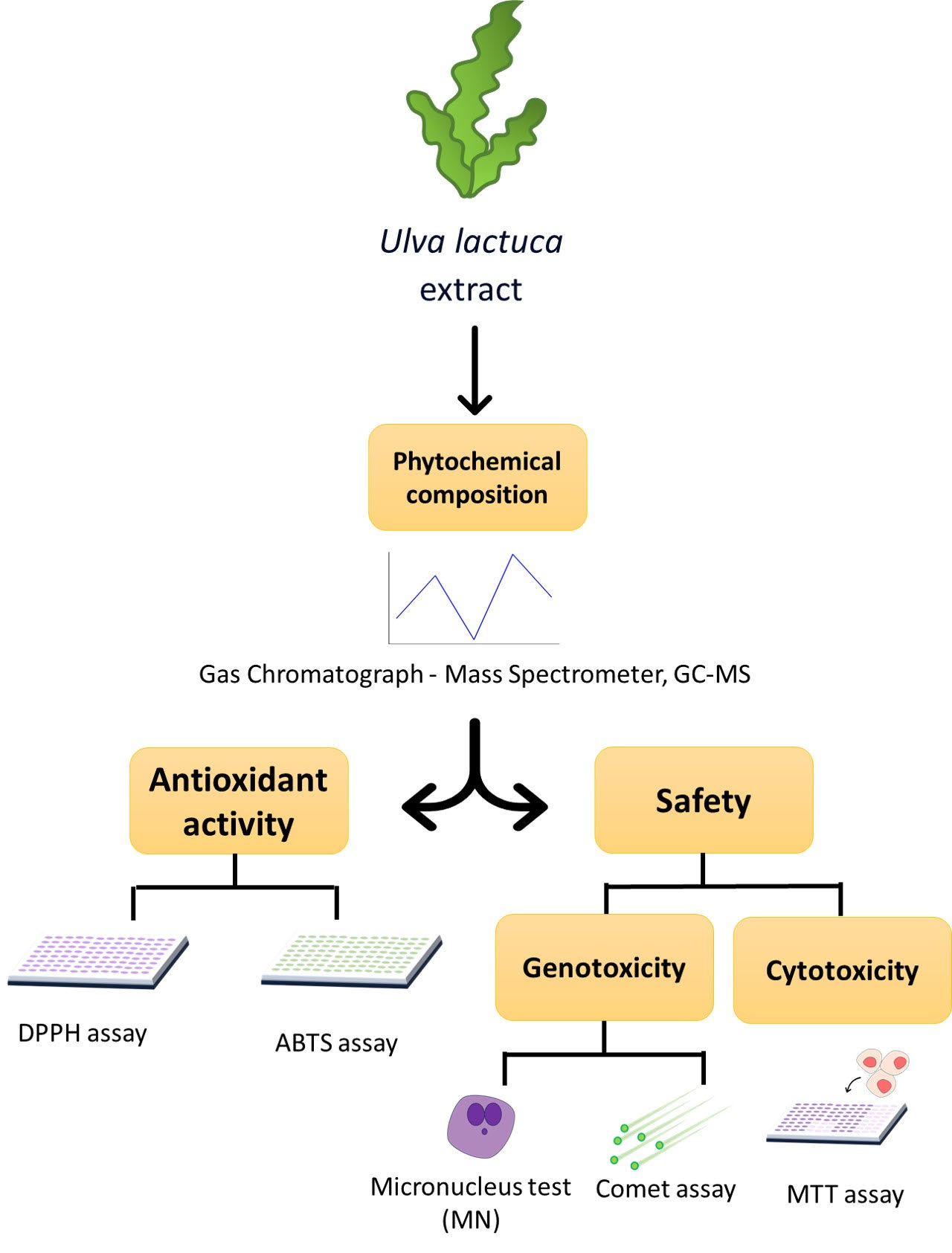
Downloads
References
HH Amin. Ulva lactuca as a cheap and safe biopesticide in fields and its chemical composition (in vitro). Egypt. J. Aquat. Biol. Fish. 2019; 23, 415-28.
P Habbu, V Warad, R Shastri, C Savant, S Madagundi and P Kekare. In vitro and in vivo antimicrobial activity of Ulva lactuca Linn. (Green algae) associated endophytic bacterial Strains. J. App. Pharmaceut. Sci. 2016; 6, 138-46.
M Godard, K Decorde, E Ventura, G Soteras, JC Baccou, JP Cristol and JM Rouanet. Polysaccharides from the green alga Ulva rigida improve the antioxidant status and prevent fatty streak lesions in the high cholesterol fed hamster, an animal model of nutritionally-induced atherosclerosis. Food Chem. 2009; 115, 176-80.
X Liu, D Liu, G Lin, Y Wu, L Gao, C Ai, Y Huang, M Wang, HR El-Seedi, X Chen and C Zhao. Anti-ageing and antioxidant effects of sulfate oligosaccharides from green algae Ulva lactuca and Enteromorpha prolifera in SAMP8 mice. Int. J. Biol. Macromol. 2019; 139, 342-51.
J Fleurence, CL Coeur, S Mabeau, M Maurice and A Landrein. Comparison of different extractive procedures for proteins from the edible seaweeds Ulva rigida and Ulva rotundata. J. Appl. Phycol. 1995; 7, 577-82.
L Perez-Urrestarazu, J Lobillo-Eguibar, R Fernandez-Canero and VM Fernandez-Cabanas. Suitability and optimization of FAO’s small-scale aquaponics systems for joint production of lettuce (Lactuca sativa) and fish (Carassius auratus). Aquacultural Eng. 2019; 85, 129-37.
S Lordan, RP Ross and C Stanton. Marine bioactives as functional food ingredients: Potential to reduce the incidence of chronic diseases. Mar. Drugs 2011; 9, 1056-100.
H Dominguez and EP Loret. Ulva lactuca, a source of troubles and potential riches. Mar. Drugs 2019; 17, 357.
MS Shalaby and HH Amin. Potential using of ulvan polysaccharides from Ulva lactuca as a prebiotic in symbiotic yogurt production. J. Probiotics Health 2019; 7, 208.
FRC Mo’o, G Wilar, HP Devkota and N Wathoni. Ulvan, a polysaccharide from macroalga Ulva sp.: A review of chemistry, biological activities and potential for food and biomedical applications. Appl. Sci. 2020; 10, 5488.
NF Ardita, L Mithasari, D Untoro and SIO Salasia. Potential antimicrobial properties of the Ulva lactuca extract against methicillin-resistant Staphylococcus aureus-infected wounds: A review. Vet. World 2021; 14, 1116-23.
V Patravale, P Dandekar and R Jain. Nanotoxicology: Evaluating toxicity potential of drug-nanoparticles. Elsevier Science, Amsterdam, Netherlands, 2012.
P Chidambararajan, V Keerthana, K Priyadharshini and B Sakthivel. In vitro antioxidant and anticancer activity of ulva lactuca l.using molt-3 Cell line. Asian J. Pharmaceut. Clin. Res. 2019; 12, 75-8.
N Gonzalez-Ballesteros, C Rodriguez-Arguelles, AP Lopez, M Lastra, M Grimaldi, A Cavazza, G Salviati and F Bigi. Macroalgae to nanoparticles: Study of Ulva lactuca L. role in biosynthesis of gold and silver nanoparticles and of their cytotoxicity on colon cancer cell lines. Mater. Sci. Eng. C 2019; 97, 498-509.
M Bajpayee, A Kumar and A Dhawan. The comet assay: Assessment of in vitro and in vivo DNA damage. Methods Mol. Biol. 2019; 2031, 237-57.
M Bajpayee, AK Pandey, S Zaidi, J Musarrat, D Parmar, N Mathur, PK Seth and A Dhawan. DNA damage and mutagenicity induced by endosulfan and its metabolites. Environ. Mol. Mutagen. 2006; 47, 682-92.
P Nugent, JN Duncan and DB Colagiovanni. Chapter 8 - Preparation of a preclinical dossier to support an investigational new drug (IND) application and first-in-human clinical trial. In: AS Faqi (Ed.). A comprehensive guide to toxicology in nonclinical drug development. Academic Press, Cambridge, 2017.
S Bhagavathy and P Sumathi. Evaluation of antigenotoxic effects of carotenoids from green algae Chlorococcum humicola using human lymphocytes. Asian Pac. J. Trop. Biomed. 2012; 2, 109-17.
W Widyaningsih, S Pramono, Zulae, Sugiyanto and S Widyarini. Protection by ethanolic extract from Ulva lactuca L. against acute myocardial infarction: antioxidant and antiapoptotic activities. Malays. J. Med. Sci. 2017; 24, 39-49.
S Sellimi, I Younes, HB Ayed, H Maalej, V Montero, M Rinaudo, M Dahia, T Mechichi, M Hajji and M Nasri. Structural, physicochemical and antioxidant properties of sodium alginate isolated from a Tunisian brown seaweed. Int. J. Biol. Macromol. 2015; 72, 1358-67.
Z Zhang, F Kong, H Ni, Z Mo, JB Wan, D Hua and C Yan. Structural characterization, α-glucosidase inhibitory and DPPH scavenging activities of polysaccharides from guava. Carbohydr. Polym. 2016; 144, 106-14.
O Ibraheem and R Maimako. Evaluation of alkaloids and cardiac glycosides contents of Ricinus communis Linn (Castor) whole plant parts and determination of their biological properties. Int. J. Toxicol. Pharmacol. Res. 2014; 6, 34-2.
P Vijayabaskar, N Vaseela and G Thirumaran. Potential antibacterial and antioxidant properties of a sulfated polysaccharide from the brown marine algae Sargassum swartzii. Chin. J. Nat. Med. 2012; 10, 421-8.
BWS Souza, MA Cerqueira, AI Bourbon, AC Pinheiro, JT Martins, JA Teixeira, MA Coimbra and AA Vicente. Chemical characterization and antioxidant activity of sulfated polysaccharide from the red seaweed Gracilaria birdiae. Food Hydrocolloids 2012; 27, 287-92.
Y Qiu, J Xu, W Liao, Y Wen, S Jiang, J Wen and C Zhao. Suppression of hepatocellular carcinoma by Ulva Lactuca ulvan via gut microbiota and metabolite interactions. J. Adv. Res. 2023; 52, 103-17.
HM Khairy and MA El-Sheikh. Antioxidant activity and mineral composition of three Mediterranean common seaweeds from Abu-Qir Bay, Egypt. Saudi J. Biol. Sci. 2015; 22, 623-30.

Downloads
Published
How to Cite
Issue
Section
License
Copyright (c) 2024 Walailak University

This work is licensed under a Creative Commons Attribution-NonCommercial-NoDerivatives 4.0 International License.





