
Immunochromatographic Strip Test for Fasciola gigantica Diagnosis Using Rabbit Polyclonal Antibodies against rFgSAP2
DOI:
https://doi.org/10.48048/tis.2026.11848Keywords:
Serological detection, Diagnosis, Immunochromatographic strip test, Fasciolosis, Saposin-like protein 2Abstract
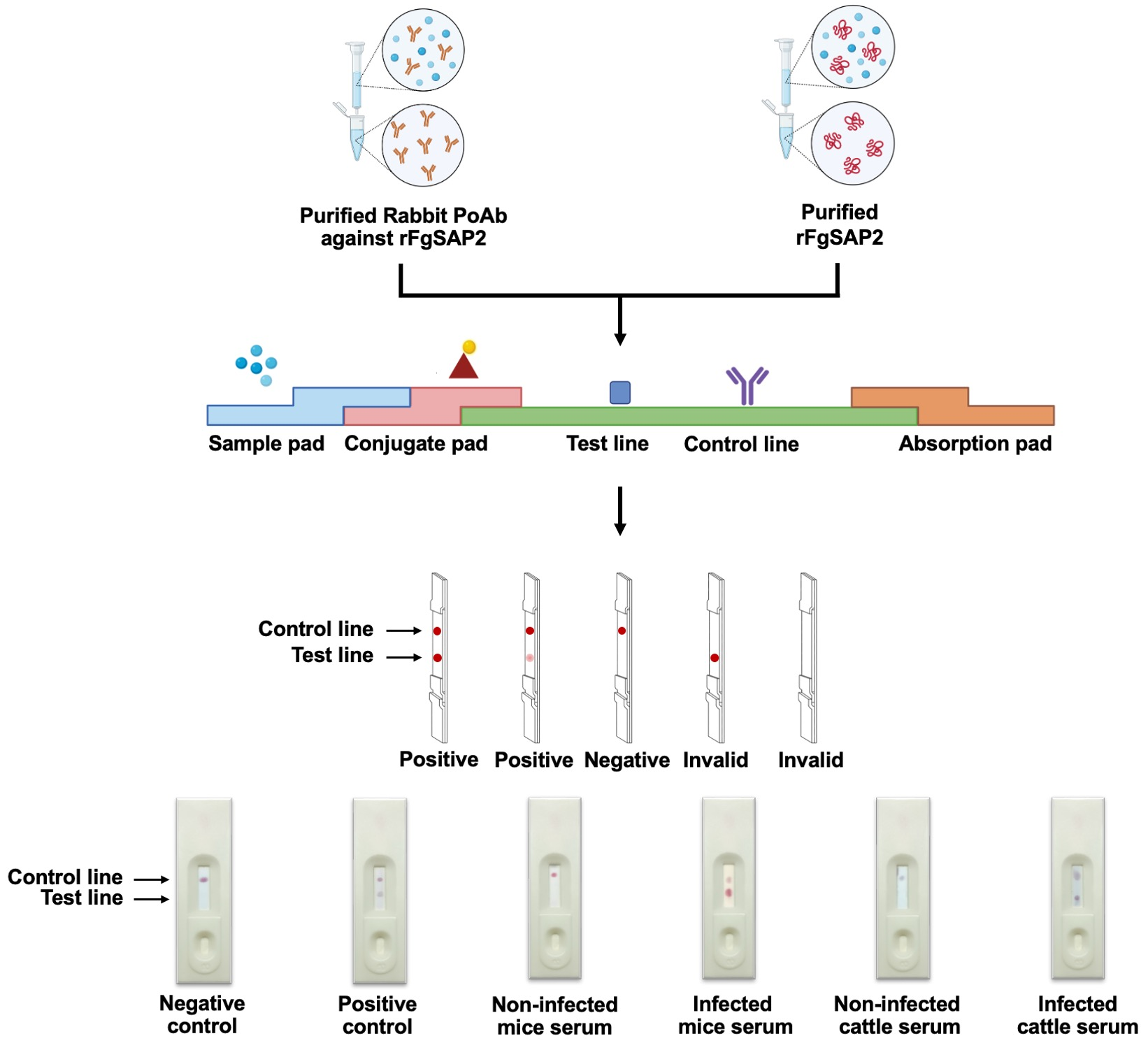
Saposin-like protein 2 (SAP2) plays a critical role in the survival of Fasciola species by disrupting the membranes of red blood cells. SAP2 is highly immunogenic and is abundantly present in the excretory-secretory (ES) antigens of both juvenile and adult stages of Fasciola spp. These characteristics make SAP2 a promising candidate for immunodiagnosis of both animal and human fasciolosis. Its strong antigenic properties also highlight its potential as a targeted biomarker for the detection of parasitic infections. Currently, the gold-standard diagnostic technique for Fasciola spp. infection involves the detection of parasite eggs through microscopic examination. However, this method has low sensitivity, particularly when egg counts are low, a situation commonly observed in chronic infections or following unsuccessful treatment. Therefore, this study aims to fine the alternative method, we developed and evaluated an immunochromatographic strip test using a rabbit polyclonal antibody (PoAb) against rFgSAP2 for the detection of fasciolosis. The recombinant Fasciola gigantica SAP2 (rFgSAP2) and rabbit PoAb against rFgSAP2 were purified and concentrated. The optimize pH and buffer were evaluated before constructing the immunochromatographic (IC) strip test. The IC strip test consists of rFgSAP2 conjugated with colloidal gold probes, protein A as a test line, and rabbit PoAb against rFgSAP2 as a control line. Both experimentally and naturally Fasciola gigantica-infected serum samples were tested using IC strips. Serum samples from thirty experimentally infected and thirty non-infected mice as well as from fourteen naturally infected and twelve healthy cattle were evaluated using IC strip test. The IC strips were dipped into the sample solution and observed the results within 15 min. These tests demonstrated sensitivity, specificity, accuracy, positive predictive value, negative predictive value, false-positive rate, and false-negative rate of 96.67%, 90.00%, 93.33%, 90.63%, 96.43%, 10.00% and 3.33%, respectively. Thus, the IC strip test could be used for the diagnosis of fasciolosis in cattle and humans in the future.
HIGHLIGHTS
- Novel immunochromatographic strip test for the detection of Fasciola gigantica
- The developed IC strip test exhibits high sensitivity (96.67%), specificity (90.00%), and accuracy (93.33%).
- This diagnostic tool demonstrates fasciolosis detection in both mice and cattle
GRAPHICAL ABSTRACT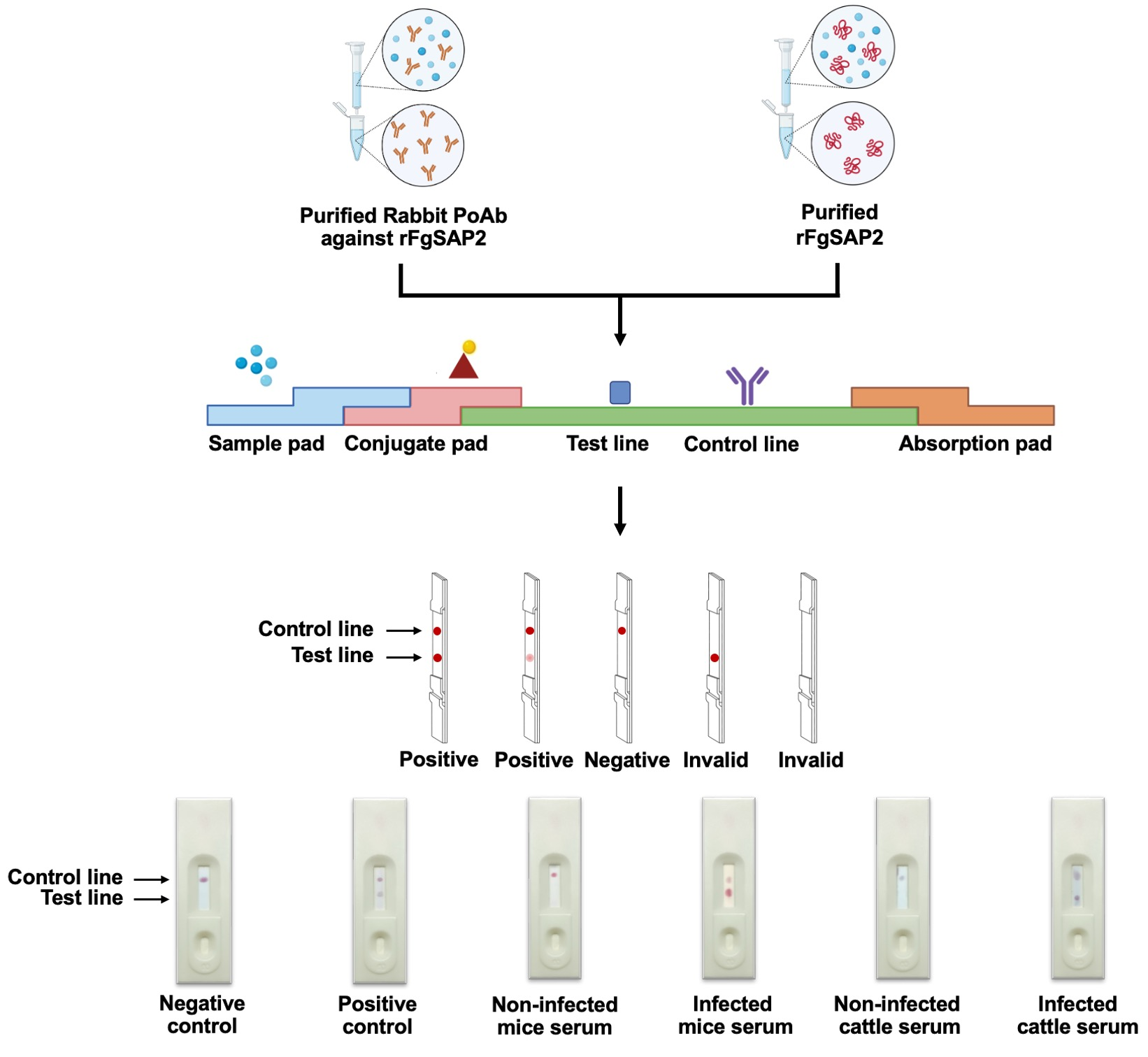
Downloads
References
A Aftab, OK Raina, A Maxton and SA Masih. Advances in diagnostic approaches to Fasciola infection in animals and humans: An overviews. Journal of Helminthology 2024; 98, e12.
O Sezgin, E Altintas, S Disibeyaz, U Saritas and B Sahin. Hepatobiliary fascioliasis: Clinical and radiologic features and endoscopic management. Journal of Clinical Gastroenterology 2004; 38(3), 285-291.
LR Rosas-Hostos Infantes, GA Paredes Yataco, Y Ortiz-Martínez, T Mayer, A Terashima, C Franco-Paredes, C Franco-Paredes, E Gonzalez-Diaz, AJ Rodriguez-Morales, DK Bonilla-Aldana, LV Barahona, AA Grimshaw, DB Chastain, S Sillau, LA Marcos and AF Henao-Martínez. The global prevalence of human fascioliasis: A systematic review and meta-analysis. Therapeutic Advances in Infectious Disease 2023; 10, 1-18.
N Changklungmoa, P Kueakhai, S Apisawetakan, S Riengrojpitak, P Sobhon and K Chaithirayanon. Identification and expression of Fasciola gigantica thioredoxin. Parasitology Research 2014; 113, 2335-2343.
S Chansap, W Cheukamud, T Suthisintong, P Kueakhai and N Changklungmoa. Development of multi-epitope Cathepsin L driven short peptide vaccine against Fasciola gigantica. Frontiers in Veterinary Science 2025; 12, 1547937.
SC Olaogun, C Byaruhanga, SO Ochai, GT Fosgate and MC Marufu. Comparison of three diagnostic methods to detect the occurrence of Fasciola Species in communally grazed cattle in the Northwest province, South Africa. Pathogens 2022; 11(12), 1398.
J Gonzalez-Miguel, D Becerro-Recio and M Siles-Lucas. Insights into Fasciola hepatica juveniles: Crossing the fasciolosis rubicon. Trends in Parasitology 2021; 37(1), 35-47.
NED Calvani and J Slapeta. Fasciola Species introgression: Just a fluke or something more? Trends in Parasitology 2021; 37(1), 25-34.
DA Zarate-Rendon, J Vlaminck, B Levecke, A Briones-Montero and P Geldhof. Comparison of Kato-Katz thick smear, mini-FLOTAC, and flukefinder for the detection and quantification of Fasciola hepatica eggs in artificially spiked human stool. The American Journal of Tropical Medicine and Hygiene 2019; 101(1), 59-61.
P Kueakhai, N Changklungmoa, K Chaithirayanon, M Phatsara, N Preyavichyapugdee, S Riengrojpitak, K Sangpairoj, P Chusongsang and P Sobhon. Saposin-like protein 2 has an immunodiagnostic potential for detecting fasciolosis gigantica. Experimental Parasitology 2015; 151-152, 8-13.
A Mirzadeh, F Jafarihaghighi, E Kazemirad, SS Sabzevar, MH Tanipour and M Ardjmand. Recent developments in recombinant proteins for diagnosis of human fascioliasis. Acta Parasitologica 2021; 66(1), 13-25.
P Anuracpreeda, R Chawengkirttikul and P Sobhon. Immunodiagnosis of Fasciola gigantica infection using monoclonal antibody-based sandwich ELISA and immunochromatographic assay for detection of circulating cathepsin L1 protease. PLoS One 2016; 11(1), e0145650.
P Anuracpreeda, T Srirakam, S Pandonlan, N Changklungmoa, C Chotwiwatthanakun, Y Tinikul, J Poljaroen, K Meemon and P Sobhon. Production and characterization of a monoclonal antibody against recombinant cathepsin L1 of Fasciola gigantica. Acta Tropica 2014; 136, 1-9.
B Gottstein, M Schneeberger, G Boubaker, B Merkle, C Huber, M Spiliotis, N Müller, T Garate and MG Doherr. Comparative assessment of ELISAs using recombinant saposin-like protein 2 and recombinant cathepsin L-1 from Fasciola hepatica for the serodiagnosis of human fasciolosis. PLoS Neglected Tropical Diseases 2014; 8(6), e2860.
P Suksomboon, P Kueakhai and N Changklungmoa. Fasciola gigantica Cathepsin L1H: High sensitivity and specificity of immunochromatographic strip test for antibody detection. Tropical Medicine and Infectious Disease 2023; 8(3), 164.
S Wongwairot, P Kueakhai, N Changklungmoa, W Jaikua, V Sansri, K Meemon, S Songkoomkrong, S Riengrojpitak and P Sobhon. Monoclonal antibody against recombinant Fasciola gigantica athepsin L1H could detect juvenile and adult cathepsin Ls of Fasciola gigantica. Parasitology Research 2015; 114(1), 133-140.
J Wang, K He, Z Wu, W Jin, W Wu, Y Guo, W Zhang and W Di. Development of a colloidal gold immunochromatographic strip for the rapid detection of antibodies against Fasciola gigantica in buffalo. Frontiers in Veterinary Science 2022; 9, 1004932.
S Liu, N Zhang, Q Yu, J Li, X Wang, X Li, X Zhang, S Cheng, T Yue, H Zhang, P Gong and X Zhang. Immunol detection of cathepsin L from Fasciola hepatica infection in sheep by monoclonal antibody-based colloidal gold test strip assay. Acta Biochimica et Biophysica Sinica 2023; 55(10):1668-1671.
G Allam, IR Bauomy, ZM Hemyeda, TM Diab and TF Sakran. Diagnostic potential of Fasciola gigantica-derived 14.5 kDa fatty acid binding protein in the immunodiagnosis of bubaline fascioliasis. Journal Helminthology 2013; 87(2), 147-153.
G Allam, IR Bauomy, ZM Hemyeda and TF Sakran. Evaluation of a 14.5 kDa-Fasciola gigantica fatty acid binding protein as a diagnostic antigen for human fascioliasis. Parasitology Research 2012; 110(5), 1863-1871.
P Anuracpreeda, R Chawengkirttikul and P Sobhon. Immunodiagnostic monoclonal antibody-based sandwich ELISA of fasciolosis by detection of Fasciola gigantica circulating fatty acid binding protein. Parasitology 2016; 143(11), 1369-1381.
P Anuracpreeda, R Chawengkirtikul, Y Tinikul, J Poljaroen, C Chotwiwatthanakun and P Sobhon. Diagnosis of Fasciola gigantica infection using a monoclonal antibody-based sandwich ELISA for detection of circulating cathepsin B3 protease. Acta Tropica 2013; 127(1), 38-45.
K Mokhtarian, AR Meamar, M Khoshmirsafa, E Razmjou, L Masoori, M Khanmohammadi, L Akhlaghi and R Falak. Comparative assessment of recombinant and native immunogenic forms of Fasciola hepatica proteins for serodiagnosis of sheep fasciolosis. Parasitology Research 2018; 117(1), 225-232.
J Duan, N Zhang, S Liu, J Li, P Gong, X Wang, X Li, X Zhang, B Tang and X Zhang. The detection of circulating antigen glutathione S-transferase in sheep infected with Fasciola hepatica with double-antibody sandwich signal amplification enzyme-linked immunosorbent assay. Animals 2024; 14(3), 506.
P Anuracpreeda, C Wanichanon, R Chawengkirtikul, K Chaithirayanon and P Sobhon. Fasciola gigantica: Immunodiagnosis of fasciolosis by detection of circulating 28.5 kDa tegumental antigen. Experimental Parasitology 2009; 123(4), 334-340.
A Mirzadeh, Z Valadkhani, A Yoosefy, J Babaie, M Golkar, ARE Rastaghi, E Kazemi-Rad and K Ashrafi. Expression, purification and in vitro refolding of the recombinant truncated Saposin-like protein 2 antigen for development of diagnosis of human fascioliasis. Acta Tropica 2017; 171, 163-171.
P Kueakhai, K Meemon, N Changklungmoa, K Chaithirayanon, S Riengrojpitak and P Sobhon. Characterization and localization of saposin-like protein-2 (SAP-2) in Fasciola gigantica. Parasitology Research 2011; 108(6), 1493-1500.
P Kueakhai, N Changklungmoa, K Chaithirayanon, S Songkoomkrong, S Riengrojpitak and P Sobhon. Production and characterization of a monoclonal antibody against recombinant saposin-like protein 2 of Fasciola gigantica. Acta Tropica 2013; 125(2), 157-162.
O Figueroa-Santiago, B Delgado and AM Espino. Fasciola hepatica saposin-like protein-2-based ELISA for the serodiagnosis of chronic human fascioliasis. Diagnostic Microbiology and Infectious Disease 2011; 70(3), 355-361.
SH Shin, A Hsu, HM Chastain, LA Cruz, ES Elder, SGH Sapp, I McAuliffe, AM Espino and S Handali. Development of two FhSAP2 recombinant-based assays for immunodiagnosis of human chronic fascioliasis. The American Journal of Tropical Medicine and Hygiene 2016; 95(4), 852-855.
ML Boisen, D Oottamasathien, AB Jones, MM Millett, DS Nelson, ZA Bornholdt, ML Fusco, DM Abelson, SI Oda, JN Hartnett, MM Rowland, ML Heinrich, M Akdag, A Goba, M Momoh, M Fullah, F Baimba, M Gbakie, S Safa, R Fonnie, L Kanneh, RW Cross, JB Geisbert, TW Geisbert, PC Kulakosky, DS Grant, JG Shaffer, JS Schieffelin, RB Wilson, EO Saphire, LM Branco, RF Garry, SH Khan and KR Pitts. Viral Hemorrhagic Fever Consortium. Development of prototype filovirus recombinant antigen immunoassays. The Journal of Infectious Diseases 2015; 212(S2), s359-s367.
K Nielsen, WL Yu, L Kelly, R Bermudez, T Renteria, A Dajer, E Gutierrez, J Williams, J Algire and STD Eschaide. Development of a lateral flow assay for rapid detection of bovine antibody to Anaplasma marginale. Journal of Immunoassay and Immunochemistry 2008; 29(1), 10-18.
X Yu, L Wei, H Chen, X Niu, Y Dou, J Yang, Z Wang, Y Tang and Y Diao. Development of colloidal gold-based immunochromatographic assay for rapid detection of goose parvovirus. Frontiers in Microbiology 2018; 9, 953.
RS Galen. Predictive value and efficiency of laboratory testing. Pediatric Clinics of North America 1980; 27(4), 861-869.
A Mirzadeh, A Yoosefy, E Kazemirad, Z Barati, M Golkar, J Babaie, F Jafarihaghighi and Z Valadkhani. Evaluation of a set of refolded recombinant antigens for serodiagnosis of human fascioliasis. PLoS One 2018; 13(10), e0203490.
G Drescher, TCBD Vasconcelos, VS Belo, MMG Pinto, JO Rosa, LG Morello and FB Figueiredo. Serological diagnosis of fasciolosis (Fasciola hepatica) in humans, cattle, and sheep: A meta-analysis. Frontiers in Veterinary Science 2023; 10, 1252454.
AV Abhyankar, PK Dash, P Saxena, R Bhargava, MM Parida, AM Jana, AK Sahni and PVL Rao. Comparison of a dipstick dot-ELISA with commercial assays for anti-dengue virus IgM antibodies. Viral Immunology 2006; 19(4), 630-636.
D Zhong, J Zheng, Z Ma, Y Wang and J Wei. Rapid detection of getah virus antibodies in horses using a recombinant E2 Protein-Based immunochromatographic strip. Animals 2024; 14(16), 2309.
G Vidarsson, G Dekkers and T Rispens. IgG subclasses and allotypes: From structure to effector functions. Frontiers in Immunology 2014; 5, 520.
JR Crowther. ELISA. Theory and practice. Methods in Molecular Biology 1995; 42, 1-218.
Published
How to Cite
Issue
Section
License
Copyright (c) 2025 Walailak University

This work is licensed under a Creative Commons Attribution-NonCommercial-NoDerivatives 4.0 International License.





