
Phytochemical Analysis and Nanoparticle Formulations of Extracts Myristica fragrans Houtt Leaves as Antibacterial
DOI:
https://doi.org/10.48048/tis.2024.8335Keywords:
Antibacterial, Chitosan, Myristica fragrans, NanoparticleAbstract
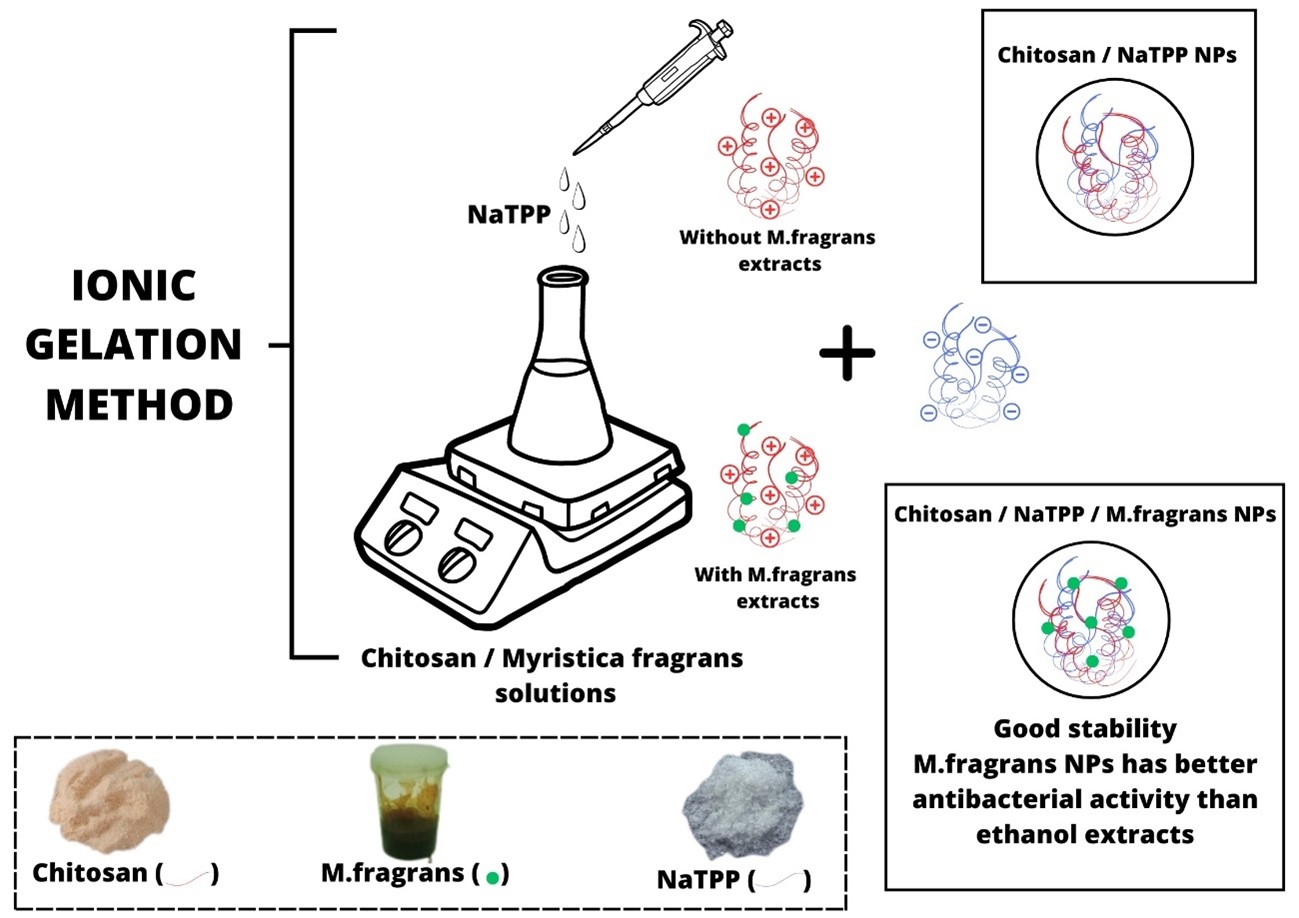
Myristica fragrans Houtt leaves contain secondary metabolites such as flavonoids, terpenoids and alkaloids, which have antibacterial properties. At the nanoscale, the particles have a bigger surface contact area, resulting in increased amounts and solubility of the active chemical. This leads to a stronger antibacterial activity. This study aims to examine the influence of several chitosan variations on particle size, antibacterial properties and the form of nanoparticles produced from Myristica fragrans leaves ethanol extract. Ethanol extract was analyzed using the UV-Vis spectrophotometric method to quantify total flavonoid content. Nanoparticles were synthesized using the ionic gelation technique with several ratios of chitosan and sodium tripolyphosphate, specifically 8:1, 10:1 and 12:1. Nanoparticles were analyzed with a Particle Size Analyzer (PSA) and Scanning Electron Microscopy (SEM). Agar diffusion test for bacteria germs using a paper backer. Myristica fragrans leaves ethanol extract was 50, 40 and 30 %, while nanoparticle extract was 5, 4 and 3 %. The overall flavonoid concentration in the QE/ethanol extract was 39.7252 ± 1.9596 mg. Antibacterial test results against Staphylococcus aureus and Escherichia coli bacteria and Myristica fragrans leaves extract limit inhibition area at 30 % (13.35 mm), 40 % (13.68 mm) and 50 % (13.93 mm) for Staphylococcus aureus and 30 (13.28), 40 (13.45) and 50 % (13.81 mm) for Escherichia coli. Myristica fragrans leaves extract chitosan nanoparticles included 3 (14.70), 4 (15.30) and 5 % (15.56 mm) for Staphylococcus aureus and 3 (14.60), 4 (14.65) and 5 % (15.05 mm) for Escherichia coli. Ionic gelation can create nanoparticles of Myristica fragrans leaves ethanol extract with chitosan and sodium tripolyphosphate. Myristica fragrans leaves nanoparticle ethanol extract exhibits better antibacterial activity than ethanol extract. Increasing chitosan concentration affects particle size. The ethanol extract of Myristica fragrans nanoparticle leaves showed slightly better antibacterial activity than the ethanol extract.
HIGHLIGHTS
- Nanoparticles of extracts and extracts have proven excellent antibacterial activity against human pathogens through paper disc diffusion method.
- Antibacterial test results against Staphylococcus aureus and Escherichia coli bacteria and Myristica fragrans leaves extract limit inhibition area at 30 % (13.35 mm), 40 % (13.68 mm), and 50 % (13.93 mm) for Staphylococcus aureus and 30 % (13.28 mm), 40 % (13.45 mm), and 50 % (13.81 mm) for Escherichia coli.
- Myristica fragrans leaves extract chitosan nanoparticles included 3 % (14.70 mm), 4 % (15.30 mm), and 5 % (15.56 mm) for Staphylococcus aureus and 3 % (14.60 mm), 4 % (14.65 mm), and 5 % (15.05 mm) for Escherichia coli.
- The synthesized extract nanoparticles can be used against human pathogens acts as antibacterial drugs.
GRAPHICAL ABSTRACT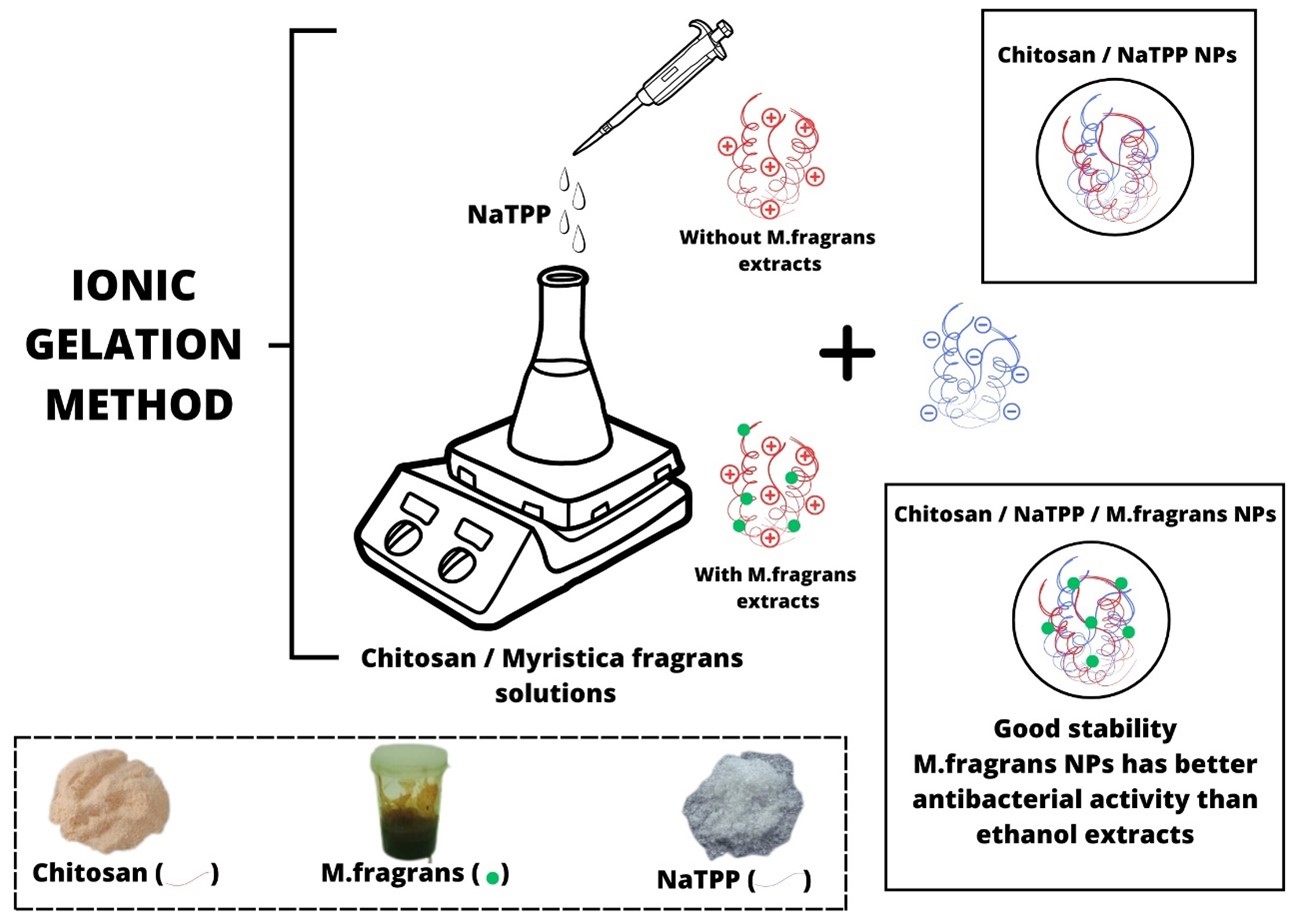
Downloads
References
M Nasrollahzadeh, SM Sajadi, M Sajjadi and Z Issaabadi. An introduction to nanotechnology. Interface sci. Tech. 2019; 28, 1-27.
M Majumdar, S Shivalkar, A Pal, ML Verma, AK Sahoo and DN Roy. Nanotechnology for enhanced bioactivity of bioactive compounds. Biotechnol. Prod. Bioact. Compd. 2019; 2020, 433-66.
O Pryshchepa, P Pomastowski and B Buszewski. Silver nanoparticles: Synthesis, investigation techniques and properties. Adv. Colloid Interface Sci. 2020; 284, 102246.
I Ielo, G Rando, F Giacobello, S Sfamemi, A Castellano, M Galletta, D Drmmi, G Rosace and MR Plutin. Synthesis, chemical-physical characterization and biomedical applications of functional gold nanoparticles: A review. Molecules 2021; 26, 5823.
Y Khan, H Sadia, SZA Shah, MN Khan, AA Shah, N Ullah, MF Ullah, H Bibi, T Bafakeeh, NB Khedher, SM Eldin, BMF Fadhl and MI Khan. Classification, synthetic and characterization approaches to nanoparticles and their applications in various fields of nanotechnology: A review. Catalysts 2022; 12, 1386.
AC Paiva-Santos, AM Herdade, C Guerra, D Peixoto, M Pereira-Silva, M Zeinali, F Mascarenhas-Melo, A Paranhos and F Veiga. Plant-mediated green synthesis of metal-based nanoparticles for dermopharmaceutical and cosmetic applications. Int. J. Pharm. 2021; 597, 120311.
S Marouzi, Z Sabouri and M Darroudi. Greener synthesis and medical applications of metal oxide nanoparticles. Ceram. Int. 2021; 47, 19632-50.
MEA El‐Hack, MT El-Saadony, AA Swelum, M Arif, MMA Ghanima, M Shukry, A Noreldin, AE Taha and KA El-Tarabily. Curcumin, the active substance of turmeric: Its effects on health and ways to improve its bioavailability. J. Sci. Food Agr. 2021; 101, 5747-62.
P Prasher, M Sharma, M Mehta, S Satija, AA Aljabali, MM Tambuwala, K Anand, N Sharma, H Dureja, NK Jha, G Gupta, M Gulati, SK Singh, DK Chellappan, KR Paudel, PM Hansbro and K Dua. Current-status and applications of polysaccharides in drug delivery systems. Colloid Interface Sci. Commun. 2021; 42, 100418.
Y Herdiana, N Wathoni, S Shamsuddin and M Muchtaridi. Drug release study of the chitosan-based nanoparticles. Heliyon 2022; 8, e08674.
LD Lubis, AT Prananda, NA Juwita, MA Nasution, RA Syahputra, S Sumaiyah, RR Lubis, MF Lubis, R Astyka, JF Atiqah. Unveiling antioxidant capacity of standardized chitosan-tripolyphosphate microcapsules containing polyphenol-rich extract of Portulaca oleraceae. Heliyon 2024; 10, e29541.
AH Hashem, AM Shehabeldine, OM Ali and SS Salem. Synthesis of chitosan-based gold nanoparticles: Antimicrobial and wound-healing activities. Polymers 2022; 14, 2293.
V Mikusova and P Mikus. Advances in chitosan-based nanoparticles for drug delivery. Int. J. Mol. Sci. 2021; 22, 9652.
R Priyadarshi and J Rhim. Chitosan-based biodegradable functional films for food packaging applications. Innovative Food Sci. Emerging Tech. 2020; 62, 102346.
R Ridwanto, VD Rosa, Z Rani and ZPA Fauzi. Utilization of chitosan from fresh water lobster (cherax quadricarinatus) shells in anti-acne gel preparations. Trends Sci. 2024; 21, 7243.
Z Sezgin-Bayindir, S Losada-Barreiro, S Fernandez-Bravo and C Bravo-Diaz. Innovative delivery and release systems for antioxidants and other active substances in the treatment of cancer. Pharmaceuticals 2023; 16, 1038.
SA Mosaddad, K Beigi, T Doroodizadeh, M Haghnegahdar, F Golfeshan, R Ranjbar and H Tebyanian. Therapeutic applications of herbal/synthetic/bio-drug in oral cancer: An update. Eur. J. Pharmacol. 2021; 890, 173657.
WH Al-Qahtani, Y Dinakarkumar, S Arokiyaraj, V Saravanakumar, JR Rajabathar, K Arjun, PK Gayathri and JN Appaturi. Phyto-chemical and biological activity of Myristica fragrans, an ayurvedic medicinal plant in Southern India and its ingredient analysis. Saudi J. Biol. Sci. 2022; 29, 3815-21.
HY Elfia and S Susilo. An update on the pharmacology, phytochemistry and toxicity of Myristica fragrans houtt. as a source of treatment: a scoping review. J. Appl. Pharm. Sci. 2023; 13, 92-106.
HP Kusumaningrum, M Zainuri, H Endrawati, BD Loka, IN Widiasa and E Sulistyowati. Chemical compounds in essential oil of nutmeg leaves (Myristica fragrans) from Batang Indonesia. J. Phys. Conf. Ser. 2021; 1943, 012096.
N Setyowati, JH Mulyo and B Yudhistira. The hidden treasure of wedang uwuh, an ethnic traditional drink from Java, Indonesia: Its benefits and innovations. Int. J. Gastron. Food Sci. 2023; 31, 100688.
MA Farag, E Mohsen and AENG El-Gendy. Sensory metabolites profiling in Myristica fragrans (Nutmeg) organs and in response to roasting as analyzed via chemometric tools. LWT 2018; 97, 684-92.
EG Anaduaka, IU Okagu, NO Uchendu, LUS Ezeanyika and BC Nwanguma. Hepato-renal toxicity of Myristica fragrans houtt. (myristicaceae) seed extracts in rat. J. King Saud Univ. Sci. 2022; 34, 101694.
MM Islam, MIN Manik, A Zobayed and F Noor. A review on medicinal properties some commonly used culinary agents of Bangladesh. J. Med. Plants 2021; 9, 111-7.
N Suthisamphat, B Dechayont, P Phuaklee, O Prajuabijinda, R Vilaichone, A Itharat, K Mokmued and N Prommee. Anti-Helicobacter pylori, anti-inflammatory, cytotoxic and antioxidant activities of mace extracts from Myristica fragrans. Evid. Based Complement. Alternat. Med. 2020; 2020, 7576818.
Y Adibuduge and M Senevirathne. Potential of nutmeg (Myristica fragrans Houtt) leaf extracts as a source of functional ingredients with antibacterial, antifungal and antioxidant activities. J. Agr. Sci. 2023; 18, 221-36.
RA Syahputra, R Fajrina, Z Rani and A Rahmadani. Producing polyurethane as wound plaster using glycerol transesterified of waste cooking oil with moringa leaf extract (Moringa oleifera Lam.) as an antimicrobial. Trends Sci. 2023; 20, 6963.
C Li, Y Chu, C Huang, S Fu and J Chen. Evaluation of antioxidant and anti-α-glucosidase activities of various solvent extracts and major bioactive components from the seeds of Myristica fragrans. Molecules 2020; 25, 5198.
E Erizal, M Hanafiah, M Mudatsir, TZ Helmi and M Yusuf. Determination of total phenolic content and total flavonoid content of nutmeg flesh (Myristica Fragrans Houtt) ethanol extract from south aceh province. Conf. Ser. Earth Environ. Sci. 2024; 1297, 012053.
L Li, H Yang, X Li, S Yan, A Xu, R You and Q Zhang. Natural silk nanofibrils as reinforcements for the preparation of chitosan-based bionanocomposites. Carbohydr. Polym. 2021; 253, 117214.
A Bouafia, SE Laouini and MR Ouahrani. A review on green synthesis of CuO nanoparticles using plant extract and evaluation of antimicrobial activity. Asian J. Res. Chem. 2020; 13, 65-70.
B Yudhistira, AS Sulaimana, F Punthi, C Chang, C Lung, SP Santoso, M Gavahian and C Hsieh. Cold plasma-based fabrication and characterization of active films containing different types of Myristica fragrans essential oil emulsion. Polymers 2022; 14, 1618.
B Dechayont, P Phuakliee, J Chunthorng-Orn, S Poomirat, T Juckmeta, K Phumlek, K Mokmued and K Ouncharoen. Antimicrobial, anti-inflammatory and antioxidant activities of the wood of Myristica fragrans. J. Herbs, Spices Med. Plants 2020; 26, 49-60.
M Das, A Banerji, VN Cheemalapati and J Hazra. Antiviral activity of indian medicinal plants: prventive measures for COVID-19. J. Global Biosci. 2020; 9, 7307-19.
D Sasidharan, TR Namitha, SP Johnson, V Jose and P Mathew. Synthesis of silver and copper oxide nanoparticles using Myristica fragrans fruit extract: Antimicrobial and catalytic applications. Sustainable Chem. Pharm. 2020; 16, 100255.
J Gouyau, RE Duval, A Boudier and E Lamouroux. Investigation of nanoparticle metallic core antibacterial activity: Gold and silver nanoparticles against Escherichia coli and Staphylococcus aureus. Int. J. Mol. Sci. 2021; 22, 1905.
AT Rancy and S Krishnakumari. Phytochemical profiling of Myristica fragrans seed extract with different organic solvents. Asian J. Pharma. Clin. Res. 2015; 8, 303-7.
H Hasbullah, DN Faridah, D Indrasti, FNA Dewi and N Andarwulan. In vitro antioxidant and antidiabetic activity of mace from Myristica fragrans houtt. Ann. Univ. Dunarea de Jos of Galati 2023; 47, 95-109.
V Kumar, N Kaur and P Wadhwa. A review over the effect of heavy metal in metabolism of Brassica juncea (L.) and Myristica fragrans. Asian J. Pharm. Res. 2021; 11, 97-103.
FS Rezaei, F Sharifianjazi, A Esmaeilkhanian and E Salehi. Chitosan films and scaffolds for regenerative medicine applications: A review. Carbohydr. polym. 2021; 273, 118631.
V Sandhiya and U Ubaidulla. A review on herbal drug loaded into pharmaceutical carrier techniques and its evaluation process. Future J. Pharm. Sci. 2020; 6, 51.
B Mehta, D Subhedar, H Panchal and Z Said. Synthesis, stability, thermophysical properties and heat transfer applications of nanofluid-A review. J. Mol. Liq. 2020; 364, 120034.
S Sagadevan, JA Lett, S Vennila, PV Prasath, GS Kaliaraj, I Fatimah, E Leonard, F Mohammad, HA Al-Lohedan, SF Alshahateet and CT Lee. Photocatalytic activity and antibacterial efficacy of titanium dioxide nanoparticles mediated by Myristica fragrans seed extract. Chem. Phys. Lett. 2021; 771, 138527.
M Chelladurai, R Sahadevan, G Margavelu, S Vijayakumar, ZI Gonzalez-Sanchez, K Vijayan and DBK C. Anti-skin cancer activity of alpinia calcarata ZnO nanoparticles: Characterization and potential antimicrobial effects. J. Drug Delivery Sci. Tech. 2021; 61, 102180.
X Wang, Y Shen, K Thakur, J Han, J Zhang, F Hu and Z Wei. Antibacterial activity and mechanism of ginger essential oil against Escherichia coli and Staphylococcus aureus. Molecules 2020; 25, 3955.
Z Rani, HM Nasution, VE Kaban, N Nasri and NB Karo. Antibacterial activity of freshwater lobster (Cherax quadricarinatus) shell chitosan gel preparation against Escherichia coli and Staphylococcus aureus. J Appl. Pharm. Sci. 2023; 13, 146-53.
Downloads
Published
How to Cite
Issue
Section
License
Copyright (c) 2024 Walailak University

This work is licensed under a Creative Commons Attribution-NonCommercial-NoDerivatives 4.0 International License.





