
Ethyl Acetate Extracts Endophytic Fungi from the Medicinal Tree Fern Cyathea Contaminans (Hook) Copel with Antimicrobial Activity
DOI:
https://doi.org/10.48048/tis.2024.8232Keywords:
Antimicrobial activity, Endophytic fungi, Internal Transcribed Spacer (ITS), Cyathea contaminans, Paecilomyces subglobosus, Penicillium citrinum, Aspergillus terreusAbstract
Medicinal plants are a rich source of naturally occurring substances utilized in treating a wide range of diseases; as a result, they serve as the basis for discovering new drugs. Research has focused on the relationship between endophytic microorganisms and host plants, as they produce a variety of secondary metabolites with significant biological functions. This study aimed to extract the endophytic fungi from various plant parts, including the roots, barks, and leaves of the Cyathea contaminans (Hook) Copel, which was collected from Kerinci, Jambi, Indonesia. By employing direct planting and pouring techniques with fungal culture media, the fungi were separated from the roots, stems, hairs, and leaves of C. contaminans and grown on rice media. The secondary metabolite of the fungus was extracted using ethyl acetate. The extracts were then tested for antimicrobial activity using a disk diffusion assay against microbial pathogens Staphylococcus aureus ATCC29213, Escherichia coli ATCC25922, and Methicillin-Resistant Staphylococcus aureus (MRSA). This research yielded 19 endophyte fungi. In the antibacterial activity screening results, four fungal strains (CBK3, CDK1, CDK4, and CAK2) were active against S. aureus, MRSA, and E. coli, with an inhibition zone in the range of 15.08 ± 0.854 to 23.52 ± 0.87 mm. All active fungal isolates were identified molecularly. CBK3 and CDK1 were Paecilomyces subglobosus PP510226 and Penicillium citrinum PP510227, respectively, while CDK4 and CAK2 were comparable to Aspergillus terreus PP510229 and Aspergillus terreus PP510228. The four endophytic fungi of Cyathea contaminans may be a new source of antibacterial compounds.
HIGHLIGHTS
- This is the 1st report of endophytic fungi isolated from medicinal tree fern Cyathea contaminans origin from Sungai Bungkal, Jambi, Indonesia.
- The four potential endophytic fungi that were successful in purification namely, Paecilomyces subglobosus, Penicillium citrinum, and Aspergillus tereus, which were reported as the source of bioactive compounds
- Endophytic fungi isolated from medicinal tree fern Cyathea contaminans showed good activity on some pathogenic bacteria: Staphylococcus aureus, Escherichia coli, and Methicillin-Resistant Staphylococcus aureus (MRSA)
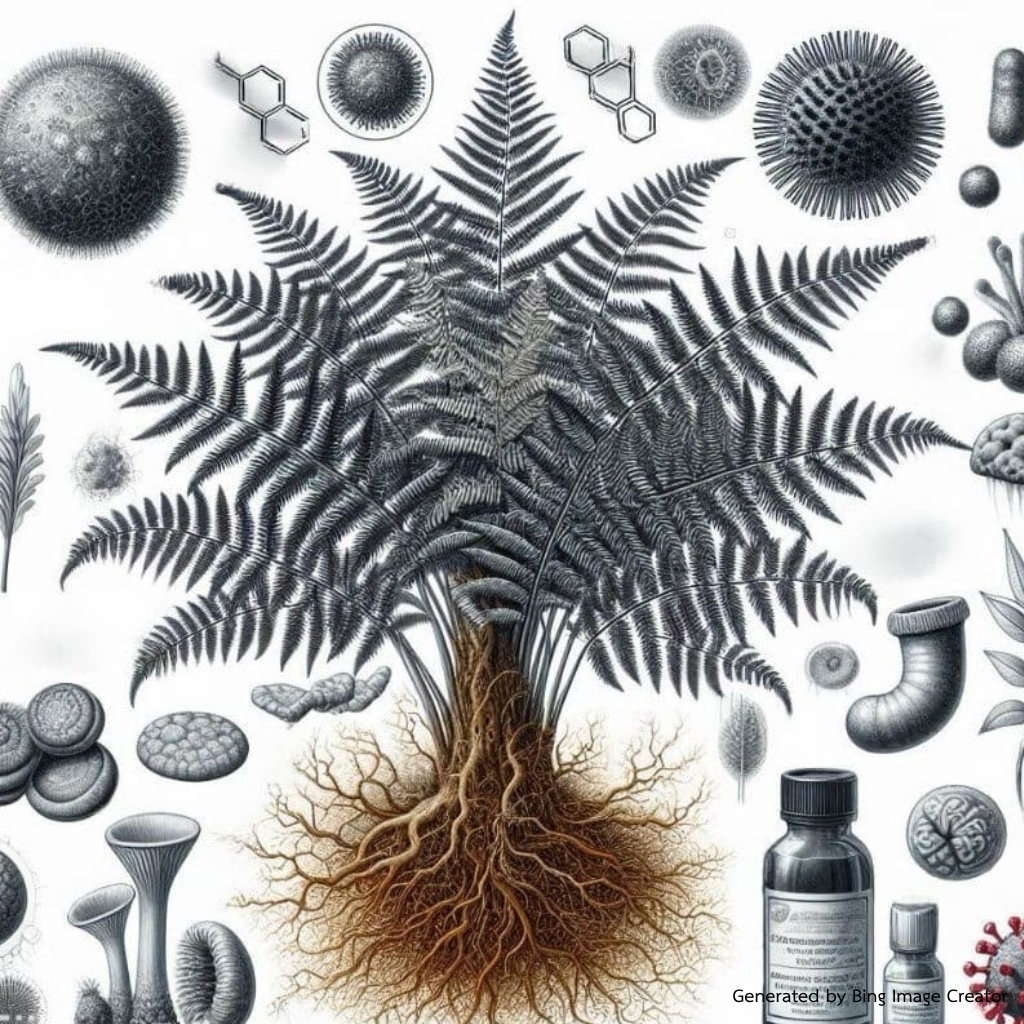
GRAPHICAL ABSTRACT
Downloads
References
C Longtine and A Tejedor. Antimicrobial activity of ethanolic and aqueous extracts of medicinally used tree ferns Alsophila cuspidata and Cyathea microdonta. Acta Bot. Malacit. 2018; 42, 119.
S Suryana, J Iskandar, P Parikesit and R Partasasmita. Ethnobotany of tree ferns in Pasir Menyan Hamlet, Sukamandi village, Subang, West Java, Indonesia. Biodiversitas 2018; 19, 2044-51.
Y Ciawi, IMAK Salain and AAG Sutapa. The potency of fern stem as the carbon material for clay-based ceramic filter. IOP Conf. Ser. Earth Environ. Sci. 2022; 999, 012020.
NKA Juliasih and IMDM Adnyana. Utilization of pteridophyta species in Cyathea Park, Bali, as traditional medicine agents: A field study and meta-synthesis review. Not. Sci. Biol. 2023; 15, 11522.
M Vasundhara, A Kumar and MS Reddy. Molecular approaches to screen bioactive compounds from endophytic fungi. Front. Microbiol. 2016; 7, 1774.
SE Kurniawan, M Mahyarudin and A Rialita. Aktivitas antibakteri isolat bakteri endofit daun pegagan (Centella asiatica) terhadap Staphylococcus aureus. Bioma: Jurnal Ilmiah Biologi 2021; 10, 14-29.
J Kjer, A Debbab, AH Aly and P Proksch. Methods for isolation of marine-derived endophytic fungi and their bioactive secondary products. Nat. Protoc. 2010; 5, 479-90.
D Handayani, HC Sari, E Julianti and MA Artasasta. Endophytic fungus isolated from Zingiber officinale Linn. var. rubrum as a source of antimicrobial compounds. J. Appl. Pharm. Sci. 2023; 13, 115-20.
N Sandrawati, W Ningsih, R Layla, AE Putra, F Ismed, TE Tallei and D Handayani. Endophytic fungi from mangrove plant acanthus ilicifolius L.: Antimicrobial, anticancer, and species determination. Trend. Sci. 2023; 20, 5089.
D Handayani, H Hafiza, R Rustini, PP Putra and N Syafni. Isolation of endophytic fungi with antimicrobial activity from medicinal plant Rhodomyrtus tomentosa (Aiton) hassk. J. Appl. Pharm. Sci. 2023; 13, 190-6.
F Ismed, HE Putra, N Arifa and DP Putra. Phytochemical profiling and antibacterial activities of extracts from five species of sumatran Lichen genus Stereocaulon. Jordan J. Pharm. Sci. 2021; 14, 189-202.
AML Konan, KJ Golly, AKM Kra, AA Adima and EEC Lohoues. Phytochemical screening and toxicity assessment of Imperata cylindricv (L.) P. Beauv. (Poaceae) raw extracts with brine shrimp (Artemia salina) lethality assay. J. Biosci. Med. 2022; 10, 153-71.
D Handayani, N Ananda, MA Artasasta, R Ruslan, O Fadriyanti and TE Tallei. Antimicrobial activity screening of endophytic fungi extracts isolated from brown algae Padina sp. J. Appl. Pharm. Sci. 2019; 9, 9-13.
LS Charya and S Garg. Advances in methods and practices of ectomycorrhizal research. In: SN Meena and MM Naik (Eds.). Advances in biological science research. Advances in biological science research: A practical approach. Academic Press, Massachusetts, 2019, p. 303-25.
D Handayani, MA Artasasta, N Safirna, DF Ayuni, TE Tallei and T Hertiani. Fungal isolates from marine sponge Chelonaplysilla sp .: Diversity, antimicrobial and cytotoxic activities. Biodiversitas 2020; 21, 1954-60.
Fatimawali, B Kepel and TE Tallei. Potential of organic mercury-resistant bacteria isolated from mercury contaminated sites for organic mercury remediation. Pak. J. Biol. Sci. 2019; 22, 45-50.
C Ferrer, F Colom, S Frasés, E Mulet, JL Abad and JL Alió. Detection and identification of fungal pathogens by PCR and by ITS2 and 5.8S ribosomal DNA typing in ocular infections. J. Clin. Microbiol. 2001; 39, 2873-9.
S Kumar, G Stecher and K Tamura. MEGA7: Molecular evolutionary genetics analysis version 7.0 for bigger datasets. Mol. Biol. Evol. 2016; 33, 1870-4.
WW Davis and TR Stout. Disc plate method of microbiological antibiotic assay. I. factors influencing variability and error. Appl. Microbiol. 1971; 22, 659-65.
C Lass-Flörl, AM Dietl, DP Kontoyiannis and M Brock. Aspergillus terreus species complex. Clin. Microbiol. Rev. 2021; 34, e00311-20..
H Sharma, AK Rai, R Chettri and PS Nigam. Bioactivites of Penicillium citrinum isolated from a medicinal plant Swertia chirayita. Arch. Microbiol. 2021; 203, 5173-82.
S Karwehl and M Stadler. Exploitation of fungal biodiversity for discovery of novel antibiotics. Curr. Top Microbiol. Immunol. 2016; 398, 303-38.
ZB Dai, X Wang and GH Li. Secondary metabolites and their bioactivities produced by Paecilomyces. Molecules 2020; 25, 5077.
GDC Ramos, JV Silva-Silva, LA Watanabe, JEDS Siqueira, F Almeida-Souza, KS Calabrese, AMDR Marinho, PSB Marinho and ASD Oliveira. Phomoxanthone a, compound of endophytic fungi Paecilomyces sp. and its potential antimicrobial and antiparasitic. Antibiotics 2022; 11, 1332.
XY Guo, HT Li, YT Shao, CY Li, WY Huang and W Li. Bioactive sorbicillinoids from a rhizospheric soil-derived Paecilomyces sp. KMU21009. Fitoterapia 2023; 166, 105443.
S Pang, ZG Guo, L Wang, Q Guo and F Cao. Anti-IAV indole-diterpenoids from the marine-derived fungus Penicillium citrinum. Nat. Prod. Res. 2023; 37, 586-91.
ZH He, CL Xie, T Wu, Y Zhang, ZB Zou, MM Xie, L Xu, RJ Capon, R Xu and XW Yang. Bioorganic chemistry neotricitrinols A-C, unprecedented citrinin trimers with anti-osteoporosis activity from the deep-sea-derived Penicillium citrinum W23. Bioorg. Chem. 2023; 139, 106756.
W Yang, Y Chen, R Cai, G Zou, B Wang and Z She. Benzopyran derivatives and an aliphatic compound from a mangrove endophytic fungus Penicillium citrinum QJF-22. Chem. Biodivers. 2020; 17, e2000192.
JX Li, QH Xu, RY Shang, Q Liu, XC Luo, HW Lin and WH Jiao. Aspergetherins A-D, new chlorinated biphenyls with anti-MRSA activity from the marine sponge symbiotic fungus Aspergillus terreus 164018. Chem. Biodivers. 2023; 20, e202300010.
Y Zhou, X Chen, Y Tang, Y Liu, Z Zhao and H Cui. New butanolide derivatives from the marine derived fungus Aspergillus terreus GZU-31-1 by chemical epigenetic manipulation. Nat. Prod. Res. 2024; 38, 1334-40.
A Hamed, AS Abdel-Razek, DA Omran, M M El-Metwally, DG El-Hosari, M Frese, HSM Soliman, N Sewald and M Shaaban. Terretonin O: A new meroterpenoid from Aspergillus terreus. Nat. Prod. Res. 2020; 34, 965-74.
DY Li, P Han, ZD Wu, CM Chen, QY Tong, HC Zhu, JR Guo, YJ Lai and YH Zhang. One new spirocyclic lactone and one new benzopyran derivative from Aspergillus terreus. J. Asian Nat. Prod. Res. 2021; 23, 429-35.
Downloads
Published
How to Cite
Issue
Section
License
Copyright (c) 2024 Walailak University

This work is licensed under a Creative Commons Attribution-NonCommercial-NoDerivatives 4.0 International License.





