
Green Synthesis of Silver Nanoparticles using Moringa oleifera: Implementation to Photoantimicrobial of Candida albicans with LED Light
DOI:
https://doi.org/10.48048/tis.2024.8032Keywords:
Photoantimicrobial, Green synthesis, Silver nanoparticles, Moringa oleifera, Candida albicans biofilms, LED lightAbstract
Green synthesis of silver nanoparticles using Moringa oleifera (AgNPs/MO) was carried out to produce nanoscale antifungal agents which are used as photosensitizing agents in photoantimicrobial therapy. This study focused on investigating the potential of AgNPs/MO producing some toxic radical compounds that inhibit the growth of Candida albicans biofilms. The inhibition mechanism uses the principle of photoinactivation treatment which combines a photosensitizer with an LED light source at a power of 100 mW for 60 - 300 s of exposure. Quantitative data analyzed were the number of viable cells and radical compounds, formed by malondialdehyde (MDA) level. It is investigated through staining the XTT (2,3-Bis-(2-Methoxy-4-Nitro-5-Sulfophenyl)-2H-Tetrazolium-5-Carboxanilide) and TBARS (Thiobarbituric Acid Reactive Substances). The results show that the maximum wavelength of AgNPs is 440 nm while the Moringa oleifera has 2 peaks at 425 and 635 nm. The maximum effect occurred in the group of photosensitizer AgNPs/MO combined LED with percentage inactivation about 76.80 % for blue LEDs and 76.20 % for red LEDs. The group of LED irradiation without photosensitizer obtained about 51.85 % for blue LEDs and 50.04 % for red LEDs. The MDA level group of AgNPs/MO combined LED also produced MDA levels of 1.772 nmol/mL for blue LED and 1.617 nmol/mL for red LED. Meanwhile, the application of photoantimicrobial using only LEDs produced MDA levels of only 1.353 nmol/mL for blue LEDs and 1.347 nmol/mL for red LEDs. This research has shown that the green synthesis of AgNPs/MO has a good potential to inhibit the growth of Candida albicans biofilms as a photosensitizer agent.
HIGHLIGHTS
- Silver nanoparticles (AgNPs) combined with Moringa oleifera (MO) extract have been shown to have potential as a photosensitizer to inhibit the growth of Candida albicans Green synthesis AgNPs/MO have a characteristic spectrum at 440 nm which is close to the blue light spectrum.
- Green synthesis AgNPs/MO combined with LED light irradiation energy can reduce the cell viability of Candida albicans up to 76.80 % through the XTT assay staining test method and produce 1.772 nmol/mL of Malondialdehyde that reacts with ROS compounds to cause cell damage.
GRAPHICAL ABSTRACT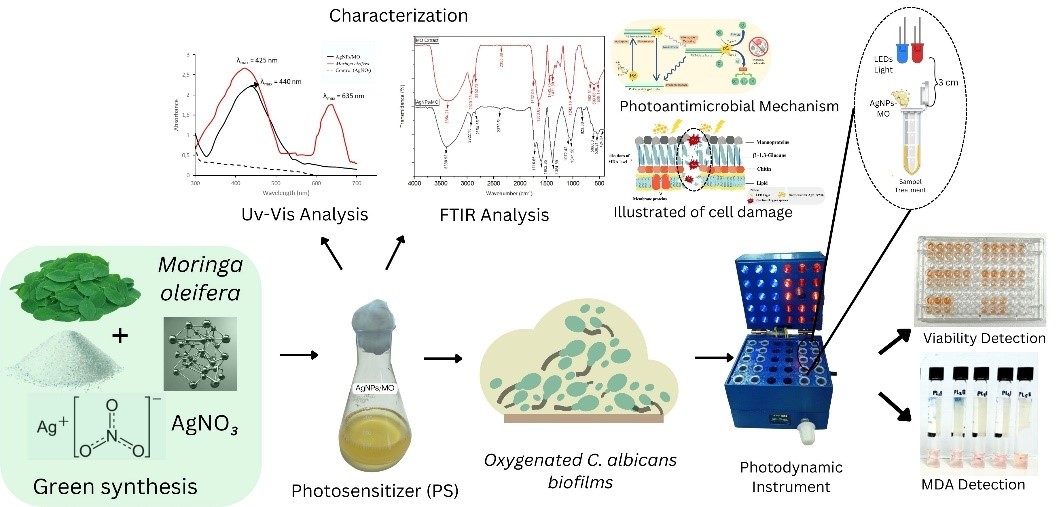
Downloads
References
HH Huang, A Anand, CJ Lin, HJ Lin, YW Lin, SG Harroun and CC Huang. LED irradiation of halogen/nitrogen-doped polymeric graphene quantum dots triggers the photodynamic inactivation of bacteria in infected wounds. Carbon 2021; 174, 710-22.
PJS Maia, I de Aguiar, M dos Santos Velloso, D Zhang, ER dos Santos, JR de Oliveira, JC Junqueira, M Selke and RM Carlos. Singlet oxygen production by a polypyridine ruthenium (II) complex with a perylene monoimide derivative: A strategy for photodynamic inactivation of Candida albicans. J. Photochem. Photobiol. A Chem. 2018; 353, 536-45.
RA Fristiyanti, NS Matin, SD Ratnaningrum, N Nurdiana, S Santoso and RD Hanifarizani. Efficacy comparison of oral and intravaginal Lactobacillus plantarum administration on Secreted Aspartyl Protease-5 (SAP5) levels in Vulvovaginal candidiasis. Trends Sci. 2023; 21, 7225.
M Henriques and S Silva. Candida albicans virulence factors and its pathogenicity. Microorganisms 2021; 9, 704.
JC Carmello, F Alves, FG Basso, CA de Souza Costa, AC Tedesco, FL Primo, EGO Mima and AC Pavarina. Antimicrobial photodynamic therapy reduces adhesion capacity and biofilm formation of Candida albicans from induced oral candidiasis in mice. Photodiagnosis Photodynamic Ther. 2019; 27, 402-7.
JMA Blair, MA Webber, AJ Baylay, DO Ogbolu and LJV Piddock. Molecular mechanisms of antibiotic resistance. Nat. Rev. Microbiol. 2015; 13, 42-51.
CN Lin, SJ Ding and CC Chen. Synergistic photoantimicrobial chemotherapy of methylene blue-encapsulated chitosan on biofilm-contaminated titanium. Pharmaceuticals 2021; 14, 346.
I Yoon, JZ Li and YK Shim. Advance in photosensitizers and light delivery for photodynamic therapy. Clin. Endosc. 2013; 46, 7-23.
SD Astuty and A Baktir. The effectiveness of laser diode induction to Carica Papaya L. chlorophyll extract to be ROS generating in the photodynamic inactivation mechanisms for C.albicans biofilms. J. Phys. Conf. Ser. 2017; 853, 012026.
AE Nel, L Mädler, D Velegol, T Xia, EMV Hoek, P Somasundaran, F Klaessig, V Castranova and M Thompson. Understanding biophysicochemical interactions at the nano-bio interface. Nat. Mater. 2009; 8, 543-57.
Y Wang, Y Jin, W Chen, J Wang, H Chen, L Sun, X Li, J Ji, Q Yu, L Shen and B Wang. Construction of nanomaterials with targeting phototherapy properties to inhibit resistant bacteria and biofilm infections. Chem. Eng. J. 2019; 358, 74-90.
S Stankic, S Suman, F Haque and J Vidic. Pure and multi metal oxide nanoparticles: Synthesis, antibacterial and cytotoxic properties. J. Nanobiotechnol. 2016; 14, 73.
TC Dakal, A Kumar, RS Majumdar and V Yadav. Mechanistic basis of antimicrobial actions of silver nanoparticles. Front. Microbiol. 2016; 7, 1831.
Y Abo-zeid and GR Williams. The potential anti-infective applications of metal oxide nanoparticles: A systematic review. Wiley Interdiscipl. Rev. 2020; 12, e1592.
RA Raj, MS AlSalhi and S Devanesan. Microwave-assisted synthesis of nickel oxide nanoparticles using Coriandrum sativum leaf extract and their structural-magnetic catalytic properties. Materials 2017; 10, 460.
S Devanesan, MS AlSalhi, RV Balaji, AJA Ranjitsingh, A Ahamed, AA Alfuraydi, FY AlQahtani, FS Aleanizy and AH Othman. Antimicrobial and cytotoxicity effects of synthesized silver nanoparticles from Punica granatum peel extract. Nanoscale Res. Lett. 2018; 13, 315.
RA Fernandes, AA Berretta, EC Torres, AFM Buszinski, GL Fernandes, CC Mendes-Gouvêa, FND Souza-Neto, LF Gorup, ERD Camargo and DB Barbosa. Antimicrobial potential and cytotoxicity of silver nanoparticles phytosynthesized by pomegranate peel extract. Antibiotics 2018; 7, 51.
M Lalunio-Manikan, AP Bonto and CMH Ebreo. Nanosilver immobilized in carbonaceous particles derived from hydrothermal carbonization of Eleusine indica leaf extract. Trends Sci. 2021; 18, 681.
KH Min, JW Shin, MR Ki and SP Pack. Green synthesis of silver nanoparticles on biosilica diatomite: Well-dispersed particle formation and reusability. Process Biochem. 2023; 125, 232-8.
SD Astuti, PS Puspita, AP Putra, AH Zaidan, MZ Fahmi, A Syahrom and Suhariningsih. The antifungal agent of silver nanoparticles activated by diode laser as light source to reduce C. albicans biofilms: An in vitro study. Laser. Med. Sci. 2019; 34, 929-37.
A Pareek, M Pant, MM Gupta, P Kashania, Y Ratan, V Jain, A Pareek and AA Chuturgoon. Moringa oleifera: An updated comprehensive review of its pharmacological activities, ethnomedicinal, phytopharmaceutical formulation, clinical, phytochemical, and toxicological aspects. Int. J. Mol. Sci. 2023; 24, 2098.
N Kumar, Pratibha and S Pareek. Bioactive compounds of Moringa (Moringa species). In: HN Murthy and KY Paek (Eds.). Bioactive compounds in underutilized vegetables and legumes. Springer, Cham, Switzerland, 2021.
PMP Ferreira, DF Farias, JTDA Oliveira and ADFU Carvalho. Moringa oleifera: Bioactive compounds and nutritional potential. Revista de Nutricao 2008; 21, 431-7.
RA Syahputra, R Fajrina, Z Rani and A Rahmadani. Producing polyurethane as wound plaster using glycerol transesterified of waste cooking oil with Moringa leaf extract (Moringa Oleifera Lam.) as an antimicrobial. Trends Sci. 2023; 20, 6963.
MR Bindhu, M Umadevi, GA Esmail, NA Al-Dhabi and MV Arasu. Green synthesis and characterization of silver nanoparticles from Moringa oleifera flower and assessment of antimicrobial and sensing properties. J. Photochem. Photobiol. B 2020; 205, 111836.
M Piksa, C Lian, IC Samuel, KJ Pawlik, IDW Samuel and K Matczyszyn. The role of the light source in antimicrobial photodynamic therapy. Chem. Soc. Rev. 2023; 52, 1697-722.
EM Setiawatie, SD Astuti and AH Zaidan. An in vitro anti-microbial photodynamic therapy (aPDT) with blue LEDs to activate chlorophylls of Alfalfa Medicago sativa L on aggregatibacter actinomycetemcomitans. J. Int. Dent. Med. Res. 2016; 9, 118-25.
AR Santos, AFD Silva, AFP Batista, CF Freitas, E Bona, MJ Sereia, W Caetano, N Hioka and JMG Mikcha. Application of response surface methodology to evaluate photodynamic inactivation mediated by Eosin Y and 530 nm LED AGAINST staphylococcus aureus. Antibiotics 2020; 9, 125.
SD Astuty, Suhariningsih, A Baktir and SD Astuti. The efficacy of photodynamic inactivation of the diode laser in inactivation of the Candida albicans biofilms with exogenous photosensitizer of papaya leaf chlorophyll. J. Laser. Med. Sci. 2019; 10, 215-24.
TN Mileto and FG Azambuja. Low-intensity laser efficacy in postoperative extraction of third molars. RGO Revista Gaúcha de Odontologia 2017; 65, 13-9.
I Laib, BD Ali and O Boudebia. Green synthesis of silver nanoparticles using Helianthemum lippii extracts (Hl-NPs): Characterization, antioxidant and antibacterial activities and study of interaction with DNA. J. Organomet. Chem. 2023; 986, 122619.
JS Moodley, SBN Krishna, K Pillay, Sershen and P Govender. Green synthesis of silver nanoparticles from Moringa oleifera leaf extracts and its antimicrobial potential. Adv. Nat. Sci. Nanosci. Nanotechnol. 2018; 9, 015011.
S Patel and N Patel. Tectona grandis seed mediated green synthesis of silver nanoparticles and their antibacterial activity. Trends Sci. 2023; 20, 5104.
SD Astuty, Y Handayani, R Abdullah, S Hajar and PM Tabaika. Mediated sensitizer of nanosilver-chlorophyll Jatropha leaf. Indonesian Phys. Rev. 2023; 6, 132-45.
M Zain, SD Astuty, S Dewang, B Armynah, RR Wahyudi and S Ramadhana. Analysis of the changes power output and energy dose to green laser against OD and MDA values after photoinactivation at Candida Albicans and Staphyloccocus epidermidis associate biofilms. AIP Conf. Proc. 2023; 2719, 020006.
F Azarbani and S Shiravand. Green synthesis of silver nanoparticles by Ferulago macrocarpa flowers extract and their antibacterial, antifungal and toxic effects. Green Chem. Lett. Rev. 2020; 13, 41-9.
S Ryu, SH Nam and JS Baek. Green synthesis of silver nanoparticles (AgNPs) of Angelica Gigas fabricated by hot-melt extrusion technology for enhanced antifungal effects. Materials 2022; 15, 7231.
M Younas, MH Rasool, M Khurshid, A Khan, MZ Nawaz, I Ahmad and MN Lakhan. Moringa oleifera leaf extract mediated green synthesis of silver nanoparticles and their antibacterial effect against selected gram-negative strains. Biochem. Syst. Ecol. 2023; 107, 104605.
S Ghojavand, M Madani and J Karimi. Green synthesis, characterization and antifungal activity of silver nanoparticles using stems and flowers of felty germander. J. Inorg. Organomet. Polymer. Mater. 2020; 30, 2987-97.
Riyanto, M Mulwandari, L Asysyafiiyah, MI Sirajuddin and N Cahyandaru. Direct synthesis of lemongrass (Cymbopogon citratus L.) essential oil-silver nanoparticles (EO-AgNPs) as biopesticides and application for lichen inhibition on stones. Heliyon 2022; 8, e09701.
DG Hirpara and HP Gajera. Green synthesis and antifungal mechanism of silver nanoparticles derived from chitin-induced exometabolites of Trichoderma interfusant. Appl. Organomet. Chem. 2020; 34, e5407.
ZA Ali, R Yahya, SD Sekaran and R Puteh. Green synthesis of silver nanoparticles using apple extract and its antibacterial properties. Adv. Mater. Sci. Eng. 2016; 2016, 4102196.
AK Nzekekwu and OO Abosede. Green synthesis and characterization of silver nanoparticles using leaves extracts of neem (Azadirachta indica) and bitter leaf (Vernonia amygdalina). J. Appl. Sci. Environ. Manag. 2019; 23, 695.
M Mohammadi, SA Shahisaraee, A Tavajjohi, N Pournoori, S Muhammadnejad, SR Mohammadi, R Poursalehi and HH Delavari. Green synthesis of silver nanoparticles using Zingiber officinale and Thymus vulgaris extracts: Characterisation, cell cytotoxicity and its antifungal activity against Candida albicans in comparison to fluconazole. IET Nanobiotechnology 2019; 13, 114-9.
S Sampaio and JC Viana. Production of silver nanoparticles by green synthesis using artichoke (Cynara scolymus L.) aqueous extract and measurement of their electrical conductivity. Adv. Nat. Sci. Nanosci. Nanotechnology 2018; 9, 045002.
GM Mohammed and SN Hawar. Green biosynthesis of silver nanoparticles from Moringa oleifera leaves and its antimicrobial and cytotoxicity activities. Int. J. Biomater. 2022; 2022, 4136641.
N Pal, M Agarwal and A Ghosh. Green synthesis of silver nanoparticles using polysaccharide-based guar gum. Mater. Today Proc. 2023; 76, 212-8.
S Jain and MS Mehata. Medicinal plant leaf extract and pure flavonoid mediated green synthesis of silver nanoparticles and their enhanced antibacterial property. Sci. Rep. 2017; 7, 15867.
LC Toan, LX Nghiem, TQ Toan, PT Thi and H Chi. Design panel of hexagonal nanowire-based blue LEDs for inactivation bacteria in food safety. J. Austrian Soc. Agr. Econ. 2022; 18, 1259-67.
S Singh and V Mohanlall. Biocatalytic and biological activities of Cassia occidentalis mediated silver nanoparticles. Trends Sci. 2022; 19, 1712.
X Wang, D Luo and JP Basilio. Photodynamic therapy: Targeting cancer biomarkers for the treatment of cancers. Cancers 2021; 13, 2992.

Downloads
Published
How to Cite
Issue
Section
License
Copyright (c) 2024 Walailak University

This work is licensed under a Creative Commons Attribution-NonCommercial-NoDerivatives 4.0 International License.





