
Combination of Blue Diode Laser and Ag NPs Nanophotosensitizer with Grape Seed Bioreductor to Overcome Biofilm Resistance
DOI:
https://doi.org/10.48048/tis.2025.9467Keywords:
Nanophotosensitizer, AgNPS, Blue laser, Biofilm, Grape seedAbstract
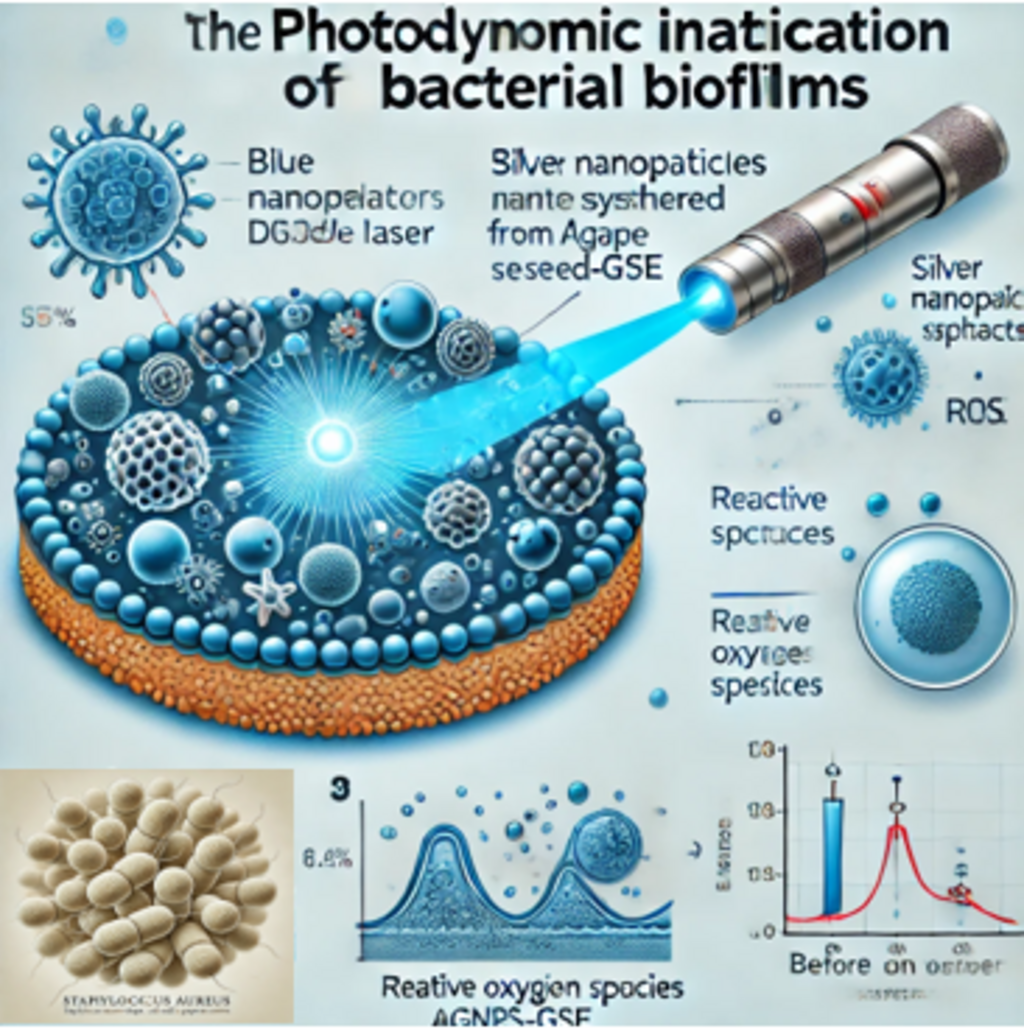
Introduction: Indonesia faces significant health issues due to infection caused by microorganisms. Microbial resistance is increasing, leading to the use of Photodynamic Inactivation, a therapeutic method generating reactive oxygen species. The study evaluates the effectiveness of blue laser and silver nanoparticles synthesized from grape seed as photosensitizers in reducing bacterial biofilms, common pathogens for infections; Materials and methods: The study involved 4 groups of samples: T0, A1 and A2, A3 and A4, and A2 and A4, each exposed to silver nanoparticles and treated with grape seed as a photosensitizer to investigate the effects of laser irradiation on biofilms. The samples were irradiated for 90, 120, 150 or 180 s. Following irradiation, the samples were cultured on TSA media and incubated for 24 h at 37 °C. The number of bacterial colonies was determined using total plate count (TPC). The data obtained were analyzed using a 2-way ANOVA factorial statistical test, followed by Tukey’s Post Hoc Test, with p < 0.05; Results and discussion: Adding 2 mM, AgNPs-GSE produced the highest percentage of bacterial biofilm inactivation. Specifically, Escherichia coli biofilms showed a 72.59 % reduction, while Staphylococcus aureus biofilms exhibited an 86.74 % reduction after 180 s of irradiation at a dose of 3.43 J/cm2; and Conclusions: The study demonstrates that irradiation with a blue diode laser at a dose of 3.43 J/cm2 for 180 s, combined with the AgNPs-GS photosensitizer, provides bacterial biofilms’ most optimal and efficient inactivation.
HIGHLIGHTS
The blue laser, combined with AgNPs-GSE, achieved up to 86.74 % reduction in bacterial biofilms. The grape seed extract facilitated the eco-friendly synthesis of silver nanoparticles, highlighting its green chemistry approach. An energy density of 3.43 J/cm2·s proved highly effective in reducing biofilms, offering a promising solution for combating resistant E. coli and S. aureus. This innovative method integrates nanotechnology and laser therapy, paving the way for advanced antimicrobial treatments.
GRAPHICAL ABSTRACT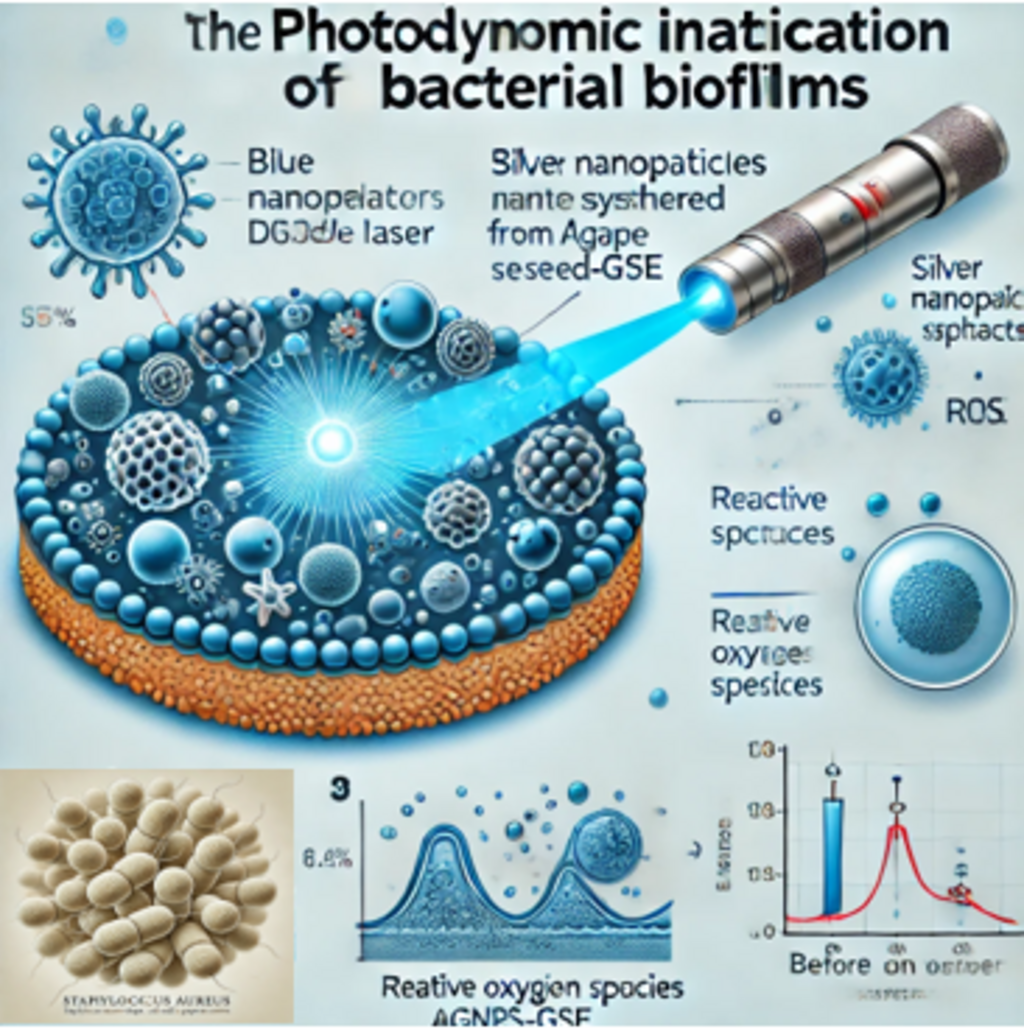
Downloads
References
Z Bhutta and S Syed. Diarrheal diseases. Encyclopedia of Food and Health 2015; 22, 361-372.
PC Okhuysen and HL DuPont. Enteroaggregative Escherichia coli (EAEC): A cause of acute and persistent diarrhea of worldwide importance. The Journal of Infectious Diseases 2010; 202(4), 503-505.
O Scudiero, M Brancaccio, C Mennitti, S Laneri, B Lombardo, MGD Biasi and R Pero. Human defensins: A novel approach in the fight against skin colonizing staphylococcus aureus. Antibiotics 2020; 9, 198.
AJ Browne, MG Chipeta, G Haines-Woodhouse EP Kumaran, BHK Hamadani and S Zaraa. Global antibiotic consumption and usage in humans, 2000 - 18: A spatial modelling study. The Lancet Planetary Health 2021; 5(12), e893-e904.
M Frieri, K Kumar and A Boutin. Antibiotic resistance. Journal of Infection and Public Health 2017; 10(4), 369-378.
SW Garini, SD Astuti, I Kusumawati and Y Susilo. Combination of curcumin photosensitizer with laser diode to reduce antibiotic resistant bacterial biofilms. Malaysian Journal of Medicine and Health Sciences 2021; 17, 78-81.
N Høiby, T Bjarnsholt, M Givskov S Molin and O Ciofu. Antibiotic resistance of bacterial biofilms. International Journal of Antimicrobial Agents 2010; 35(4), 322-332.
S Roy, I Hasan and B Guo. Recent advances in nanoparticle-mediated antibacterial applications. Coordination Chemistry Reviews 2023; 482, 215075.
L Rozykulyyeva, SD Astuti, AH Zaidan, AAS Pradhana and PS Puspita. Antibacterial activities of green synthesized silver nanoparticles from Punica granatum peel extract. AIP Conference Proceedings 2020; 2314(1), 060012.
SD Astuti, IW Widya, D Arifianto and R Apsari. Effectiveness photodynamic inactivation with wide spectrum range of diode laser to Staphylococcus aureus bacteria with endogenous photosensitizer: An in vitro study. Journal of International Dental and Medical Research 2019; 12(2): 481-486.
AK Yaqubi, SD Astuti, AH Zaidan, A Syahrom and DZI Nurdin. Antibacterial effect of red laser-activated silver nanoparticles synthesized with grape seed extract against Staphylococcus aureus and Escherichia coli. Lasers in Medical Science 2024; 39(1), 47.
MR Khan, KM Fromm, TF Rizvi, B Giese, F Ahamad, RJ Turner, M Füeg and E Marsili. Metal nanoparticle - microbe interactions: Synthesis and antimicrobial effects. Particle & Particle Systems Characterization 2020; 37(5), 1900419.
MS Tufail and I Liaqat. Silver nanoparticles and their applications - a comprehensive review. Pure and Applied Biology 2022; 11(1), 315-330.
A Roy, O Bulut, S Some, AK Mandal and MD Yilmaz. Green synthesis of silver nanoparticles: Biomolecule-nanoparticle organizations targeting antimicrobial activity. RSC Advances 2019; 9(5), 2673-2702.
A Sangwan, H Kumar, A Yadav, J Rani and R Kumar. Evaluation of antibacterial efficacy of iron oxide nanoparticles against Vibrio vulnificus: A comparative study with standard antibiotics. Journal of the Indian Chemical Society 2024; 101(12), 101457.
SD Astuti, DH Kharisma, S Kholimatussa’Diah and AH Zaidan. An in vitro antifungal efficacy of silver nanoparticles activated by diode laser to Candida albicans. AIP Conference Proceedings 2017; 1888, 020016.
AS Joshi, P Singh and I Mijakovic. Interactions of gold and silver nanoparticles with bacterial biofilms: Molecular interactions behind inhibition and resistance. International Journal of Molecular Sciences 2020; 21(10), 7658.
D Bamal, A Singh, G Chaudhary, M Kumar, M Singh, N Rani, P Mundlia and AR Sehrawat. Silver nanoparticles biosynthesis, characterization, antimicrobial activities, applications, cytotoxicity and safety issues: An updated review. Nanomaterials 2021; 11(8), 2086.
A Bouafia, SE Laouini, AS Ahmed, AV Soldatov, H Algarni, KF Chong and GAM Ali. The recent progress on silver nanoparticles: Synthesis and electronic applications. Nanomaterials 2021; 11(9), 2318.
A Sharma, H Kumar, C Saini, D Yadav, K Yadav, A Kumar and G Rani. Revolutionizing material science: Enhanced functionalities through reduced graphene oxide/Al2O3/CuO/TiO2 nanocomposites. Journal of Molecular Structure 2025; 1323, 140763.
S Ying, Z Guan, PC Ofoegbu, P Clubb, C Rico, F He and J Hong. Green synthesis of nanoparticles: Current developments and limitations. Environmental Technology & Innovation 2022; 26, 102336.
I Imelda, SD Astuty, PL Gareso, Z Dwyana, NF Arifin and SD Astuti. Green synthesis of silver nanoparticles using Moringa oleifera: Implementation to photoantimicrobial of Candida albicans with LED light. Trends in Sciences 2024; 21(9), 8032-8032.
AK Yaqubi, SD Astuti, AH Zaidan and DZI Nurdin. Blue laser-activated silver nanoparticles from grape seed extract for photodynamic antimicrobial therapy against Escherichia coli and Staphylococcus aureus. Journal of Lasers in Medical Sciences 2023; 14, e69.
S Al-Zahrani, S Astudillo-Calderón, B Pintos, E Pérez-Urria, JA Manzanera, L Martín and A Gomez-Garay. Role of synthetic plant extracts on the production of silver-derived nanoparticles. Plants 2021; 10(8), 1671.
HR El-Seedi, RM El-Shabasy, SAM Khalifa, A Saeed, A Shah, R Shah, FJ Iftikhar, MM Abdel-Daim, A Omri, NH Hajrahand, JSM Sabir, X Zou, MF Halabi, W Sarhan and W Guo. Metal nanoparticles fabricated by green chemistry using natural extracts: Biosynthesis, mechanisms, and applications. RSC Advances 2019; 9, 24539-24559.
F Al-Otibi, SK Alkhudhair, RI Alharbi, AA Al-Askar, RM Aljowaie and S Al-Shehri. The antimicrobial activities of silver nanoparticles from aqueous extract of grape seeds against pathogenic bacteria and fungi. Molecules 2021; 26(19), 6081.
A Michalak. Phenolic compounds and their antioxidant activity in plants growing under heavy metal stress. Polish Journal of Environmental Studies 2006; 15(4), 523-530.
R Majumdar, BG Bag and N Maity. Acacia nilotica (Babool) leaf extract mediated size-controlled rapid synthesis of gold nanoparticles and study of its catalytic activity. International Nano Letters 2013; 3, 53.
R Sharma, H Kumar, D Yadav, C Saini, R Kumari, G Kumar, AB Kajjam, V Pandit, M Ayoub, Saloni, Y Deswal and AK Sharma. Synergistic advancements in nanocomposite design: Harnessing the potential of mixed metal oxide/reduced graphene oxide nanocomposites for multifunctional applications. Journal of Energy Storage 2024; 93, 112317.
SD Astuti, A Zaidan, EM Setiawati and Suhariningsih. Chlorophyll mediated photodynamic inactivation of blue laser on Streptococcus mutans. AIP Conference Proceedings 2016; 1718(1), 120001.
SD Astuti, IB Utomo, EM Setiawatie, M Khasanah, H Purnobasuki, D Arifianto and KA Alamsyah. Combination effect of laser diode for photodynamic therapy with doxycycline on a wistar rat model of periodontitis. BMC Oral Health 2021; 21, 80.
I Yoon, JZ Li and YK Shim. Advance in photosensitizers and light delivery for photodynamic therapy. Clinical Endoscopy 2013; 46(1), 7-23.
ET Carrera, HB Dias, SCT Corbi, RAC Marcantonio, ACA Bernardi, VS Bagnato, MR Hamblin and ANS Rastelli. The application of antimicrobial photodynamic therapy (aPDT) in dentistry a critical review. Physiology & Behavior 2017; 176, 100-106.
PAD Permatasari, SD Astuti, AK Yaqubi, EAW Paisei and N Anuar. Effectiveness of Katuk leaf chlorophyll (Sauropus androgynus (L) merr) with blue and red laser activation to reduce Aggregatibacter actinomycetemcomitans and Enterococcus faecalis biofilm. Biomedical Photonics 2023; 12(1), 14-21.
SD Astuti, A Sulistyo, EM Setiawatie, M Khasanah, H Purnobasuki, D Arifianto, Y Susilo, KA Alamsyah, Suhariningsih and A Syahrom. An in-vivo study of photobiomodulation using 403 nm and 649 nm diode lasers for molar tooth extraction wound healing in wistar rats. Odontology 2022; 110, 240-253.
A Yadav, H Kumar, P Kumar, G Rani and S Maken. Syzygium cumini leaf extract mediated green synthesis of ZnO nanoparticles: A sustained release for anticancer, antimicrobial, antioxidant, and anti-corrosive applications. Journal of Molecular Structure 2025; 1325, 141017.
T Siddiqui, MK Zia, M Muaz, H Ahsan and FH Khan. Synthesis and characterization of silver nanoparticles (AgNPs) using chemico-physical methods. Indonesian Journal of Chemical Analysis 2023; 6(2), 124-132.
H Yang, YY Ren, T Wang and C Wang. Preparation and antibacterial activities of Ag/Ag+/Ag3+ nanoparticle composites made by pomegranate (Punica granatum) rind extract. Results in Physics 2016; 6, 299-304.
R Sharma, H Kumar, R Kumari, G Kumar, B Swami, A Kumar and R Kumar. Next-generation nanocomposites: Optimizing Al2O3-CuO-ZnO and reduced graphene oxide for enhanced performance. Next Nanotechnology 2025; 7, 100119.
S Sajjad, SAK Leghari, NUA Ryma and SA Farooqi. Green synthesis of metal-based nanoparticles and their applications. In: S Kanchi and S Ahmed (Eds.). Green metal nanoparticles. Scrivener Publishing, Massachusetts, 2018, p. 23-77.
K Loza, J Diendorf, C Sengstock, L Ruiz-Gonzalez, JM Gonzalez-Calbet, M Vallet-Regi, M Köller and M Epple. The dissolution and biological effects of silver nanoparticles in biological media. Journal of Materials Chemistry B 2014; 2, 1634-1643.
KJ Sreeram, M Nidhin and BU Nair. Microwave assisted template synthesis of silver nanoparticles. Bulletin of Materials Science 2008; 31, 937-942.
JY Song and BS Kim. Rapid biological synthesis of silver nanoparticles using plant leaf extracts. Bioprocess and Biosystems Engineering 2009; 32, 79-84.
MA Radzig, VA Nadtochenko, OA Koksharova, J Kiwi, VA Lipasova and IA Khmel. Antibacterial effects of silver nanoparticles on gram-negative bacteria: Influence on the growth and biofilms formation, mechanisms of action. Colloids and Surfaces B: Biointerfaces 2013; 102, 300-306.
TD Raftery, H Lindler and TL McNealy. Altered host cell - bacteria interaction due to nanoparticle interaction with a bacterial biofilm. Microbial Ecology 2013; 65, 496-503.
A Dhayal, H Kumar, S Prakash, A Kumar, M Brahma and M Maruthi. Development of starch/whey protein isolate biofilm incorporated with silver oxide nanoparticles: A multifunctional antioxidant, antibacterial, photocatalytic, and anticancer agent. Inorganic Chemistry Communications 2025; 171, 113661.
S Kwiatkowski, B Knap, D Przystupski, J Saczko, E Kędzierska and K Knap-Czop. Photodynamic therapy-mechanisms, photosensitizers and combinations. Biomedicine & Pharmacotherapy 2018; 106, 1098-1107.
AB Ormond and HS Freeman. Dye sensitizers for photodynamic therapy. Materials 2013; 6, 817-840.
IO Bacellar and MS Baptista. Mechanisms of photosensitized lipid oxidation and membrane permeabilization. ACS Omega 2019; 4(6), 21636-21646.
R Itri, HC Junqueira, O Mertins and MS Baptista. Membrane changes under oxidative stress: The impact of oxidized lipids. Biophysical Reviews 2014; 6, 47-61.
MQ Mesquita, CJ Dias, MG Neves, A Almeida and MAF Faustino. Revisiting current photoactive materials for antimicrobial photodynamic therapy. Molecules: A Journal of Synthetic Chemistry and Natural Product Chemistry 2018; 23(10), 2424.
A Yadav and H Kumar. Self-assembled quantum dots decorated polypyrrole based multifunctional nanocomposite. Colloids and Surfaces A: Physicochemical and Engineering Aspects 2023; 666, 131241.
Published
How to Cite
Issue
Section
License
Copyright (c) 2025 Walailak University

This work is licensed under a Creative Commons Attribution-NonCommercial-NoDerivatives 4.0 International License.





